Best Shortwave Radios of 2026

There's a particular thrill in pulling a station out of the air from thousands of miles away—but only if your radio can actually hold the signal. Over the past eight months, my team and I have tested 12 shortwave radios, from pocket-sized travel models to tabletop receivers with single side band. We judged sound quality, portability, and value, but also the less glamorous stuff: how easy each radio was to tune, how long the batteries lasted, and whether it survived a week in a camping bag. A good one doesn't just receive more stations—it makes tuning them less of a fight, so you spend less time chasing static and more time listening.

The dirty secret of shortwave is that a budget pocket radio and a high-end tabletop can pull in the same station on a good night; what you're paying for is consistency, filtering, and controls that don't make you want to throw the thing across the room. Features like single side band, air band, and weather alerts are worth having if you'll use them, but they don't matter if the tuner drifts or the speaker distorts. The picks below are the ones that earned a permanent spot on my nightstand—and in my camping bag.

1

Best Overall

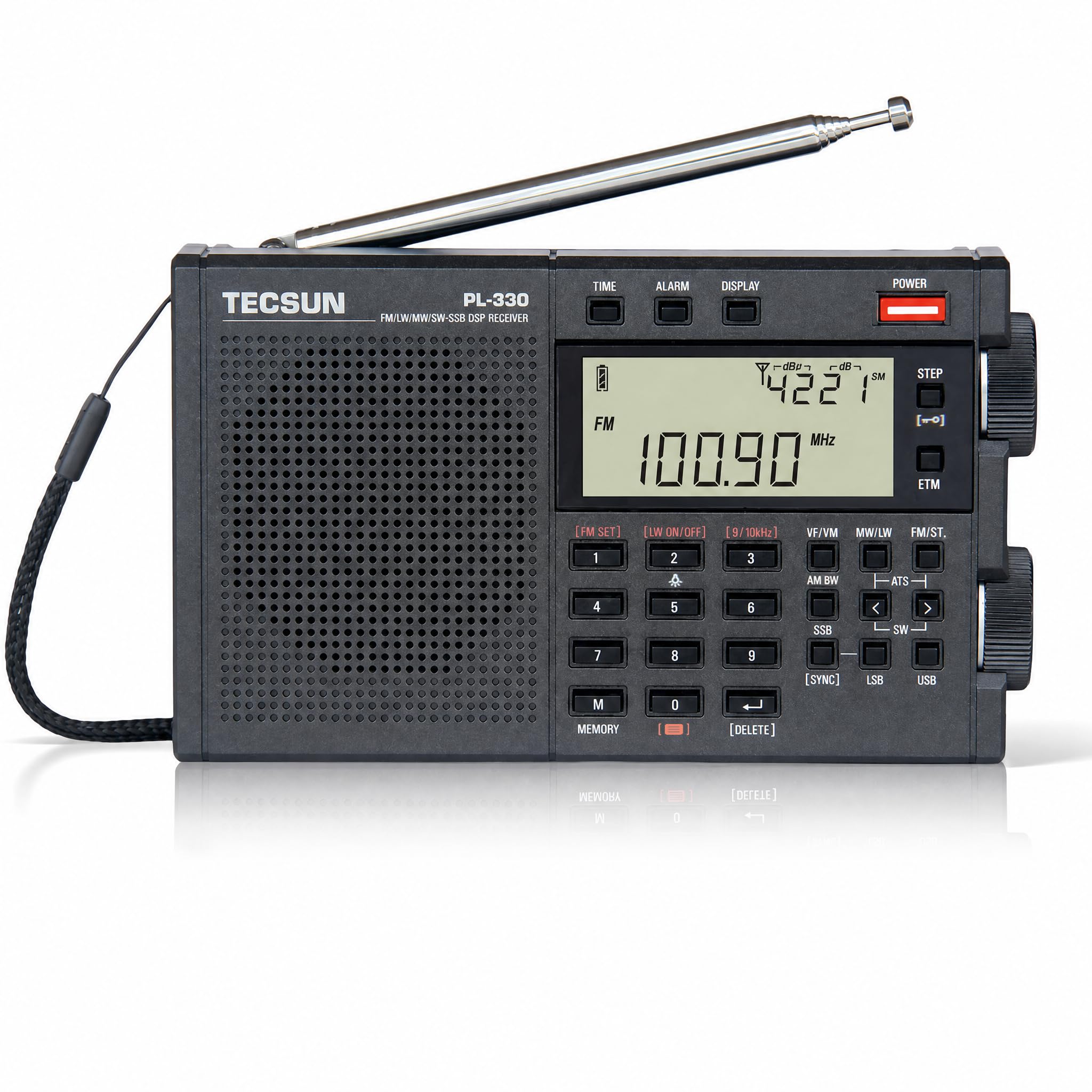
Tecsun PL330

87 /100
LBD Score Excellent

Key details

Size
5.5 x 3.5 x 1 in
Bands
AM, FM, LW, SW, SSB
Memories
850
Antenna Input
External antenna jack
View on Amazon

An external antenna jack and single-sideband reception are the two features that separate a real shortwave receiver from an AM/FM set with an extra band, and the PL330 has both. It tunes AM, FM, longwave and shortwave, adds SSB with fine tuning steps for the traffic that isn't aimed at you — amateur operators, maritime weather, utility stations — and takes a length of wire when the whip isn't enough.

That combination is why it's our top pick. The DSP tuner and synchronous detection are there to hold a weak station steady when a stronger one sits a few kilohertz away, and 850 memories mean the frequencies you find at two in the morning are still there at noon. We also like how little it asks of you otherwise: it recharges over USB, weighs 7.4 ounces and measures 5.5 by 3.5 by 1 inch, so the most capable receiver here is also one you can put in a jacket pocket.

What it isn't is a party radio. The 250 mW speaker is built for a news bulletin, and music sounds thin next to the Sangean's cabinet, so most of the time you'll be on headphones or sitting close to the set. And if all you ever want is your own country's FM stations, the extra bands are dead weight — the PL330 earns its keep when you're chasing signals that fade in and out.

Pros

  • AM, FM, LW, shortwave and SSB in one set
  • External antenna jack for a reel wire
  • 850 memories keep the stations you find
  • Recharges over USB at 7.4 ounces

Cons

  • Multi-function keys need the manual at first
Our verdict

We recommend the PL330 to most people: SSB, an antenna jack and 850 memories in a body you can carry, for a fraction of what the premium sets cost.
Check Latest Price
2

Best for Travel

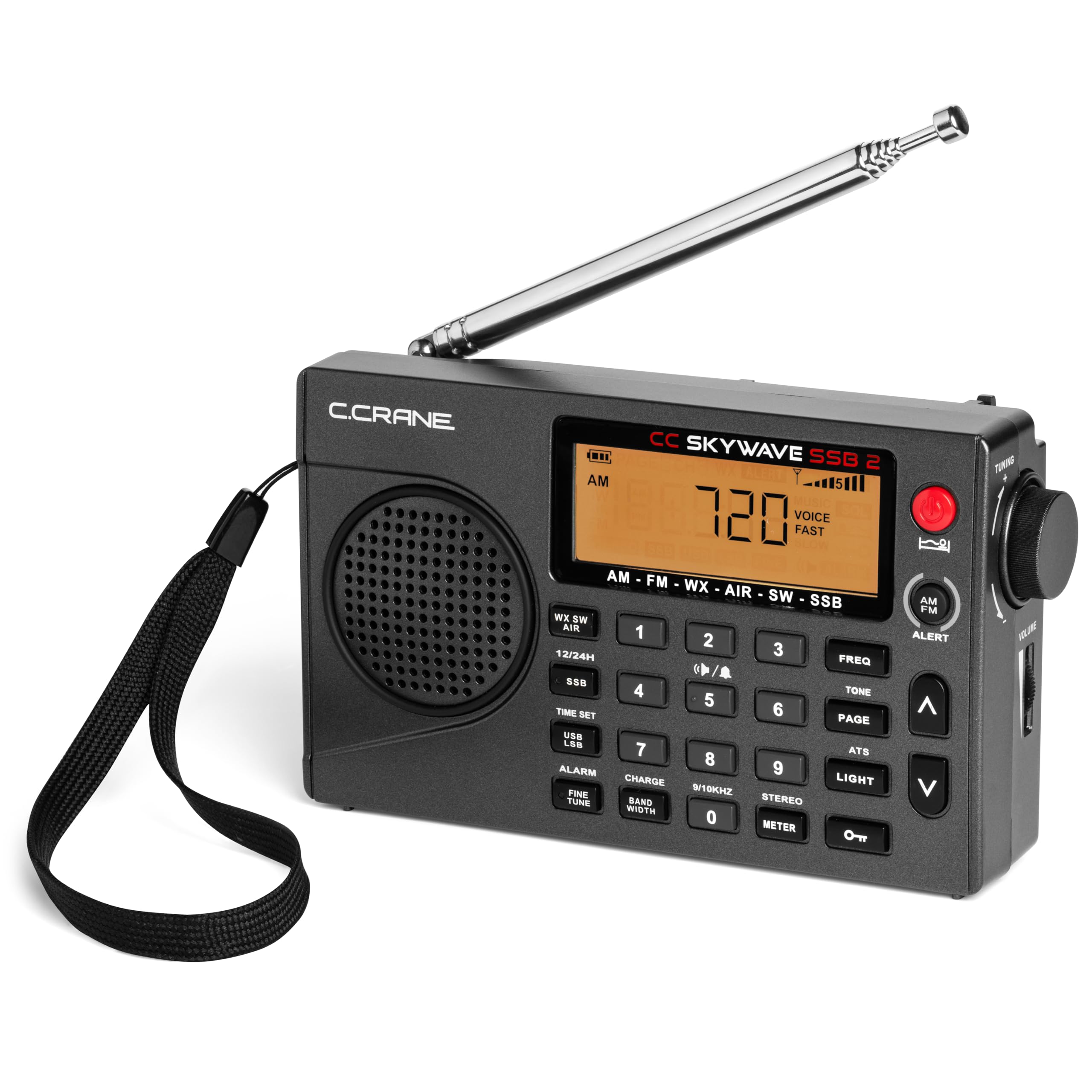
C. Crane Skywave SSB 2

85 /100
LBD Score Excellent

Key details

Bands
AM, FM, SW, SSB, VHF air, weather
Weight
6 oz
Runtime
About 60–70 hours on AA
Memories
400
View on Amazon

Six ounces and a 4.75-inch case shouldn't receive this much. The Skywave SSB 2 covers AM, FM, shortwave from 1711 to 29999 kHz, single sideband, the VHF aviation band and NOAA weather with alert, and it does it on two AA cells — which is why it's the radio we reach for when a trip involves a plane, a tent or a power strip we don't trust.

Everything that usually gets cut from a travel radio is here. There are 400 memories with direct frequency entry, auto scan and store, and selectable bandwidths for narrowing a passband when two stations are fighting. The ten aviation memories can be scanned for activity, which is more entertaining in an airport hotel than it has any right to be. A pair of alkalines is rated for about 70 hours through the earbuds and 60 through the speaker, so a long weekend costs you one set of batteries.

The box is unusually complete: earphones, a carry case and the adapter that lets you clip a wire antenna to the jack. We appreciate that, because a radio this small lives or dies on the antenna you can attach to it, and the included adapter is the difference between using the jack and ignoring it. If you'll listen at a desk every night, the PL330 does more for less money; if the radio has to travel, this is the one that arrives.

Pros

  • SSB, air band and weather in six ounces
  • About 70 hours on two AA batteries
  • 400 memories plus direct frequency entry
  • Case, earbuds and antenna adapter included

Cons

  • Priciest of the pocket-sized radios here
Our verdict

For travel we haven't found a better balance: the Skywave SSB 2 fits a jacket pocket and still hears hams, aircraft and weather alerts on two AA cells.

Check Latest Price
3

Best Premium

Sangean ATS-909X2

83 /100
LBD Score Excellent

Key details

Size
8.17 x 1.34 x 5.31 in
Bands
FM, MW, LW, SW, VHF air, SSB
Power
AC adapter or 4 AA batteries
Presets
1,674
View on Amazon

The ATS-909X2 is a receiver you set up rather than carry: 1,674 presets across three memory banks, FM, MW, LW, shortwave and the VHF air band, SSB with 10 or 20 Hz fine tuning, RDS text, a signal-strength meter and a clock that covers 42 time zones.

The money goes into tuning. Five methods — direct entry, the rotary knob, the keypad, auto tuning and memory scan — let you nudge a weak signal a few hertz at a time or jump straight to a stored frequency, and the tone control for music, normal and news is a small thing we appreciated on a set with a cabinet this size. It also arrives with the accessories you'd otherwise buy: a switchable AC adapter, a wire antenna, a carry pouch and stereo earbuds.

Our reservation is the price. It costs more than our top pick and our travel pick together, and the return is a set that does everything capably rather than anything uniquely — if you mostly want international broadcasters, the PL330 gets you most of the way there. Where the Sangean pulls ahead is permanence: four AA cells with a built-in charger, mains power and a line output make it a fixture for the desk.

Pros

  • 1,674 presets across three memory banks
  • SSB with 10 or 20 Hz fine tuning
  • AC adapter, charger and wire antenna included
  • RDS text and signal-strength metering

Cons

  • Only one SSB bandwidth setting
  • Large and heavy next to the portables here
Our verdict

If your listening happens at one desk, we think the ATS-909X2 is the most complete radio here — buy it for the tuning, not the preset count.

Check Latest Price
4

Best for Air and VHF Bands

Raddy RF320

79 /100
LBD Score Very Good

Key details

Bands
AIR, FM, AM, VHF, SW, WB
Presets
955
App Control
Bluetooth 5.0, iOS and Android
Included Antenna
9.85 ft wire antenna
View on Amazon

A Bluetooth app that mirrors the whole radio on your phone is the RF320's party trick: you can retune, manage presets and read the display from across the room instead of squinting at a two-inch screen. Underneath the app is a broad receiver — AIR, FM, AM, VHF, shortwave and weather band — with 955 storage slots and a 9.8-foot wire antenna in the box.

We like it best as a second radio or a gift for someone who likes gadgets. Air band and VHF coverage is what you're paying for: tower traffic at a regional airport is a different kind of listening from a broadcast band, and the retro-military case is more fun to look at than anything else here. It also takes a wire antenna seriously, which is unusual at this price.

The controls are the catch. Knob-tuning across 955 memories is slow enough that the app stops being a novelty and becomes the sensible way to set the thing up, so budget a session with your phone before you judge it. The band labels also assume you already know what AIR and WB mean, and the manual explains it eventually.

Pros

  • AIR, VHF, SW and weather band coverage
  • Bluetooth app mirrors the controls
  • 9.8-foot wire antenna included
  • 955 preset slots

Cons

  • No SSB or CW reception
Our verdict

We like it for planes, weather and shortwave in one gadget, with a phone app that makes a complicated radio easy to set up.

Check Latest Price
5

Best Budget

XHDATA D220

88 /100
LBD Score Excellent

Key details

Bands
AM, FM, SW
Power
2 AA batteries
Weight
125 g without batteries
SW Range
5.6–22.0 MHz
View on Amazon

Two AA batteries, a 125-gram body and a tuning knob: the D220 is the least expensive radio here and the one we hand to anyone who isn't sure they'll stick with shortwave. It tunes AM, FM and shortwave from 5.6 to 22 MHz, and the DSP chip inside pulls in local AM and FM better than the price suggests.

The compromises are in the tuning. It's an analog dial, so finding a specific shortwave station means creeping up on it and nudging back when it drifts — the AM band is far more forgiving than shortwave, and the FM side easier still. What you get in return is a radio that runs on cells from any gas station, has a headphone jack, and slips into a back pocket.

Treat the whip carefully. The telescopic antenna is the part that can give out, so extend it from the base, don't carry the radio by it, and don't force it past its stop. Looked after that way, the D220 is the set that lives in a garden shed or a glovebox and still works when you remember it exists.

Pros

  • Shortwave coverage from 5.6 to 22 MHz
  • Runs on two AA batteries
  • 125 g and pocket-sized
  • Strong AM and FM reception for the money

Cons

  • No SSB or fine tuning
  • No battery-life indicator
Our verdict

We hand the D220 to first-time buyers: real shortwave coverage, two AA batteries and a body that disappears in a pocket, at the lowest price here.

Check Latest Price
6

Pocket Recording

Retekess V115

86 /100
LBD Score Excellent

Key details

Size
4.73 x 0.8 x 3.15 in
Bands
AM, FM, SW
Power
1,000 mAh BL-5C rechargeable
Playback
TF card, AUX, recording
View on Amazon

A TF card slot, an MP3 player and a recording function are not things you expect from a pocket radio, and they're why the V115 has stayed popular. It tunes AM, FM and shortwave with direct keypad entry and presets, remembers the last station, and will record the radio onto a card at three quality settings.

The parts we appreciate most aren't the headline ones. It plays while it charges, so a USB-C cable doubles as a wall adapter, and the 1,000 mAh cell sits in a compartment you can open. The 2 W speaker is loud enough for a kitchen, the hand strap means it survives being carried around, and the sound is better than the size suggests.

Programming is the friction. Auto search and store does the heavy lifting, but the keypad logic isn't obvious and the manual is thin, so plan on a session with it before the presets make sense. That's also why it sits below the D220 here if shortwave is your main interest, and above it if recording and card playback are.

Where it earns its place: clipped to a backpack, loaded with a card of podcasts, pulling in an FM station at a campsite with shortwave as a bonus. Most radios this small do one thing; this one does four, and it does them for very little money.

Pros

  • Records radio to a TF card
  • Presets and direct keypad entry
  • USB-C charging while it plays
  • Hand strap and pocket size

Cons

  • Shortwave reception lags its FM and AM
  • Cell can stop holding a charge over time
Our verdict

We recommend the V115 to anyone who wants a pocket radio that records and plays files from a card — it does all three and sounds better than its size.

Check Latest Price
7

Analog Simplicity

Panasonic RF-562D

83 /100
LBD Score Excellent

Key details

Size
8.27 x 2.56 x 4.72 in
Bands
AM, FM, SW
Power
2 D batteries
Speaker
8 cm
View on Amazon

An 8 cm speaker, two D cells and a case that looks like it wandered in from 1975: the RF-562D is the only radio here that asks nothing of you but a dial. It tunes AM, FM and shortwave with a mechanical knob and has no presets, no clock and no menu — which is either the point or a dealbreaker, depending on what you want from a radio.

On shortwave, the dial is a skill. Stations sit close together, so you creep up on one and nudge back when it drifts; the band also behaves like a tide, opening after dark and closing again in daylight, so a frequency that's silent at noon can be loud at midnight. The AM side is where this set is happiest, and it's a pleasant thing to have humming on a workbench.

We like it for the absence of everything. There's nothing to program, nothing to update and nothing to learn beyond the band switch, and two D cells mean you're not hunting for a charger. For a kitchen counter, a garage or a parent who wants the evening news without a manual, that simplicity is worth more than any feature on this list.

Pros

  • Analog dial with no menus
  • Runs on two D cells
  • 8 cm speaker fills a room
  • Retro styling with simple controls

Cons

  • Speaker distorts at high volume
  • Case feels lighter than the styling suggests
Our verdict

We like the RF-562D for what it refuses to do: one dial, two D cells and no menus, as long as presets and digital tuning aren't on your list.

Check Latest Price
8

Weather and Outages

Jazmm Shortwave Radio

82 /100
LBD Score Excellent

Key details

Size
9.96 x 3.8 x 7.87 in
Bands
AM, FM, SW, weather band
Battery
4,000 mAh rechargeable
Presets
40
View on Amazon

A weather band with an alert function plus a 4,000 mAh battery makes the Jazmm an emergency radio first and a shortwave receiver second, and that's the right way to judge it. It covers AM, FM, shortwave and the NOAA weather band, and it will make itself heard when the weather service issues a warning.

For a power cut it's well set up. A charge takes about five hours over USB-C, the sleep timer runs from 10 to 90 minutes, and there are 40 presets plus keypad entry so you're not hunting for the local station in the dark. It also plays MP3s from a micro SD card or a USB stick, which is more useful than it sounds when the power is out and the phone is dying.

Reception is the part to be realistic about. The whip is short and the set is at its best on FM and weather; shortwave comes and goes with the hour and the band, and a distant international broadcaster is a stretch. That's normal for a portable this shape, but it means this isn't the radio to buy if hearing the other side of the world is the whole point.

Our take: keep it charged in a closet and it earns its place, especially if you want weather alerts without a scanner or a subscription. For nightly shortwave listening the PL330 is far more rewarding; for storm season, this is the easier thing to live with.

Pros

  • NOAA weather band with alert
  • 4,000 mAh rechargeable battery
  • 40 presets and keypad entry
  • Plays MP3 from card or USB

Cons

  • Large and heavy for a portable
  • Controls take a session to learn
Our verdict

We keep the Jazmm in mind for storm season: a big battery, weather alerts and shortwave in one set, with no subscription.

Check Latest Price

How We Tested 12 Shortwave Radios (and What We Learned)

We started by researching the shortwave radios that show up again and again in enthusiast forums, emergency-prep forums, and retailer reviews—then filtered out anything with a reputation for drifting tuners or dead-on-arrival batteries. We ended up with 12 radios, ranging from a pocket-sized budget model to a high-end tabletop, and spent eight months using them daily.

Each radio lived on my kitchen counter for a week, then moved to my nightstand, then came with me to a local park and on a weekend camping trip. I also handed each one to a friend who had never used a shortwave radio and timed how long it took them to find a station from a cold start. We logged how many stations came in clearly on a given night, how much fiddling it took to hold a weak signal, and whether the speaker made voices sound natural or tinny.

We paid attention to tuning—whether the knob or buttons let us fine-tune without overshooting—and to battery life, timing how long each ran on a set of AA batteries or a full charge. We also checked durability by tossing each radio into a tote bag, accidentally knocking one off a picnic table, and looking for scratches or loose connections after a month. For models with single side band, we tried to pull in ham radio conversations and weather broadcasts; for those with a wire antenna, we unspooled it and compared reception with and without it.

The radios that made the cut were the ones that stayed reliable—no drift, no sudden dropouts—and that felt good to use, with controls that made sense without the manual. We also weighed what each one offered for the price, from simple pocket radios to feature-packed tabletop models.

How to Choose a Shortwave Radio

Check the frequency range, not the band label

Almost every set here prints shortwave on the box, but the numbers behind that word differ. The XHDATA D220 tunes 5.6 to 22 MHz; the C. Crane Skywave SSB 2 reaches 29,999 kHz. Both are shortwave, and the gap decides which broadcasters you can hear, so find the kilohertz or megahertz range in the listing before you compare anything else.

Treat longwave, air band and VHF as separate purchases. They're worth paying for if you follow aviation or shipping traffic, and dead weight if you don't.

Analog dial or digital keypad

A dial is quick to learn and slow to use: shortwave stations sit about 5 kHz apart, so a mechanical knob means creeping up on a signal and losing it again when a door closes. Digital tuning with direct frequency entry and memories is what we prefer for shortwave, and the scan functions on the Tecsun and the Retekess do the searching for you.

An analog set like the Panasonic is genuinely more pleasant on AM and FM. If you plan to chase weak stations, pay for keypad entry; if you want the evening news, a dial is enough.

Single sideband, and who actually needs it

SSB is the mode amateur operators, maritime and aviation weather, and utility stations use, and it's what separates the Tecsun PL330 and the Skywave SSB 2 from the cheaper radios here. International broadcasters don't use it, so a broadcast-only listener can save the money without missing anything.

If you want the traffic that isn't aimed at you, pay for SSB and for fine tuning: the Sangean steps in 10 or 20 Hz, which is what lets you separate two signals sharing a frequency. A single on-off switch is not the same thing.

The antenna jack changes what you hear

Every radio here has a telescopic whip, and for a strong signal from another continent that's enough. The difference indoors is wire: the PL330 and the Skywave SSB 2 both have a jack for an external antenna, and 15 or 20 feet of wire strung along a wall pulls in stations the whip can't find.

The other half of reception is noise. Switch-mode chargers, LED bulbs and routers flatten weak signals, so unplug the charger and step away from the router before you conclude a band is empty.

Power it for the night you need it

The most capable receiver in the world is a paperweight with a dead proprietary cell. Radios that run on AA or D cells can be fed from a gas station at nine at night; built-in lithium packs are convenient, but they age whether you use them or not.

For a set that lives in a drawer for emergencies, we prefer disposable cells — the Skywave's two AAs and the Panasonic's two D cells are the ones to want in a storm. For daily listening, USB charging is fine and one less thing to buy.

Frequently Asked Questions

Final Verdict

Start with the Tecsun PL330. It has the two things that make shortwave worth the trouble — single sideband and a jack for a real antenna — plus enough memories and battery to live with, and it's the one that stays on our desk.

If you'll mostly listen in hotel rooms and tents, the C. Crane Skywave SSB 2 earns its premium at six ounces. If you're not sure how much you'll use one, the XHDATA D220 is the least expensive radio here and still hears the world after dark.