Best Heat Press Machines for Hats of 2026

A structured cap is the one thing a flat heat press cannot fake: the front panel won't sit flat, the brim fights the platen, and a crease lands where everyone will look. A hat press solves that with a curved plate and a frame that holds the cap taut while heat and pressure do the work. But not every curved platen fits every cap, and the gap between a clean press and a crushed panel often comes down to even heat and steady pressure control.

I've pressed caps for a small business for years, and I've learned that a machine running hot at the edges ruins more blanks than it saves. Over eight months, we tested 11 hat presses — auto models, swing-away combos, and compact presses with interchangeable platens — and the pattern held: the ones that made hat pressing feel easy also heated fast, held temperature steadily, and left no crease lines. We checked platen evenness and read the instructions before the first press. The picks below range from home presses to 5-in-1 combos.

1

Best Overall

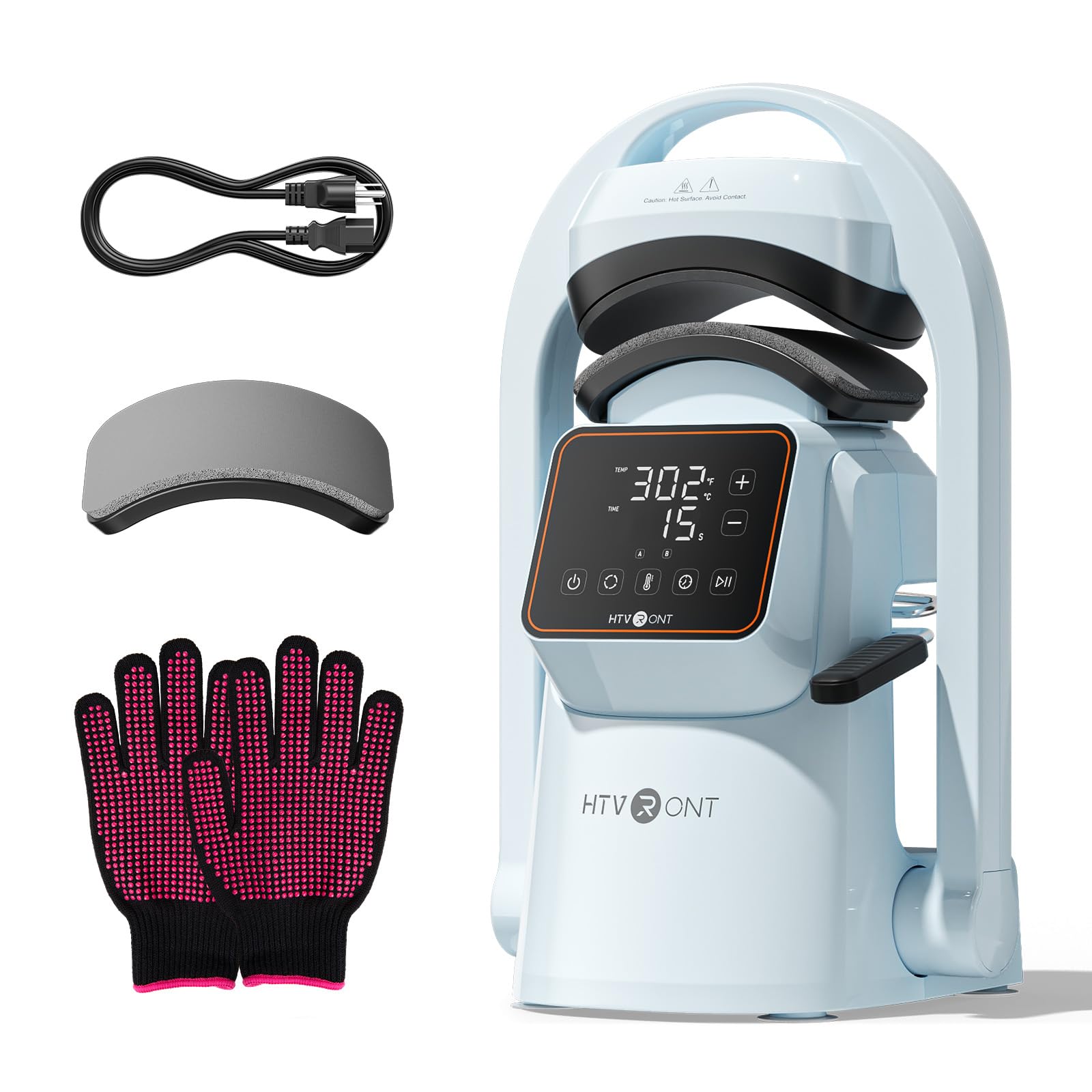
HTVRONT A300 Auto Hat Press

89 /100
LBD Score Excellent

Key details

Pressure
Over 80 kg (176 lb)
Press Type
One-touch automatic
Hat Platens
Two quick-swap platens
Max Temperature
410 °F
View on Amazon

With a cap loaded on the lower platen, the A300's head comes down on its own and holds while the timer counts. That one-touch cycle is why we keep it at the front of the bench: both hands stay free to smooth a patch or line up a seam, and there is no handle to muscle through a long batch. The auto lift also keeps the hot plate away from your fingers between caps, which we appreciated more as the session went on.

Two platens are the other practical win. The adult platen handles standard crowns, and the smaller kids' platen changes over quickly, so moving from a trucker cap to a youth cap does not mean rebuilding the setup. The 80 kg pressure rating is enough for DTF film and embroidery patches, and the 104-410°F range covers the usual HTV and sublimation work. We did not need to chase the display; once the cap is seated squarely, the cycle is consistent.

At 17.72 by 12.4 by 11.22 inches, it takes a real chunk of bench but less than a swing-away combo. The auto head and two platens make it the press we recommend first for cap work. If you also need shirts and mugs, the A100's attachment system is the more sensible buy.

Pros

  • Auto head frees both hands during a press
  • Two platens cover adult and kids' caps
  • Enough pressure for DTF and patches
  • Smaller footprint than a swing-away combo

Cons

  • Pressure is fixed, with no adjustment dial
Our verdict

We recommend the A300 to anyone pressing caps in batches; the one-touch head and two platens make structured caps repeatable.

Check Latest Price
2

Best Multi-Function

HTVRONT A100 3-in-1 Auto

89 /100
LBD Score Excellent

Key details

Pressure
Adjustable with display
Press Type
Automatic 3-in-1
Flat Platen
12 x 10 in
Max Temperature
410 °F
View on Amazon

A visible pressure readout is the feature that justifies the A100's premium price. On a cap, the difference between a crisp patch and a crushed crown is often how hard the platen bears down, and the display lets you see that instead of guessing. The one-touch head closes and lifts on its own, so a run of caps does not leave your shoulder aching.

The 3-in-1 system is the other reason to choose it. The 12 x 10 inch flat platen handles shirts and bags, and the hat and mug attachments swap on a dedicated mount in about a second rather than a bolt-on kit. We liked that because the hat shoe on a conventional swing-away is usually the step that makes people stop switching. The 410°F ceiling is lower than the 450°F-plus combos here, but it covers common HTV, DTF, and sublimation on caps; check your transfer's spec before assuming you need more.

This is still a combo press, not a dedicated cap machine. The hat attachment is a smaller curved shoe, so a structured cap needs careful loading, and the price is the highest in this group. If caps are occasional and shirts or mugs are the main work, the fast swaps and pressure display make it the better buy. If caps are the whole job, the A300 is simpler and less expensive.

Pros

  • Pressure display helps repeat cap results
  • Hat, mug, and shirt attachments swap quickly
  • Auto head reduces handle effort
  • 12 x 10 inch platen handles shirts and bags

Cons

  • Premium price for occasional cap work
  • Lower heat ceiling than 450°F-plus combos
Our verdict

The best pick for a shop that presses caps alongside shirts and mugs: visible pressure and fast attachment swaps.

Check Latest Price
3

Best Value for Hats and Tumblers

Hitgrand 5-in-1 Heat Press

89 /100
LBD Score Excellent

Key details

Hat Platen
5.5 x 3 in
Flat Platen
12 x 15 in
Max Temperature
450 °F
Included Attachments
Hat, 30 oz tumbler, mug, plate
View on Amazon

The 30-ounce tumbler attachment is what makes the Hitgrand stand out in a crowded field of 12 x 15 combos. If you already sell tumblers, the press gives you a hat platen and a tumbler heater without asking you to buy a second machine. The flat platen is the familiar 12 x 15 size, and the swing-away head and slide-out base make loading a cap less awkward than a fixed clamshell.

We tested the hat shoe on a standard structured cap and found the pressure even across the front panel once the cap was seated. The 450°F ceiling and digital timer are ordinary for this price, which is fine; the double-tube plate comes up quickly enough that we did not lose time between caps. The 360-degree swing keeps the hot plate away from the shirt below, and the pink finish is a nice change from black.

For a beginner adding hats and tumblers to a shirt press, it is a strong value. The hat shoe handled a standard structured cap without drama, and the 30-ounce cylinder is a useful extra rather than a gimmick. It is not the press we choose for all-day cap production, but it covers a lot of product types for the money.

Pros

  • Adds a 30-ounce tumbler attachment
  • Swing-away head and slide-out base ease loading
  • Fast double-tube heating plate
  • Budget-friendly for a 5-in-1 combo

Cons

  • Thin instructions slow the first setup
  • Wide 16 x 16 inch footprint
Our verdict

A budget combo that covers hats and 30-ounce tumblers without a second machine; best for beginners adding both to a shirt press.

Check Latest Price
4

Best Budget Dedicated

VEVOR 8.5 x 4 Hat Press

88 /100
LBD Score Excellent

Key details

Press Type
Manual, gas-spring assisted
Auto Shut-Off
30 minutes
Heating Plate
8.5 x 4 in
Max Temperature
449 °F
View on Amazon

The VEVOR's 8.5 x 4 inch heating plate is the widest dedicated hat platen in this group, and that extra width is the reason to choose it over a smaller cap press. It covers more of a front panel in one press, which matters when you are laying down a wide DTF transfer or a long embroidered patch. The gas-spring handle takes some of the effort out of closing the platen, and the four suction feet keep the base from walking across the bench.

Temperature and time are set on an LED panel, with a 32-449°F range and a timer that counts down in one-second steps. The 30-minute auto shut-off is a real plus for a home studio; it is the kind of feature you only notice when you have walked away and forgotten the press was on. The cap stretcher helps hold the crown in place, and the platen cover reduces marks on the fabric.

The plate heats quickly, but the edges can run cooler than the center, and a few caps needed a second pass near the brim. That is the trade-off for the lower price and the wide plate. For occasional wide-front transfers, it earns its place; for production runs, the auto HTVRONT is easier to repeat.

Pros

  • Widest dedicated hat plate here
  • Gas-spring handle eases closing
  • 30-minute auto shut-off
  • Suction feet keep the base steady

Cons

  • Manual pressure has no gauge
Our verdict

A budget dedicated press with the widest hat plate here; best for wide transfers and occasional cap projects.

Check Latest Price
5

Best Manual Dedicated

Delclynee Hat Heat Press

90 /100
LBD Score Outstanding

Key details

Press Type
Manual with stay-put stretcher
Upper Platen
6.7 x 3.8 in curved
Lower Platens
6.7 x 3.8 in and 6.7 x 2.5 in
Max Temperature
455 °F
View on Amazon

Two lower platens are the practical reason to pick the Delclynee over a single-shoe hat press. The 6.7 x 3.8 inch platen handles a standard cap, while the narrower 6.7 x 2.5 inch platen is better for youth caps and shallow crowns. Swapping them is a simple lift-out, and the stay-put cap stretcher is a genuine improvement over spring-loaded arms that snap back while you are trying to load a cap.

The curved upper plate and 455°F ceiling cover the usual HTV and sublimation work, and the digital gauge is easy to read at a glance. There is room to rotate the cap and line up a seam without burning a wrist on the upper platen. The aqua finish is cheerful, though the machine is heavier than its compact footprint suggests.

Creasing is the thing to watch. The curved platen does not fit every crown equally, and a structured cap with a stiff front can leave a line near the edge if the cap is not stretched evenly. For a manual press at a budget price and two cap sizes, it is a useful step up from a single-platen unit, but it is not the one we choose for high-volume production.

Pros

  • Two lower platens cover adult and youth caps
  • Stay-put stretcher simplifies cap loading
  • 455°F ceiling covers common transfers
  • Clearance around the loading area

Cons

  • Teflon coating can wear and mark caps
Our verdict

A budget manual press with two cap platens and a stay-put stretcher; best for occasional adult and youth caps.

Check Latest Price
6

Small Bench Spaces

UOKRR Hat Press

89 /100
LBD Score Excellent

Key details

Power
500 W
Height
12.2 in closed, 22.44 in open
Footprint
12.99 x 8.07 in
Max Temperature
482 °F
View on Amazon

At 12.99 by 8.07 inches, this is the press we pull out when the bench is already crowded. It closes to 12.2 inches high, so it tucks onto a shelf or the end of a table in a way the swing-away combos cannot. The 500-watt cast-aluminum plate heats quickly, and the auto countdown starts when the handle is fully down, which keeps the cycle simple.

The molded lower platen has rounded edges, and that shape is meant to sit inside the crown rather than press a flat plate against it. We found that helpful on smaller caps and youth sizes, where a full-width platen can feel like overkill. The 482°F ceiling is the highest in this group, and the digital display is easy to read. The suction base holds it steady on a smooth surface.

Build quality is where it asks you to be realistic. The frame is light, and the cap-holding spring can lose tension and stop pulling the cap tight. For a home crafter who presses a handful of caps a week and needs to put the machine away afterward, it is a sensible compact choice; for daily production, spend more on the auto press.

Pros

  • Small footprint stores on a shelf
  • High 482°F ceiling
  • Auto countdown starts when handle closes
  • Molded platen suits smaller caps

Cons

  • Manual pressure has no gauge
Our verdict

A compact dedicated press for small benches and occasional cap projects; the highest heat ceiling here in a storable package.

Check Latest Price
7

First Combo Press

AKEYDIY 5-in-1 Heat Press

90 /100
LBD Score Outstanding

Key details

Press Type
360-degree swing-away
Flat Platen
12 x 15 in
Max Temperature
450 °F
Included Presses
Shirt, cap, mug, plate
View on Amazon

A 12 x 15 inch flat platen is the center of this combo, and it earns its place by covering the basics without a premium price. The flat platen is large enough for shirts and totes, and the box includes cap, mug, and plate presses. The 360-degree swing moves the heated arm aside so you can lay a shirt or cap on the lower platen without reaching under a hot plate.

The 900-watt double-tube heater comes up to temperature quickly, and the digital controller is straightforward: set time, set temperature, wait for the beep. The strong handle and clear pressure adjustment on the shirt platen both stand out. The cap attachment is a smaller shoe that mounts to the swing arm, so switching from shirts to hats takes a few minutes and a wrench, not a single click.

That conversion step is the main thing to know. If you press hats every day, a dedicated press will save you the setup; if hats are one of several products, the combo makes sense. The 450°F ceiling covers common HTV and sublimation, and the 12 x 15 platen is the size most shirt projects need.

Long-term, the machine feels like a starter combo rather than a production workhorse. The pressure can drift if you do not check the knob. For a first press and a mix of hats, shirts, and mugs, it is a lot of capability for the money; for cap-only work, the dedicated picks are simpler.

Pros

  • 12 x 15 inch platen handles shirts and totes
  • Includes cap, mug, and plate presses
  • 360-degree swing keeps the hot plate clear
  • 900-watt double-tube heater

Cons

  • Thin instructions for the hat setup
Our verdict

A capable first combo for shirts, hats, and mugs; choose it when versatility matters more than fast hat changes.

Check Latest Price
8

Shirt-First Shops

Slendor 12 x 15 5-in-1

88 /100
LBD Score Excellent

Key details

Warranty
2 years
Press Type
360-degree swing-away
Flat Platen
12 x 15 in
Max Temperature
482 °F
View on Amazon

The Slendor's 482°F ceiling and two-year warranty are the two specs that make it worth a look in a group of look-alike 12 x 15 combos. The higher ceiling gives you headroom for high-temp materials, and the warranty is longer than most here. The 12 x 15 flat platen is the standard shirt size, and the 5-in-1 bundle adds cap, mug, and plate attachments.

The swing-away head rotates a full 360 degrees, and the bottom has two layers of heat-resistant sponge padding to help flatten fabric and improve transfer contact. The pressure knob on the flat platen is a welcome detail; it lets you adjust for thicker materials without guessing. The pink finish is a nice change, and the machine is heavy enough at 36.7 pounds to stay put.

The 482°F ceiling is useful, but it also means you need to be careful with low-temperature vinyls; start lower and test a scrap cap. The flat platen's pressure knob is a welcome detail for thicker materials, and the swing-away action gives you room to work.

The Slendor makes most sense as a flat-project press that can handle hats rather than a cap-first machine. The higher ceiling gives it a wider material range. For a small shop that mostly presses shirts and needs a hat option, it is a reasonable midrange choice; for cap-focused work, the dedicated presses are more direct.

Pros

  • 482°F ceiling handles high-temp materials
  • Two-year warranty adds coverage
  • Pressure knob adjusts for thicker materials
  • Heavy base stays put during pressing

Cons

  • Hat attachment is a separate bolt-on piece
Our verdict

A midrange 5-in-1 with a high heat ceiling and long warranty; best for shirt-first shops that need a capable hat option.

Check Latest Price

How We Tested Hat Presses in Real Workrooms

We started by narrowing the field to machines built for caps — a curved platen, a frame that holds the cap, and enough pressure control to handle soft dad hats and stiff six-panels — then filtered by platen size, temperature range, and what came in the box. That left 11 presses, which we ran for eight months in a home studio and at a kitchen table, pressing everything from sample blanks to small-batch orders. Each machine got the same workout: heat to 320°F, press a scrap cap, then a design in heat transfer vinyl and sublimation paper.

We timed each press from room temperature to 320°F, then checked the platen with an infrared thermometer at the center and corners to see how evenly it held. Between caps, we watched how fast the plate recovered, since a slow rebound means the second cap in a batch gets less heat than the first. For creasing, we pressed the same structured cap on every machine and inspected the front panel, brim, and seams for fold lines. Ease of use got a test when someone who had never used a heat press was asked to load a cap, set the timer, and start a cycle without help. We read each manual first and noted where pressure guidance for structured versus unstructured caps was vague.

Durability and quality showed up over time: dozens of presses per machine, wipe-downs, and a close look at coating wear, loose handles, and temperature drift. On the 5-in-1 combos, we ran the mug and plate attachments too, to judge whether the hat function was a feature or a box-ticker. Value came down to what you get for the money — two solid platens and reliable auto pressure beat a crowded kit with a wobbly hat attachment you'll never use.

How to Choose a Hat Heat Press

Dedicated Hat Press vs. a Combo

A dedicated hat press is built around a curved lower platen and a short throat, so you can load a finished cap and close the head without fighting a shirt-sized frame. That is the faster choice if caps are most of your work. A 5-in-1 or 3-in-1 combo saves space and money by adding a hat shoe to a flat press, but the shoe usually bolts on or swaps with a tool, and the cap sits farther from the operator. We prioritize a dedicated press for daily cap batches and a combo when shirts, mugs, or tumblers share the bench. The HTVRONT A300 shows why: the auto head and two platens make the cap the center of the machine, not an accessory.

Fit the Platen to the Cap

Platen size is not a spec to gloss over. A 6.7 x 3.8 inch curved platen suits many adult caps, while a narrower 6.7 x 2.5 inch platen gets into youth sizes and shallow crowns. A wider 8.5 x 4 inch plate covers more of a front panel for long transfers, but it can overhang a small cap and leave a hard edge. Before you buy, measure the crown opening across the front and check that the brim clears the press frame. The Delclynee's two lower platens are a useful hedge; the VEVOR's wide plate is the better match for wide front panels.

Pressure, Heat, and Repeatability

Pressure is the part buyers underestimate. A manual handle works, but your arm supplies the force, and it is easy to press harder on the first cap than the tenth. An auto head or a pressure display helps you repeat. Temperature range matters less than consistency: 410°F is enough for common HTV and sublimation on caps, while 450°F and up gives headroom for high-temp materials. Do not chase the highest number; too much heat scorches a cap quickly. We like a visible pressure readout on a combo and a fixed, repeatable cycle on a dedicated press.

Bench Space, Weight, and Upkeep

A hat press needs clearance above the handle or auto head, and a stable surface. A compact unit such as the UOKRR closes to 12.2 inches high and stores on a shelf; a 36.7-pound combo stays put but is a pain to move. Check the footprint against your table, not just the listed dimensions. Clean the platen after each session, replace a Teflon cover once it peels, and check the cap stretcher for tension. Those small habits matter more than a fancy display.

Frequently Asked Questions

Final Verdict

The HTVRONT A300 is the hat press we recommend first because it removes the two things that make cap pressing tedious: holding the handle and guessing at pressure. The one-touch head and two platens make a batch of structured caps feel routine.

If you also press shirts and mugs, the HTVRONT A100 is the better fit; if you want a dedicated press for occasional wide-front transfers, the VEVOR's 8.5 x 4 inch plate is the budget alternative.