Best Home Theater Speaker Systems of 2026

In a home theater, you're picking between two kinds of work. One box, one cable, done — or a receiver, five speakers, and an afternoon of speaker wire. Both can sound terrific, and both fall apart the same way: the center channel gets buried under the explosions and you're back to reading subtitles. A good system fixes that before it does anything flashy.

Over nine months my team ran 10 systems through their paces — soundbars with wireless surrounds, wired 5.1 kits, one 7.1 rig — in a living room, a basement with a projector, and a bedroom where the TV gets watched late and quiet. We compared dialogue clarity, how far Dolby Atmos and DTS:X tracks threw sound around the room, how fussy Bluetooth and wireless pairing were, and how long setup took with one person doing it.

What I'd tell a first-time buyer: the center channel does more for nightly TV watching than any other speaker in the box, and where the subwoofer sits matters more than its wattage rating. Below are the systems that earned their spot.

1

Best Overall

Yamaha YHT-4950U

89 /100
LBD Score Excellent

Key details

Channels
5.1
Receiver
Included, 4 HDMI inputs
Room Calibration
YPAO automatic
Surround Speakers
Wired to the receiver
View on Amazon

The receiver is why this one wins. Yamaha ships the YHT-4950U as a complete kit — AV receiver, four satellites, a center channel, a subwoofer, and speaker wire — and that receiver is what turns a box of speakers into something you can run a whole room from: four HDMI inputs, 4K Ultra HD passthrough with HDCP 2.2, and Bluetooth for phones and podcasts. Nothing else in this set puts an amplifier and an HDMI switcher in the same carton.

Sound is where it earns the spot rather than just the spec sheet. Bass arrives without much twist of the volume dial, which matters more at 10pm in an apartment than it does in a demo room, and dialogue stays planted in the center channel while effects move around it. YPAO, Yamaha's room calibration, walks you through measuring the room and then sets speaker levels and distances so the surrounds don't shout over the front three.

The feature we didn't expect to care about: virtual CINEMA FRONT. If the sofa is against the back wall and there's nowhere to hang a rear speaker, the receiver will run a 5.1 mix with all five speakers across the front, and it holds the effect far better than it has any right to. Otherwise, plan the wire runs before you unbox. The surrounds are wired, full stop, and the wire in the box suits a small room — buy a spool and cut your own lengths for anything bigger.

Setup is genuinely a one-person job, even with the calibration pass, and the on-screen menus are readable from the couch. What you're buying underneath all of it is a system that leaves room to change your mind later: a different center channel, a bigger subwoofer, a better pair of surrounds. Buy it once and stop shopping.

Pros

  • Receiver, speakers, subwoofer, and wire in one box
  • Four HDMI inputs with 4K and HDCP 2.2
  • YPAO room calibration sets levels for you
  • Virtual CINEMA FRONT works with the couch against the wall

Cons

  • Surround speakers need a wire run to the receiver
Our verdict

We recommend it to anyone who wants one purchase to end in a working 5.1 system: a real receiver, four HDMI inputs, and room calibration in the box.

Check Latest Price
2

Best With Your Own Receiver

Klipsch Reference Theater Pack

93 /100
LBD Score Outstanding

Key details

Channels
5.1
Mounting
Keyhole slot and threaded insert
Receiver
Not included
Subwoofer
Wireless, down-firing
View on Amazon

Four satellites, a center, and a subwoofer, each small enough to hang like a picture frame — the Reference Theater Pack is what a five-channel system looks like when nobody wants to see it. Every satellite has a keyhole slot and a threaded insert, so it goes on a wall, on a shelf, or on a bracket, and the horn-loaded tweeters give the set a voice that's noticeably more forward than the bar-based systems here.

We rate it as the liveliest package in this set for the money. It plays loud without hardening up, dialogue and effects sit right at the front of the mix, and the cabinets disappear into a room with no space for towers. It isn't a system on its own, though: there's no receiver in the box, so add that to the budget. The subwoofer, at least, connects wirelessly to the receiver, which is a real help when the only free corner is behind the couch.

Two things worth knowing. The subwoofer is the component to test early — a dead-on-arrival amplifier is the failure to watch for, so confirm it works in the first week while returns are still easy. And horns reward a little patience with placement: toe the fronts toward the seat and the soundstage locks in, while flat against the wall the treble turns shouty. Neither is a reason to skip it; both are reasons to spend an evening on setup instead of an afternoon.

Pros

  • Horn tweeters give dialogue and effects real bite
  • Keyhole and threaded mounts on every satellite
  • Wireless subwoofer placement
  • Compact cabinets suit small rooms

Cons

  • No AV receiver included
Our verdict

Our pick for anyone who already owns a receiver: horn-loaded satellites with real bite and a wireless sub you can tuck in a corner.

Check Latest Price
3

Best Wireless Surround

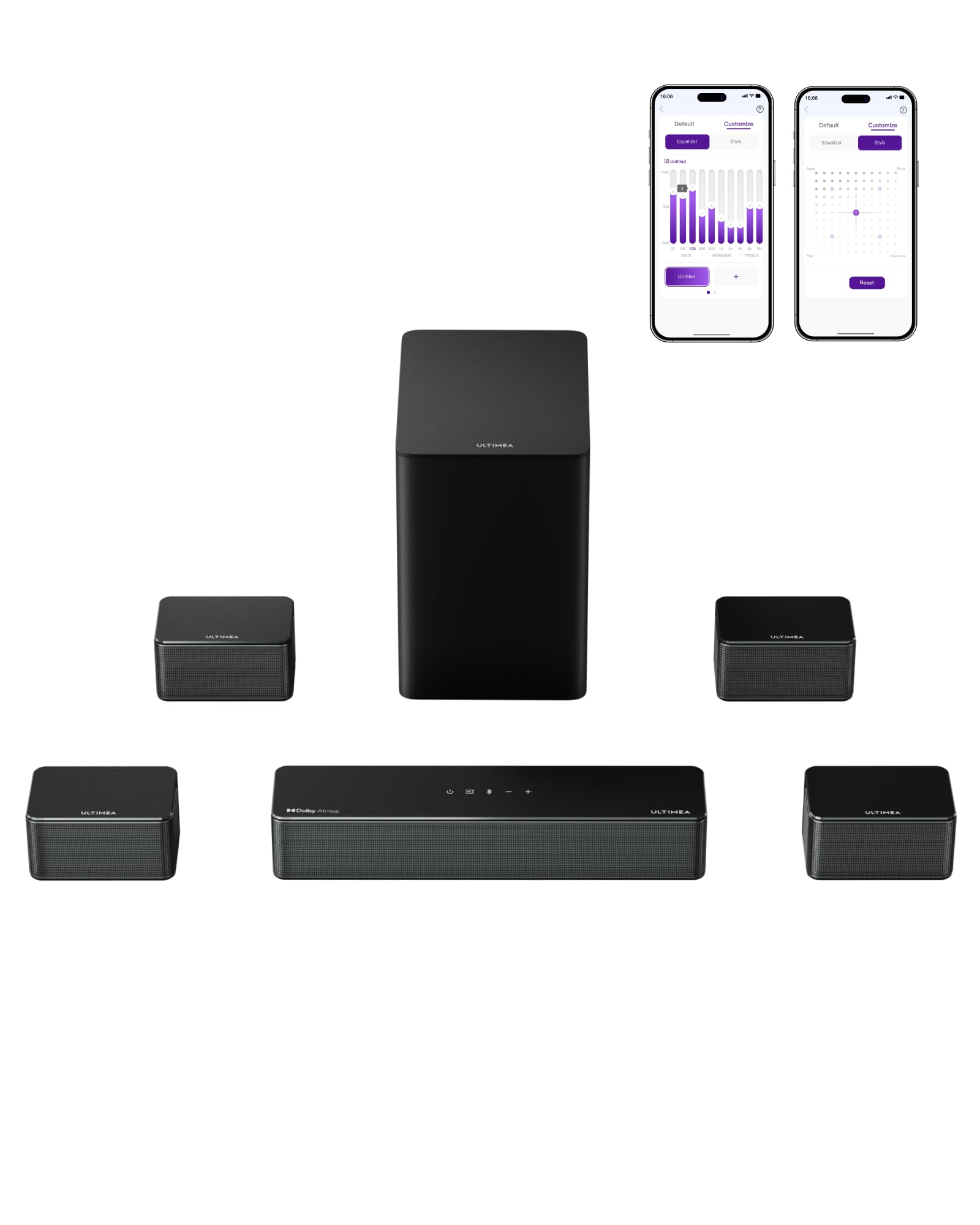
ULTIMEA Skywave X50

89 /100
LBD Score Excellent

Key details

HDMI
eARC with 4K HDR passthrough
Channels
5.1.4
Subwoofer
Wireless 8 in.
Surround Speakers
Wireless, each needs power
View on Amazon

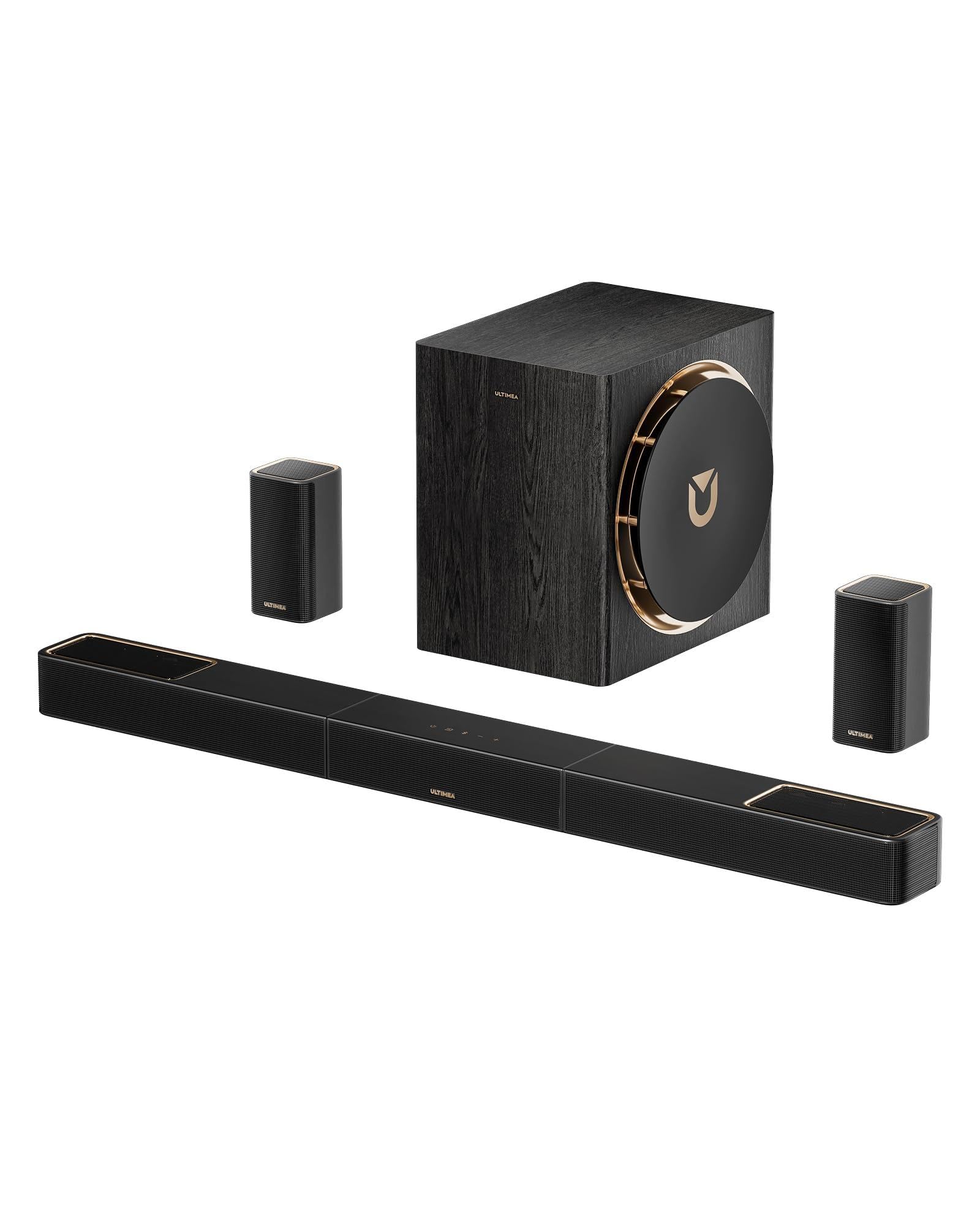
Two surround speakers, an 8-inch subwoofer, and no cable between them and the bar. The Skywave X50 is the system we point at anyone whose living room can't take a wire run, and the 5GHz link Ultimea uses is the part that decides whether it works: dropouts are the usual failure of wireless surround, and this is the one we trust most in a crowded room.

It's a real 5.1.4 layout rather than a stereo bar wearing a badge — Dolby Atmos decoding, height effects that put rain and helicopters above your head, and 760W on tap from a GaN amplifier. The rear pair does more work than their size suggests, and the app lets you set levels speaker by speaker and pick from a long list of EQ presets, which is how you fix a surround that ends up too close to the sofa.

Route a console through the bar and you'll want to know one thing: the HDMI passthrough handles 4K HDR but not VRR, so a PS5 or an Xbox loses variable refresh on the way to the TV. Plug the console into the TV and send audio back over eARC instead and nothing is lost.

Setup is the other reason it's here. The surrounds arrive paired to the bar and the subwoofer links itself, so most of the install is deciding where the two rear speakers go, and the brackets and screws come in the box. What wireless costs you is an outlet behind the sofa for each surround — a smaller ask than a cable run, but not nothing.

Pros

  • Wireless surrounds and wireless subwoofer
  • Real 5.1.4 with Dolby Atmos decoding
  • Per-speaker levels and EQ presets in the app
  • Wall brackets for the surrounds included

Cons

  • No VRR passthrough for consoles
  • Each wireless surround needs a power outlet
Our verdict

We reach for this when a cable run to the back of the room isn't happening — 5.1.4 with surrounds and a subwoofer that are genuinely wireless.

Check Latest Price
4

Best for Sony TV Owners

Sony BRAVIA Theater System 6

84 /100
LBD Score Excellent

Key details

Channels
5.1
Height Formats
Dolby Atmos and DTS:X
Surround Speakers
Wired to wireless amp box
Subwoofer Connection
Wired to the bar
View on Amazon

The rear speakers are wired — but only to a small amp box that talks to the bar wirelessly, and that distinction decides whether this Sony fits your room. You need a power outlet behind the sofa and a short cable to each rear speaker. You don't need a cable crossing the floor from the front of the room, which is the part that usually kills the idea.

For a Sony household we think it's the smoothest 5.1 here. Pair it with a compatible BRAVIA TV and the bar shows up in the TV's own menu, Voice Zoom 3 lifts quiet dialogue, and one remote covers both. There's a dedicated center channel in the 35.7-inch bar, Dolby Atmos and DTS:X are both decoded, and speech stays anchored instead of drifting off with the effects.

Sound quality is the strongest thing about it. It fills a small-to-medium living room without strain and doesn't come apart at the top of the volume range, and the rear channels do enough that an Atmos mix reads as height rather than as louder sides. Multi Stereo — the same signal from every speaker — is a better party trick than it sounds like it would be.

If you want the deepest dynamics in this set, the Klipsch packages do more with a movie mix, and a receiver-based system will always out-flex a bar. What the Sony has instead is a cabinet slim enough to sit under a television without crowding it, a center channel that keeps dialogue legible at low volume, and headroom to spare in a medium room. Buy it for the room, not the spec sheet.

Pros

  • Atmos and DTS:X with a dedicated center channel
  • Rears need no cable run to the front
  • TV-menu control and Voice Zoom 3 with BRAVIA TVs
  • Slim 35.7-inch bar

Cons

  • Wired subwoofer ties the bass to the front of the room
  • Reliability can slip after several months
Our verdict

We think it's the best-sounding bar-based system here, and its rear amp box solves the cable problem most apartments have.

Check Latest Price
5

Best Midrange Atmos

ULTIMEA Poseidon D80

83 /100
LBD Score Excellent

Key details

HDMI
eARC with 4K passthrough
Channels
7.1
Subwoofer
Wireless 6.5 in.
Surround Speakers
4 wired
View on Amazon

Four surround speakers at this money is the headline: two flank the bar at the front, two sit behind you, all of them wired back to the bar, plus a 6.5-inch wireless subwoofer. That's more discrete speakers around your head than anything else in this set at the same price, and the extra front pair widens the stage so effects sweep across the room instead of jumping from bar to rear.

Dolby Atmos decoding is on board, and the 7.1 processing spreads a mix convincingly — it's a virtual layer on top of a real speaker array, not a stereo bar with a badge on it. Volume isn't a problem either: it plays loud without breaking up, and the bass holds together at the levels that actually matter in a living room.

The bar passes 4K HDR through to the TV with eARC back, so one cable carries picture and sound, and you can switch a console and a streamer at the bar. The app handles EQ presets and level tweaks, and the remote is a full-size wand with the basics on it rather than a credit-card afterthought.

Where we land: this is the Atmos set we recommend when the budget is midrange and you want more speakers around you than a bar alone can give. Buy it somewhere with a generous return window, though — reliability is the weakest part of the package, and a few of these have quit within months.

Pros

  • Four wired surround speakers plus the bar
  • Dolby Atmos with 4K HDR passthrough and eARC
  • Wireless 6.5-inch subwoofer
  • App EQ and level control

Cons

  • All four surround speakers run by wire
  • Subwoofer link can drop when it sits idle
Our verdict

Atmos, four surround speakers, and 4K passthrough for midrange money — the set we hand to games-and-movies households.

Check Latest Price
6

Best for a Dedicated Room

Klipsch Reference R-625FA 5.1

91 /100
LBD Score Outstanding

Key details

Channels
5.1 with 2 height channels
Receiver
Not included
Subwoofer
12 in. powered, 400W
Front Speakers
Floorstanding, 40 in. tall
View on Amazon

A 40-inch tower with a second driver angled at the ceiling is the whole idea. The R-625FA pair fires upward as well as forward, so Atmos effects arrive from above without cutting holes in the ceiling, and the rest of the bundle — R-52C center, R-41M bookshelf surrounds, a 12-inch 400W powered subwoofer — completes a 5.1 system with two height channels built in.

Budget for a receiver, and budget for the room. There's no amplifier in the box, so this is for someone who has already picked one, and the speakers want space: 40 inches of tower on each side, a little clearance behind them for the height drivers to bounce off the ceiling, and a corner for the sub. Setup is what speaker setup always is — connect five speakers and a sub, then run the receiver's own calibration.

What the towers buy you is headroom. The horn tweeters are efficient, so an ordinary receiver drives them loudly without strain, and the 12-inch subwoofer has output to spare — the first thing you'll do is dial it back. Dynamics are the reason to pay for floorstanders: a big score and a car chase have room to breathe, and the center channel keeps dialogue out in front of all of it.

Fit and finish is part of the pitch. The copper-colored woofers behind magnetic grilles look like serious equipment, the black wood-grain vinyl reads as furniture rather than as a box, and the speakers carry a five-year Klipsch warranty. If the room is already dedicated and the receiver is already chosen, this is the set to build the room around.

Pros

  • Up-firing height channels built into the towers
  • 12-inch 400W powered subwoofer
  • Efficient horn tweeters are easy to drive
  • No stands needed for the front pair

Cons

  • No receiver included
  • Towers need ceiling clearance and floor space
Our verdict

We haven't heard scale like this from anything else here — two 40-inch towers, Atmos height built in, and a 12-inch sub that needs taming.

Check Latest Price
7

Tight Budgets

Bobtot B38

85 /100
LBD Score Excellent

Key details

Inputs
HDMI ARC, optical, coaxial, Bluetooth
Channels
5.1
Subwoofer
4 in. with built-in amp
Surround Speakers
5 wired to the subwoofer
View on Amazon

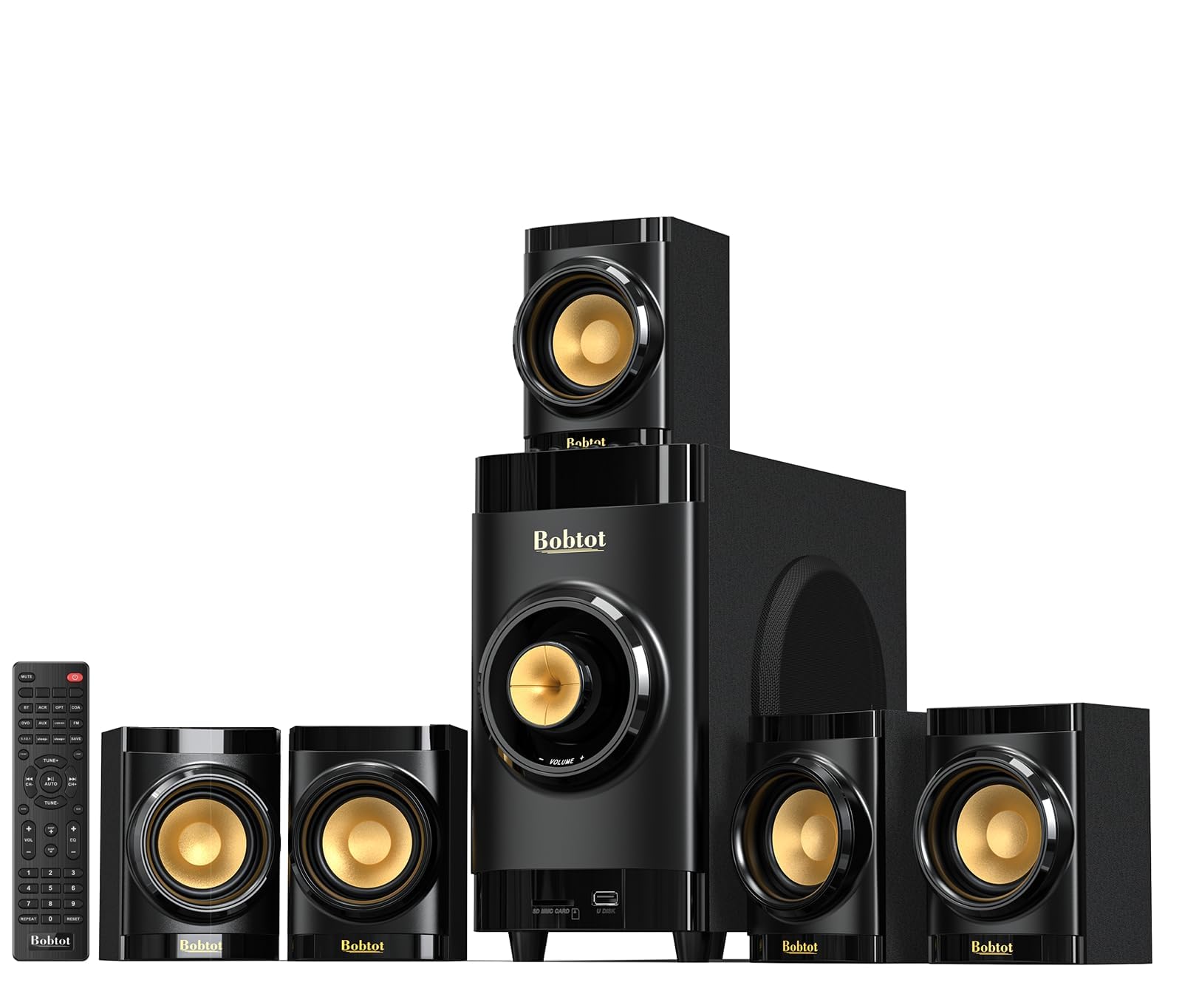
Everything wires into the subwoofer. The Bobtot's five speakers — center, two front, two rear — run on captive cables back to the box that houses the amplifier and the 4-inch sub, and that single fact explains what this system is good at and what it isn't.

What it's good at: a real five-channel layout for the least money here, in a room where a small sub is a feature rather than a compromise. The 4-inch subwoofer won't shake a floor, but it gives dialogue and effects a bottom end the TV can't, and the satellites stay clear on top. In a bedroom, a den, or a first apartment, that's the whole job.

The catch is geometry, and you can do the sums before you order. Wherever the sub goes, the five cables follow, and the rear pair only reaches so far — measure from the corner where the sub will sit to the back of the room, because there's no wireless option and no detaching the speakers from their leads. Inputs cover a TV and a phone through HDMI ARC, optical, coaxial, and Bluetooth, with the picture left to the TV. It's the least expensive honest 5.1 here, and in a small room with realistic expectations it earns its place.

Pros

  • Least expensive real 5.1 in this set
  • Compact satellites and sub suit small rooms
  • HDMI ARC, optical, coaxial, and Bluetooth inputs

Cons

  • All five speakers wire back to the subwoofer
  • 4-inch subwoofer is modest for a larger room
Our verdict

We recommend it as the cheapest way into real 5.1 here, for a small room where every speaker can wire back to the sub.

Check Latest Price

How We Tested the Best Home Theater Speaker Systems

We started with a shortlist of 32 systems and cut it down from the spec sheets: anything without HDMI eARC or ARC, without a dedicated center channel, or without Dolby Atmos or DTS:X decoding got dropped. We also sorted the wired kits from the wireless ones, since that's the choice most shoppers are actually making. Ten systems made the cut, and each one lived in a real room for nine months — a main living room, a basement with a projector, and a bedroom where the TV gets watched late at low volume.

My team set up every system alone, with a stopwatch running from the first box opened to the first sound out of the speakers. We counted how much speaker wire each wired kit demanded and how visible the runs were behind a couch, and noted whether wireless surrounds held their connection with a router and a microwave in the way. We paired two phones over Bluetooth, walked to the far end of the room to find where audio dropped out, and switched between a streaming stick and a game console to see how cleanly each system handled the handoff.

Then we just watched. Dialogue-heavy dramas at low volume, action scenes with the subwoofer doing real work, sports, playlists, and a lot of games — judged on whether the center channel kept voices anchored to the screen and whether Atmos effects moved around the room or simply got loud. Across nine months we logged every dropped wireless connection, every idle hiss, and every input that had to be reselected by hand. The systems below are the ones that stopped needing us to fix something.

How to Choose a Home Theater Speaker System

Decide on the Receiver First

Two very different products sit under the same label. A kit like the Yamaha YHT-4950U arrives with an AV receiver, which is the amplifier, the HDMI switcher, and the room calibration in one box. A package like the Klipsch Reference Theater Pack is speakers only, and you supply the receiver. The speaker-only route usually sounds better for the money and gives you a genuine upgrade path, but the receiver isn't free, and you'll want one with enough HDMI inputs for a console, a streamer, and whatever comes next.

Add both numbers before you compare. What looks like the cheaper speaker package stops looking cheaper once a receiver is in the cart, and the complete kit wins on simplicity every time.

How the Rears Get Behind You

Wireless surround is a spectrum, not a switch. A true wireless system, like the ULTIMEA Skywave X50, sends audio to the surrounds and the subwoofer over a radio link, so no cable crosses the room — but each surround still needs a power outlet. Then there's the compromise Sony uses on the BRAVIA Theater System 6: the rear speakers are wired to a small amp box that talks to the bar wirelessly, so you get a short cable to each speaker and one outlet behind the sofa instead of a run across the floor.

Count outlets before you choose, and remember that wired surrounds are the cheapest and the most reliable of the three. They still need a plan, though — which is what virtual surround modes, like the Yamaha's CINEMA FRONT, exist to work around when there's no wall behind you.

Match the Subwoofer to the Room

A big subwoofer in an apartment is a negotiation with the neighbors; a small one in a finished basement is a waste of a movie. Match the driver to the space. Small subs pressurize a bedroom or den perfectly well, and a large sub you have to keep turned down is money you didn't need to spend.

Where it sits matters as much as what it is. A corner reinforces bass, and a down-firing design is more forgiving of placement than a front-firing one. If the subwoofer is wired to the bar, as it is on the Sony, sort out the corner before you sort out the furniture.

What 5.1, 7.1, and 5.1.4 Actually Mean

The first number is the main channels and the subwoofer, so 5.1 is three speakers across the front, two behind you, and a sub. The .4 is height: four effects channels, either from dedicated up-firing speakers like the ones built into the Klipsch towers or from processing.

Watch the word virtual in a listing. Some bars use it for processing that fakes surround from stereo; others use it for processing layered on top of real surround speakers, which is what the ULTIMEA Poseidon D80 does. The question that settles it: does the box contain a speaker for each channel it claims? If it does, the processing is a bonus. If it doesn't, it's decoration.

HDMI, eARC, and Consoles

One cable is the goal: console into the bar, bar into the TV over eARC, TV remote handling the volume. That works beautifully until a format gets dropped in the passthrough. The ULTIMEA Skywave X50 passes 4K HDR but not variable refresh, which matters on a PS5 or an Xbox. A receiver-based system like the Yamaha's sidesteps the issue, since it has four inputs and you can send the console straight to the TV if something doesn't pass.

If you game, check the passthrough list against your console's output before you buy, and remember that eARC on the TV is the feature that makes any of this work.

Frequently Asked Questions

Final Verdict

Buy the Yamaha YHT-4950U if you want one order, one setup, and a receiver with four HDMI inputs and automatic calibration. It's the system we recommend to most people, and the one that leaves the door open to better speakers later.

If you already own a receiver, the Klipsch Reference Theater Pack buys you more dynamics for the same money. And if a cable to the back of the room isn't going to happen, the ULTIMEA Skywave X50 does 5.1.4 without one.