Best Lavalier Microphones of 2026

I stopped recording audio from across the room a few years ago and never went back. Clip a lavalier a few inches below someone's chin and the room falls away — the vent hum, the neighbor's dog, the echo off bare walls. The catch is that a wireless one also has to hold its connection, outlast the shoot, and not sound like a walkie-talkie. We've spent eight months clipping 12 of them to people.

Here's what first-time buyers get wrong: they shop the spec sheet. Range in meters and hours of battery look decisive, but a take is more often ruined by something smaller — a cable that doesn't fit the phone in your pocket, a clip that rattles against a shirt button, a noise-cancelling mode that eats your consonants. Compatibility matters more than any number printed on the box.

The picks below are the ones we kept reaching for, across phone shoots, camera rigs, and a helmet setup that genuinely surprised me.

1

Best Overall

Hollyland Lark M2

95 /100
LBD Score Outstanding

Key details

Battery
Up to 40 hrs with case
Receivers
Camera and USB-C
Audio Format
48 kHz/24-bit
Transmitter Weight
0.32 oz
View on Amazon

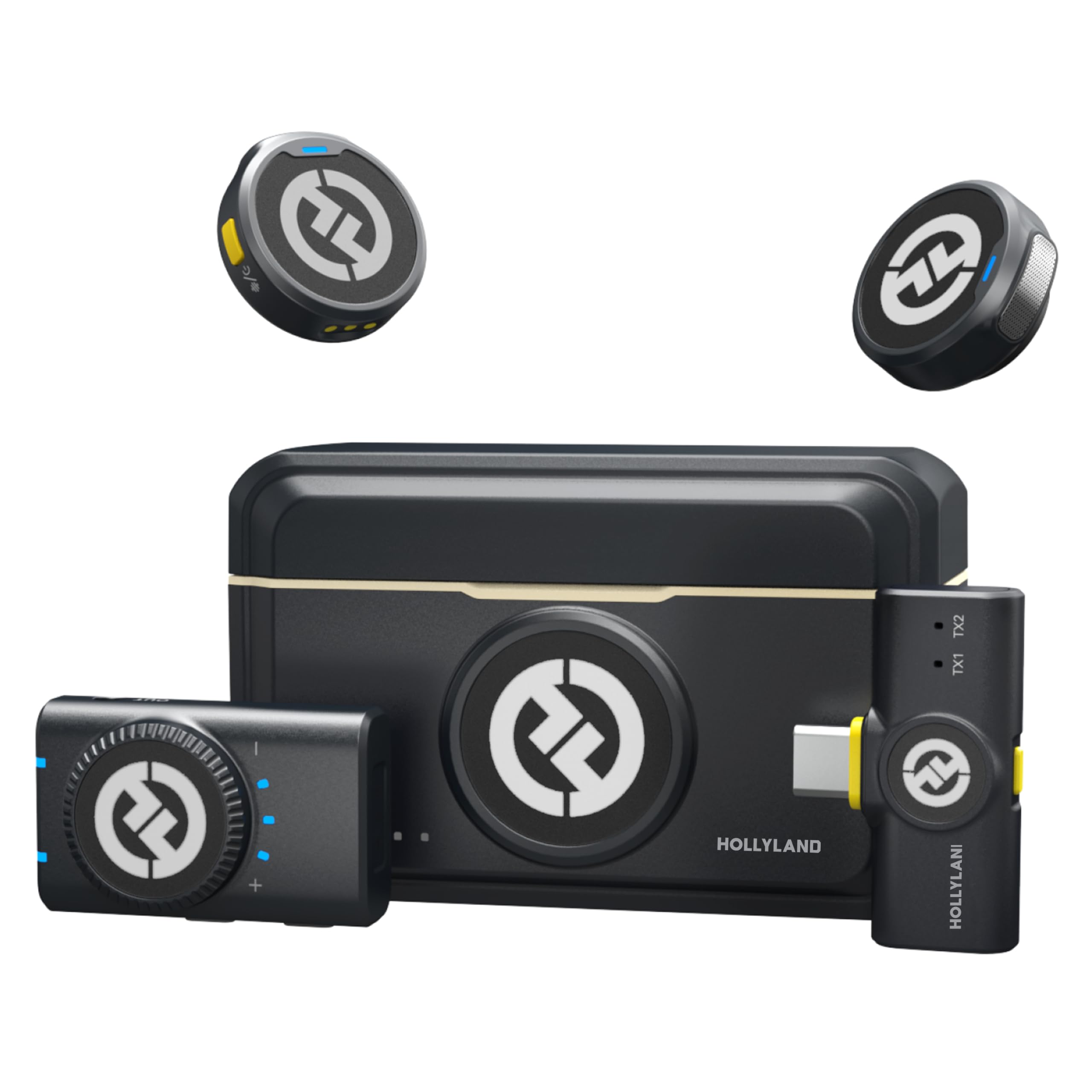
The transmitter is 9 grams, and the mounting is the part we didn't expect to care about. A magnet holds the mic against the inside of a shirt with a clip plate outside, so there's no bunching at the collar and no cable to hide — on a plain tee the whole thing disappears. The case carries a camera receiver and a separate USB-C receiver as well, which means one kit covers a phone shoot in the morning and a camera shoot in the afternoon without hunting for an adapter.

Sound is why it's our default. The system records at 48 kHz/24-bit with a 70 dB signal-to-noise ratio, and what came back was clean and unprocessed rather than flattened the way heavy noise cancellation can sound. One press of the yellow button on the transmitter toggles noise cancellation, and the camera receiver has its own switch for mono and stereo, so a two-person interview lands on separate channels without a menu. Hollyland rates each transmitter at 10 hours and the case at 40 hours in total.

That 40-hour figure is the case recharging the mics, not one endless charge — a single transmitter covers a shooting day on its own. In practice we drop both transmitters and both receivers into the case at the end of a shoot and stop thinking about it, which is the point of paying for a case rather than a pouch. Ours has lived in a jacket pocket for weeks at a stretch without a dead mic at the wrong moment.

Pros

  • Magnetic mount hides the mic under a shirt
  • Camera and USB-C receivers in one case
  • Clean 48 kHz/24-bit voice with no app
  • 40 hours of charging in the case

Cons

  • No Lightning receiver in this configuration
  • 10-hour rating assumes noise cancellation off
Our verdict

Our default because the whole kit lives in one case: two 9 g transmitters, a camera receiver and a USB-C receiver, and voice that needs no fixing afterward.

Check Latest Price
2

Best for DJI Camera Owners

DJI Mic Mini

93 /100
LBD Score Outstanding

Key details

Battery
Up to 48 hrs with case
Max Range
400 m
Receivers
USB-C and 3.5 mm camera
Transmitter Weight
0.35 oz
View on Amazon

Range and battery are where the Mic Mini pulls ahead of everything else here. DJI rates the transmitters at 400 metres and the charging case at a combined 48 hours — the biggest numbers in this set — and the transmitters weigh 10 g, within a couple of grams of the lightest kit we recommend. Instead of one noise cancellation switch there are two levels: Basic for a quiet room and Strong for a street.

It earns its place inside DJI's own ecosystem. A transmitter pairs directly with OsmoAudio devices, Pocket and Action cameras among them, at 48 kHz/24-bit with no receiver in the chain — one less box to mount, one less thing to charge. If your bag already holds a DJI camera, that's tidier than anything a third-party kit can offer, which is why this one lives beside the gimbal rather than in the general kit bag.

Phones are the part to test. The box includes a USB-C phone adapter and a 3.5 mm camera cable rather than a Lightning one, and some iPhone models can need the receiver in line plus a third-party app before the phone sees the mic. Insta360's X4 is the other device to check rather than assume. Record a clip on your exact handset before a shoot that matters; on USB-C Android phones it behaves.

Pros

  • Direct pairing with DJI cameras, no receiver
  • 400 m range and 48 hours with the case
  • 10 g transmitters with two noise-cancellation levels

Cons

  • USB-C adapter only
  • 48-hour rating counts the charging case
Our verdict

Buy it if your camera is a DJI: it pairs to Osmo gear without a receiver and runs for days, while phone shooters should test the adapter first.

Check Latest Price
3

Best for Paid Work

DJI Mic 2

93 /100
LBD Score Outstanding

Key details

Max Range
250 m (FCC)
Phone Adapters
USB-C and Lightning
Receiver Display
OLED with headphone output
Internal Recording
32-bit float, up to 14 hrs per transmitter
View on Amazon

Thirty-two-bit float internal recording is the reason this kit costs what it does. Each transmitter records on its own for up to 14 hours, so the audio exists in two places at once: on the mic and at the receiver. If a shout clips the receiver, the internal file still has the headroom to pull it back. For anyone whose second take costs money, that's the entire argument.

The rest is built for the same buyer. The receiver has an OLED display and a headphone output, so you can watch levels and hear what's being captured instead of hoping. DJI rates range at 250 metres and the signal-to-noise ratio at 85 dB, and the kit includes both USB-C and Lightning phone adapters plus a 3.5 mm cable for cameras.

One thing to schedule: a test run on your phone. iPhone pairing has been inconsistent, so record a clip on your exact handset before a paid job rather than trusting the first connection at the location.

For work where a lost take is expensive, the internal recording is the feature that decides it, and the display and headphone jack make the whole thing feel like a tool rather than an accessory. For a phone-first creator doing short reviews, the Mic Mini gets most of the way there with a simpler setup.

Pros

  • 32-bit float internal recording as a safety net
  • OLED receiver with headphone monitoring
  • USB-C and Lightning adapters included
  • 250 m rated range

Cons

  • Heaviest transmitters in this set
  • Most expensive kit here
Our verdict

Worth the premium when a reshoot isn't an option — each transmitter records 32-bit float internally, so a clipped take is recoverable.

Check Latest Price
4

Best Budget Kit

Hollyland Lark A1 Combo

92 /100
LBD Score Outstanding

Key details

Battery
Up to 42 hrs with case
Receivers
Lightning and USB-C
Audio Format
48 kHz/24-bit
Transmitter Weight
0.28 oz
View on Amazon

Two receivers ship in the case — one Lightning, one USB-C — alongside two 8 g transmitters. That's the practical answer for a household or a small team splitting an older iPhone, an Android phone, and a camera between them: nobody borrows a dongle, and the whole kit fits in one hand.

For the money, this is the kit we point budget buyers to. It records 48 kHz/24-bit, handles up to 120 dB of sound pressure without breaking up, and gives you three noise cancellation levels instead of one, plus three EQ voicings and three reverb sizes set on the transmitter. Six-step gain adjustment and an auto-limit guard cover the two things that ruin amateur audio: a voice that's too quiet, and a laugh that distorts.

Range is 200 metres, which matters only if you film someone walking away from you. The habit worth forming is a two-minute check the day it arrives: power on both transmitters, record a sentence into each, and confirm both wake up and pair. A dead transmitter is the one fault that would waste a shoot, and it's obvious immediately rather than three weeks in.

Pros

  • Lightning and USB-C receivers in the box
  • 8 g magnetic transmitters
  • Three noise-cancellation levels with EQ and reverb

Cons

  • Lightning receiver only serves older iPhones
  • Two receivers to keep track of
Our verdict

The budget kit we point mixed-device households to: Lightning and USB-C receivers in the box, 8 g transmitters, and controls that go beyond on and off.

Check Latest Price
5

Best Wired Lav

Rode Lavalier GO

93 /100
LBD Score Outstanding

Key details

Capsule
4.0 mm
Connector
3.5 mm TRS
In The Box
Clip, pop shield, pouch
Polar Pattern
Omnidirectional
View on Amazon

A four-millimetre capsule is the whole pitch. The Lavalier GO is small enough to sit behind a shirt placket or under a lapel without a bulge, and it plugs into a 3.5 mm input rather than pairing with anything. For anyone who already owns a camera, a recorder, or a wireless transmitter, this is the simplest way to make the voice noticeably better than the built-in mic is doing.

Because the pickup pattern is omnidirectional, placement is forgiving: clipped slightly off-centre below the chin, it holds the voice even when the subject turns their head. A foam pop shield is in the box for plosives, and the clip has cable management built in — a small thing that stops the cable tugging at the capsule. Rode specs 20 Hz to 20 kHz and a 67 dB signal-to-noise ratio.

What it doesn't do is solve the rest of the chain. There's no gain control and no way to monitor, so the level is whatever your camera or transmitter hands you. And plugged into some third-party wireless transmitters, this capsule has picked up interference, so test the combination at home rather than on location.

Pros

  • 4 mm capsule stays out of sight
  • Omnidirectional pickup forgives placement
  • Pop shield and cable-managing clip included

Cons

  • Wired, so the subject stays tethered
  • No gain or level control of its own
Our verdict

The simplest way to upgrade voice on gear you already own — a 4 mm capsule that plugs into a camera, recorder, or wireless transmitter.

Check Latest Price
6

Phone-First Creators

PQRQP 3-in-1 Wireless Mic

91 /100
LBD Score Outstanding

Key details

Battery
Up to 10 hrs per transmitter
Receiver
Lightning, USB-C, and camera
Max Range
328 ft
Audio Format
48 kHz/24-bit
View on Amazon

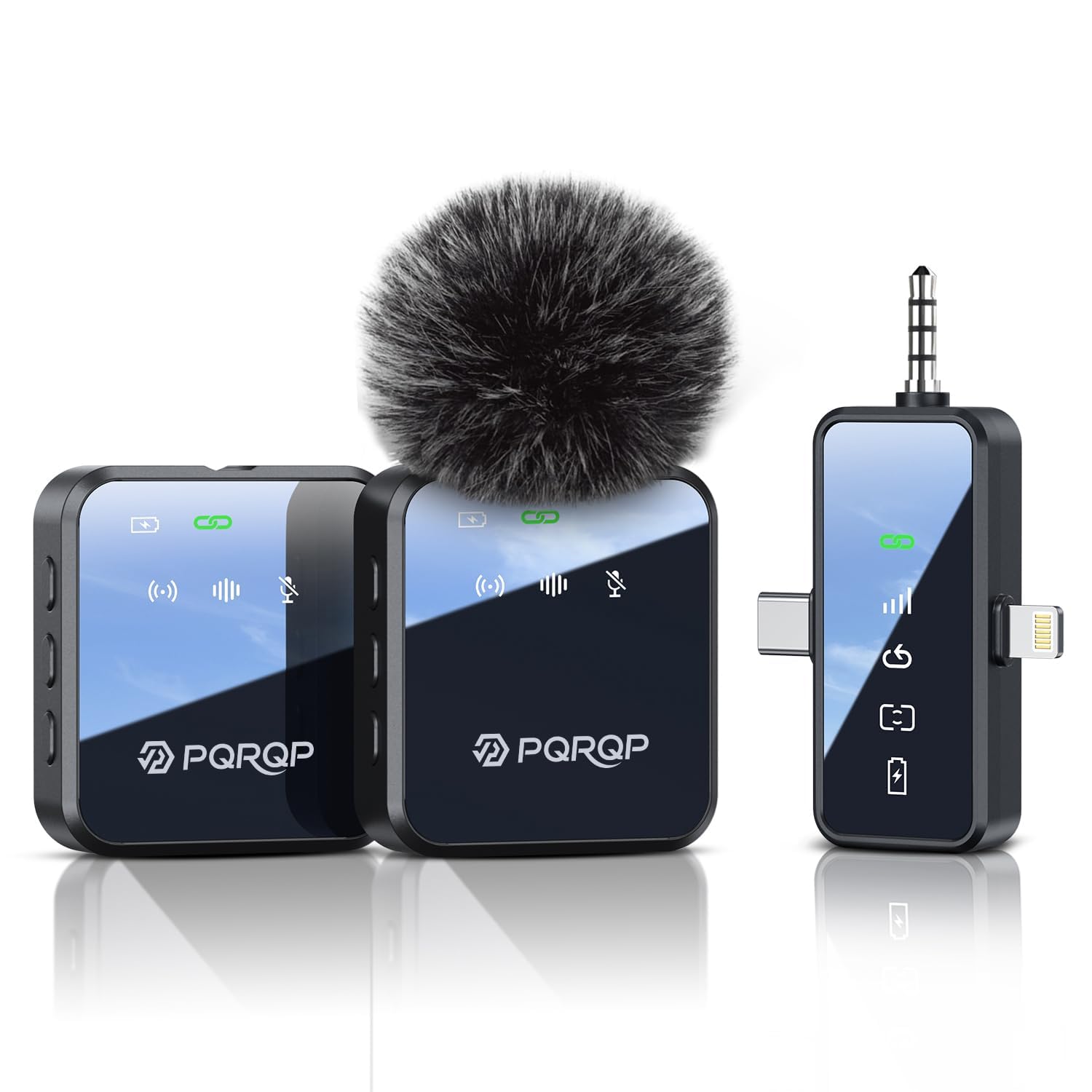
One receiver covers Lightning, USB-C, and a camera's 3.5 mm input, which is a strange amount of coverage for a kit this cheap. If you shoot on a phone one week and a borrowed camera the next, that single dongle is the reason to look here.

The specs read well: 48 kHz/24-bit audio, a 328 ft connection, and around 10 hours per transmitter. There's a one-touch mute on the mic and a reverb setting, which is more fun than useful until you're narrating and want a little room around the voice. The clips hold firmly and everything drops into the included bag.

This is the kit we hand to someone making shorts and reels who doesn't want to think about audio. Voices come through clean and forward, and the noise cancellation is strong enough for a busy street without making anyone sound like a robot. It won't flatter a treated-room interview the way the Lark M2 does, but nothing else here is this easy to hand to a beginner.

Pros

  • One receiver for Lightning, USB-C, and camera
  • 48 kHz/24-bit audio at a budget price
  • One-touch mute and reverb on the mic
  • Around 10 hours per transmitter

Cons

  • Storage bag instead of a charging case
Our verdict

One receiver covers Lightning, USB-C, and a camera input, with two transmitters included — our pick for phone-first publishing on a budget.

Check Latest Price
7

Action Camera Rigs

Purple Panda Lavalier

89 /100
LBD Score Excellent

Key details

Cable
4.9 ft plus 9.8 ft extension
Power
No battery needed
Connector
3.5 mm TRS/TRRS
In The Box
Fuzzy windscreen, foam guard, two clips
View on Amazon

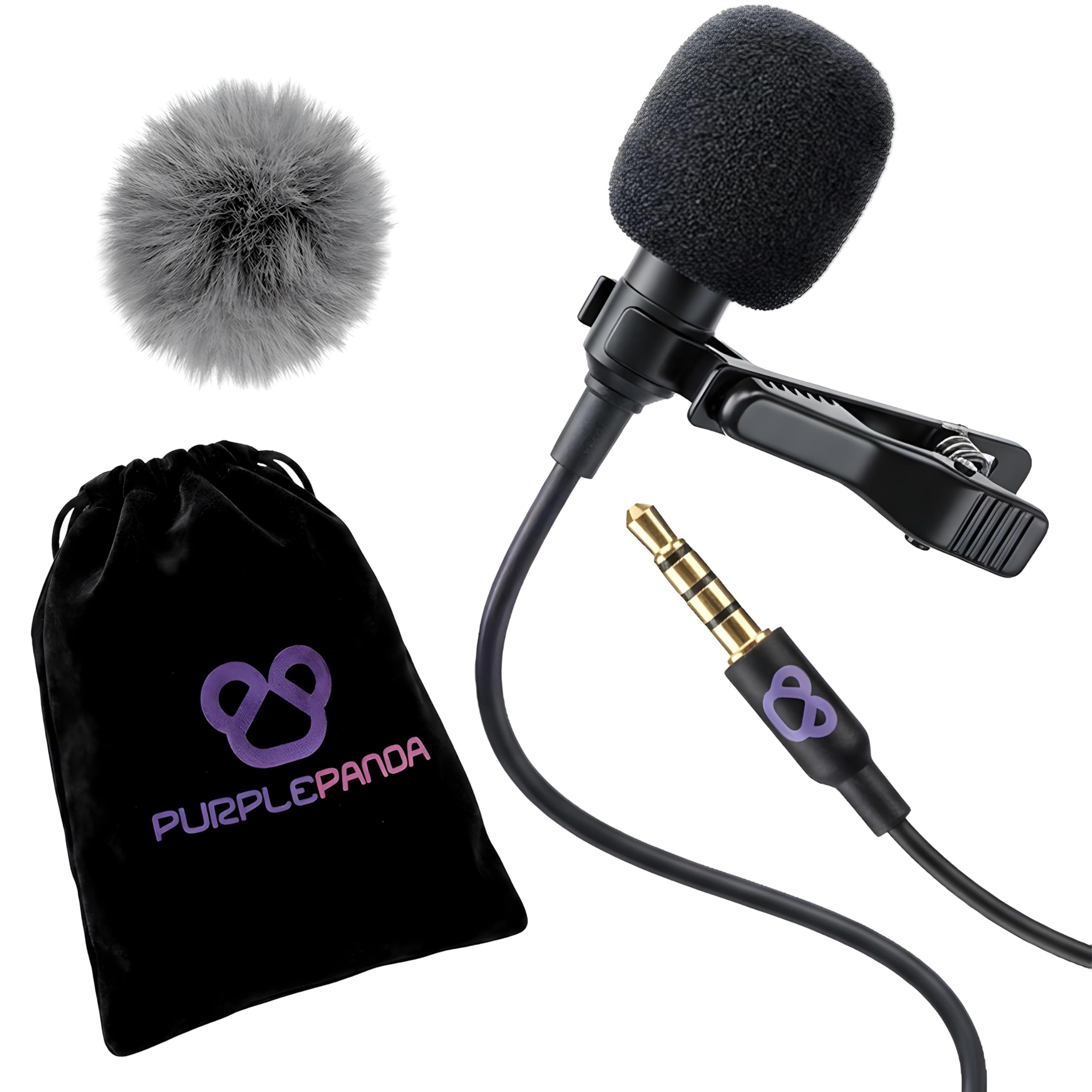
Cable is the feature: 4.9 ft at the mic plus a 9.8 ft extension in the box, enough to run from a helmet or a jacket collar back to a camera on the bars without buying anything else. For motovlogging, that length is the difference between a usable rig and a tangle.

The rest is deliberately simple. It's an omnidirectional capsule with a 40 Hz to 16 kHz range, a fuzzy windscreen and a foam guard for wind, two clips, and no battery to charge. The mic terminates in a TRRS plug with a TRS adapter included, so it can go into a phone adapter, a camera input, or a recorder.

This earns its place anywhere a wireless kit is a liability — a helmet, a handlebar, a wet ride where a transmitter is one more thing to lose. What it needs from you is the right adapter, since action cameras require the brand's own 3.5 mm adapter sold separately, and phones need a similar dongle. Listen for hiss too: with some recorders this capsule picks up a high-pitched buzz, so record a test clip on your setup before relying on it.

Pros

  • 9.8 ft extension included for long cable runs
  • No battery or pairing to manage
  • Windscreen and foam guard for open-air recording

Cons

  • Requires a separately sold adapter for action cameras
Our verdict

For helmet and handlebar rigs, the long extension and the absence of a battery make it the simplest wired answer — as long as you own the right adapter.

Check Latest Price

How We Tested the Best Lavalier Microphones

We started with research: comparing spec sheets across the connector types these kits ship with, checking what each box actually contained — transmitters, receivers, adapters, charging case — and setting aside anything that couldn't cover at least two of the four devices we record on. That left 12 microphones, which we used over eight months.

Most of the testing happened where these mics actually live. We clipped them to T-shirt collars in a home office with an HVAC vent overhead and a box fan running two feet away, and wore them through a two-person interview in a kitchen with the fridge humming. We listened for clothing rustle every time someone turned their head, and for whether the noise-cancelling modes swallowed consonants along with the room.

Then we made them work. A full-day livestream showed us when the low-battery warning hit; a walk across an open rooftop on a breezy afternoon tested wind handling and how far we could stray before the signal dropped; the wired options went into a motorcycle helmet. We plugged each receiver into a phone, a tablet, a camera, and a laptop to count how many adapters a shoot really required, unclipped and re-clipped each mount a few dozen times, and packed everything back into its case to see what survived a bag. At the end, we tallied what came in the box against the price, since several kits quietly require a separate adapter to work with the phone you already own.

How to Choose a Lavalier Microphone

Wireless freedom or a cable you can trust

Wireless kits solve movement: the subject can cross a room, and two transmitters let you record two people on separate channels. Wired lavs solve everything else — no charging, no pairing, no dropout — at the cost of a tether, which is why they still win for seated interviews, desk recording, and helmet rigs.

If you already own a camera with a 3.5 mm input or a wireless transmitter, a capsule like the Rode Lavalier GO lifts the voice more than a second wireless kit would. If the subject needs to move, budget for wireless and accept the charging routine.

Count the receivers before you buy

Connectors are where lavalier purchases go wrong. A USB-C receiver won't serve a Lightning iPhone, a phone receiver won't plug into a camera's mic input, and a 3.5 mm lav can't talk to a phone without an adapter. Count the devices you'll realistically record with, then count the receivers in the box.

The Hollyland Lark A1 Combo is the clean example: a Lightning receiver and a USB-C receiver ship with the same two transmitters. Single-receiver kits still work — the DJI Mic Mini covers USB-C phones and cameras — but a Lightning phone then needs its own adapter, and that is the purchase people forget.

Weight and mounting decide whether the mic disappears

Transmitters here run from 8 to 10 g, and at that weight the mount matters more than the number. A magnet lets you put the capsule inside a shirt with the plate outside, which hides it completely and avoids the collar dip a clip creates. A clip is more secure on a stiff collar, a jacket lapel, or a subject wearing a seatbelt.

If you shoot in knits and thin cotton, prioritize magnetic mounting; if you shoot executives in structured jackets, a clip is fine. Either way, add a furry windscreen outdoors — the foam ones handle breath, not wind.

Noise cancellation and the safety net

Noise cancellation on a lav is a filter, not a silent room. It lifts the voice above steady background noise, and pushed hard it can leave voices sounding processed or thin, so use the weakest setting that clears the room.

The more valuable feature for paid work is a safety net: auto-limiting that stops a sudden laugh from clipping, or internal recording that keeps a second copy. The DJI Mic 2 is the clearest case here — 32-bit float files live on the transmitter, so a clipped take can be rescued after the fact.

Read the battery and range numbers carefully

Big battery numbers usually include the charging case. A 40-hour kit is 40 hours of recharging, not 40 hours on one charge; a single transmitter is closer to a shooting day, and noise cancellation shortens that further.

Range figures assume a clear line of sight and shrink around walls and bodies, so treat 200 to 400 m as headroom rather than a promise. Charge the case after every shoot and buy the range you'll use — most interviews happen within ten feet.

Frequently Asked Questions

Final Verdict

Start with the Hollyland Lark M2 unless something specific rules it out. It's the one kit here that covers a USB-C phone and a camera from the same case, the 9 g transmitters vanish under a shirt, and the voice needs no fixing afterward.

Two requirements send people elsewhere. If you shoot on DJI gear and want the longest battery and range, the Mic Mini pairs without a receiver at all. If a lost take costs you money, pay for the Mic 2 and its 32-bit float internal recording.