Best Light Meters for Film Photography of 2026

The cheapest insurance in a film bag isn't a spare roll — it's a light meter. Every frame costs money twice: at the counter, and again when the scans come back thin because you guessed at the light in open shade. Sunny 16 gets you close until you're shooting backlit portraits or the twenty minutes after sunset. A meter turns the light in front of you into a shutter speed and aperture you can trust.

I've carried one for years, and over seven months my team and I shot with 10 different meters on rangefinders, a medium-format body, and a 35mm SLR that lives in a coat pocket. What nobody tells a first-time buyer: incident metering, dome pointed back toward the camera from your subject's position, is more consistent than reflective metering in high-contrast light. You'll also reach for a meter far more often if you can read it and set your camera without pulling it away from your eye, so the picks below run from pared-down and basic to more than I'll ever need.

1

Best Overall

Sekonic Flashmate L-308X

93 /100
LBD Score Outstanding

Key details

Weight
2.82 oz
Flash Range
f/1.0 to f/90.9 at ISO 100
Ambient Range
0 to 19.9 EV at ISO 100
Metering Types
Incident and reflected
View on Amazon

Every film exposure comes down to two readings: the light falling on your subject and the light bouncing off it. The Flashmate L-308X takes both. Slide the lumisphere across and it becomes an incident meter; slide it back and it reads reflected light through a 40-degree lens. That single switch is why it's our top pick here.

What settled it for us is how much it covers without asking for anything extra. Ambient metering runs from 0 to 19.9 EV at ISO 100, flash from f/1.0 to f/90.9 at ISO 100, and dedicated Cine and HD Cine modes handle frame rate and shutter angle if you also shoot motion. There's even a lux and foot-candle readout for scouting a location before you unpack a camera.

Where it stops is spot metering. The reflected reading is a 40-degree average, so if you work the Zone System with a large-format camera and want a one-degree read on a shadow across the street, this isn't your meter. For everything else, the incident dome is the reading that saves the frame, because a white shirt or a dark coat can't fool it the way it fools a camera's built-in meter.

What it doesn't do is talk to your camera. You set the ISO, take the reading, and transfer the pair to the lens yourself. That's the right division of labor for film: the meter's job is the light, and the exposure gets made at the camera's dials.

Pros

  • Incident and reflected metering from one sliding dome
  • Meters ambient and flash, with dedicated cine modes
  • 2.82 ounces, small enough for a shirt pocket
  • Wide 0 to 19.9 EV ambient range at ISO 100

Cons

  • No spot metering for Zone System work
  • Runs on AA cells rather than USB-C charging
Our verdict

One meter for incident and reflected light, ambient and flash, in a body light enough to forget — this is the pick we recommend to most film shooters.
Check Latest Price
2

Best Budget

LightMate AirPro

85 /100
LBD Score Excellent

Key details

Weight
5.3 oz
Metering
35° reflected
ISO Range
ISO 1 to 3200
Shooting Modes
A, S, M and EV
View on Amazon

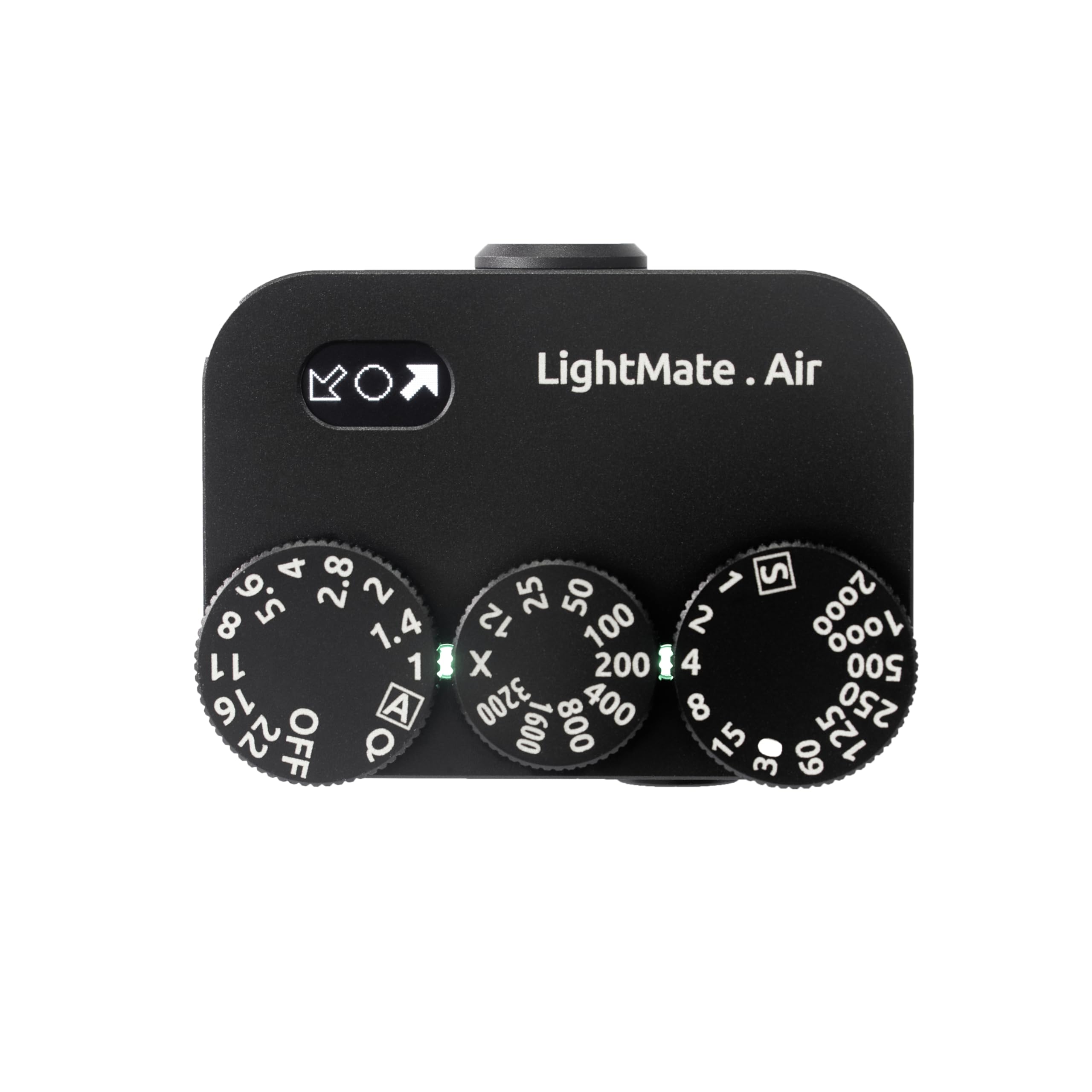
The AirPro reads reflected light only, through a wide 35-degree window, and that one fact should decide whether you keep reading. Point it down a sunlit street and you have an exposure in a second. Point it at a backlit portrait and it will average the sky into your subject's face. For a street or travel shooter, that trade is easy to make.

Three independent dials — aperture, ISO, and shutter speed — click through half stops with audible feedback, so you can build a whole exposure without a menu. That's the part we kept appreciating: ISO 1 to 3200 on a dial is a different experience from scrolling a number on a screen, and half-stop clicks line up with what most older lenses can actually set. Aperture-priority, shutter-priority, manual, and EV modes are all there.

Manual mode offers more than ten exposure indicator styles, including dual LED cardinal points, and you can color them to taste. That's more customization than most film shooters will want — we picked one and stopped — but it means the display can show what matters at a glance. It's rated to plus or minus 0.1 EV, and the half-stop click is the part you'll actually feel in your hand.

The metal shell is the surprise: this feels like equipment rather than an accessory, and a black body with three dials sits comfortably next to a rangefinder or an old SLR. It's the least expensive meter here by a wide margin, and the one we hand to someone who wants modern metering with old-fashioned controls.

Pros

  • Three dials that click through half stops
  • ISO 1 to 3200 covers slow film stocks
  • Full metal body at the lowest price here
  • A, S, M and EV modes with customizable indicators

Cons

  • Reflected light only, with no incident dome
  • Reads a 35° average, so no distant spot readings
Our verdict

Buy it if you meter reflected light and want three real dials and a metal body for the least money here; anyone who needs an incident dome should look elsewhere.

Check Latest Price
3

Best Battery-Free

Sekonic Studio Deluxe III

88 /100
LBD Score Excellent

Key details

Power
Battery-free photocell
Weight
11.2 oz
Readout
Analog calculator dial
Metering Types
Incident and reflected
View on Amazon

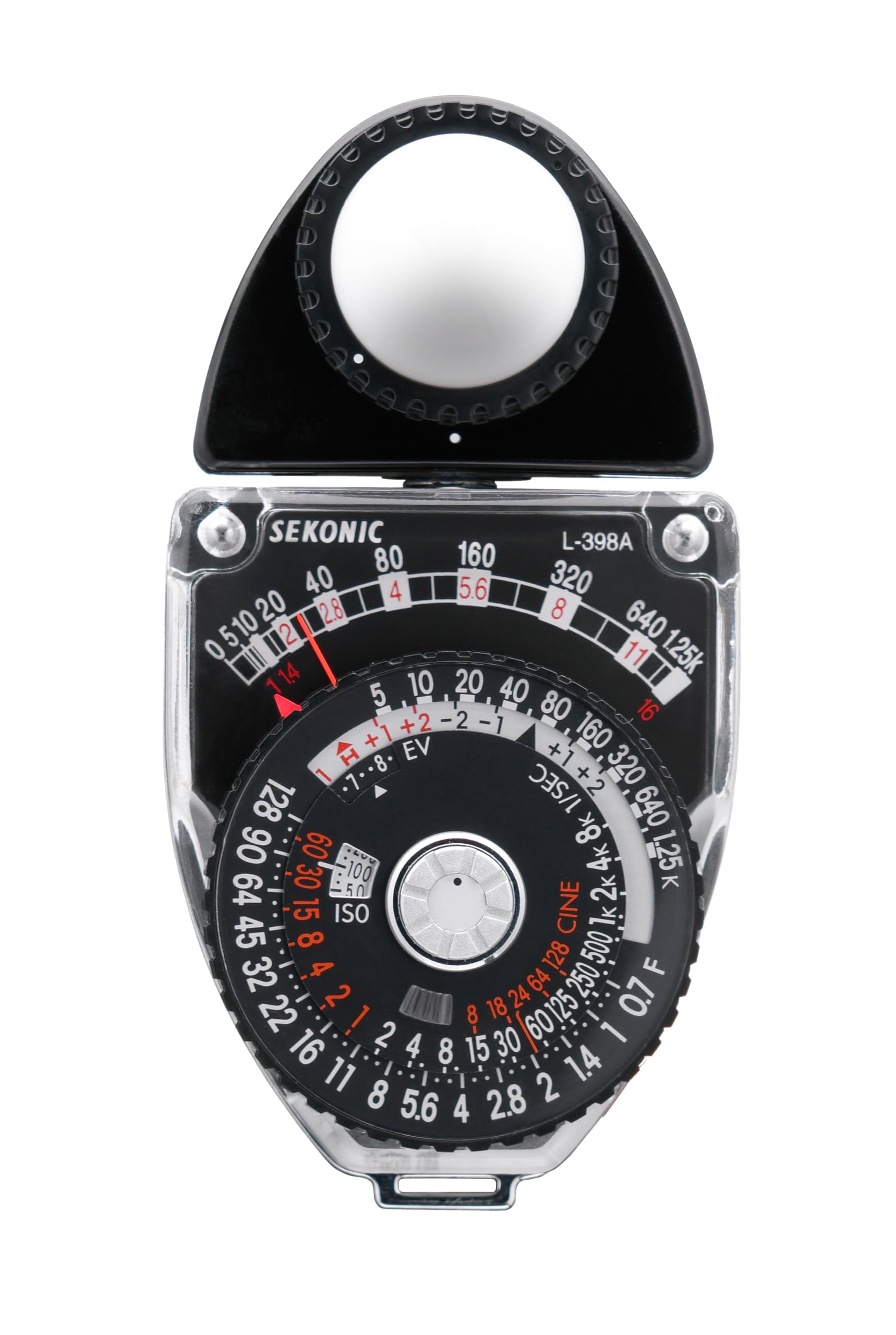
There is no battery in the Studio Deluxe III. Its amorphous photocell generates the power it needs from the light it's measuring, so the meter is ready the moment you pick it up, however long it's been sitting in a drawer. If you shoot a 1950s rangefinder whose selenium cell died decades ago, that isn't a novelty — it's the whole reason to own one.

The dial is the other half of the argument. Instead of one recommended shutter and aperture pair, the calculator dial lays out the full spread at once, so you can see exactly what opening up a stop costs in depth of field without re-metering. If you're learning to see light rather than just find an exposure, that's the lesson a first meter should teach, and this one teaches it every time you turn the ring.

The head swivels, so you can hold the dome where the light is and still read the dial without turning the meter around. Incident readings use the lumisphere; reflected ones need the lumigrid swapped in first, which is a step you'll do with cold fingers more than once. Lumisphere, lumidisc, and lumigrid come in the box, along with a high slide, strap, and case.

It is slow in the way a mechanical camera is slow, and if that's why you shoot film, the dial will feel natural within a roll. Chase light that changes by the second and a digital readout serves you better — never needing a battery costs a little patience, and that's the trade.

Pros

  • Battery-free photocell, ready whenever you pick it up
  • Dial shows every aperture and shutter pair at once
  • Swivel head keeps the dome in place while you read
  • Lumisphere, lumidisc, lumigrid and case included

Cons

  • Ambient light only, with no flash metering
  • Heaviest meter in this group at 11.2 ounces
Our verdict

Our pick for a camera with no meter and no patience for batteries: the analog dial shows every aperture and shutter pair at once.

Check Latest Price

How We Tested Light Meters for Film

We started with every current meter sold to film shooters. I read the manuals first, then cut anything that hid the reading behind a menu, anything that needed a phone to be useful in the field, and anything I couldn't imagine carrying in a jacket pocket. Ten meters made the cut, and we shot with them for seven months.

Over those seven months they went everywhere I went: a shaded porch at noon, a coffee shop window at f/2, a windy overlook twenty minutes before sunset, and a week of gray coastal fog. Each time out I took a reference reading, then read every other meter at the same spot and wrote down the pair, counting the disagreement in stops. Where a meter did both, I also metered the scene incident off the dome and reflected off a mid-tone to see how far the two landed apart. Meters that sat half a stop off on a bright day showed it in my negatives; anything a full stop out got rechecked.

Accuracy is only half of it. I handed each meter to a friend who had never used one and timed how long it took her to get a usable reading, since basic operation is the whole reason to carry one. I also set aperture and shutter with the meter at chest height, in gloves, in flat sun — dials that needed a second look got marked down. Battery-free cells spent a night in a cold car and were checked for drift at dawn; rechargeable meters had to survive a full shooting day. Then each one rode in a pocket with keys and got knocked off a picnic table onto pavement, and we noted which dials loosened, which markings wore, and which still read true.

How to Choose a Light Meter for Film Photography

Start With the Metering You Can Perform

An incident dome reads the light falling on your subject from the subject's position, and it cannot be fooled by a white shirt, a dark coat, or a bright sky behind a head. A reflected meter reads from where you stand, which is convenient for street work and wrong more often, because it averages whatever fills its angle — 35 to 40 degrees on the meters here. Spot metering reads a narrow circle at a distance and costs the most.

If you shoot slide film or portraits, prioritize the dome. On negative film in daylight, a reflected reading is usually close enough. Buy for the reading you cannot currently take, not for the one your camera already does.

Match the Meter to the Camera You Carry

An eleven-ounce meter and a three-ounce meter are the same tool in the shop and different tools by the third hour of walking. The heavy one stays in the bag; the light one ends up in a pocket beside a spare roll.

One trap worth naming: compact describes plenty of meters that fit a glovebox rather than a shirt pocket, so check the weight instead of trusting the word. If you want the meter to ride on the camera, confirm a mounting plate is supplied, because most meters do not include one.

Decide Between a Dial and a Display

An analog calculator dial puts every aperture and shutter pair in front of you at once, so you see the trade rather than a verdict, and it works without a battery in any temperature. A digital meter hands you one pair, chosen quickly, and is easier to read at dusk.

We lean toward the dial for learning and the display for volume. Forty frames of a moving subject is no place to be spinning a calculator ring.

Settle the Power Question Before You Pack

Three options, three habits. A battery-free photocell never needs a spare, which suits a camera with no battery of its own and a meter that lives in a drawer for months. A meter running on AA cells wants a spare in the bag. A rechargeable one trades that spare for a USB-C cable and a wall outlet at the end of the day.

None of these is better in the abstract. Pick the failure mode you can live with on the trip you actually take.

Pay for Flash Only If You Fire Strobes

Flash metering is the line between a general meter and a studio one. The Flashmate L-308X reads flash from f/1.0 to f/90.9 at ISO 100 alongside ambient light; the Studio Deluxe III is ambient only. For a film portrait session under strobes, an ambient-only meter leaves you guessing at ratios and falloff.

If your film work is daylight and available light, skip the feature and put the difference into film or a better lens.

Frequently Asked Questions

Final Verdict

The Sekonic Flashmate L-308X is the meter we recommend, because it answers the question that stops most film shooters at the start: which light can this thing read? Incident or reflected, ambient or flash, it covers all four in a body that slips into a shirt pocket, and the sliding lumisphere switches between the two readings without a menu.

Choose the LightMate AirPro if you never take an incident reading and want metal, dials, and the smallest outlay here. Choose the Studio Deluxe III if the meter will sit beside a camera that has no meter at all and you want a dial that never needs a battery. Whatever you carry, take a mid-tone reading the same way at the start of each roll; consistency teaches you more than any single reading.