Best Light Pollution Filters for City Astrophotography of 2026

A light pollution filter doesn't erase light pollution — it subtracts the wavelengths streetlights throw into the sky and passes the rest. That's why the same filter can be a revelation on one target and a muddy green smudge on another. When the match is right, the Orion Nebula lifts off an orange sky; when it isn't, you've paid for a dimmer view with a color cast.

I shoot under a Bortle 8 sky, so I've made my share of those mistakes. Over six months, my team and I put 11 filters in front of the same camera under the same bad sky, and the gap between well-coated glass and a cheap one shows up fast: flare around bright stars, coating smudges, and stars that lose their color once you stack. One word of advice — match the mount before you match the marketing. These come as 1.25-inch eyepiece barrels, 2-inch diagonals, and camera threads, and they don't interchange.

Narrowband cuts deeper into city glow; broadband keeps more of the natural scene. Below are the ones worth your money.

1

Best Overall

Optolong L-eNhance 2-inch

89 /100
LBD Score Excellent

Key details

Coating
Multiple anti-reflective coatings
Filter Type
Dual narrowband (H-alpha and H-beta/O-III)
Thread Size
2-inch (48mm)
Camera Compatibility
Color CMOS, CCD, and DSLR cameras with 2-inch thread
View on Amazon

The Optolong L-eNhance is the filter we recommend first when the target is an emission nebula and the sky is doing its best to wash it out. Its dual narrowband design passes the H-alpha, H-beta, and O-III lines that nebulae emit while suppressing a large share of the sodium and mercury glow that city lighting throws at the sensor. That is a different job from making the whole night sky look darker, and it is the job most urban deep-sky imagers actually need.

We like the 2-inch threaded mount because it seats directly on the camera side of a telescope with a standard 48mm connection; the multi-layer coatings also help keep reflections down when a bright star sits near the frame. For a color CMOS, CCD, or DSLR setup, the filter is built to pull nebula signal out of a bright background without turning the exposure into a monochrome silhouette. It is not a magic eraser: stars still shrink, and the color balance needs work in processing.

The limitation is target choice. Galaxies, reflection nebulae, and broad star fields emit across the spectrum, so a narrowband filter dims them along with the sky. We also do not treat it as a first filter for wide-field Milky Way shots; a camera-lens filter is the better tool there. But for the city nebula imager with a 2-inch camera connection, this is the most targeted filter in this set. It is a specialist, and it rewards being used as one.

Pros

  • Strong H-alpha, H-beta, and O-III transmission
  • Suppresses sodium and mercury city glow
  • Standard 2-inch thread for astronomy cameras
  • Multi-layer coatings reduce reflections

Cons

  • Narrowband design dims galaxies and reflection nebulae
  • Requires a 2-inch camera or telescope thread
Our verdict

If you photograph emission nebulae through a 2-inch telescope and color camera, the L-eNhance is the filter we recommend first.
Check Latest Price
2

Best for Camera Lenses

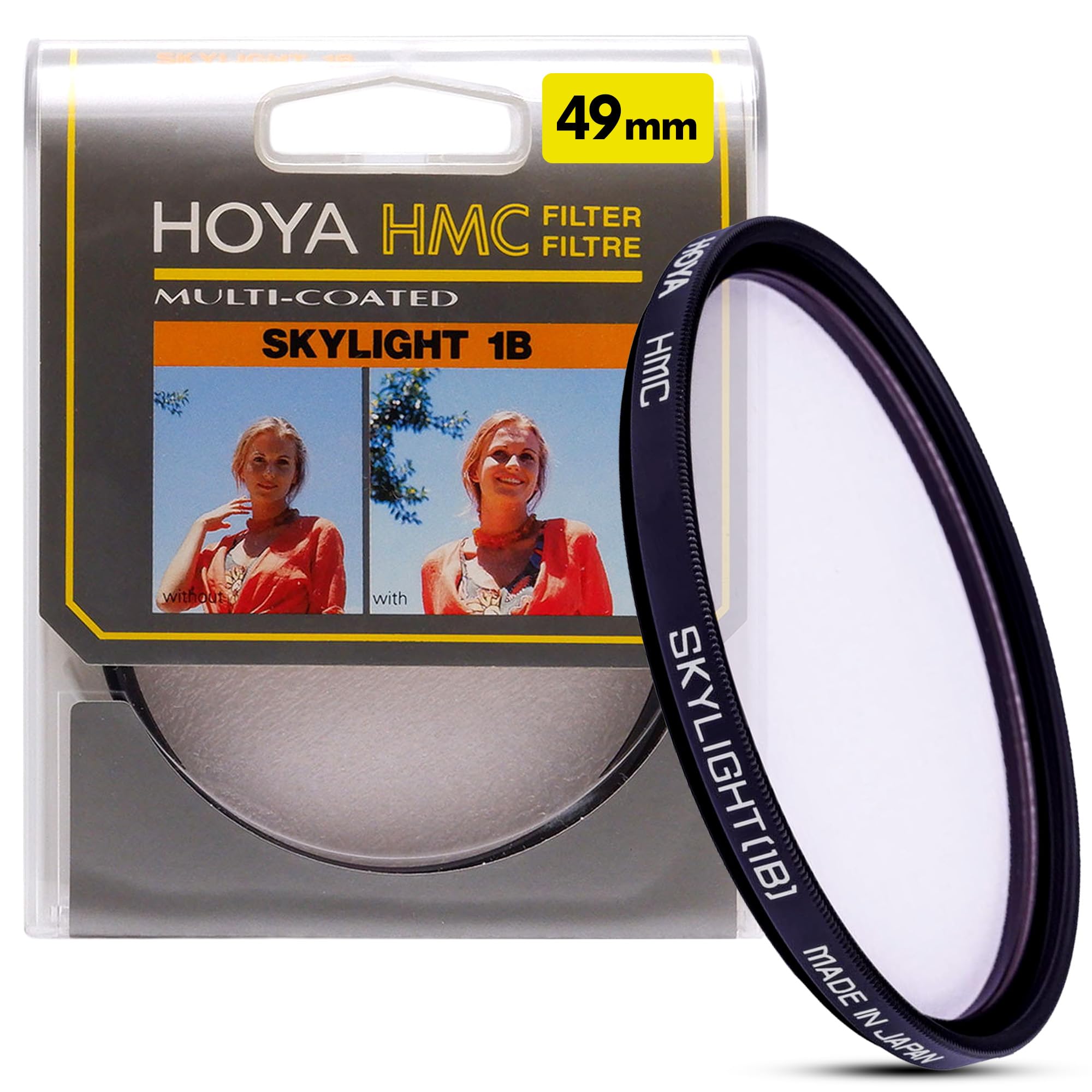
HOYA Starscape 49mm

92 /100
LBD Score Outstanding

Key details

Frame
Slim aluminum ring
Filter Type
Didymium light-pollution filter
Thread Size
49mm
Light Transmission
97%+
View on Amazon

The Hoya Starscape is the filter we put on a camera lens, not a telescope. It is a 49mm screw-in didymium filter designed to cut the yellow-orange wavelengths from sodium and mercury vapor lights while leaving more of the star field intact than a deep-sky narrowband filter. For wide-field Milky Way work, that balance is the point: you want cleaner contrast without turning the scene into a false-color nebula portrait.

We were pleased by how much the slim aluminum ring stays out of the way on a wide lens; the low-profile frame is there to reduce vignetting, and the 97%+ transmission claim is paired with multi-layer coatings that help control flare. The effect is subtler than a dedicated nebula filter, which is exactly why we prefer it for landscape astrophotography. It improves the separation between stars and sky while keeping the foreground and star colors closer to natural.

The catch is the thread size. This is a 49mm filter, so it only fits lenses with a 49mm front thread; step-up rings can bridge the gap, but they add another surface and another place for flare. It also will not rescue a nebula the way a dual narrowband filter can. We treat it as a specialty tool for wide-field nightscapes, not an all-purpose city filter.

Pros

  • Cuts sodium and mercury vapor glow
  • Keeps star and foreground color more natural
  • Slim ring reduces vignetting on wide lenses
  • 97%+ transmission with multi-layer coating

Cons

  • Fits only 49mm lens threads without adapters
  • Not a deep-sky nebula filter
Our verdict

For wide-field Milky Way shots with a 49mm lens, the Hoya Starscape is the camera-lens filter we recommend first.

Check Latest Price
3

Best Budget Telescope Filter

SVBONY CLS 1.25-inch

86 /100
LBD Score Excellent

Key details

Filter Type
CLS broadband
Thread Size
1.25-inch (28.5mm)
Nebula Transmission
90%
Off-band Transmission
0.1%
View on Amazon

SVBONY's CLS filter is the cheapest way in this set to try broadband light-pollution suppression on a 1.25-inch telescope, and that is a useful thing to be. The 1.25-inch barrel threads onto a standard eyepiece or camera nosepiece, and the glass is coated to pass about 90% of the main nebula emission lines while holding off-band transmission down to roughly 0.1%.

We appreciate the aluminum frame and the clear labeling; it is easy to tell which side goes toward the telescope, and the filter seats without wobble in a standard 1.25-inch adapter. The CLS design blocks the sodium and mercury lines that make up a lot of older city glow, so the sky background drops and faint nebulae gain contrast. For a color CCD or an unmodified DSLR, that can make the difference between a washed-out frame and one you can actually process.

We wish the format were larger. A 1.25-inch filter sits close to the sensor and can vignette on bigger chips, and it needs a 1.25-inch nosepiece rather than a native camera mount. The other limit is the light itself: modern LED streetlights spread across the spectrum, so no broadband filter can erase them. This one is a budget entry, not a cure.

Pros

  • 90% transmission of main nebula lines
  • Blocks sodium and mercury emission lines
  • Standard 1.25-inch eyepiece thread
  • Low-cost entry into filtered imaging

Cons

  • 1.25-inch barrel can vignette larger sensors
  • Broadband design is less effective against LED light
Our verdict

If you image through a 1.25-inch focuser on a budget, the SVBONY CLS is the low-cost filter we point to first.

Check Latest Price
4

Best for 52Mm Lenses

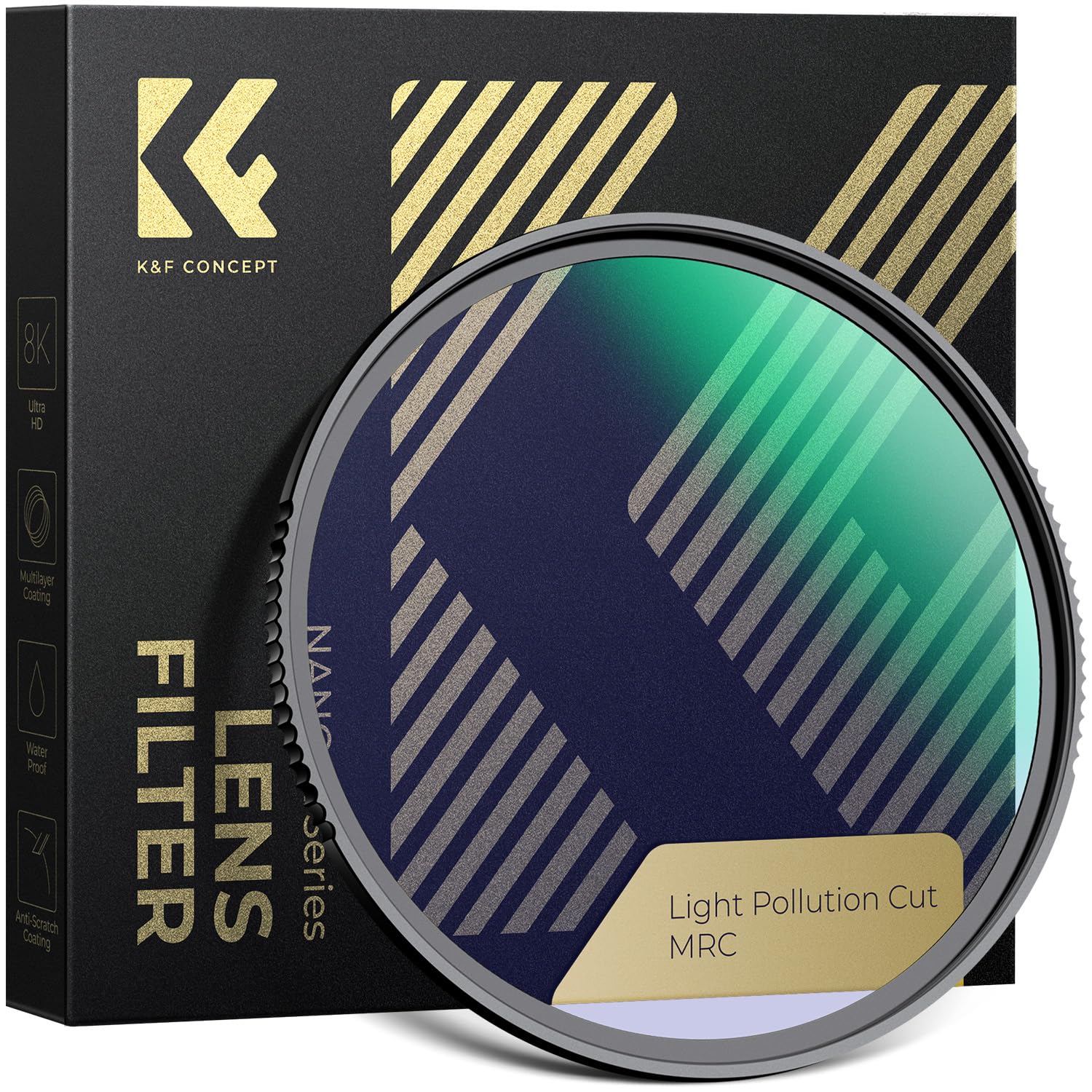
K&F Concept 52mm

90 /100
LBD Score Outstanding

Key details

Coatings
28 multi-layer
Frame Depth
0.15 inch
Thread Size
52mm
Water Resistance
Waterproof
View on Amazon

The K&F Concept Nano-X is the 52mm filter we suggest for a lens that already has a 52mm thread and a habit of catching streetlight flare. Its 0.15-inch frame is deliberately thin, so it is less likely to vignette on a wide-angle lens, and the 28-layer coating is there to resist water, oil, and scratches as much as to reduce reflections.

We found the light-pollution effect is gentler than a telescope filter's: it takes the yellow edge off city glow and helps stars sit more clearly against the sky, but it does not turn a Bortle 7 backyard into a dark-sky site. That is the right expectation for a camera-lens filter. We also like that it doubles as front-element protection, which makes it easier to leave on for a night walk.

One caveat belongs before a big shoot: the glass can arrive less than perfectly clear, and a few copies have left smears or marks on images. Inspect it under a bright light and test a frame before you commit; a clean copy is a useful, slim filter, but the copy matters.

Pros

  • Slim 0.15-inch frame reduces vignetting
  • Cuts yellow city glow
  • 28-layer coating resists water and oil
  • Protects the front element

Cons

  • Fits only 52mm lens threads
Our verdict

For a 52mm lens and a tight budget, the K&F Concept is a sensible night-sky filter, provided you check the glass on arrival.

Check Latest Price
5

Visual Nebula Viewing

Astromania UHC 1.25-inch

84 /100
LBD Score Excellent

Key details

Coating
Anti-reflection coatings
Filter Type
UHC
Thread Size
1.25-inch (31.75mm)
Frame Material
Aluminum
View on Amazon

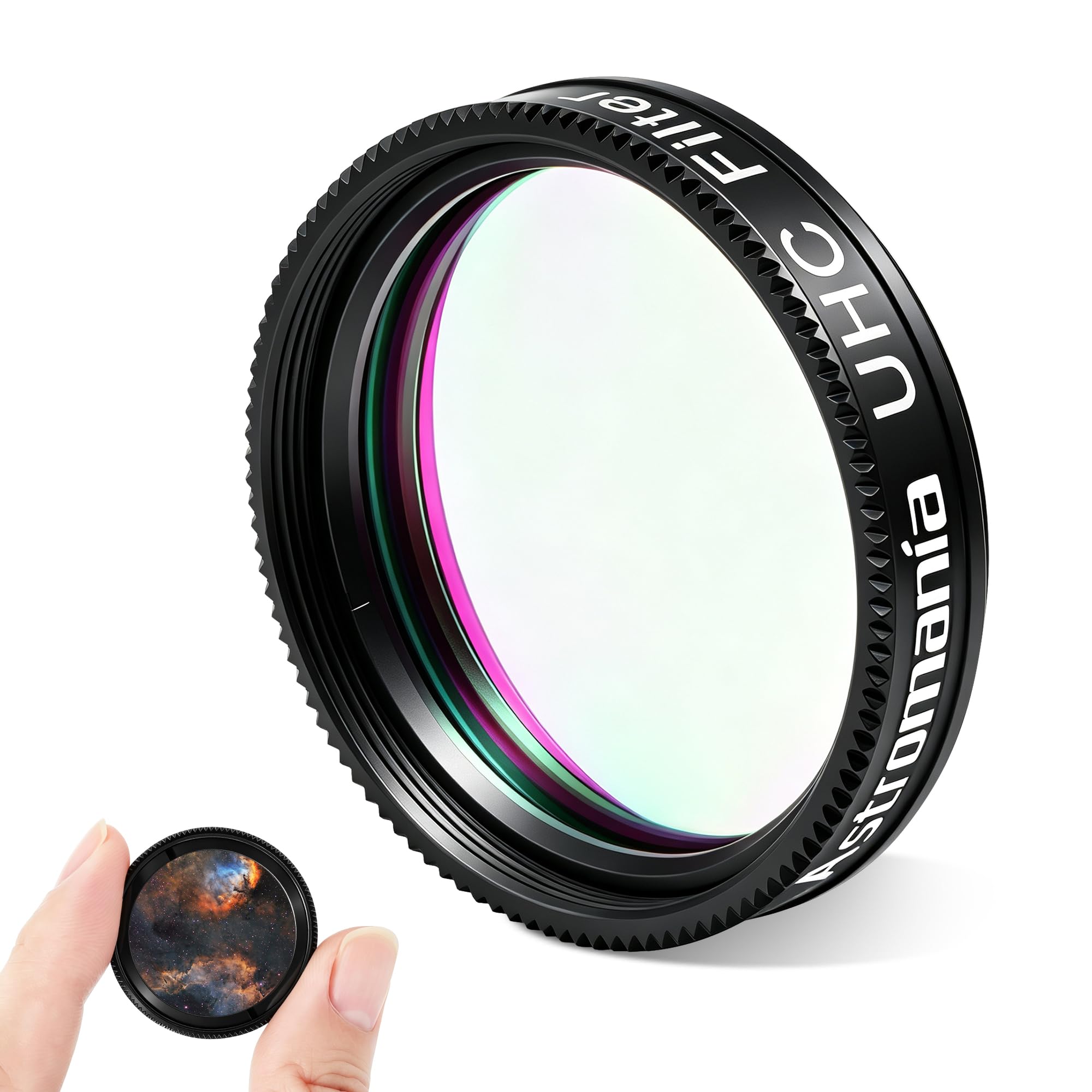
Astromania's 1.25-inch UHC filter is the familiar budget answer for someone who wants to see nebulae from a city backyard. It screws into a standard 1.25-inch eyepiece, uses an aluminum frame and coated optical glass, and is priced at the low end of this group.

We suggest it for visual observing first. On bright emission nebulae, the UHC bandpass cuts artificial light and lifts contrast, and the effect is easy to see even without a camera. We noticed the trade-off in the same view: the whole field gets dimmer, and stars can pick up a blue or purple tint. That is normal for an aggressive filter, but it is worth knowing before you point it at a faint target.

The Astromania is not the filter we choose for serious camera work. It has no camera-specific mounting beyond the 1.25-inch barrel, and the image quality is uneven enough that we treat it as a visual and casual afocal tool. If you already have a 1.25-inch focuser and want a cheap way to see whether filtered viewing suits you, it earns a place; if you are building a deep-sky imaging rig, look elsewhere.

Pros

  • Low-cost UHC for visual nebula viewing
  • Standard 1.25-inch eyepiece thread
  • Aluminum frame and coated optical glass
  • Boosts contrast on bright nebulae

Cons

  • Dims the whole field
  • Can tint stars blue or purple
  • Not suited to serious camera imaging
Our verdict

If your goal is visual nebula hunting from a light-polluted backyard, the Astromania UHC is the budget pick we suggest.

Check Latest Price

How We Tested Light Pollution Filters Under a Bortle 8 Sky

We started with a couple dozen listings and dropped anything that didn't state coating type or transmission, then sorted by mount: 1.25-inch eyepiece barrels, 2-inch diagonals, and 49mm and 52mm camera threads. A filter you can't thread onto your rig is a filter you can't test, and the remaining 11 all got the same six months.

Most nights we were on a backyard deck under a Bortle 8 sky, with a rooftop and a darker site an hour out for comparison. Using one camera and identical exposures, we shot the Orion Nebula, the Pleiades, Andromeda, and the North America Nebula with each filter and without, then noted how much sky glow dropped away, whether the nebula's faint edges actually appeared, and whether the frame came back neutral or tinted green, blue, or magenta. We also ran each one visually through a small refractor and a reflector, watching how much contrast the Orion Nebula picked up at the eyepiece.

At the bench, we pointed every filter at a white wall lit by mixed sodium and LED streetlights to check color cast, then angled a bright lamp across the front element to see how much flare came back. Each one got handled with fingertips and cleaned with a microfiber cloth, which showed us which coatings smeared and which wiped clean. We threaded them on and off in the dark, counting cross-threads and listening for glass rattling loose in the aluminum ring.

Build quality and price don't track the way you'd expect — a couple of the least expensive filters had the cleanest machining, and one pricier one arrived with coating imperfections. What separated the winners was how little they changed the color of the stars while still cutting the glow.

How to Choose a Light Pollution Filter for City Astrophotography

Start With the Target, Not the Filter Name

A light pollution filter is a wavelength tool, so start with the target. Emission nebulae emit strongly at H-alpha, H-beta, and O-III, and a narrowband or UHC-type filter can isolate those lines while rejecting the sodium and mercury glow that dominates older city lighting. A wide-field Milky Way shot is broadband, so a gentler didymium or broadband filter is usually the better fit; a deep-sky narrowband filter can leave the scene dark and color-shifted. We prioritize that target match over coating counts or brand names. If you shoot both, treat the two filter types as separate tools.

Match the Thread Before You Fall for the Glass

Filters are not universal. Telescope filters come in 1.25-inch and 2-inch barrels, and camera-lens filters are sized to the lens front thread, such as 49mm or 52mm. A 1.25-inch filter is convenient on a small eyepiece or nosepiece, but it can vignette a larger sensor; a 2-inch filter gives more clearance but needs a 2-inch camera connection. Step-up rings can adapt a lens filter, though each extra surface invites flare. Check the thread on your eyepiece, camera nosepiece, or lens barrel before ordering, and do not assume an adapter is included.

Know Which City Light You Are Fighting

Older sodium and mercury vapor lamps emit in narrow bands, which is why a UHC or CLS filter can make a dramatic difference. Modern LED streetlights are broad-spectrum, so no filter can remove them cleanly; the best you can do is isolate the nebula lines and manage the gradient in processing. If your street is all LED, expect a subtler gain and plan more total exposure time. We still find filters useful under LED light, but we do not expect them to replace a dark sky.

Read the Passband, Not the Label

Labels such as UHC, CLS, and dual narrowband describe the shape of the passband, not a guarantee of performance. A UHC filter is generally broadband and aimed at visual contrast; a CLS filter is a broadband imaging filter; a dual narrowband filter is more aggressive and target-specific. Look for the transmission of the nebula lines and the blocking of the artificial-light lines, then match those figures to your camera and target. A filter with a very narrow passband can produce striking nebula contrast, but it is a poor choice for galaxies or star fields.

Plan for Vignetting, Cleaning, and Handling

Thin frames matter on wide lenses, and 2-inch filters matter on larger telescope sensors. A 1.25-inch filter sits close to the chip and can darken the corners; a low-profile lens filter reduces the chance of vignetting on a wide-angle lens. Coated glass also needs care: use a blower first, then a clean microfiber cloth, and avoid abrasive cleaners that can strip the coating. We treat a filter as a long-term accessory, so a case and a safe cleaning routine are part of the purchase.

Frequently Asked Questions

Final Verdict

For most city astrophotographers chasing emission nebulae, the Optolong L-eNhance is the filter we recommend first. Its dual narrowband design is the most target-specific in this set, and the 2-inch thread suits a telescope with a standard 2-inch camera connection. If your work is wide-field Milky Way with a camera lens, choose the Hoya Starscape for a 49mm lens or the K&F Concept for a 52mm lens. On a 1.25-inch telescope budget, the SVBONY CLS is the practical entry point.