Best MP3 Players of 2026

The first time I left my phone at home and clipped a player the size of a matchbox to my waistband instead, I kept reaching for a pocket that wasn't buzzing. A good MP3 player isn't nostalgia — it's the fix for a phone that dies by 4 p.m., for notifications slicing into a run, and for a music library that eats half your storage. Press a button, hear a song, no lock screen in between.

We've spent four months living with 14 of them, from screenless clip-ons to palm-sized models with color displays, and the gaps show up fast — in the buttons, in the battery, and in how the thing actually sounds through a pair of cheap earbuds. Onboard storage matters less than you'd think, since nearly every model here takes a microSD card, so a 32GB player can hold as much as a pricier one. The real fork in the road is the interface: a touchscreen is lovely for scrolling a big library and maddening with sweaty hands, which is why so many people go looking for physical buttons. What's below is the short list I'd hand to a friend.

1

Best Overall

Globluum SU7

85 /100
LBD Score Excellent

Key details

Screen
4 inches
Storage
96 GB
Battery Life
25 hours
Connectivity
Aux, Bluetooth, USB, Wi-Fi
View on Amazon

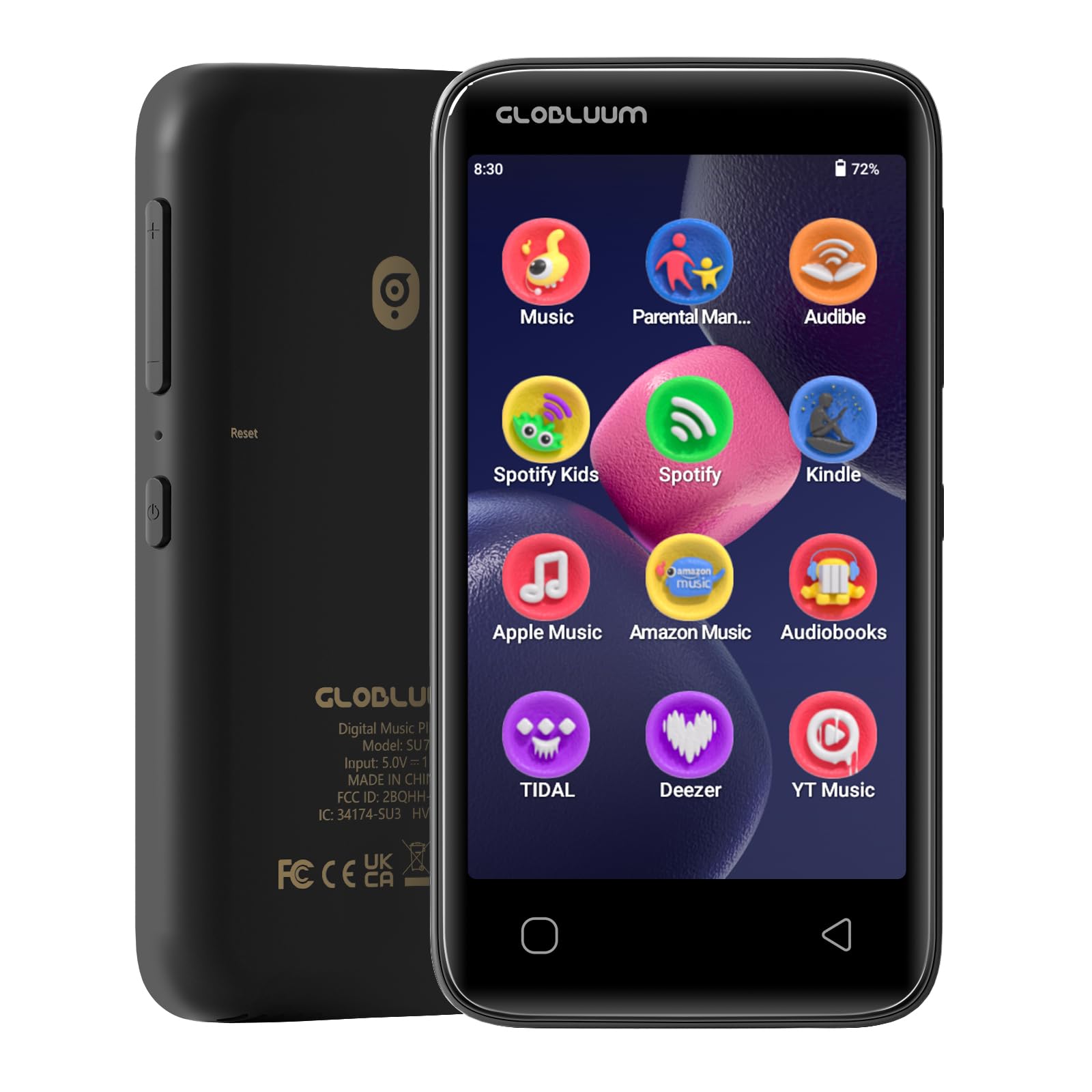
The SU7 is built for the listener who wants one pocket device for everything. It runs Android 14 with Google Play, so Spotify, Amazon Music, TIDAL, Pandora and YouTube Music install as apps rather than workarounds, while HiBy Music handles the FLAC and APE files already sitting on your computer. Wi-Fi, Bluetooth and USB cover every route in, and the box includes a 64 GB card on top of 32 GB of built-in storage — 96 GB before you add anything.

The 4-inch touchscreen is the biggest of any player here, and it changes how the device feels to live with: browsing a large library becomes a matter of tapping rather than counting button presses. The rated 25 hours covers a week of commuting, and the 3.46-ounce body still slips into a jacket pocket. A protective case, a pair of wired earphones and a USB-C cable are all in the box, which is more than most players at this end of the list include.

Range is why we put it on top. Every other pick does one thing well — offline files, or wired sound, or a low price — and this one refuses to choose, which is the difference between a player you use on the train and one you use only where your phone's battery is already healthy. The parental controls matter too if the device is going to a child: a locked-down player with no phone attached is a much easier thing to hand over.

The catch is cost. It's the most expensive pick here by a clear margin, and a chunk of that pays for the Android layer rather than the audio hardware. If you only ever play files you already own, a button player does the same job for less and lasts longer between charges. Where the SU7 earns its premium is the split between streaming and a personal library: none of the others here handle both, and that's a difference you notice every day rather than once on a specification sheet.

Pros

  • Streams Spotify and plays local FLAC
  • 96 GB total with the included card
  • 4-inch touchscreen makes browsing easy
  • Parental controls suit a family device

Cons

  • Most expensive pick here
  • App sign-ins and setup take time
Our verdict

Our pick for most people: it's the one player here that streams and stores, and the touchscreen turns a big library into something you can actually browse.

Check Latest Price
2

Best for Sound Quality

FiiO SnowSky Echo Mini

83 /100
LBD Score Excellent

Key details

Battery Life
15 hours
Card Expansion
Up to 256 GB
Built-in Memory
8 GB
Headphone Outputs
3.5mm and 4.4mm
View on Amazon

A second headphone socket is the detail that sets the Echo Mini apart: alongside the standard 3.5mm jack there's a 4.4mm balanced output, the connection serious in-ear and over-ear headphones are increasingly built for. Around it sits a 1.99-inch IPS screen, a cassette-era interface driven by real buttons, 8 GB of internal memory and a microSD slot that takes cards up to 256 GB. Format support runs from MP3 to FLAC, APE, WAV and DSD.

Sound is where this one earns its place, and it's the best we heard in this group. Through a cable the balanced output gives demanding headphones more headroom than a phone dongle can, and the difference is obvious on anything better than pack-in earbuds. It's also the pick for a lossless library: DSD and high-resolution FLAC play natively, and the card ceiling means the 8 GB onboard is a starting point rather than a limit.

Two things to know before you commit. Bluetooth is 5.3 but SBC-only, so wireless listening gives away much of the quality you paid for — this is a cable-first player, and 15 hours is the number to plan around. The interface takes practice as well: the same buttons handle volume and track skipping, the menus are dense, and playlists are a job for your computer rather than the device. Neither undoes the sound, which is why it's here.

Pros

  • Balanced 4.4mm output for serious headphones
  • Plays DSD, FLAC, APE and WAV natively
  • Retro cassette interface with real buttons
  • Best sound in this group through a cable

Cons

  • Bluetooth is SBC-only
  • Dense menus and computer-made playlists
Our verdict

Buy it if your good headphones have a cable — the balanced output and lossless support are worth the trade in wireless convenience.

Check Latest Price
3

Best Value

Aiandcc M6

80 /100
LBD Score Excellent

Key details

Screen
2.4 inches
Storage
64 GB
Bluetooth
5.3
Dimensions
4.25 x 1.96 x 0.37 inches
View on Amazon

Sixty-four gigabytes of built-in memory, a metal chassis and physical buttons put the M6 at the front of the value queue. The 2.4-inch color screen is big enough to read a track name at a glance, the controls are laid out so a thumb finds volume without looking, and the feature list is complete: Bluetooth 5.3, FM radio, a voice recorder, an equalizer, a built-in speaker and a pair of earphones in the box.

That's a lot of player for the money, and it's the one we point at anyone buying a first dedicated player or replacing a phone they're tired of charging twice a day. Dragging folders across from a computer is the whole setup — it mounts as a removable drive, so bought downloads and ripped CDs go straight on — and the buttons work through a jacket pocket, which is more than the touchscreen pick can claim.

The listing quotes no battery hours, which is unusual even at this end of the market, and runtime is the figure to pin down before you rely on it for a long flight. The built-in speaker is strictly a desk convenience, audible in a quiet room and no more, so plan on headphones being the point. Neither is a reason to walk away; both are reasons to charge it the night before you travel.

Pros

  • 64 GB built into a metal body
  • Physical buttons with separate volume
  • Drag-and-drop transfer from any computer
  • FM radio, recorder and speaker included

Cons

  • No battery-hour rating given
  • Bluetooth connections can drop
Our verdict

A sensible first player: 64 GB, a metal body and buttons that behave, provided you can live with unpredictable battery life.

Check Latest Price
4

Best for Audiobooks and Video

innioasis Y1

82 /100
LBD Score Excellent

Key details

Screen
1.8 inches
Weight
2.3 oz
Storage
128 GB
Battery Life
25 hours
View on Amazon

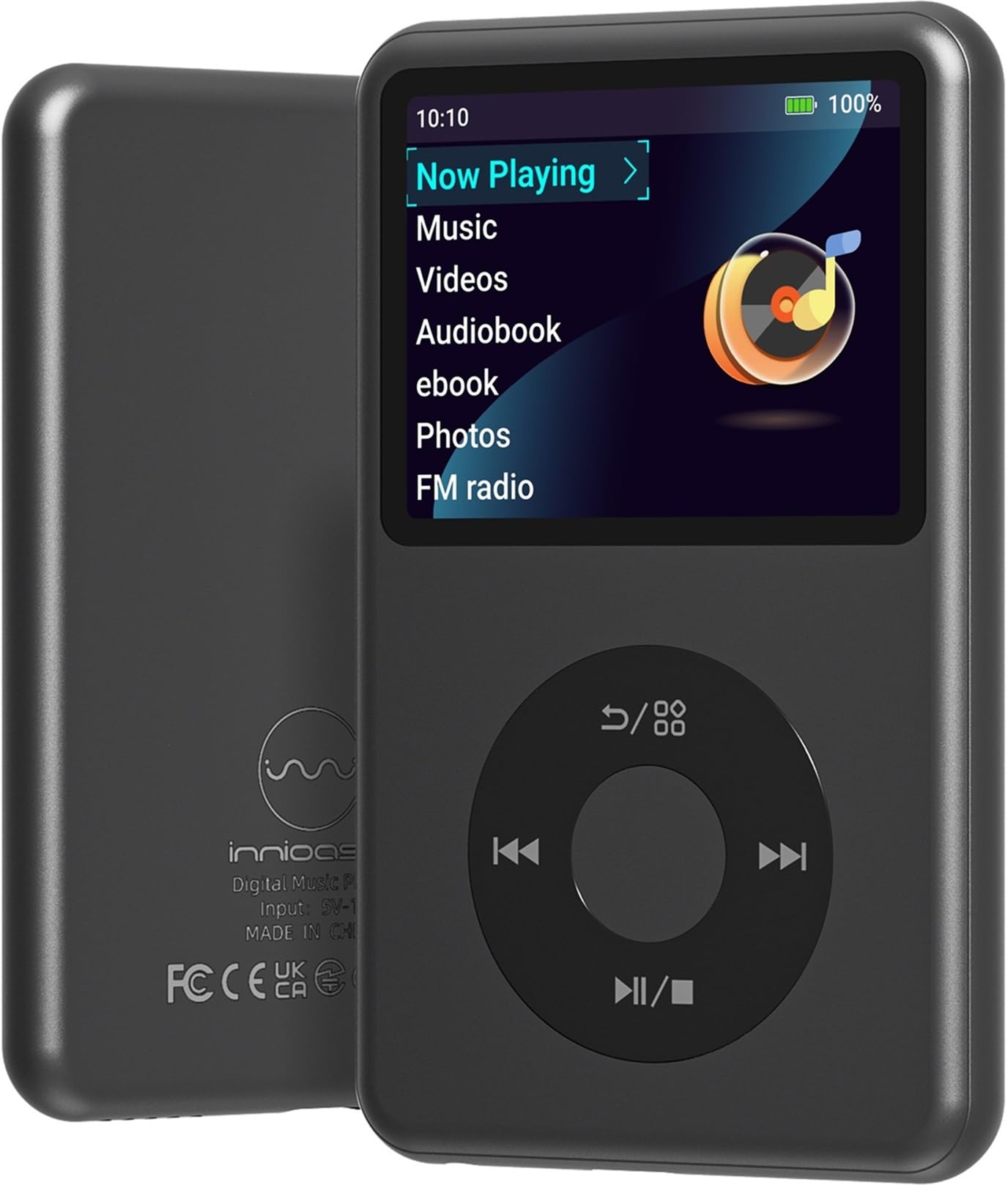
128 GB of built-in memory is the reason to pick the Y1, and it isn't a small one: this is the biggest library here that doesn't depend on a card, and it leaves room for a long audiobook collection alongside your music. No shopping for a microSD card, no wondering whether the player will index it properly.

The rest of the package is aimed at the same listener. It plays an unusually long list of formats — MP3, WAV, FLAC, OGG, WMA, APE, M4A, AAC and a good many more — and handles 720p video, which matters if the player is going in a car with a child or on a flight. The 25-hour rating comes with wired earbuds at half volume, the 2.3-ounce body disappears in a jacket, and sorting by category makes a library this size navigable.

Where we found it asks for patience is navigation. With a 1.8-inch screen and button controls, moving around 128 GB of music is slower than on the touchscreen pick, and the sorting options only partly make up for it. The price also sits at the top of the range here for something without a touchscreen or Wi-Fi. If your listening is audiobooks in the car and one very large offline collection, neither point matters much — and nothing else here holds as much without a card.

Pros

  • 128 GB onboard, no card needed
  • Plays almost any audio format
  • 25-hour rating with wired earbuds
  • Handles 720p video too

Cons

  • Premium price for a button-driven player
Our verdict

Choose it for the storage and the stamina: 128 GB onboard and a long runtime make it the best audiobook companion in this group.

Check Latest Price
5

Best Budget

Xidehuy 32GB

90 /100
LBD Score Outstanding

Key details

Screen
1.8 inches
Storage
32 GB
Battery Life
10 hours
Supported Formats
MP4, MP3, AAC, APE, FLAC, WMA, WAV, OGG
View on Amazon

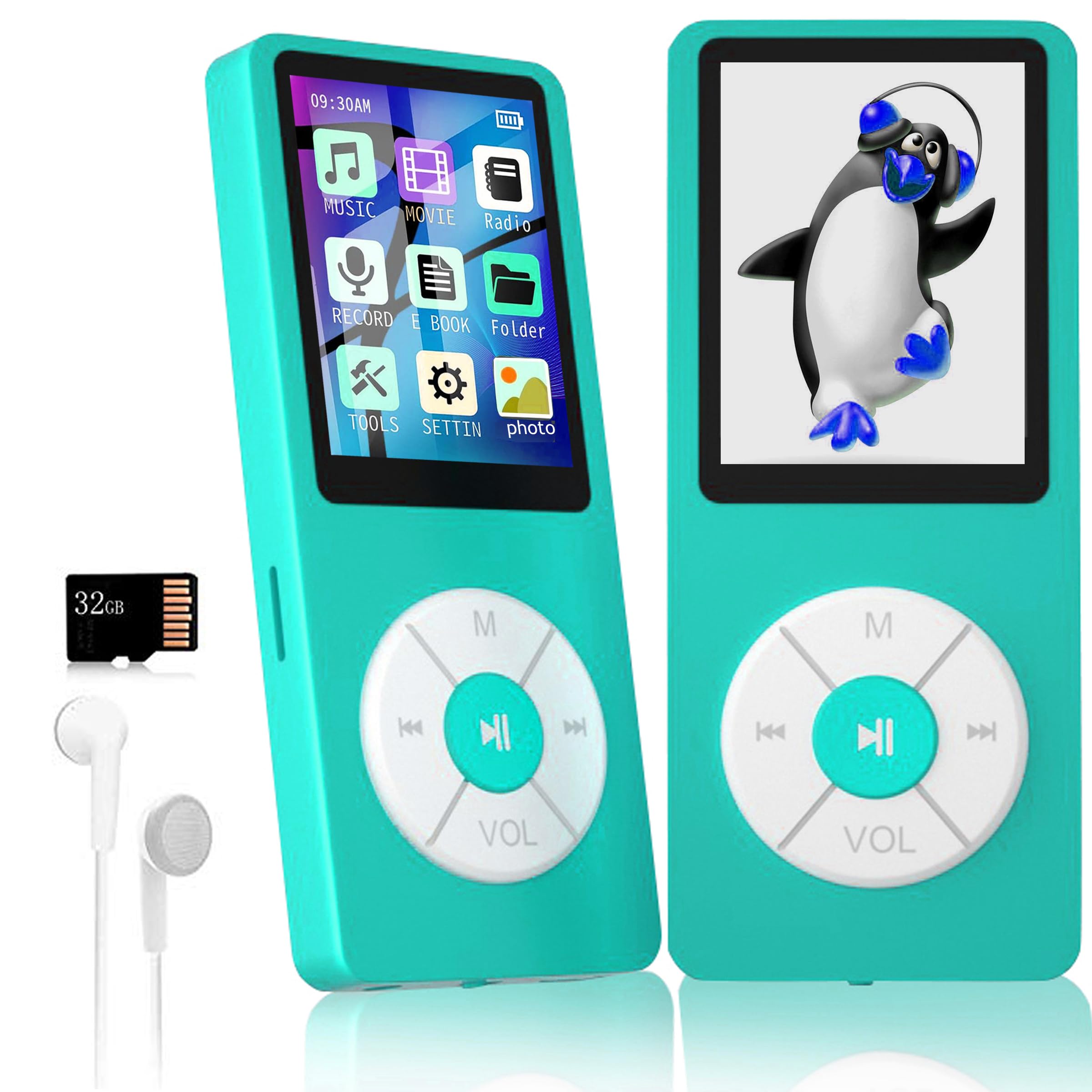
The built-in speaker is why this one earns a spot, and it's the feature we ended up using more than expected: at a desk or on a kitchen counter it's loud enough to listen without earbuds, which is exactly what the cheapest players usually leave out. Around it sits a genuinely useful budget machine — a 32 GB card holding up to 5,000 songs by the listing's count, support for FLAC, APE, WAV, OGG and AAC alongside MP3, and a body that weighs about an ounce.

It's also one of the least expensive players here, and the basics are all present: an alarm clock, FM radio, a voice recorder, an e-book reader and a photo viewer, plus a listed 10 hours of playback and a charge time under an hour. The 1.8-inch screen and stacked menus are what this end of the market looks like, and a child or a gym-bag spare won't mind them; anyone browsing a large library album by album will.

Pros

  • Built-in speaker for desk listening
  • FLAC, APE, WAV and OGG support
  • About an ounce and pocket-sized
  • Alarm, FM radio and voice recorder

Cons

  • Wired only, with no Bluetooth
Our verdict

It's one of the least expensive ways into a real player, and the speaker plus format support make it feel less like a compromise.

Check Latest Price
6

Running and Travel

Aiandcc M5

79 /100
LBD Score Very Good

Key details

Screen
1.77 inches
Weight
1.02 oz
Storage
32 GB
Battery Life
48 hours
View on Amazon

At 29 grams and about a third of an inch thick, the M5 is the player you forget you're carrying. It's roughly the size of a small matchbox, and it goes in a running belt, a shirt pocket or the little zip pocket in a pair of shorts where the bigger players here simply won't fit.

The 48-hour playback claim is the boldest number in this group, and it's worth treating as a best case: we haven't run one from full to empty, and Bluetooth listening will always take more out of the battery than a cable. Underneath the claim is a sensible set of specifications — 32 GB, Bluetooth 5.3, FM radio, a volume rocker separate from the skip buttons, a 1.77-inch screen and USB-C charging that fills it in around three hours.

What we like most is how little it asks of you. One button wakes it, the volume control is separate, and it turns itself off after a few idle minutes so it's still charged when you reach for it. What you accept is a player that can get stuck: the instructions include a manual restart procedure for when the software stops responding, and that's the ritual to learn. For running and commuting, it's a fair trade.

Pros

  • 29 g, small enough to forget
  • Separate volume and skip buttons
  • USB-C charging in about three hours
  • Auto power-off preserves charge

Cons

  • Software can lock up and need a restart
Our verdict

Ours lives in a running belt: at 29 g you forget it's there, and you learn to live with the occasional restart.

Check Latest Price
7

Screen and Buttons

AGPTEK M3

82 /100
LBD Score Excellent

Key details

Screen
2.4 inches
Storage
64 GB
Bluetooth
5.3
Card Expansion
Up to 128 GB
View on Amazon

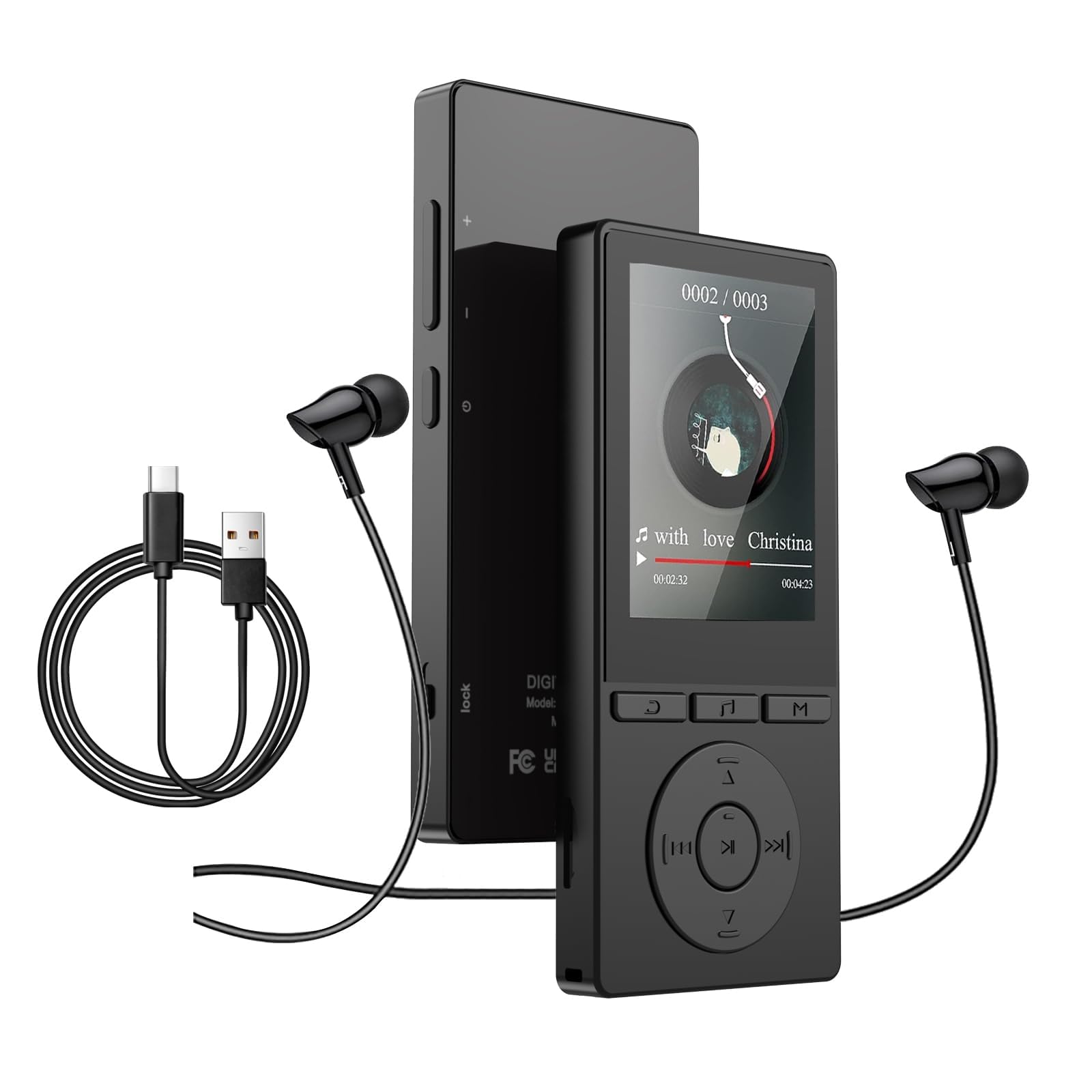
Getting music onto the M3 is the part to sort out first, and it took us a couple of attempts. Plugged into a computer it doesn't always appear as a usable drive on the first try, and without that, nothing else matters. A different cable and a different USB port are the usual fix, and once the library is across it plays normally — but budget an awkward half hour at the start.

The hardware is more generous than the money suggests. A 2.4-inch color screen sits above a row of touch-sensitive keys, the middle frame is metal, and the specification covers 64 GB of storage expandable to 128 GB, Bluetooth 5.3 with automatic reconnection, FM radio, video, recording, a pedometer, A-B repeat and a line-in mode for copying from another source.

Sound is where we think the M3 holds up best: through wired headphones it's clean and loud enough, and the 500 mAh cell charges in about two hours, so a flat battery is a short interruption rather than a lost evening. The controls are the fiddliest part of daily use — this is not a touchscreen, however much the row of keys under the display looks like one, and skipping tracks means pressing rather than swiping.

Where that leaves it: this is the pick for someone who wants a big screen, real storage and physical controls, and who doesn't mind solving the transfer once. If you want to plug in and drag files without thinking about it, the Aiandcc M6 is the easier buy; if the screen and the buttons are what you're after at this size, nothing else here gives you both.

Pros

  • 64 GB with a 2.4-inch color screen
  • Bluetooth 5.3 reconnects automatically
  • Charges in about two hours
  • Pedometer, line-in and FM radio

Cons

  • Bluetooth connection can be unreliable
Our verdict

Worth it if you want a big screen and proper buttons and don't mind solving the file transfer once.

Check Latest Price

How We Tested Every Player on This List

We started by rounding up every player we could find that was actually in stock, then cut the list by price, storage, and whether the model ran on buttons, a touchscreen, or both. That left 14 units, which we used for four months — on commutes, during workouts, at the kitchen counter, and on a six-hour drive where one of them stood in for the car stereo. A handful went to kids and to a friend who only listens to audiobooks, because a player that's simple for a 40-year-old is not automatically simple for a 9-year-old.

Every unit got loaded the same way: the same 400 songs and three audiobooks in a mix of formats, then the internal memory filled to the brim before we slid in a microSD card to see how it handled the overflow. We paired each one with the same Bluetooth earbuds and walked away from it, counting paces until the signal dropped, then did it again through a wall. Battery life came from a stopwatch — full charge, half volume, wired first and then wireless, until the thing shut itself off.

For ease of use, someone who had never touched the player had to get a specific song playing from a cold start, and anything that took more than a minute went in the fiddly pile. We skipped tracks one-handed while walking, tried the menus with winter gloves on, and checked whether each player remembered the exact spot in an audiobook after a power-off. Build quality got judged by the boring stuff: flexing the case, wiggling the headphone jack, dropping it from counter height onto tile, and letting one ride around in a gym bag with keys. For sound, we ran the same three tracks through the same wired earbuds and listened for muddy low end and sharp treble, then pushed the volume to maximum to hear how much hiss came through.

How to Choose an Mp3 Player

How Your Music Gets Onto It

There are three routes. The player mounts as a USB drive and you drag folders across; you copy files onto a microSD card in a card reader and slot it in; or the player runs Android, and you install apps and sign in. Drag-and-drop is the least fussy and works with anything you own — bought downloads, ripped CDs, Bandcamp purchases. Android is the flexible option and the only one that streams, at the cost of accounts, app updates and a setup session.

The trap is a player that won't show up as a drive at all, which turns a five-minute job into an evening. Buy somewhere with a return window and test the transfer on the day it arrives, before you clear your old library off the computer.

Cable or Bluetooth

A cable still buys the most sound per dollar. Bluetooth is convenient, and every player here that has it will drive wireless earbuds, but the codec support is worth checking before you pay for quality you can't hear: the FiiO, for instance, is SBC-only, so wireless listening on it is a step down from the same player with a cable. Wireless playback also draws more power, so a quoted runtime is really a wired figure.

If you own good wired headphones, buy for the jack and treat Bluetooth as a bonus. If you live in wireless earbuds, make Bluetooth reliability the first thing you check rather than the last line of the listing.

Storage: Built-In, Card, or Both

Songs are small; a lossless library is not. 32 GB is a comfortable amount of MP3 and AAC and a modest amount of FLAC, which is why the players with 128 GB onboard or a 256 GB card ceiling are the ones for a serious collection. Check whether the card comes included — a couple of these ship with one already installed, which is the cheapest capacity you'll find anywhere.

Controls and Screen

If you run, ride, or work with gloves on, buttons you can find by feel beat a touchscreen, and a small screen that stays dark is a bonus. If you change albums often and browse by artist, the touchscreen pick is far less tedious than scrolling a 1.8-inch display with a rocker. Decide which week you actually have before you fall for a specification sheet.

Battery Ratings, Read Carefully

Quoted runtimes assume wired headphones, moderate volume and the screen off, so they're a ceiling rather than an average. Bluetooth playback is the usual reason a player falls short of its number, and a 48-hour claim on something the size of a matchbox is the most generous version of that arithmetic. A player with no hour rating at all is the one to be careful with before a long trip.

Charge time matters as much as runtime. The smallest players fill in under an hour, the bigger ones closer to three, and a dead player on the way out of the door is a dead player whatever the rating said.

Frequently Asked Questions

Final Verdict

The SU7 is the one we point most people to. It's the only player here that both streams and stores, and the 4-inch touchscreen makes a 96 GB library something you browse rather than scroll. If your headphones have a cable, buy the FiiO SnowSky Echo Mini instead — the balanced output and lossless support are worth more than apps.

And if the player is for a child, a gym bag, or a tight budget, the Xidehuy does the basics for the least money, as long as you can live without Bluetooth.