Best Turntables of 2026

A turntable does one thing: it drags a diamond stylus through a spiral groove and turns the wobble into music. Everything that separates a satisfying deck from an irritating one — how steadily the platter spins, how cleanly the tonearm tracks, whether motor hum leaks into your speakers — hides behind that plain description. Get it right and you stop noticing the equipment.

I ran a belt-drive deck for years before hearing what a well-isolated direct-drive motor did to a familiar bassline, and it reframed the category for me. Over the past six months, we've lived with nine turntables, from plug-and-play models with speakers built in to fully manual decks for people who cue by hand. One lesson up front: a built-in phono stage matters as much as the cartridge — without one, your new player stays silent until you buy something else.

Looks count here more than with most electronics, since this sits on a shelf in your living room rather than in a rack. So does the daily ease of just dropping a needle. Below are the decks worth your money, sorted by how you actually listen.

1

Best Overall

Audio-Technica AT-LP120XUSB

95 /100
LBD Score Outstanding

Key details

Drive
Direct-drive, quartz speed lock
Speeds
33 1/3, 45, 78 RPM
Outputs
RCA and USB
Tonearm
S-shaped with counterweight and anti-skate
View on Amazon

Most decks here play 33s and 45s and stop there. This one adds 78 RPM, and it has a USB port, so inherited shellac and the thrift-store LP you took a chance on can both end up as files on a laptop. Those are the headline extras. They aren't the reason it's our top pick.

What separates it from the rest of this group is that it lets you correct a problem instead of living with one. There's a counterweight for tracking force and an anti-skate dial for the pull toward the label, and between them they decide whether a warped or hot-cut pressing plays through or skates across the side. On the fixed-setting decks here, a record that won't track is a record you don't play. Here it's a dial to turn.

The hardware underneath earns its keep: a die-cast aluminum platter, an aluminum body, and a direct-drive motor with quartz speed lock, which means no belt to stretch and no speed to drift. It weighs around twenty pounds, and it stays where you put it when the bass comes in. Of the decks here, this is the one we trust most on build — short of the Pioneer, nothing else in the group feels this solid.

The trade is the arm: it doesn't lift itself at the end of a side, so you are the auto-return. The hydraulically damped cue makes the drop gentle enough that we stopped thinking about it inside a week, but if you know you'll wander off mid-record, the AT-LP60X does that part for you. Budget a few minutes for the counterweight and anti-skate during setup; that's the only real work in the box.

Pros

  • Plays 33, 45, and 78 RPM records
  • Counterweight and anti-skate you can adjust
  • USB output for digitizing vinyl
  • Heavy aluminum build resists vibration

Cons

  • Arm doesn't lift or return at the end of a side
Our verdict

Our pick for the long haul: it plays 78s as well as LPs, its arm can be dialed in when a record fights back, and the USB port gets the collection onto a computer.

Check Latest Price
2

Best Budget

Audio-Technica AT-LP60X

91 /100
LBD Score Outstanding

Key details

Drive
Belt-drive, fully automatic
Preamp
Built-in, switchable phono or line
Speeds
33 1/3 and 45 RPM
Platter
Die-cast aluminum
View on Amazon

Press start and the arm lifts, swings over, and lowers itself into the lead-in groove; when the side ends it lifts again and settles back on its rest. That's the whole interaction. Nothing about playing a record requires you to touch the tonearm, which is the point in a house full of people who have never owned one.

This is the deck we hand to first-time buyers, and not because it's the least expensive thing that spins. It's because cueing by hand is the step beginners get wrong — the dropped stylus, the slid arm, the gouged first track — and this deck removes it. The switchable preamp does the second helpful thing: it plugs straight into powered speakers, so there's no receiver to buy on day one.

Underneath it's modest: belt drive, a die-cast aluminum platter, a fixed cartridge with a replaceable diamond stylus. Because nothing about the arm is adjustable, a record that wants more tracking force has nowhere to get it — the deck either holds the groove or it doesn't, and when it doesn't there's no dial to rescue the side. Higher up this list, that's the lever you're paying for.

Setup is a few minutes of platter, belt, lid, cable. Spend the effort you saved on the speakers, because that's where the upgrade lives.

Pros

  • Automatic start and return
  • Switchable preamp works with powered speakers
  • Quick, tool-free setup

Cons

  • Plastic plinth feels light in the hand
  • Plays 33 1/3 and 45 RPM only
Our verdict

We send first-time buyers here: the arm sets itself down and lifts itself off, and the built-in preamp means a pair of powered speakers is all you need.

Check Latest Price
3

Best All-In-One

1byone High Fidelity Belt Drive

89 /100
LBD Score Excellent

Key details

Speeds
33 and 45 RPM
Speakers
Built-in stereo pair with amplifier
Bluetooth
Input for phone or tablet streaming
Cartridge
Magnetic with adjustable counterweight
View on Amazon

A turntable with speakers built in usually means a plastic box and an arm that feels like a toy. This one is a walnut-finished cabinet with a metal face, and the tonearm carries a counterweight you can actually set — the detail that says someone thought about playing records rather than selling a gadget.

It's a complete little system: belt drive, 33 and 45, a magnetic cartridge with a diamond Audio-Technica stylus, a built-in amplifier and a stereo pair, Bluetooth for streaming from a phone, and an aux input. Auto off, a detachable dust cover, and about thirteen pounds of cabinet.

We're comfortable recommending it to a room that has no receiver and no plan to buy one. The volume is the surprise — it fills a medium room, and the tone stays warm rather than thin, which is more than we expected from two speakers sharing a box with a motor. The adjustable counterweight is what keeps it honest: set the tracking force properly and the arm behaves, where a fixed arm on a cheap all-in-one can be defeated by a warped pressing.

And this is a system rather than a component. The stylus is replaceable, but the amplifier and the speakers are the package; there's no path where this becomes a deck feeding a better rig. As a first setup that sits on a sideboard and needs one cable to the wall, that's a fair trade.

Pros

  • Speakers and amplifier built into the cabinet
  • Adjustable counterweight and magnetic cartridge
  • Bluetooth input for streaming from a phone
  • Wood and metal cabinet rather than plain plastic

Cons

  • Bluetooth is input-only, so no wireless speakers
Our verdict

For a room with no receiver, we're happy to recommend it: a real counterweighted tonearm and a pair of speakers that fill the space, in one wooden cabinet.

Check Latest Price
4

Best for DJs

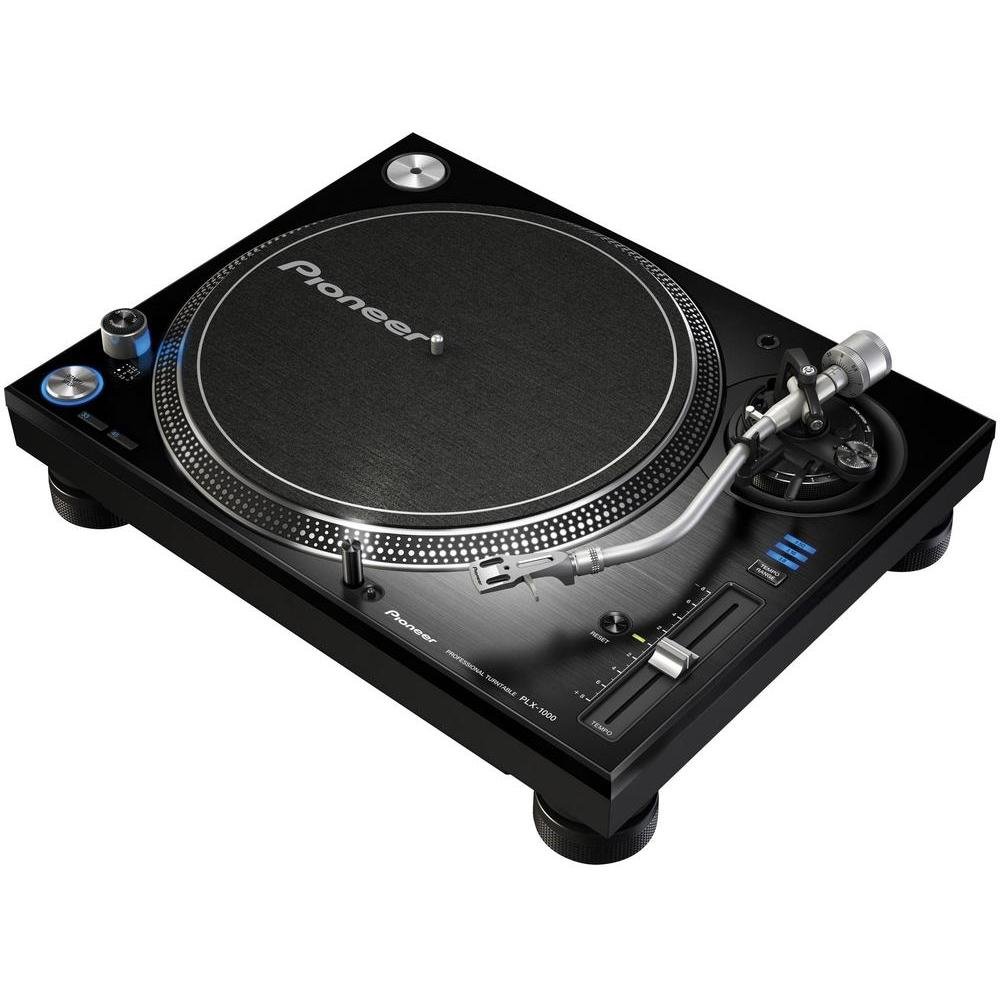
Pioneer DJ PLX-1000

87 /100
LBD Score Excellent

Key details

Drive
High-torque direct drive
Pitch
Multi-pitch control with reset
Weight
38 lb
Tonearm
S-shaped, VTA-adjustable
View on Amazon

Thirty-eight pounds is the specification that explains everything else here. High-torque direct drive, a zinc chassis, a control layout a working DJ can operate without looking — the weight is how all of that holds still while you cue, back-cue, and generally lean on it. If you need a turntable that behaves like an instrument, this is the only one in this group built for it.

The feature set is professional rather than domestic: an S-shaped tonearm with VTA adjustment, multi-pitch control with a reset button, a slip mat, a dust cover, and a headshell that takes standard cartridges, so a swap is a two-minute job. It's also DVS-ready if you want to mix digital files on real vinyl.

Where it asks something back is the arm. A loose tonearm bearing is the fault to look for, so check the arm for play before the return window closes. And this is furniture, not a tabletop accessory: a deck this heavy on shelving that flexes is a waste of what it does best.

What it isn't is a beginner's deck. There's no automation, the setup is a real setup, and the rewards are torque, stability, and pitch control rather than convenience. For listening alone, the AT-LP120XUSB gets most of the way there with far less mass and money. For anything involving a crossfader, the conversation ends here.

Pros

  • High-torque direct drive with instant start
  • Heavy zinc chassis resists vibration and knocks
  • Multi-pitch control with a reset button
  • VTA-adjustable tonearm takes standard headshells

Cons

  • 38-pound chassis needs dedicated, level furniture
  • Cue lever drops faster than delicate cartridges like
Our verdict

Anyone who needs torque and a deck that won't walk should buy this one; it's club gear that happens to sound good in a living room.

Check Latest Price
5

Best Portable

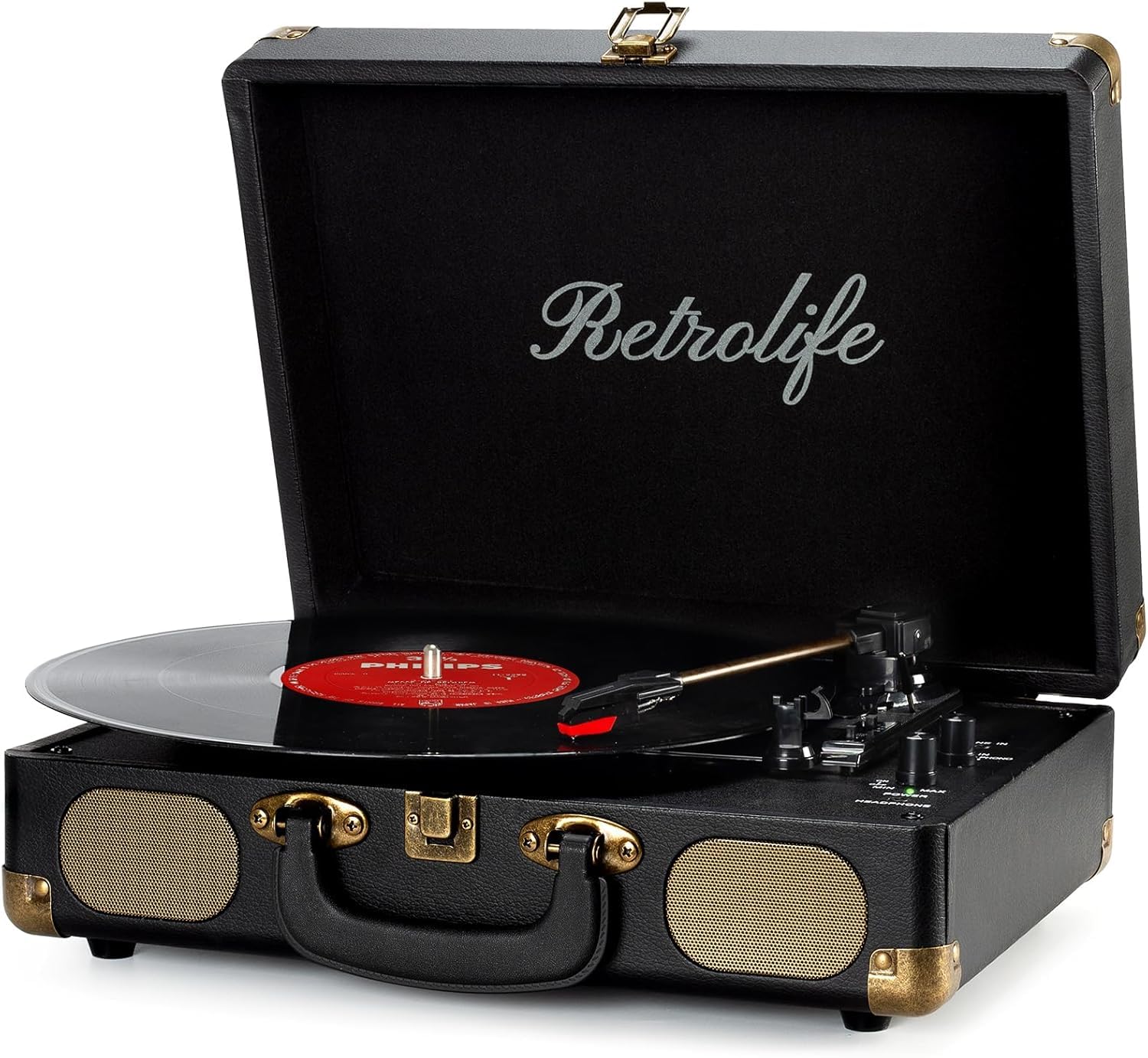
Retrolife R609

91 /100
LBD Score Outstanding

Key details

Speeds
33, 45, 78 RPM
Cabinet
Suitcase style with carry handle
Outputs
RCA line out and headphone jack
Speakers
Built-in stereo pair
View on Amazon

The handle is the point. Latch the lid, pick it up by the case, and this is the only deck here you can carry to a friend's house or out to the patio. Judged as a portable record player rather than a hi-fi component, it does its job well — and it's the one that gets used in houses where a component deck would sit idle.

Inside the suitcase: belt drive, three speeds including 78, all three record sizes, a stereo pair behind the grille, Bluetooth for streaming from a phone, an RCA line out, a headphone jack, and an auto-stop switch. The stylus is replaceable, which matters more at this end of the market than anywhere else.

The line out is the upgrade path: run the RCAs into a real stereo and the deck becomes a source instead of the whole system. There's a headphone jack too, which is the quiet-hours option and one more thing small players tend to skip.

Three speeds means the box of 45s and the stack of inherited 78s both play, which is more than several decks here manage. It's the least precious turntable in this group, and in a house with children that counts for something.

Pros

  • Carry-handle case moves between rooms
  • Three speeds including 78 RPM
  • RCA and headphone outputs for better sound
  • Auto stop at the end of a side

Cons

  • Bluetooth is input-only, with no wireless output
Our verdict

Buy it for a kid who asked for a record player, or for the patio: the case, the handle, and the built-in speakers make it the one that actually travels.

Check Latest Price
6

Wireless Setups

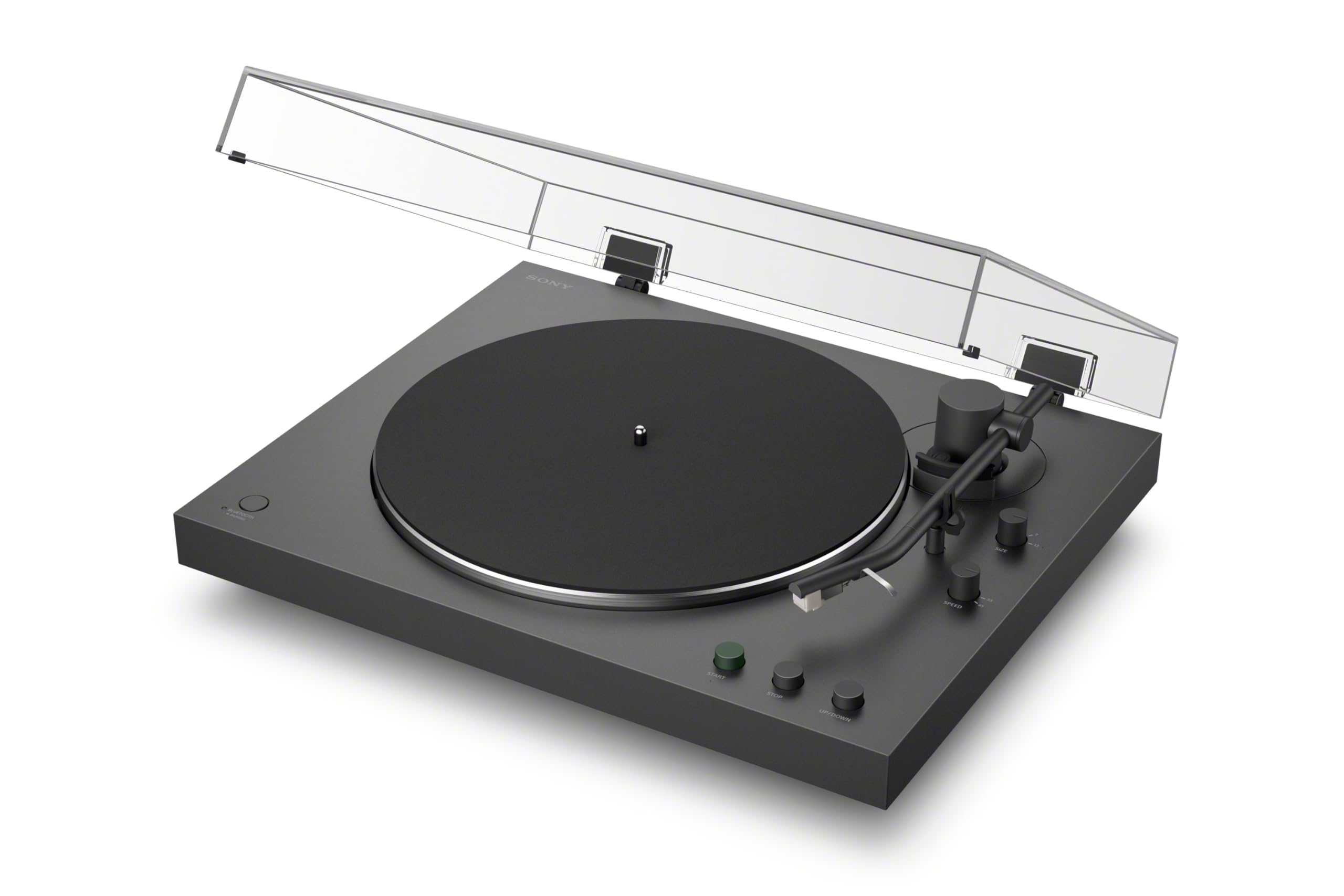
Sony PS-LX3BT

89 /100
LBD Score Excellent

Key details

Preamp
Built-in switchable phono EQ
Speeds
33 1/3 and 45 RPM
Operation
Fully automatic with auto return
Connection
Bluetooth output or wired cable
View on Amazon

The question this deck answers isn't which turntable sounds best. It's how you play records when the only speaker in the house is a Bluetooth one and there's no amplifier to plug into. Sony's answer is a fully automatic belt-drive deck with a switchable phono EQ built in and Bluetooth on the output side, so it talks to a wireless speaker, a soundbar, or headphones with no cable at all.

The rest is deliberately plain: one button starts the side, stops it, and sends the arm home at the end; an aluminum platter with a rubber slip mat; a clear dust cover that lets you watch the record go round; 33 and 45; about eight pounds of metal chassis.

The automatic cycle is what earns its keep. One button plays a side and the arm goes home when the record ends, which is the difference between playing a record and babysitting one. The switchable EQ is the other useful piece — it works into a line input or a receiver's phono stage, so the same deck fits a house with a stereo and a house without one.

Bluetooth here is a convenience, not a substitute for the cable when the speaker sits in the same room. If wireless isn't the point, the AT-LP60X does the same automatic trick for less money.

Pros

  • Fully automatic start, stop, and return
  • Bluetooth output to wireless speakers or headphones
  • Switchable phono EQ for either input type

Cons

  • No tracking or anti-skate adjustment
  • New model with an unproven long-term record
Our verdict

We like it for the house with a wireless speaker and no amplifier: one button plays a side, and the Bluetooth output saves a cable across the room.

Check Latest Price

What Six Months With Nine Turntables Taught Us

We started with a couple dozen decks from brands we'd happily recommend to a friend, then filtered by the things that actually change how a record sounds and how often you play one: belt or direct drive, whether a phono preamp is built in, whether the tonearm lifts and returns on its own, and what you'd still have to buy before hearing a note. Nine made the cut, and each one lived in a real system for six months rather than a week on a bench.

Every deck played the same stack of records — a bass-heavy pressing, a piano album that exposes speed drift, and a worn thrift-store LP — through the same powered speakers and headphones. We listened for motor rumble in the silence between tracks, whether sustained notes held pitch, and whether the last song on a side, where the groove is tightest, stayed clean or turned harsh. Late-night headphone sessions were the real tell, because that's when a noisy motor or a flimsy plinth announces itself.

Setup was timed from opening the box to first record, including balancing the tonearm, setting tracking force and anti-skate, and dialing in the counterweight; a week later we checked whether any of it had drifted. We lifted each plinth, tapped the base mid-song, spun the platter by hand to feel for wobble, and opened and closed dust covers until the hinges either felt solid or didn't. We also paired Bluetooth, ripped a record over USB, and let auto-stop and auto-return do their thing — or fail to.

Since a turntable is furniture as much as audio gear, each one stayed in place for weeks while we judged how it looked with a record on it and a mess of cables behind. Value came down to the full bill, because a deck that needs a separate preamp or speakers isn't cheap at any price. And we kept a running note on which ones made us want to play just one more side — ease of use is the reason one deck got far more play than the rest.

How to Choose a Turntable

Automatic, Manual, or Auto-Stop

A fully automatic deck lifts the arm, sets it down, and on most models sends it home at the end of the side. A manual deck does none of that; you cue every record and lift the arm yourself. In between is auto-stop, which cuts the motor at the end but leaves the arm where it is — the Retrolife works that way.

Automation costs you adjustment: fixed tracking force, no anti-skate. If you swap cartridges or play worn pressings, buy manual. If you want one button and nothing else, buy automatic and accept the factory settings.

Belt Drive or Direct Drive

Belt drive puts a rubber belt between the motor and the platter, which keeps motor noise out of the groove; the belt is a wear item and speed can drift as it ages. Direct drive couples the platter straight to the motor for instant starts, more torque, and speed held by a quartz reference.

For sitting and listening, either is fine — the AT-LP60X is belt-drive, the AT-LP120XUSB is direct, and both hold pitch. For cueing and scratching, only direct drive makes sense.

The Preamp Question

A moving-magnet cartridge puts out a tiny phono-level signal that needs equalization and a large boost before any amplifier can use it. If your amp or powered speakers have a phono input you're set; if they don't, you need a phono preamp in the chain. Most decks here build one in, switchable between phono and line.

The trap is that switch. Line into a phono stage distorts; phono into a line input gives you a thin, very quiet signal that sounds like a broken deck.

Speakers, Bluetooth, and USB

An all-in-one is a turntable, amplifier and speakers in a single cabinet — the 1byone is the best of that breed here, and it needs nothing but a wall socket. A component deck needs something to play into, whether that's powered speakers or a receiver.

Bluetooth gets confused constantly, because it runs in two directions: input streams a phone into the deck's speakers, output sends the record to a wireless speaker. Only the Sony transmits. Decide which you need before you buy, because nothing you add later fixes the wrong one.

Placement, Weight, and the Shelf You Already Own

A turntable wants a level, rigid surface that isn't shared with a speaker. Put it on the same shelf as a subwoofer and footfalls and bass arrive at the stylus as a skip; heavier plinths resist that, which is part of what the Pioneer's mass buys.

Measure before you commit. The AT-LP60X is about fifteen inches deep and four high, and a hinged lid needs clearance above it — on a built-in shelf, check the lid opens before you decide where the deck lives.

Frequently Asked Questions

Final Verdict

Most people should buy the Audio-Technica AT-LP120XUSB and stop looking. It plays every speed, it lets you dial in a record that won't track, and the USB port means the collection isn't locked to the format.

If a button is worth more to you than a counterweight, the AT-LP60X does the automatic routine for a fraction of the outlay. Neither needs a receiver — just speakers you'd be happy to own on their own.