Best Paper Shredders of 2026

The way a paper shredder lets you down usually isn't dramatic. It's the grind, the stall, and a half-inch of bank statement still sticking out while the motor gets too hot to touch. I've fished enough jammed pages out with a letter opener to be picky, and the fix is simple: a machine that swallows a full stack and doesn't need a cooldown before the pile is done.

Quiet operation, jam resistance, and durability are what reviewers bring up most, and none of them appear on a spec sheet. Security ratings deserve a second look, too — cross-cut strips are not micro-cut confetti, and for a document with an account number on it, the size of the pieces matters more than the sheet count on the box. My team and I spent six months feeding statements, junk mail, cards, and stray staples through 10 shredders to see which ones actually held up.

The picks below run from a compact model that tucks under a small desk to a heavy-duty machine that keeps going for an hour straight, and each one earned its spot by handling the boring stuff well — full bins, tight corners, and a Monday-night pile of mail.

1

Best Overall

Aurora AU1210MA

95 /100
LBD Score Outstanding

Key details

Cut Type
Micro cut, P-4
Bin Capacity
5 gallons
Continuous Run
60 minutes
Sheets Per Pass
12 sheets
View on Amazon

Sixty minutes of continuous running is the number that settled this one for us. Most shredders here ask you to stop after four, six, or thirty minutes and wait for the motor to cool, and that pause is what turns a box of old statements into a two-day project. The Aurora AU1210MA keeps cutting: 12 sheets a pass, into micro-cut particles measuring 5/32 by 15/32 of an inch, at P-4 security.

Particle size matters more than the P-4 label on its own. Those pieces are far harder to reassemble than the half-inch strips a plain cross-cut produces, and if you are destroying tax returns, medical paperwork, or anything with an account number on it, that difference is the whole point. The 5-gallon bin is sized for a real session rather than a coffee break, and it pulls out as a basket instead of making you lift the cutting head off the top.

We expected a micro-cut office machine to make a racket, so the quiet running was a genuine surprise; shredding while someone is on a call does not derail the call. At 22.4 pounds it is a place-it-once machine, so give it a permanent corner rather than a closet shelf. The status lights cover bin full, overload, and overheat, which saves you from guessing why it stopped.

Pros

  • Micro-cut P-4 particles instead of strips
  • 60 minutes of continuous running
  • 5-gallon pull-out bin for long sessions
  • Quiet enough to run at your desk

Cons

  • 22.4 pounds, so it stays where you put it
Our verdict

If your shredding comes in bursts — a filing cabinet, a tax year, a move — we think the Aurora's hour of continuous micro-cut running makes it the easiest one to live with.

Check Latest Price
2

Best Heavy-Duty

Fellowes Powershred 99Ci

93 /100
LBD Score Outstanding

Key details

Cut Type
Cross cut, P-4
Bin Capacity
9 gallons
Continuous Run
30 minutes
Sheets Per Pass
18 sheets
View on Amazon

Thirty-six pounds is the first thing you notice, and it is an honest summary of what this machine is: office equipment rather than a desk accessory. The 99Ci takes 18 sheets a pass and cuts them into cross-cut particles at P-4, dropping the shreds into a 9-gallon pull-out bin that takes a very long time to fill.

That bin is what we keep coming back to. Nine gallons means an afternoon of steady shredding without one trip to the recycling, and the drawer pulls out rather than requiring you to lift a cutting head off a basket. SafeSense is the other feature we rate: the cutters stop when anything gets close to the feed opening, which is the sort of protection you want in a room where kids or pets wander through.

Thirty minutes of continuous running sits between the budget machines and the hour-long marathon of our top pick, and it is the right shape for shared use. Nobody shreds for thirty minutes straight at home, but three people working through their own piles will get there. Fellowes lists 62.1 dB, which in a shared room is the difference between shredding whenever you like and waiting for a quiet moment.

The trade-off is money: this is priced like the equipment it is, well above the home machines here. What you get for it is an 18-sheet throat, a drawer you rarely empty, a two-year product warranty, and a lifetime warranty on the cutters themselves.

Pros

  • 18 sheets a pass into a 9-gallon bin
  • SafeSense stops cutters near hands
  • Listed at 62.1 dB, quiet for its size
  • Lifetime cutter warranty behind it

Cons

  • 36.4 pounds, so it needs a permanent spot
Our verdict

We think the 99Ci earns its price in a shared office: an 18-sheet throat, a 9-gallon bin, and SafeSense that stops the cutters near hands.

Check Latest Price
3

Best Auto-Feed

Amazon Basics 200-Sheet Auto Feed

88 /100
LBD Score Excellent

Key details

Cut Type
Cross cut, P-4
Bin Capacity
8.5 gallons
Continuous Run
60 min auto, 10 min manual
Auto-Feed Capacity
200 sheets
View on Amazon

The 200-sheet tray on top is the entire argument: load a stack, close the lid, and the machine feeds itself for up to an hour while you do something else. The manual slot at the front takes 10 sheets at a time. Everything comes out as P-4 cross-cut particles measuring 5/32 by 25/32 of an inch, into an 8.5-gallon pull-out bin.

Staples do not need pulling, which matters more than it sounds when you are working through a box of bank files. The duty cycle is split, though: an hour on the auto tray, ten minutes on the manual slot, then 45 minutes of cooldown either way. That makes the front slot a supplement rather than a second shredder. Anti-jam auto reverse backs a crooked stack out, and a sleep mode keeps it from drawing power between sessions.

Where it earns its place is the job nobody wants to start: the box of decades-old files that has moved house twice. Fill the tray, walk away, come back to a full bin, repeat — no feeding sheets by hand for an hour. It is the priciest machine here, 32.9 pounds, and 22.8 inches wide, so measure the floor before you commit.

Pros

  • 200-sheet tray runs unattended for an hour
  • Takes staples without pulling them
  • 8.5-gallon bin means fewer empties
  • Anti-jam auto reverse clears crooked stacks

Cons

  • Manual slot stops after ten minutes
  • 22.8 inches wide and 32.9 pounds
Our verdict

Load 200 sheets, walk away, and come back to a full bin — that is the case for this one when a backlog is the job.

Check Latest Price
4

Best Quiet Performer

Bonsaii C169-B

91 /100
LBD Score Outstanding

Key details

Cut Type
Cross cut, P-4
Noise Level
60 dB
Continuous Run
40 minutes
Sheets Per Pass
15 sheets
View on Amazon

Sixty decibels is the claim, and quiet is why this one is in the guide at all: a shredder you can run while someone in the next room is on a call is a shredder you actually use during the workday. The C169-B also runs 40 minutes continuously, takes 15 sheets a pass, and cuts P-4 cross-cut particles from paper, cards, CDs, staples, and mail.

The bin is a 5-gallon pull-out rated for roughly 350 sheets, with a clear window so you can see the fill level without lifting anything. It sits on easy-roll casters, which sounds trivial until you are vacuuming around it, and the whole machine is 18 pounds — light enough for one person to shift.

Two things are worth knowing. The 15-sheet figure is a ceiling on clean 20-pound bond, not a working rhythm; a lighter, steadier feed keeps the cutters moving. And Bonsaii backs this one with a one-year limited warranty, which is the detail to weigh if you shred often, because longevity is the least settled part of the machine's case.

Pros

  • Stated 60 dB, quiet for 15 sheets
  • 40 minutes of continuous shredding
  • 5-gallon pull-out bin with a window
  • Easy-roll casters and a light 18 pounds

Cons

  • 15-sheet rating is a ceiling, not a rhythm
  • One-year warranty and an unsettled longevity record
Our verdict

Where noise is what everyone notices, the C169-B's 60 dB running and 40-minute stamina make it our pick for a home office.

Check Latest Price
5

Best Budget

Bonsaii C275-A

91 /100
LBD Score Outstanding

Key details

Cut Type
Cross cut, P-4
Bin Capacity
5.5 gallons
Continuous Run
6 minutes
Sheets Per Pass
12 sheets
View on Amazon

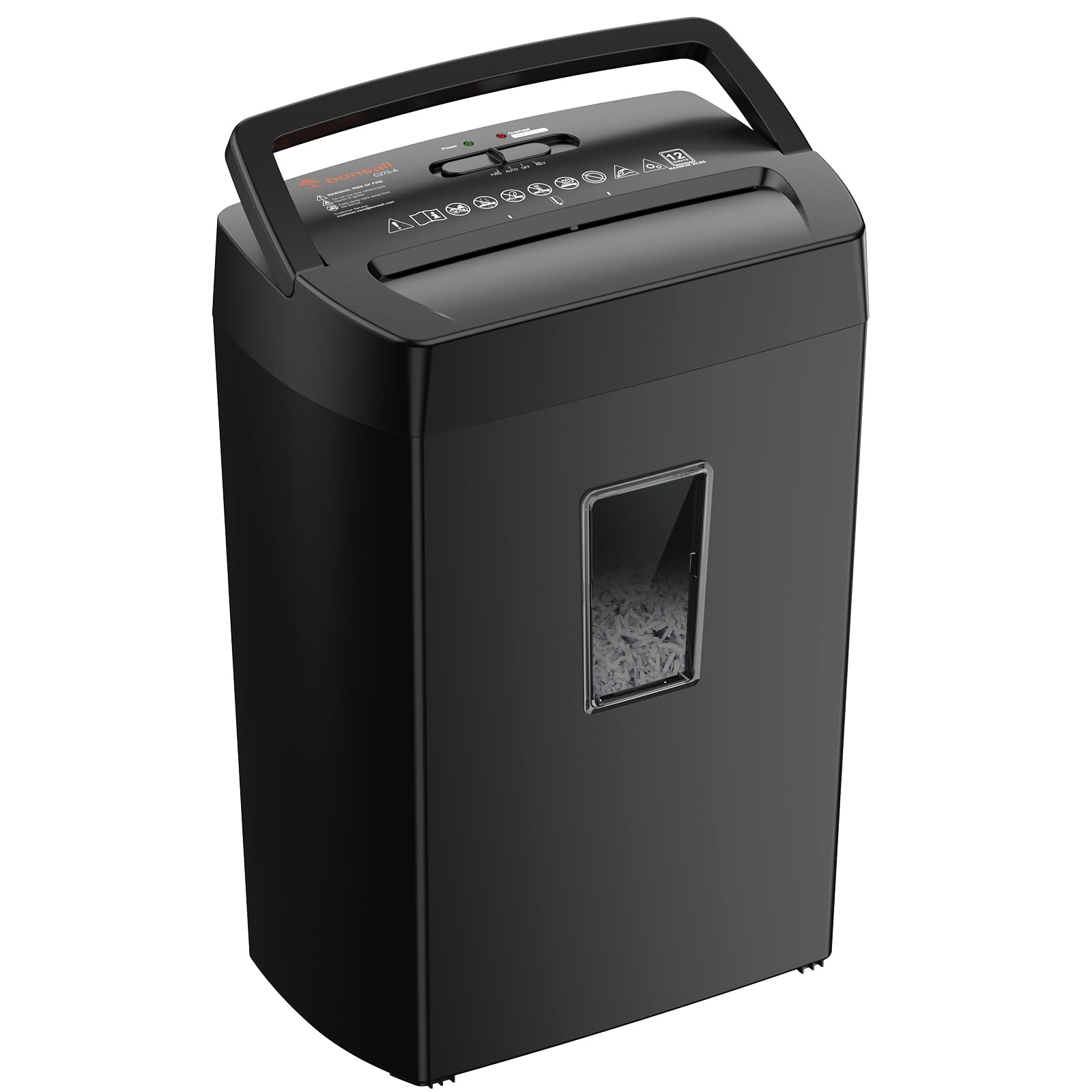
A 5.5-gallon bin with a clear window is more than this price bracket usually offers, and it is the detail that makes the C275-A the budget pick worth buying rather than just the cheapest route to a cross-cut. Twelve sheets a pass at P-4, auto start/stop, a portable handle on the cutting head, and a 21-liter basket underneath.

Six minutes is the catch. The cooling design gives you six minutes of continuous running before the motor needs a break, so this is a household machine in the most literal sense: a grocery bag of mail, a stack of statements, done. If you are clearing a filing cabinet, six minutes gets you started and no further — the C169-B or the Aurora above are the machines for that job.

For light duty it is well judged. At 12 pounds and 18.3 inches tall it tucks beside a desk or under a counter, auto start/stop means there is nothing to switch on, and reverse handles an occasional overfeed. Micro-cut it is not, but for bills, envelopes, and old cards, P-4 cross-cut is plenty.

Pros

  • 5.5-gallon bin with a see-through window
  • 12 sheets a pass at P-4
  • 12 pounds and 18.3 inches tall
  • Auto start/stop and manual reverse

Cons

  • Six minutes of running, then a cooldown
Our verdict

We point light-duty households at the C275-A: 12 sheets a pass, a big windowed bin, and a price that leaves room for bags and lubricant.

Check Latest Price
6

Best for Small Spaces

Locksworth 8-Sheet

87 /100
LBD Score Excellent

Key details

Cut Type
Cross cut, P-4
Bin Capacity
4.23 gallons
Continuous Run
4 minutes
Sheets Per Pass
8 sheets
View on Amazon

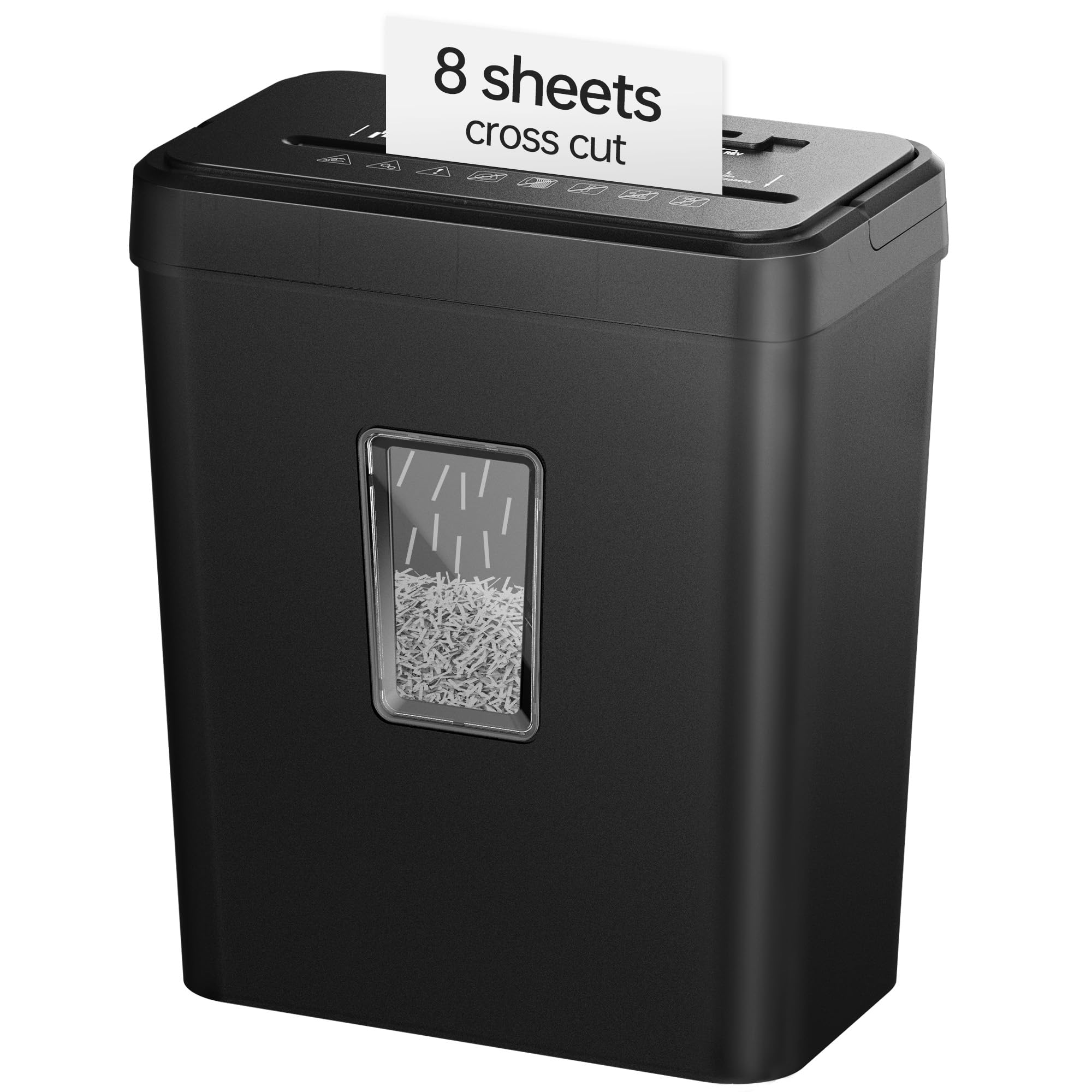
Four minutes on and a full hour off is the rhythm this one insists on, and that ratio is the first thing to be honest about. As an eight-sheet P-4 cross-cut for a household's worth of mail, it works. As a backlog clearer it does not, and no amount of patience fixes a one-hour cooldown.

What it does well is fit. At 12.4 inches wide, 7.48 deep, and 14.61 tall, it slips under a desk or onto a shelf, and the 4.23-gallon bin has a window so you are not guessing at the fill line. The lid switch is the detail that won us over: lift the head off the basket mid-run and the blades stop, which is the feature you want in a house with a curious kid.

For a small home office or an apartment where the shredder lives in a closet, that combination — small, safety-minded, and the least expensive machine in this guide — is more useful than a bigger unit you resent the footprint of. It is also the newest machine here, with less of a track record than the Bonsaii or the Aurora, so weigh that against the savings.

Pros

  • Fits under a desk at 14.6 inches
  • Blades stop when the lid lifts
  • Windowed 4.23-gallon bin shows the fill level
  • Least expensive machine in this guide

Cons

  • Four minutes, then a one-hour cooldown
Our verdict

Small-space shoppers should start here: an eight-sheet cross-cut that fits under a desk and stops the blades when the lid comes off.

Check Latest Price
7

High-Volume Desks

Amazon Basics 24-Sheet

88 /100
LBD Score Excellent

Key details

Cut Type
Cross cut, P-4
Bin Capacity
7 gallons
Run And Cool
40 min on / 50 min off
Sheets Per Pass
24 sheets
View on Amazon

If the Fellowes 99Ci is the office standard, this is the same job for less money: 24 sheets a pass, P-4 cross-cut particles at 4 by 38 millimeters, a 7-gallon bin, and a dedicated slot for CDs and DVDs that the deskside machines here do without.

The duty cycle is 40 minutes on and 50 minutes off, which is a working rhythm rather than a coffee-break allowance, and anti-jam auto reverse backs the cutters out when a stack goes in crooked. Indicator lights cover bin full, door open, overload, and overheat, so a stop is diagnosable rather than mysterious.

It is a tall machine at 23.2 inches, in a metal-and-plastic enclosure, and 31.6 pounds means it is not moving once it is placed. Twenty-four sheets is also more throat than most desks need; feed five or six sheets at a time and you are paying for capacity you will never touch.

Where it lands for us is a small office with daily shredding and no appetite for the premium badge. What keeps it out of the top tier is durability: of the Amazon Basics machines here, longevity is the weakest part of the story, and a shredder that quits early is no bargain at any price.

Pros

  • 24 sheets a pass and a 7-gallon bin
  • 40 minutes on, 50 minutes off
  • Dedicated CD and DVD slot
  • Anti-jam auto reverse and status lights

Cons

  • 31.6 pounds and 23.2 inches tall
  • Longevity is the weakest part of its case
Our verdict

For a two- or three-person office shredding daily, the 24-sheet Amazon Basics does what the premium machines do for noticeably less money.

Check Latest Price
8

Deskside Shredding

Fellowes 14C10

89 /100
LBD Score Excellent

Key details

Cut Type
Cross cut, P-4
Bin Capacity
5 gallons
Cutter Warranty
5 years
Sheets Per Pass
14 sheets
View on Amazon

Fellowes publishes plenty about the 14C10 — 14 sheets a pass, P-4 cross-cut particles, a 5-gallon pull-out bin rated for over 250 sheets, a patented safety lock — and not the one number we want most: how long it runs before it needs to cool.

What is on the page is decent. It takes paper, credit cards, paper clips, staples, and unopened junk mail, the safety lock disables the cutters when the machine is not in use, and the warranty is the best here for the cutting head itself: five years on the cutters against one year on the machine.

The caution is the feed. Pushing the full 14 sheets is where jams start on a deskside cross-cut, and a lighter, steady feed keeps it moving; the safety lock and the pull-out bin make the rest of the routine easy.

Where we land is that it suits a desk someone sits at every day: a few sheets at a time, a bin emptied weekly rather than daily, and P-4 particles going into it. If your shredding happens in one big annual session, the Aurora's hour of running is the better spend.

Pros

  • 14 sheets a pass at P-4
  • Five-year cutter warranty outlasts the electronics
  • Safety lock disables the cutters
  • 5-gallon bin holds about 250 sheets

Cons

  • Jams if you push the full 14 sheets
Our verdict

As a deskside machine, we rate the 14C10 for its 14-sheet throat, P-4 particles, and a five-year cutter warranty that outlasts the electronics.

Check Latest Price

How We Tested Paper Shredders (and What We Fed Them)

We started by pulling every shredder we could find that claimed a high security level and a run time long enough to clear a full inbox, then narrowed by sheet capacity, bin size, and footprint — a machine that doesn't fit where you'll use it quietly stops getting used. That left 10 models, from compact 8-sheet units to a heavy-duty machine rated for an hour of continuous work. We bought them at retail so no brand got to send us a hand-picked unit.

Each one lived in a home office corner for six months and got fed the stuff people actually shred: bank statements, junk mail, windowed envelopes, expired cards, and the occasional staple or paper clip that slipped through. Every machine started with the same 20-page stack, and we counted how many sheets went through before the first jam and whether the reverse function cleared it without tweezers. We also looked at what came out the other side — confetti versus strips, and whether a card went in whole and came out in pieces.

Noise got measured at ear height while a full stack ran, and again from the next room, because that's when a shredder's volume actually matters. We ran each machine until its thermal cutoff kicked in and noted how long the cooldown took. Bins were emptied mid-job to see whether dust escaped, whether the window stayed readable, and whether the basket came out without lifting the whole head unit. Durability showed up in small things — casters that still rolled after weeks of being kicked under a desk, a motor that sounded in month six the way it did in week one. Value came last: what a machine could actually do set against where it sits in the price range, not the sheet count printed on the box.

How to Choose a Paper Shredder

Match the Cut to What You Are Destroying

Strip-cut is the one to avoid: long ribbons a patient person can reassemble. Cross-cut machines turn a sheet into confetti, and P-4 is the level to look for at home, because the pieces are small enough that reconstruction stops being realistic. Micro-cut goes smaller still, and it is the right call if you are destroying tax files, medical paperwork, or anything carrying an account number.

Micro-cut cutters want a pass of shredder oil more often than cross-cut ones, so add a bottle to the budget. The Aurora sits at the micro-cut end of this guide; the Bonsaii C275-A shows what ordinary P-4 cross-cut buys you for a lot less.

Read the Duty Cycle Before the Sheet Count

Every machine here has a motor that heats up and a thermostat that stops it, and the run time is the honest measure of how big a job it takes on. Four to six minutes covers a grocery bag of mail; twenty to forty minutes covers a filing cabinet; a full hour covers the cabinet plus the shoebox in the closet.

Manufacturers rate sheet capacity on clean 20-pound bond with nothing else in the throat, so treat the number as a ceiling. Feeding roughly half the rating, steadily, is what keeps a home shredder out of jam-and-reverse loops.

Auto-Feed Is a Backlog Tool, Not an Everyday One

A 200-sheet tray solves one specific problem: a large volume of paper you do not want to handle twice. Load it, close the lid, and the machine works for an hour unaided, staples and all. It is slower per sheet than hand-feeding, and it takes the footprint of a small printer — the Amazon Basics model here is 22.8 inches wide.

If your shredding arrives in envelopes a few at a time, an ordinary 12- or 15-sheet machine is quicker to live with. Auto-feed earns its space when a cabinet, not a mail pile, is the job.

Bin Size Decides How Often You Stop

Bonsaii rates its 5-gallon bin at about 350 sheets; Fellowes puts its 5-gallon bin at over 250. Call it 50 to 70 shredded sheets per gallon, which makes a 9-gallon bin roughly double the interval between empties.

A pull-out drawer or basket is much easier to manage than lifting a cutting head off a wastebasket, and a clear window tells you the bin is full before the machine jams. Purpose-made shredder bags keep the confetti from escaping when you tip it out.

Noise, Weight, and Where It Ends Up

Decibel figures are listed inconsistently — the Bonsaii C169-B claims 60 dB, the Fellowes 99Ci says 62.1, the Amazon Basics machines say 70 — and a few decibels is a real difference in a room where people are working.

Whether the machine moves matters just as much: a 12-pound body or casters mean it can come out of a closet, while a 30-to-36-pound unit is furniture. Measure for the bin as well as the machine, because a pull-out drawer needs clearance in front of it, and compact in a listing never covers that.

Frequently Asked Questions

Final Verdict

Most people should buy the Aurora AU1210MA. An hour of continuous running means the job finishes in one sitting, the micro-cut particles are about as close to unreconstructable as a home machine gets, and the 5-gallon bin does not need emptying mid-session.

If three or four people share it, the Fellowes 99Ci and its 9-gallon bin are worth the step up in price and weight. If you shred a grocery bag of mail a month, the Bonsaii C275-A is the smaller, simpler spend.