Best PC Coolant of 2026

The worst thing a coolant can do isn't fail to cool — it's what it leaves behind six months later: a cloudy block, a stained tube, a film of dye settled into the fins. I've cleaned enough neglected loops to be picky. What you want is boring reliability — a fluid that holds its color, keeps temperatures steady, and rinses out without a fight. Over the past six months, my team and I have run 14 coolants through two live loops, and the differences showed up by week ten, not on day one.

The first fork in the road is premix versus concentrate. Premix is pour-and-go; concentrate is cheaper but puts the mixing ratio in your hands, and a weak mix costs you corrosion protection. The other thing nobody tells a first-time builder: the louder the dye, the more likely it is to stain your tubing.

So we weighted cooling performance and long-term stability over shelf appeal, and we cared about the unglamorous parts — flushing, cleaning, how easily a loop came apart. The picks below are the ones that behaved.

1

Best Overall

Aqua Computer Double Protect Ultra

89 /100
LBD Score Excellent

Key details

Type
Pre-mixed 1 L
Color
Clear
Metals
Copper and aluminum
Formulation
Anti-foam, low conductivity
View on Amazon

Copper and aluminum in the same loop is the detail that makes Aqua Computer's Double Protect Ultra our top pick. Plenty of coolants list copper, brass, or nickel protection; this one is explicit about copper and aluminum, and that matters when a radiator, block, or fitting brings a second metal into the loop. It's also a ready-to-use liter, so there's no ratio to guess and no additive to measure. We appreciate the low-conductivity, anti-foam formulation for the same reason: fewer things in the loop that can make noise or cause trouble.

Clear coolant is the low-drama choice, and we mean that as praise. You can see the condition of the fluid, the tubing, and the reservoir without pulling the loop apart, and there's no dye to fade into the acrylic. Clarity is the part we care about most, and this is the fluid we trust to stay clear in service, not one that turns cloudy and sends you hunting for sediment. That fits the job of a daily-driver coolant better than a dramatic color does.

We're also glad it doesn't ask you to become a chemist. Pour it in, leak-test, and keep an eye on the loop. For a first fill, a rebuild, or a mixed-metal loop where protection comes before presentation, this is the bottle we reach for. It's the least fussy way to get the basics right.

Pros

  • Ready-to-use 1 L premix
  • Listed for copper and aluminum
  • Low conductivity and anti-foam
  • Clear fluid simplifies loop checks

Cons

  • Clear variant only; no color choice
Our verdict

Our default for a custom loop is this clear premix: ready to use, listed for copper and aluminum, and formulated to keep foaming and conductivity down.

Check Latest Price
2

Best Colored Coolant

Corsair Hydro X XL8

93 /100
LBD Score Outstanding

Key details

Type
Pre-mixed 1 L
Color
Translucent purple
Additives
None required
Metals Protected
Copper, brass, nickel
View on Amazon

Purple is the reason to notice Corsair's XL8, but the practical part is that it's a premixed liter with no extra additives to measure. The appeal for a colored build is simple: you pour it in, and the loop gets its tint without a separate dye step. The cooling record is strong, and the bottle protects copper, brass, and nickel, which covers the common block and radiator metals in a typical custom loop.

What makes it a runner-up rather than our default is the color's behavior in a real loop. The shade can read pink through clear tubing, so the bottle's deep purple isn't always what you see against a black case or under white light. That's not a reason to skip it if you want a purple build; it's a reason to test the look in your tubing before you commit. We also appreciate that a liter leaves some margin for a fill and a top-off, and the no-additives formula keeps the fill simple.

Pros

  • Ready-to-use 1 L premix
  • Protects copper, brass, and nickel
  • Strong cooling results
  • Vivid purple color

Cons

No notable drawbacks to flag.

Our verdict

Want color without mixing? XL8 is the ready-to-use purple premix we point to, with strong cooling results and a simple no-additive fill.

Check Latest Price
3

Best for Acrylic/PETG Loops

EK-CryoFuel Premix Clear

92 /100
LBD Score Outstanding

Key details

Type
Pre-mixed 1000 mL
Color
Clear
Conductivity
Low
Loop Materials
Acrylic, PETG, POM, rubber
View on Amazon

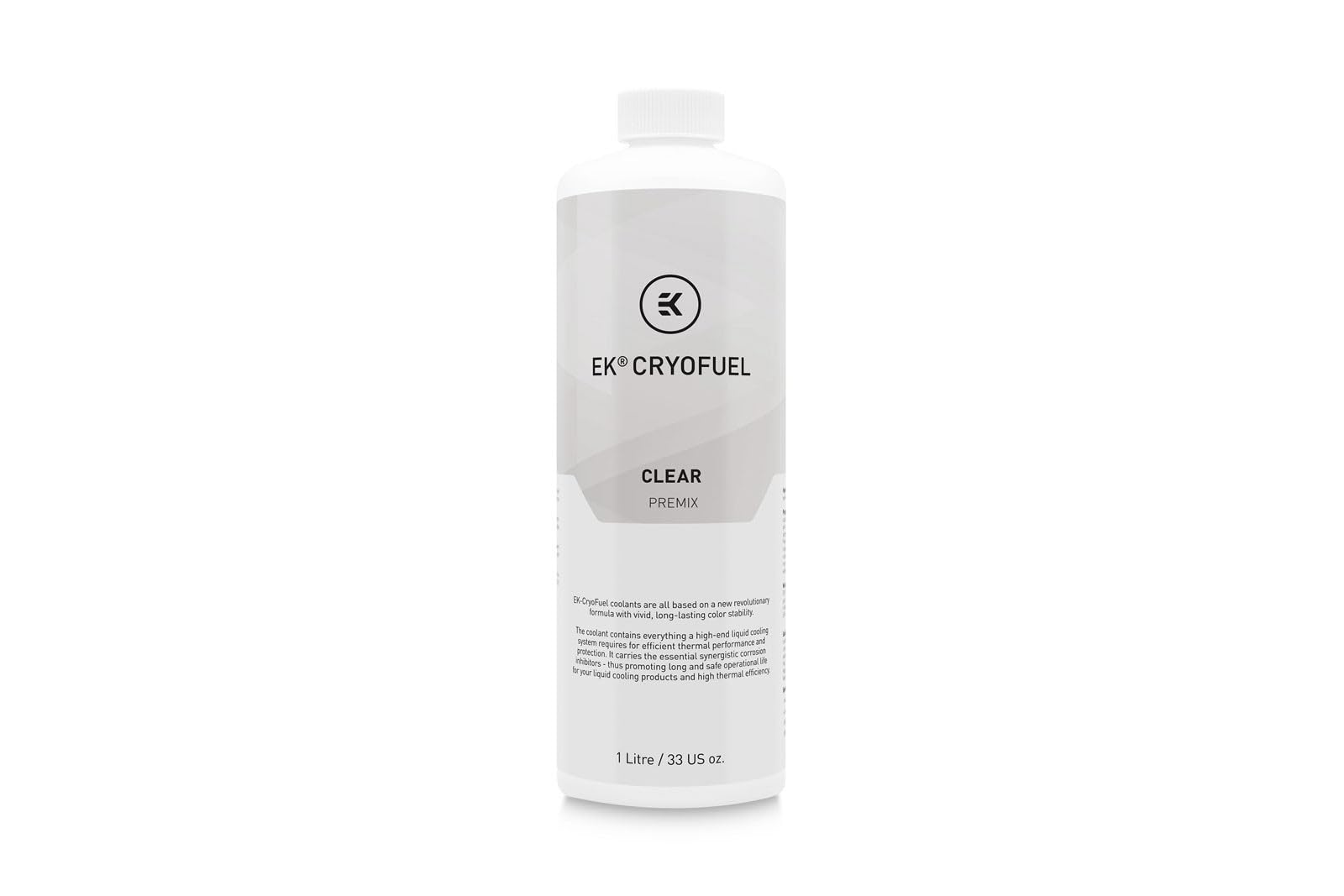
The compatibility line on EK's CryoFuel Premix is the first thing we check: acrylic, PETG, POM acetal, and common rubber seals. If your loop is built from those materials, that's a useful vote of confidence, because a coolant that's fine with copper can still be the wrong choice for a particular plastic or gasket. It's a full-liter premix, so there's no distilled water to buy and no ratio to get wrong.

Clear fluid and low electrical conductivity are a sensible pairing for a loop that sits near expensive electronics. It's also non-toxic and biodegradable, which doesn't hurt; those aren't the reasons you buy a coolant, but they make disposal and spills less annoying. The clear look also lets you spot clouding or sediment early, which is the kind of maintenance signal you want from a daily driver.

The reason it lands as a runner-up rather than the top pick is scope: our top pick is the safer bet for mixed metals, while this one is the better match for an acrylic or PETG loop. It's a full-liter premix, low conductivity, and no mixing. The material list is the part that earns it a place.

Pros

  • Acrylic, PETG, POM, rubber compatibility
  • Low electrical conductivity
  • Ready-to-use 1000 mL premix
  • Non-toxic, biodegradable formula

Cons

  • Premium price for a clear premix
Our verdict

Acrylic and PETG loops are where we trust this clear premix most: an explicit material list, low conductivity, and no mixing step.

Check Latest Price
4

Best Long-Life Colored Coolant

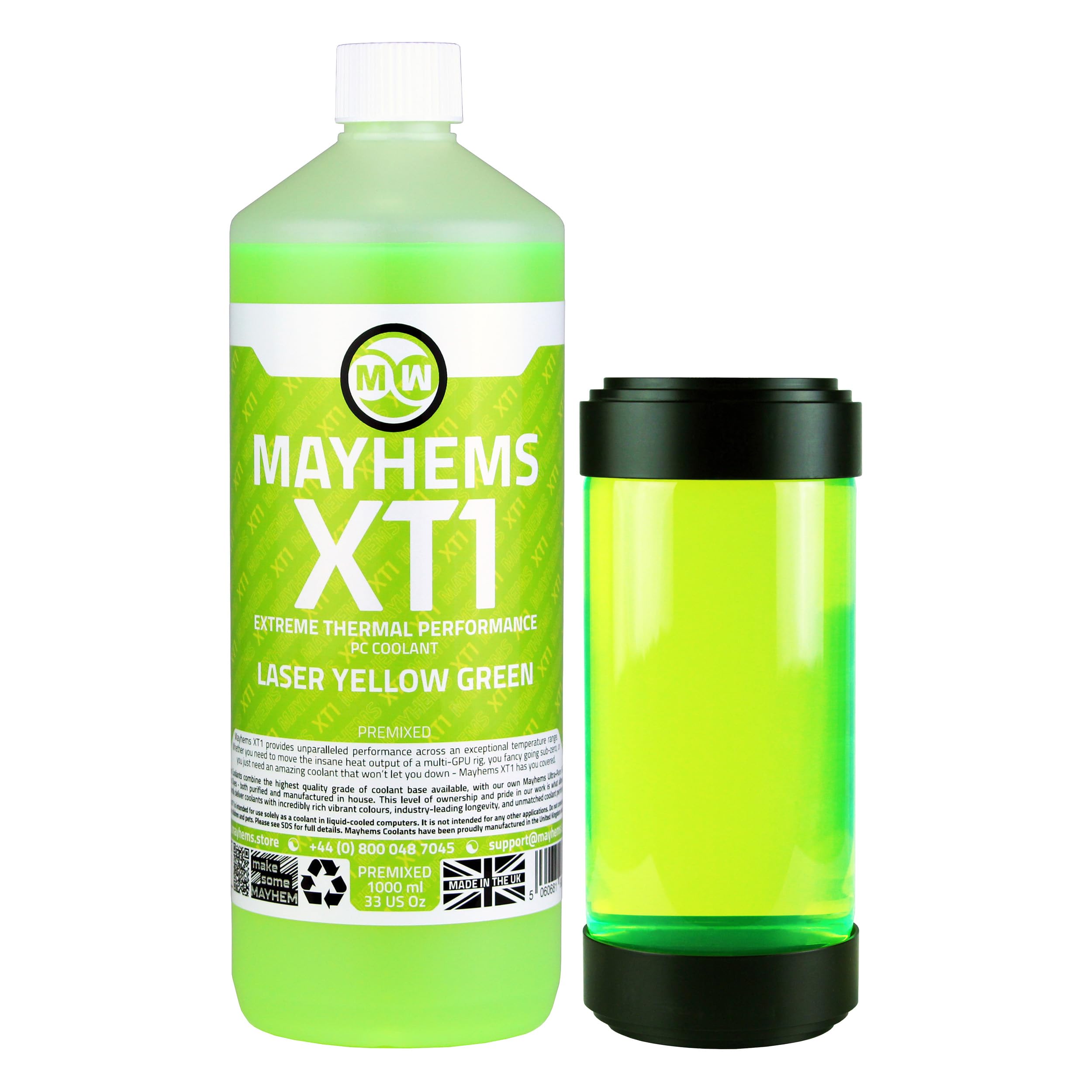
Mayhems XT1

89 /100
LBD Score Excellent

Key details

Type
Pre-mixed 1 L
Color
Laser yellow green
Lifespan
Long-life formulation
Protection
Corrosion and scale
View on Amazon

Mayhems positions XT1 as its longest-life coolant, and that's the promise that matters for a colored loop. Dye is usually the first thing to give up in a custom loop, so a fluid that's built around thermal performance and corrosion protection is more interesting than a bottle that only looks good on day one. The laser yellow-green is vivid, almost highlighter-bright in the right light, and it's a ready-to-use liter. It suits a build where the coolant is part of the color scheme and you don't want to babysit the loop.

The formula is aimed at scale and corrosion protection, and the one-liter bottle is a practical size for a small-to-mid loop. The long-life wording is the maker's, so treat it as a reason to choose XT1 over a show fluid, not as permission to ignore the loop. Check the fluid at the same time you clean the dust filters, and drain it if the color shifts or the tubing starts to haze.

Pros

  • Ready-to-use 1 L premix
  • Corrosion and scale protection
  • Long-life formulation
  • Vivid laser yellow-green

Cons

No notable drawbacks to flag.

Our verdict

XT1 is the colored premix we choose when the loop is meant to look vivid between drains, with corrosion and scale protection in a ready-to-use liter.

Check Latest Price
5

Best Budget Clear Coolant

PrimoChill Pure

85 /100
LBD Score Excellent

Key details

Type
Pre-mixed 0.9 L
Color
Clear
Pump Care
Lubricating properties
Formulation
Low viscosity, low chemical content
View on Amazon

Low viscosity is the reason PrimoChill Pure earns a place in a budget loop. It's a clear premix with no glycols or heavy chemical load, and it's formulated with lubricating properties for the pump. That last part is the practical bit: a high-flow pump doesn't need a thick fluid, and a little lubrication is welcome over a long service life. Check your loop capacity before you start.

What we like most is that it doesn't pretend to be a show fluid. There's no dye to fade, no opaque particle load to settle in a block, and no long-life claim to pin your hopes on. You get a clear coolant that protects common loop materials and keeps the loop easy to inspect. For a first build or a budget rebuild, that's the right set of priorities. If your loop is acrylic-heavy or you want a manufacturer's material list for PETG, EK's premix is the safer match.

Pros

  • Low-viscosity clear premix
  • Pump-lubricating properties
  • Makes loop inspection easy
  • Budget-friendly clear option

Cons

  • 0.9 L bottle is short of a full liter
Our verdict

Pure is the low-viscosity clear premix we recommend for a simple loop on a tight budget, with pump-friendly lubrication and no dye to fade.

Check Latest Price
6

Concentrate Loops

EK-CryoFuel Concentrate

87 /100
LBD Score Excellent

Key details

Type
Concentrate 100 mL
Color
Clear
Mixing
Distilled water required
Loop Materials
Acrylic, PETG, POM, rubber
View on Amazon

A 100 mL bottle that you dilute with distilled water is a different kind of purchase from a liter of premix. You're buying shelf space and control over the mix, not a pour-and-go fill. That's the appeal of EK's CryoFuel Concentrate: it's small enough to keep a spare on hand, and it's built to the same low-conductivity, non-toxic formula as the brand's premix. The material list covers acrylic, PETG, POM acetal, and common rubber seals.

The concentrate is clear, so it won't add color to a loop, and the one-year manufacturer warranty is a useful backstop. We like it for a builder who already has distilled water and a clean loop, because the mixing step is the whole trade-off. You have to measure, you have to use distilled water, and you have to accept that a cloudy mix is usually a mixing problem rather than a coolant problem. None of that is hard, but it is more work than opening a premix.

What keeps it in the also-consider tier is the lack of margin for error. A concentrate is less forgiving if you're new to custom loops or if you're topping off in a hurry. For an experienced builder who wants a compact spare and doesn't mind the extra step, it's a sensible pick. For everyone else, a premix is the easier path.

Pros

  • Compact 100 mL concentrate
  • Low electrical conductivity
  • Acrylic, PETG, POM, rubber compatibility
  • One-year manufacturer warranty

Cons

No notable drawbacks to flag.

Our verdict

If you keep distilled water on hand, this is the compact concentrate we reach for: low conductivity, broad plastic compatibility, and a one-year warranty.

Check Latest Price

How We Tested the Best PC Coolants

The shortlist started with research rather than bottles. We read spec sheets and retail listings for two dozen fluids, sorted them by premix or concentrate, checked which metals each one claimed to work with, and worked out cost per liter of usable fluid so a small concentrate bottle wasn't quietly the most expensive option in the room. That narrowed it to 14 coolants, which ran for six months.

The first was a working thermal loop on a test bench — CPU block, 360mm radiator, pump-reservoir — running several hours a day under sustained load. We logged coolant and component temperatures against a distilled-water baseline, and watched the reservoir after every fill and after ramping the pump to see whether foam built up or cleared. The second loop was built to be looked at: clear tubing and a clear-topped block, photographed from the same angle under the same light every two weeks so a color shift or dye creeping into the microfins showed up before it became a permanent stain.

At the end we drained both loops and took the blocks apart. We noted how much rinsing it took to run clear, whether anything had caked between the fins, and whether fittings or nickel plating had gone cloudy or pitted. Concentrates earned or lost points on the mixing itself — how clear the instructions were and whether the ratio left us confident. A vivid dye or a translucent tint only counted if it still looked that way in month five.

How to Choose a Pc Coolant

Match the coolant to your loop materials

A coolant's first job is to keep dissimilar metals from corroding and to leave plastics alone. Check both sides of your loop: copper, nickel, brass, and aluminum for the metal parts; acrylic, PETG, POM, and rubber for the tubing, blocks, and seals. A fluid that lists copper and nickel isn't automatically the right choice for an aluminum radiator, so look for the metals you actually have. Aqua Computer Double Protect Ultra is the clear example here: it's explicitly listed for copper and aluminum, which is the pairing that catches people out.

Choose premix for simplicity, concentrate for control

Premixed coolant is ready to pour and leaves less room for error, which is why it's the better default for most first builds. A concentrate is smaller and cheaper to ship, but you supply the distilled water and the measuring. EK's CryoFuel Concentrate is a good example of the format: compact, low conductivity, and compatible with common loop plastics, but it only works if you mix it properly. Use distilled water, not tap, and follow the bottle's ratio rather than eyeballing it.

Decide how much color you need

Clear coolant is the low-maintenance choice: no dye to fade, no particles to settle, and you can see clouding or sediment before it becomes a bigger problem. Translucent colors add visual punch with fewer solids than opaque show fluids, but the shade can shift through clear tubing and under different lighting. If the exact color matters, test a sample in your tubing before you commit. If a bottle tells you to stop circulation after a set number of hours, treat it as a show fluid, not a daily driver.

Plan for bottle size and upkeep

A liter is a useful benchmark for a small-to-mid loop, but it isn't a universal fill. A 0.9-liter bottle is not a full liter, and a large loop with a big reservoir can drink more than you expect. Buy enough for the fill plus a little top-off, and keep distilled water on hand if you're using a concentrate. PrimoChill Pure is a good budget example of the 0.9-liter size: fine for a compact loop, tight if you're filling a lot of tubing and radiators.

Don't expect coolant to fix temperatures

A coolant's job is protection and flow, not a dramatic temperature drop. If your loop is running hot, the first things to check are radiator size, airflow, pump speed, and block contact. What coolant can do is keep the loop clean, reduce foaming, and avoid galvanic corrosion. Low-viscosity fluids like PrimoChill Pure are aimed at high-flow pumps, while anti-foam formulas like Aqua Computer's are easier to live with in a quiet build. Pick for the loop you have, not for a temperature miracle.

Frequently Asked Questions

Final Verdict

After testing the set, Aqua Computer Double Protect Ultra is the coolant we recommend for most custom loops. It's ready to use, explicitly compatible with copper and aluminum, and its anti-foam, low-conductivity formula is the right baseline for a loop you want to leave alone.

If color is the point, Corsair XL8 gives you a vivid premix; if your loop is acrylic-heavy, EK's CryoFuel Premix has the material list to match. The right pick is the one that fits your metals and your maintenance habits, not the brightest bottle on the shelf.