Best Powered Subwoofers of 2026

A subwoofer is the one speaker in a home theater that can ruin a room as easily as it fills it. Bought cheap or placed badly, it booms over dialogue and rattles the pictures on the wall. Placed well, movies gain weight and music gains a floor. That's the whole job: adding the low end you feel without smearing the low end you hear.

Over eight months, we've had 11 powered subwoofers in our living rooms, through movie nights, weekend music sessions, and one unfortunate round of action films at 2 a.m. Two things stood out. Port design matters more than the wattage printed on the box — a well-shaped port is what keeps an explosion from turning into a chuff. And auto-on circuitry, which nobody advertises, decides whether the sub is awake for the quiet opening of a movie or asleep through it.

The picks below earned their spots in real rooms, from a cramped den to an open basement, and each one suits a different space and budget. Room size is the first question; everything else comes second.

1

Best Overall

Klipsch R-12SW

96 /100
LBD Score Outstanding

Key details

Woofer
12 inches
Dimensions
20"D x 20"W x 17.75"H
Amplifier Power
400 W dynamic
Low Frequency Response
29 Hz
View on Amazon

The case for the R-12SW is simple: it's the only subwoofer here with a 12-inch driver and 400 watts of amplification, and it costs about what the 10-inch models do. That's why it's our top pick. A bigger driver moving more air, with an amplifier that never has to strain at normal listening levels, is the difference between bass that adds weight to a movie and bass that just makes the room louder.

The low end is rated to 29 Hz, deep enough to put a real floor under a bass line and give low effects somewhere to land. The copper-spun cone and brushed black cabinet are also more interesting to look at than the usual black box, which counts for something in a room you actually sit in.

Setup is straightforward — line and LFE inputs, a low-pass crossover, and a phase control, which is everything a receiver with a sub out needs and enough to blend it by ear if you don't have room-correction software. The thing to plan around is size. At 20 inches deep, 20 wide, and nearly 18 tall, it's a substantial piece of furniture and it wants a corner nobody is using.

Compare it with the Synergy Sub-100 below and the difference is mostly cabinet: the smaller Klipsch is easier to fit, the R-12SW is easier to hear. Measure the spot first, then buy the largest of the two that fits.

Pros

  • 12-inch driver and 400 watts of headroom
  • Rated down to 29 Hz
  • Line and LFE inputs with crossover and phase
  • Copper cone and brushed finish look the part

Cons

  • A 20-inch-deep cabinet needs real floor space
Our verdict

Our default for movie-first rooms: a 12-inch driver, 400 watts of headroom, and the lowest rated extension here at 29 Hz.

Check Latest Price
2

Best for Small Rooms

Polk PSW10

95 /100
LBD Score Outstanding

Key details

Woofer
10 inches
Crossover
80–160 Hz
Dimensions
17"D x 14.25"W x 14.5"H
Amplifier Power
100 W peak, 50 W RMS
View on Amazon

The PSW10 is the subwoofer we reach for when the room is the constraint rather than the budget. A 10-inch driver in a cabinet 14.25 inches wide and 14.5 tall, about 17 inches deep, tucks beside a sofa or under a side table in a way the 12-inch Klipsch never will, and the detachable grille lets it pass for furniture when it has to.

What you give up is output. The amplifier is rated at 50 watts RMS with 100 watts of peak on tap, which is modest beside almost everything else here, and in a big open living room you'll hear it working. In a den, a bedroom, or an apartment living room, that trade goes the right way: the bass is clean and tuneful rather than boomy, and it blends with small speakers instead of overrunning them.

The back panel has line-level and speaker-level inputs, speaker-level outputs, a continuously variable 80–160 Hz crossover, and a phase toggle — enough to hook up to a receiver that predates subwoofer outputs. There's no dedicated LFE jack, though, so a receiver with a single sub output needs a Y-splitter into the left and right line inputs. Once it's connected, the auto-on circuit wakes it with the signal, which means it can live behind a chair and stay out of the conversation.

Pros

  • Compact 14.25-inch-wide cabinet
  • Clean bass that suits small rooms
  • Speaker-level inputs work with older receivers
  • Adjustable 80–160 Hz crossover and phase switch

Cons

  • 50 watts RMS limits output in larger rooms
  • Port chuff can appear at high volume
Our verdict

The subwoofer to buy when the room is small and the neighbors are close: compact, clean, and easy to live with, as long as you don't ask it to fill a big space.

Check Latest Price
3

Best for Mid-Size Rooms

Klipsch Synergy Sub-100

92 /100
LBD Score Outstanding

Key details

Woofer
10 inches
Warranty
5 years parts and labor
Dimensions
15.7"D x 12.5"W x 14"H
Amplifier Power
150 W continuous, 300 W dynamic
View on Amazon

Think of the Sub-100 as the R-12SW with 10 inches instead of 12 and a smaller appetite for floor space. It's 12.5 inches wide, 14 tall, and about 15.7 deep, roughly 25 pounds — the sort of subwoofer that goes between a bookcase and the wall without becoming the thing everyone comments on.

Klipsch rates it at 150 watts continuous with 300 watts of dynamic headroom through a spun-copper Cerametallic front-firing driver, and backs it with five years of parts-and-labor cover, which matches the best warranty in this group. The removable grille comes off cleanly if you prefer looking at the copper driver to a black square, and the gain and crossover are easy to reach and adjust by ear.

Where it falls short is headroom. The mid-size room we used it in was comfortably filled, but in a large open space 150 watts continuous runs out well before the R-12SW does, and the deepest effects lose their weight first. What it does not give you is the last word in output — but it does give you a subwoofer you can actually place, and in most rooms that's the harder problem.

Pros

  • 150 watts continuous, 300 dynamic
  • Much smaller cabinet than the R-12SW
  • Five-year parts-and-labor warranty
  • Removable grille and easy-to-reach controls

Cons

  • Runs out of output in large open rooms
Our verdict

A genuine Klipsch subwoofer in a 12.5-inch-wide cabinet — the right call when floor space decides the purchase and the room is mid-size.

Check Latest Price
4

Best Budget Pick

Dayton Classic CS800

90 /100
LBD Score Outstanding

Key details

Woofer
8 inches
Dimensions
14"D x 11.5"W x 12.37"H
Amplifier Power
150 W
Low Frequency Response
35 Hz
View on Amazon

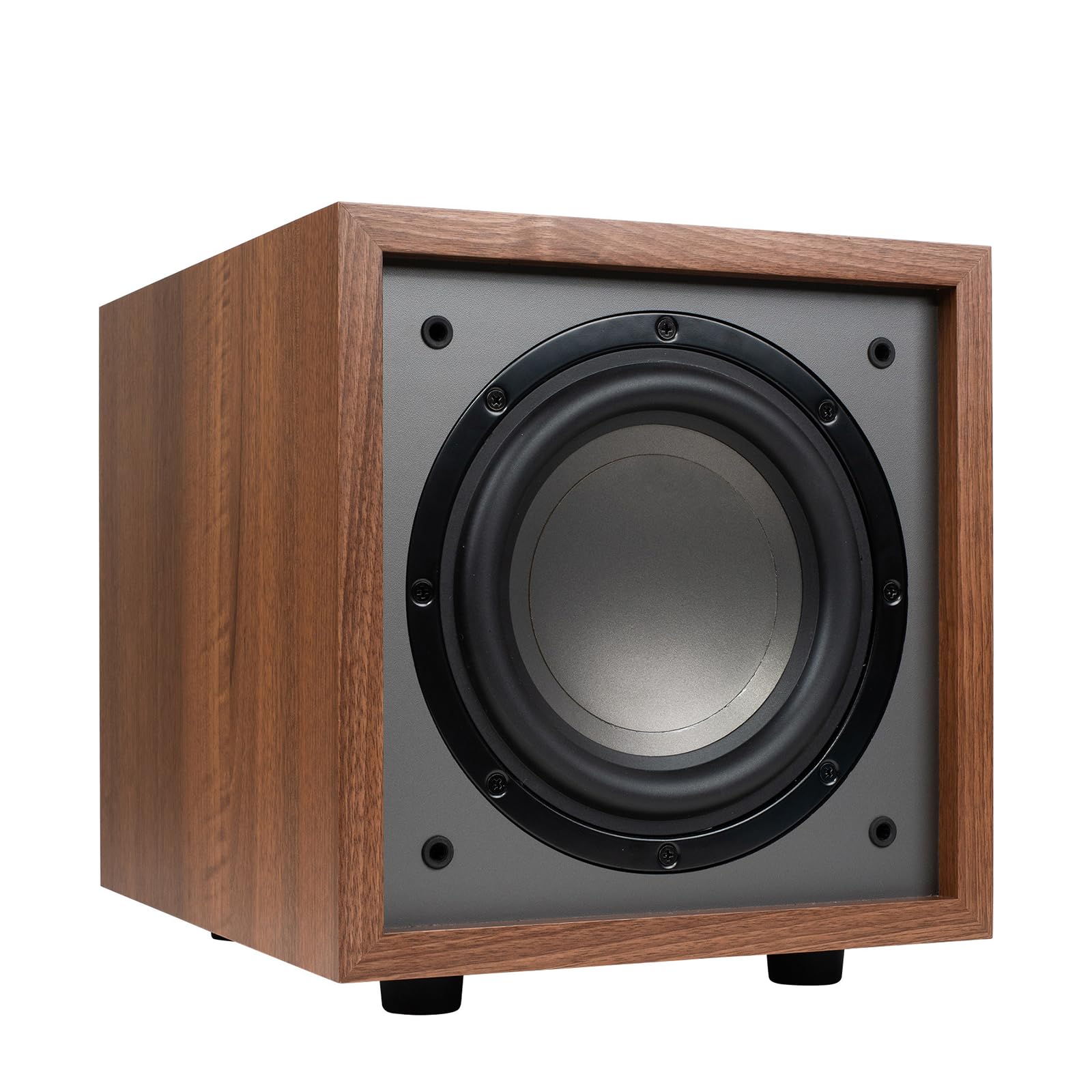
The CS800 is the subwoofer here that doesn't ask to be hidden. The wood-grain cabinet, the swappable grille, and a footprint about 11.5 inches across make it the one we put in a living room rather than a theater corner, and at 12.37 inches tall it slides under a side table or beside a bookshelf and looks deliberate there instead of tolerated.

Inside is a 150-watt Class D amplifier and an 8-inch driver in a braced cabinet, rated down to 35 Hz. Dayton also fits stereo RCA, LFE, and speaker-level inputs, plus auto-on, and covers the whole thing for five years — the longest warranty in this group alongside Klipsch's.

An 8-inch driver can't move the air a 12-inch one does, and that's the honest limit here. In a bedroom, a study, or a small living room with bookshelf speakers, we didn't miss the bigger boxes at all; the bass stays tight and tuneful rather than thick, which is exactly what a music-first system wants. Pair it with a pair of stand-mount speakers and the whole setup disappears into the room.

Pros

  • Wood finish and 12.37-inch-tall cabinet
  • 35 Hz from an 8-inch driver
  • LFE, RCA, and speaker-level inputs with auto-on
  • Five-year warranty

Cons

  • Output suits small and mid-size rooms only
  • Black grille sold separately
Our verdict

The best-looking small subwoofer here, and the one to buy when the system lives in a shared room and the bass has to stay tight.

Check Latest Price
5

Best for Tight Spaces

Edifier T5s

90 /100
LBD Score Outstanding

Key details

Woofer
8 inches
Crossover
30–160 Hz
Amplifier Power
70 W RMS
Low Frequency Response
35 Hz
View on Amazon

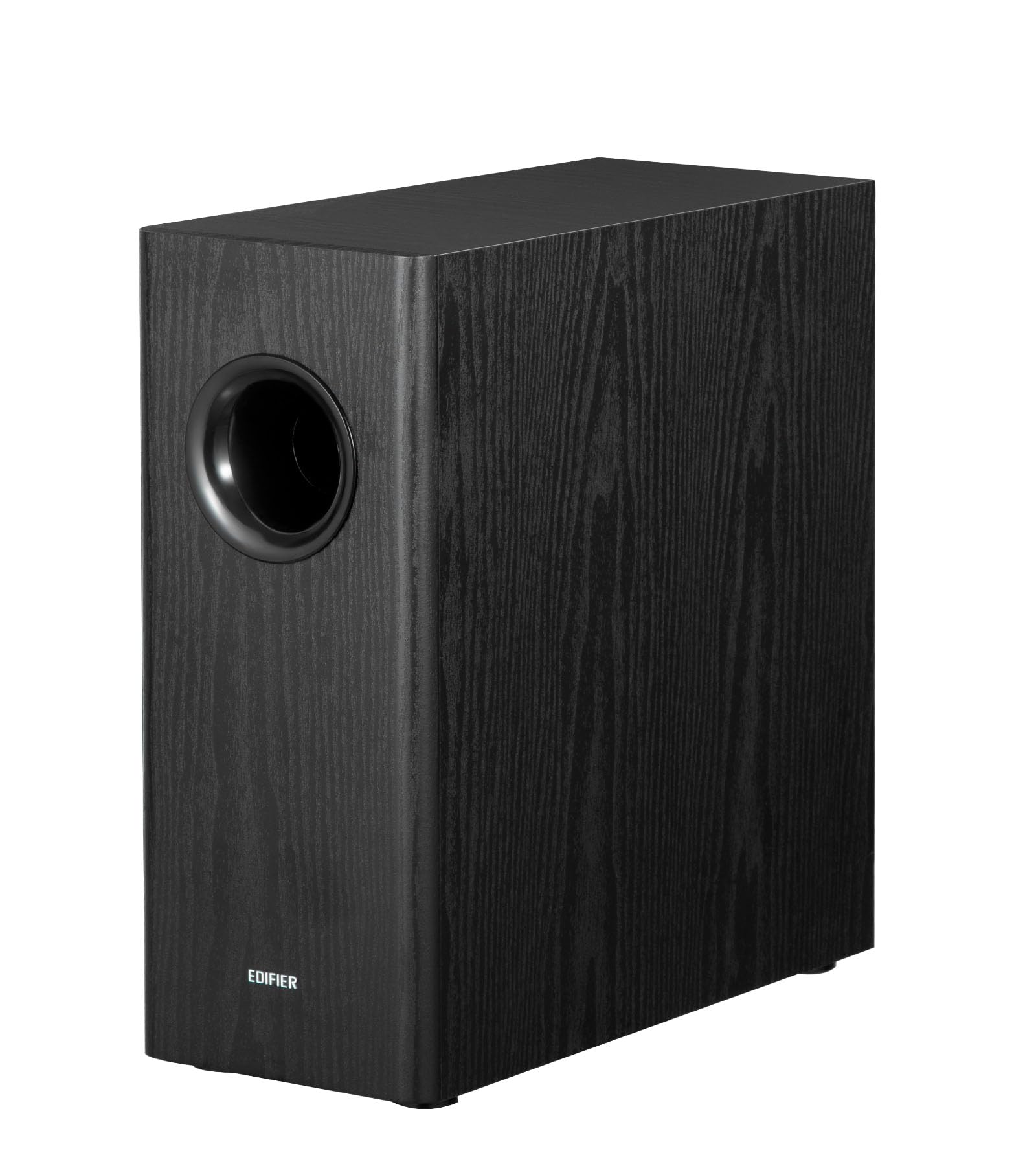
Six and a half inches is the number that matters here. At 6.69 inches wide and 16.14 tall, the T5s is the only subwoofer in this group that fits between a desk and a wall or alongside a narrow media console, and because the driver fires forward it can sit close to a wall — though the port on its right side does want a little breathing room. Slim subwoofers usually mean a small driver and a thin sound; this one puts an 8-inch long-throw woofer in an 18mm MDF cabinet, so the narrowness comes out of cabinet depth rather than driver size.

Seventy watts RMS is the least power here, and it shows in a big room: this is a bedroom, office, or apartment subwoofer, not a theater one. What it does have is unusual control for the size — a 30–160 Hz low-pass filter, a 0/180 phase switch, and auto standby after 15 minutes of silence. The one thing we noticed is pairing: the T5s is happiest fed from an amplifier or powered speaker with a sub output, and it can be fussy with some of Edifier's own speaker systems. Get past that and it's the least intrusive way to add real bass to a small system.

Pros

  • 6.69 inches wide fits where others won't
  • 30–160 Hz crossover and phase switch
  • Auto standby after 15 minutes
  • Front-firing driver sits close to a wall

Cons

  • 70 watts RMS limits it to small rooms
  • Can be fussy to pair with Edifier speakers
Our verdict

The narrowest subwoofer here by a wide margin, and the sensible choice when the gap between the desk and the wall is all the space you have.

Check Latest Price
6

Yamaha-Based Systems

Yamaha NS-SW100

91 /100
LBD Score Outstanding

Key details

Woofer
10 inches
Dimensions
18.85"D x 20"W x 18.6"H
Power Switch
Manual, rear panel
Amplifier Power
100 W
View on Amazon

A 100-watt amplifier inside a cabinet 20 inches wide, 18.6 tall, and 18.85 deep is a strange ratio on paper, and it's the first thing to get straight about the NS-SW100. The upside is that a box this size doesn't have to work hard: the larger air volume and Yamaha's Twisted Flare Port let modest power produce room-filling bass at ordinary volumes. The downside is that you're surrendering a lot of floor for 100 watts.

The rest of the design points the same way. Advanced YST II and the flared port exist to keep the low end tight rather than loose, so the NS-SW100 reads as musical first and theatrical second — the opposite of what its size suggests. The 10-inch cone driver is fed by gain and crossover controls you set by ear.

In a small or mid-size room this is an easy subwoofer to live with: it blends into a system without much fiddling and never sounds like it's straining. Our reservation is value. This is the most expensive subwoofer in this group, and the Klipsch pair give you more output and deeper extension for less, so you're paying for cabinet volume and Yamaha's tuning rather than for bass you can feel.

Pros

  • Tight, musical bass from a 10-inch driver
  • Large cabinet helps modest power
  • Blends easily into small and mid-size rooms

Cons

  • Manual power switch with no auto-off
Our verdict

A well-behaved, musical subwoofer with a big cabinet and a modest amplifier — worth it if you want Yamaha's tuning and can spare the floor.

Check Latest Price

How We Picked and Tested These Subwoofers

The shortlist started with research, not listening. We compared driver size against cabinet volume, checked which amplifier class each manufacturer used, and read the back panel: LFE only, or line-level and speaker-level inputs too? Anything without a phase control or an auto-standby mode got cut, which left 11 subwoofers to test over eight months.

Those 11 lived in our homes rather than a lab. Each spent at least three weeks in a living room running off an AV receiver for movie nights and weekend music, and we rotated a few into a small den on a stereo amp and one into a bedroom to see how a compact box handled a real 12-by-14-foot space.

Setup got timed and repeated — one person, box to first movie — then we redid the connection a second way to see how much the manual and the back panel actually helped. Listening followed the same handful of scenes and tracks every time: we noted whether the bass stayed underneath dialogue or smeared into it, and when a sub that sounded open in the living room turned muddy in the den. To find the limit, we kept raising the volume until we heard port chuff, cabinet buzz, or a rattling grille, and wrote down where that happened. For power, we left each one on auto-standby for a week, listening for the relay click, for whether it woke in time on a quiet opening scene, and for transformer hum in a silent room.

Size and value got the last word. We measured footprints, slid each one under a console table, and lifted them alone to see what moving day would feel like. Final rankings went by what each delivered in the room it stood in, not by watts or price tag.

How to Choose a Powered Subwoofer

Match the driver to the room

An 8-inch subwoofer like the Dayton Classic CS800 or the Edifier T5s is the right answer for a bedroom, a study, or an apartment living room, where it only has to pressurize a modest space. A 10-inch model such as the Polk PSW10 or the Klipsch Synergy Sub-100 sits in the middle, and a 12-inch design like the R-12SW is what an open-plan room wants when the seating is well away from the speakers. Bigger isn't automatically better — a 12-inch sub turned down in a small room often sounds worse than an 8-inch one working in its comfort zone.

The trap is the wattage number. Dynamic, peak, and continuous ratings aren't interchangeable: the R-12SW's 400 watts is a dynamic figure, while the Synergy Sub-100's 150 watts is continuous with 300 dynamic, so the gap between them is narrower than the two headline numbers suggest. Compare like with like before you pay for a bigger number.

Check the inputs before anything else

Every subwoofer here needs mains power and a signal, and the way the signal arrives is where most setups go wrong. A receiver with a single RCA subwoofer output is the easy case — one cable and you're done. If your amplifier predates that, you need a model with speaker-level inputs, which the Polk PSW10 and the Dayton Classic CS800 both provide, and the Edifier T5s handles the same situation by chaining through its own signal input instead.

Look at what your receiver actually offers before you order: a sub out, a pair of pre-outs, or nothing but speaker terminals. Buying a subwoofer whose inputs don't match is the one mistake here that no amount of tuning fixes.

Set the crossover, then move the box

Two controls do most of the blending. The low-pass crossover decides where the subwoofer takes over from your main speakers — around 80 Hz is the usual starting point, higher with small satellites that can't play low — and phase helps it arrive in step with them. A wide range, like the 30–160 Hz filter on the Edifier T5s or the 80–160 Hz control on the Polk, gives you more room to work with modest speakers.

Placement comes next, and it costs nothing. A corner gives you more output, but it can also make the bass thick and one-notey; a spot along a wall roughly a third of the way into the room is usually cleaner. Move the sub a foot at a time and listen before you touch another dial.

Plan for power, floor space, and finish

Two things you live with every day are how the subwoofer switches on and how much floor it takes. An auto-on circuit wakes it with the signal and puts it back to sleep when the room goes quiet — the Edifier T5s does that after 15 minutes — while a manual rear-panel switch means walking over each time, which gets old fast if the sub sits behind a cabinet. Footprint matters just as much: compact in a listing usually means it fits a shelf, not that it disappears. The 20-inch depth of the R-12SW against the 12.37-inch height of the CS800 is the difference between claiming a corner and sliding under a side table.

Finish is the last thing, and the one buyers underestimate. A wood-grain cabinet like the Dayton's reads as furniture in a shared room; a black cube reads as a black cube. If the subwoofer is going to sit in view, that's worth more than another 50 watts.

Frequently Asked Questions

Final Verdict

Buy the Klipsch R-12SW if the room can take a 20-inch-deep cabinet: the 12-inch driver and 400 watts give you more genuine low-end output than anything else here, and it reaches down to 29 Hz while the 10-inch models are still climbing.

If floor space or a shared wall changes the requirement, the Dayton Classic CS800 is the better small-room answer — its 12.37-inch-tall cabinet disappears beside a bookcase and its five-year warranty matches the best cover here. Between the two, the Polk PSW10 is the apartment compromise.