Best Pure Sine Wave Inverters of 2026

A pure sine wave inverter does one job: turn the 12 volts sitting in your battery into the smooth AC power your appliances expect. The waveform is exactly where the cheap units give themselves away — a modified sine wave box will happily light a lamp, then make a CPAP hum all night, send a laptop charger running hot, or refuse to start a fridge compressor at all. Even among true sine wave models, the differences come down to unglamorous things: how the unit behaves when a load kicks on, how much noise it makes while it works, and whether the remote control actually saves you a walk out to the battery bay.

We've spent the better part of a year running these in garages, vans, and one memorably dark power outage — nine units in all, from a 300-watt cigarette-lighter model to 3,000-watt hardwired systems. One thing I'd tell any first-time buyer: ignore the peak wattage printed on the front and find the continuous rating, then leave headroom for the appliances that spike at startup. The picks below cover everything from running a CPAP overnight to keeping an RV's electrical system alive, and each one earned its spot on performance rather than a spec sheet.

1

Best Overall

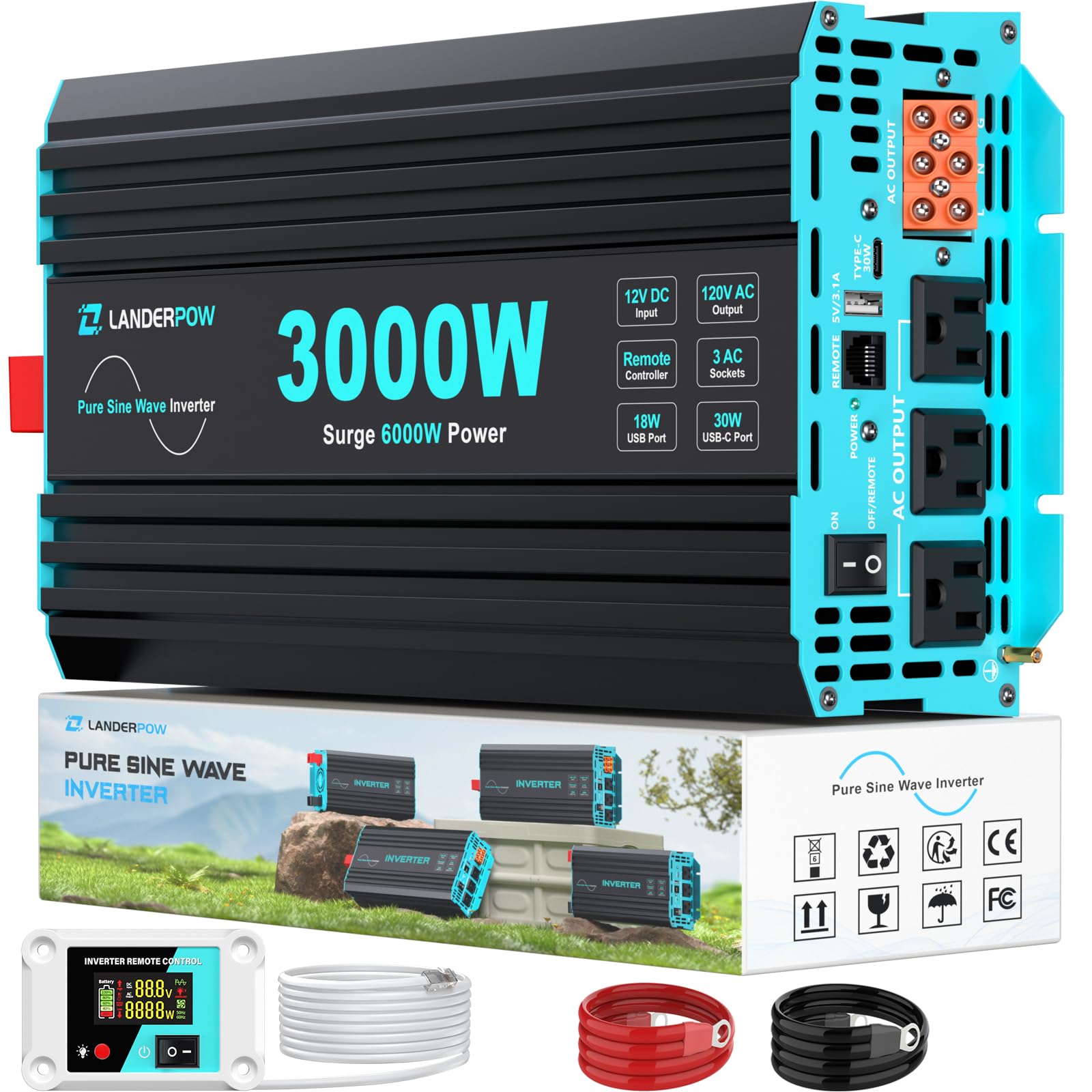
LANDERPOW 3000W Pure Sine Wave Inverter

88 /100
LBD Score Excellent

Key details

Remote
15 ft wired, LED screen
Outlets
3 AC, USB-C, USB, hardwire
Surge Power
6000 watts
Continuous Power
3000 watts
View on Amazon

At 7.5 pounds, the LANDERPOW is the lightest 3000-watt inverter in this group — light enough to hold in one hand while you line up the mounting screws, which is not true of the 9.9-pound BELTTT. That matters more than it sounds, because a unit this size usually ends up in a battery bay or under a dinette where you're working at an awkward angle. We also like that it covers all three ways out of the box: three AC outlets on the face, a hardwire terminal for a permanent circuit, and a 30W USB-C plus a 5V/3.1A USB port.

The 15-foot wired remote is the part we point to first if you're building this into a van or a small trailer. Its LED screen reads battery voltage, load, and output together, so the state of your bank is visible from the living space instead of buried behind a cushion. That's the difference between knowing your battery is sagging and finding out when the fridge stops.

Rated at 3000 watts continuous and 6000 watts of surge, it has the headroom a compressor needs to start — a 10,000 BTU air conditioner or a full-size fridge is within reach — and conversion efficiency above 91% keeps the DC draw from ballooning over a long weekend. Three AC outlets also mean a laptop and a couple of small appliances can stay plugged in rather than taking turns. The 1AWG pure copper battery cables in the box are the right gauge for this class, which is one less thing to order separately.

The supplied battery cables are two feet, so the unit has to sit close to the battery; longer 1AWG cables are the fix, and buying them up front saves a second order and a second wait. Against that, this one carries the longest coverage here — a year of replacement plus two more of support — which is the sort of thing that matters when a 3000-watt unit is bolted under a bed.

Pros

  • 3000W continuous with 6000W surge headroom
  • Three AC outlets plus hardwire and USB-C
  • 15-ft remote shows battery, load, and output
  • Lightest 3000W case here at 7.5 lb

Cons

  • Cooling fans get audible under a heavy load
Our verdict

We recommend the LANDERPOW as the default 3000-watt choice: three AC outlets, a hardwire terminal, a genuinely useful 15-foot remote display, and three years of coverage in the lightest case here.

Check Latest Price
2

Best for Trucks and Vans

BELTTT 3000W Pure Sine Wave Inverter

88 /100
LBD Score Excellent

Key details

Remote
23 ft wired, LCD
Outlets
2 AC, 20A outlet, USB, hardwire
Surge Power
6000 watts
Continuous Power
3000 watts
View on Amazon

Twenty-three feet of remote cable is the longest run in this group, and the BELTTT pairs it with a front-panel LCD that shows input voltage, output voltage, battery state, and load at once. For a truck or a Class C where the battery bay sits far from anywhere you sit, that reach is the whole argument: mount the inverter where the heavy cable run stays short, then switch it on from the cab.

We think that combination — long remote, real display, and a 20-amp outlet that feeds an RV-style circuit without hardwiring — makes this the pick for work trucks, vans, and older RVs with a 20-amp inlet. Add dual AC sockets, a 5V/2.1A USB port, and a hardwire terminal and you have more connection options than anything else on this page.

The 9.9-pound case is heavier and longer than the LANDERPOW's — 17 inches against 13.8 — which is the trade for a bigger chassis and more heatsink area. Measure your mounting space before you commit. The box includes two 1/0AWG three-foot battery cables and a set of 45-amp fuses, so the DC side arrives largely covered.

What gives us pause is the long run. The failures that matter here are early ones, a few months of light use rather than years of service, and coverage is a single year against the LANDERPOW's three. If longevity and warranty carry weight in your decision, the top pick is the safer purchase even though it gives up the 20-amp outlet.

Pros

  • 23-ft remote cable, the longest reach here
  • LCD reports input, output, battery, and load
  • Dual AC, 20A outlet, USB, and hardwire
  • 1/0AWG cables and spare fuses included

Cons

  • Fans are loud once they ramp up
Our verdict

We like the BELTTT for anyone whose battery sits far from the driver's seat — 23 feet of remote cable, a 20-amp outlet, and a panel that shows what the whole system is doing.

Check Latest Price
3

Best for Shore Power

ZETAWALE 2500W Pure Sine Wave Inverter

88 /100
LBD Score Excellent

Key details

Outlets
2 AC, USB, USB-C
Surge Power
5000 watts
Transfer Switch
Built-in automatic
Continuous Power
2500 watts
View on Amazon

The reason to look at the ZETAWALE is a part you never see: a built-in automatic transfer switch. Plug into shore power and it passes that power straight through; unplug and it moves the load to your battery bank on its own. A separate transfer switch is another box, another mounting spot, and relay wiring between the two, so having it inside the inverter is what earns this one a place here.

We like it for a van or a small motorhome where the shore cord and the inverter feed the same circuit. At 2500 watts continuous and 5000 peak it sits a step below the 3000-watt units, so plan loads accordingly: a 5000 BTU window air conditioner or a coffee maker is comfortable, while a roof air and a microwave together are not. Two AC outlets, USB, and USB-C are the connection set.

Installation is where it impressed us most. At 8.2 pounds and about 14 inches long, it slots into spaces where the 17-inch BELTTT won't go, the hardwire path handles a permanent circuit, and the LCD remote shows what's coming in and going out. The 24-month warranty is the second longest in this group, behind the LANDERPOW's three years.

The remote is the piece to test the day it arrives, while returning it is still simple — mount it, wire it, and confirm the display before the install is finished. That's a five-minute check on an otherwise straightforward unit, and it's the only thing about this one we'd want to see working before the trim goes back on. On a trailer that already has a shore inlet, nothing else here does the same job for the money.

Pros

  • Built-in transfer switch handles shore power automatically
  • 8.2 lb in a compact 14-inch case
  • LCD remote shows input and output
  • 24-month warranty

Cons

  • Only two AC outlets for the wattage
Our verdict

We recommend the ZETAWALE when your rig already has a shore-power circuit, because the built-in transfer switch saves you a second box and the wiring between them.

Check Latest Price
4

Best for Cars

BESTEK 300W Pure Sine Wave Inverter

91 /100
LBD Score Outstanding

Key details

Weight
1.4 lb
Outlets
2 AC, 2 USB
Surge Power
700 watts
Continuous Power
300 watts
View on Amazon

The plug is the story here. This one draws through a 12V accessory socket, and those sockets are fused at 15 to 20 amps in most vehicles — roughly 180 to 240 watts whatever the inverter is rated for. The 300-watt continuous figure becomes real only when you run it straight off the battery with a clamp adapter. Through the cigarette lighter, plan on small loads, which is exactly the range this one is built for.

Within that ceiling, we think it's the most sensible thing here for a car. At 1.4 pounds and about the size of a paperback it lives in a glovebox, and the wider 11-17V input range is there for newer vehicles and Teslas, whose systems sit outside the plain 12V window. Two AC outlets and two USB ports at 2.4 amps each cover a laptop, a phone, and a CPAP, and the built-in 40-amp fuse is the protection a plug-in unit needs.

Pure sine output at this end of the market is the other half of the appeal. Laptops, radios, and CPAP machines are exactly the loads that run hot or buzz on a modified sine wave, and this one hands them grid-shaped power from a socket. ETL, RoHS, and FCC listings are all present, which is worth having on something that lives in a car.

An 18-month warranty is longer than we expect on a car accessory, and it takes some of the sting out of the price of being an early adopter on a small unit. Our advice is to keep it to what a socket can feed — a laptop, a CPAP, a camera battery, a fan — and to step up to a hardwired inverter the moment a kettle or a fridge enters the picture.

Pros

  • 1.4 lb and small enough for a glovebox
  • Two AC and two USB ports
  • Pure sine output for laptops and CPAPs
  • 11-17V input works in newer vehicles

Cons

  • Early failures are the main risk
  • Fan noise is noticeable under load
Our verdict

We think the BESTEK is the right small inverter for a car: 1.4 pounds, pure sine output, two AC and two USB ports, and enough for a laptop and a CPAP on the road.

Check Latest Price

How We Tested Pure Sine Wave Inverters

We started by gathering every pure sine wave inverter we could find with a continuous rating between 300 and 3,000 watts, then cut the list by the details that change daily life with one: whether it had a hardwire port, what kind of remote came in the box and how much cable it came with, how many AC and USB outlets it offered, and whether the price was reasonable for the wattage. Nine made the cut, spread across plug-in and hardwired designs.

Testing ran for eight months, mostly on a garage bench wired to a bank of deep-cycle batteries, with one unit spending a week in a van and another carrying a two-day home outage. Every inverter ran the same loads: a microwave, a coffee maker, a CPAP, a laptop charger, a small fridge, and a shop vac. I noted whether each appliance started on the first try or needed a second attempt, and whether voltage at the outlets held steady with a multimeter while the load ran.

I measured DC draw with a clamp meter and logged how much each unit pulled from the battery overnight with nothing plugged in. A decibel meter at three feet recorded fan noise at idle and under a 1,500-watt load, and I watched how quickly each case got hot and whether the fan cycled or just ran nonstop. Remotes were tested from the far end of the garage and from inside a truck cab, cable runs were measured end to end, and I checked terminal torque and cable gauge on every hardwire connection. At the end of the eight months, each unit re-ran the startup test to see whether it had lost any punch.

How to Choose a Pure Sine Wave Inverter

Size for the Surge, Then Add Up the Loads

Continuous wattage is what the unit can hold all day; surge wattage is what it delivers for a second or two while a compressor or motor starts. That headroom is why a 2500- or 3000-watt unit can run a small air conditioner whose nameplate reads far lower. Total up everything you expect to run at once, then check that the largest single load's start-up fits inside the surge rating.

Running one big appliance at a time is the realistic pattern even on a 3000-watt unit. A fridge, a coffee maker, and a microwave sharing a circuit at the same moment is how people trip these into protection — budget for the sequence, not the sum.

Choose the Connection Before the Wattage

A 12V accessory socket is fused at 15 to 20 amps in most vehicles, which caps you near 180 to 240 watts no matter what the inverter claims. That is the trap: a 300-watt plug-in unit is realistically a 180-watt unit unless you run it straight off the battery with a clamp adapter.

Anything above that needs its own fused cable to the battery, and once you're running cable you want it short and thick — 1AWG or 1/0AWG for a 3000-watt unit, with the fuse close to the positive terminal. If routing heavy cable through a vehicle isn't a job you want, price an installer in before you buy.

Outlets, Transfer Switching, and the Display

Two AC outlets covers a laptop and a lamp; three plus a hardwire terminal is what a built-in circuit wants. If your rig has a shore-power inlet, an inverter with a built-in automatic transfer switch, like the ZETAWALE, replaces a separate box and the relay wiring between them. The trap is buying the two pieces separately when an integrated unit costs about the same.

A remote with a display is worth more than one with only a switch. Seeing battery voltage and load from inside the cabin is how you catch a sagging bank before the fridge quits at 2 a.m.

Efficiency and Fan Noise

Conversion efficiency across the 12V-to-120V units here sits above 90%, and the difference matters most at the top of the range, where a few percent becomes real heat in the case and real amps out of the bank. Fans are the honest trade for that efficiency: every unit in this group makes noise under load, and the ones that cool hardest run loudest.

The trap is judging noise at idle, when nothing is running. A unit that's silent on the bench can be intrusive at 2000 watts, so mount the remote where you can switch it off without getting out of bed.

Certification and Coverage

For a vehicle install that will be inspected or insured, the listing you want is UL 458. Check the badge against the model number rather than trusting the word 'certified' on a bullet point.

Warranty ranges from a single year to three across this set, and since the failures that matter tend to show up in the first season, coverage is worth more than a small difference in price. Test the unit on a known load before you mount it somewhere you'll have to crawl back into.

Frequently Asked Questions

Final Verdict

For most builds, the LANDERPOW is the one to buy: 3000 watts continuous with three AC outlets, a hardwire terminal, a 15-foot remote that actually tells you something, and the longest coverage in this group, all in a 7.5-pound case. It leaves you room to grow without leaving you guessing about your battery.

Go with the BELTTT if your battery bay sits far from your seat and you want 23 feet of remote cable and a 20-amp outlet. If the trailer already has a shore-power circuit, the ZETAWALE's built-in transfer switch does a job the others need extra hardware for. And for a laptop and a CPAP in the car, the BESTEK is all the inverter you need.