Best Power Strips of 2026

A power strip is the most boring thing you'll buy this year — until a laptop brick sags out of the socket or the cord won't reach the one outlet your couch isn't covering. Most look identical on the shelf; the difference shows up in month three, when outlet spacing, plug grip, and the cord jacket are the only things you still notice. You want one that disappears: outlets spaced far enough apart that adapters don't fight, a flat plug that clears the wall behind your desk, and a cord that actually gets to where you sit.

I've bought plenty of these over the years, and my team has just spent six months with 14 of them, filling every outlet to see what gave. The surprise wasn't which ones failed — it was how differently two strips with the same outlet count handled a desk's worth of gear, and how quickly a strip with no USB-C starts to feel dated.

Below are the ones that stayed plugged in, sorted by where they earn their keep: the desk, the TV wall, the bedside table, and the bag you take on trips.

1

Best Overall

HANYCONY 8-Outlet Power Strip

96 /100
LBD Score Outstanding

Key details

Outlets
8
USB Ports
4 (2 USB-C)
Cord Length
5 ft braided
Surge Rating
1080 joules
View on Amazon

Three sides instead of one long bar is the design decision that makes this strip work. Eight AC outlets and four USB ports, two of them USB-C, sit on the top and both flanks of a block just over 8 inches across, so plugs fan outward instead of queueing along a single edge.

We set one up as a desk hub with a monitor, a laptop dock, a lamp, speakers and two phones on the USB side, and still had sockets free. What we appreciated most was how little room it took to do that: the block tucks behind a monitor stand or sits on a shelf, and the flat plug means the desk still goes flush against the wall.

Two USB-C ports at this end of the market is the detail we keep coming back to. Most strips here give you one, or none, and having the pair means a phone and a tablet both charge without an adapter block, which is exactly the clutter the ports are supposed to remove.

Mounting is sorted too, with keyhole slots on the back and a braided 5-foot cord that coils without kinking the way the flat cords on cheaper strips do. Five feet is desk length rather than room length, so measure before you commit if the outlet is across the room; the olcorife below solves that case.

Pros

  • Eight outlets and four USB ports on three sides
  • Two USB-C ports, still uncommon at this level
  • Flat plug, braided 5 ft cord, wall-mount slots
  • Costs less than the 12-outlet strips here

Cons

  • USB ports share 3.1 A of total output
Our verdict

For most desks and dorm rooms, this is the strip we point people to: eight outlets, four USB ports with two USB-C, and a footprint small enough to hide.

Check Latest Price
2

Best for Maximum Outlets

ALESTOR 12-Outlet Power Strip

96 /100
LBD Score Outstanding

Key details

Outlets
12
USB Ports
4 (1 USB-C)
Cord Length
6 ft
Surge Rating
2700 joules
View on Amazon

Twelve outlets is the whole argument for this strip. It is the pick for the wall behind a television, where the console, soundbar, router, modem, streaming box, lamp and two chargers all want a socket, and where a 6-foot cord lets the strip sit on the cabinet floor rather than hang off the wall.

Two of the twelve are spaced roughly 2 inches apart for adapters, with the other ten at standard spacing. That covered a couple of power bricks for us but not a row of them, and if your gear is mostly wall warts, the Anker 351's wider body handles that better.

Where it beats everything else here is surge capacity. At 2,700 joules it is the highest in this set, backed by a 15 A circuit breaker and a protected indicator that tells you the protection is still live. The four USB ports, one of them USB-C, sit on the end of the strip where they stay reachable even when it is jammed under a shelf.

What gives us pause is longevity. This is the shakiest long-term picture among the full-size strips here, with the USB bank and the power switch the parts that go first, which is why the 24-month coverage matters more than usual. Buy it for the outlet count and the joules, and keep the receipt.

Pros

  • 12 outlets and 4 USB ports, one of them USB-C
  • 2,700 joules, the highest surge rating here
  • 6 ft cord plus a 15 A breaker and protected light
  • 24-month warranty, longer than most here

Cons

  • Only two of the twelve outlets are widely spaced
Our verdict

When your media cabinet has more plugs than sockets, this is the one: 12 outlets, four USB ports and the highest surge rating in this group.

Check Latest Price
3

Best for Media Cabinets

Anker 351 Power Strip

96 /100
LBD Score Outstanding

Key details

Outlets
12
USB Ports
3 (1 USB-C)
Cord Length
5 ft
Surge Rating
2100 joules
View on Amazon

The problem this strip solves is the socket you cannot use, and it is the best answer to that in this group. Extra space between outlets means a chunky adapter does not take the neighbouring socket out of play, and on a 13-inch body there is room to spread out rather than stack up.

It showed most with the awkward gear: a projector brick at one end, a smart plug at the other, small chargers filling the gaps. The 5-foot cord is cut for a desk or a side table rather than a room crossing, and the whole thing feels denser than the budget strips here, which is part of what the extra outlay buys.

The connected-equipment warranty is the detail that should settle it for expensive gear. Surge protection is rated at 2,100 joules, and if a surge gets through, Anker covers up to $200,000 of what was plugged in, on top of an 18-month warranty on the strip itself. Nothing else here offers that kind of backing.

Where it gives ground is the USB side. There are three ports including USB-C, but the USB bank is the part that can stop working while the outlets carry on, so treat those ports as a bonus and put anything mission-critical on AC. That trade only makes sense if you need the spacing.

Pros

  • Widest outlet spacing of the 12-outlet picks
  • Connected-equipment warranty backs what is plugged in
  • Sturdy 13-inch body with a desk-length 5 ft cord
  • 2,100 joules and an 8-point safety system

Cons

  • USB ports can fail while the outlets keep working
Our verdict

If your plugs are bulky, buy this: 12 widely spaced outlets, a 13-inch body, and a warranty that covers what you plug into it.

Check Latest Price
4

Best for Small Spaces

Anker 341 Power Strip

96 /100
LBD Score Outstanding

Key details

Outlets
8
USB Ports
3 (1 USB-C, 20 W)
Cord Length
5 ft
Surge Rating
2000 joules
View on Amazon

Some rooms give you one reachable outlet and no floor space to build a charging station around it. This Anker is built for that: 8.3 inches long and under 2 inches wide, with outlets on three sides, so it sits along the back of a nightstand instead of jutting off the wall.

Two details sold us. The 45-degree flat plug means the furniture still sits flush, and the keyhole slots let you screw the strip to the back of a shelf where nobody has to look at it. On a nightstand running a lamp, a watch charger and two phones, it disappeared entirely.

The 20 W USB-C port is the reason to choose this over a plain strip: a phone left on it overnight charges at full speed rather than trickling. The AC side carries a 2,000-joule rating, and the switch sits where you can reach it without dragging the strip out from behind the bed.

What you give up is capacity and reach. Eight outlets go quickly once a monitor, speakers and a couple of chargers are on them, and the 5-foot cord keeps it close to the wall it is plugged into. For a media wall, the 351 above is the better answer; for one person's corner, this is plenty.

Pros

  • Compact 8.3-inch body with outlets on three sides
  • 45-degree flat plug sits flush behind furniture
  • 20 W USB-C port fast-charges a phone
  • 2,000 joules and keyhole mounting with screws

Cons

  • Three USB ports share their total output
Our verdict

The one we pack for a nightstand, dorm desk or hotel room: eight outlets in a slim body, a flat plug, and a 20 W USB-C port.

Check Latest Price
5

Best Long Cord

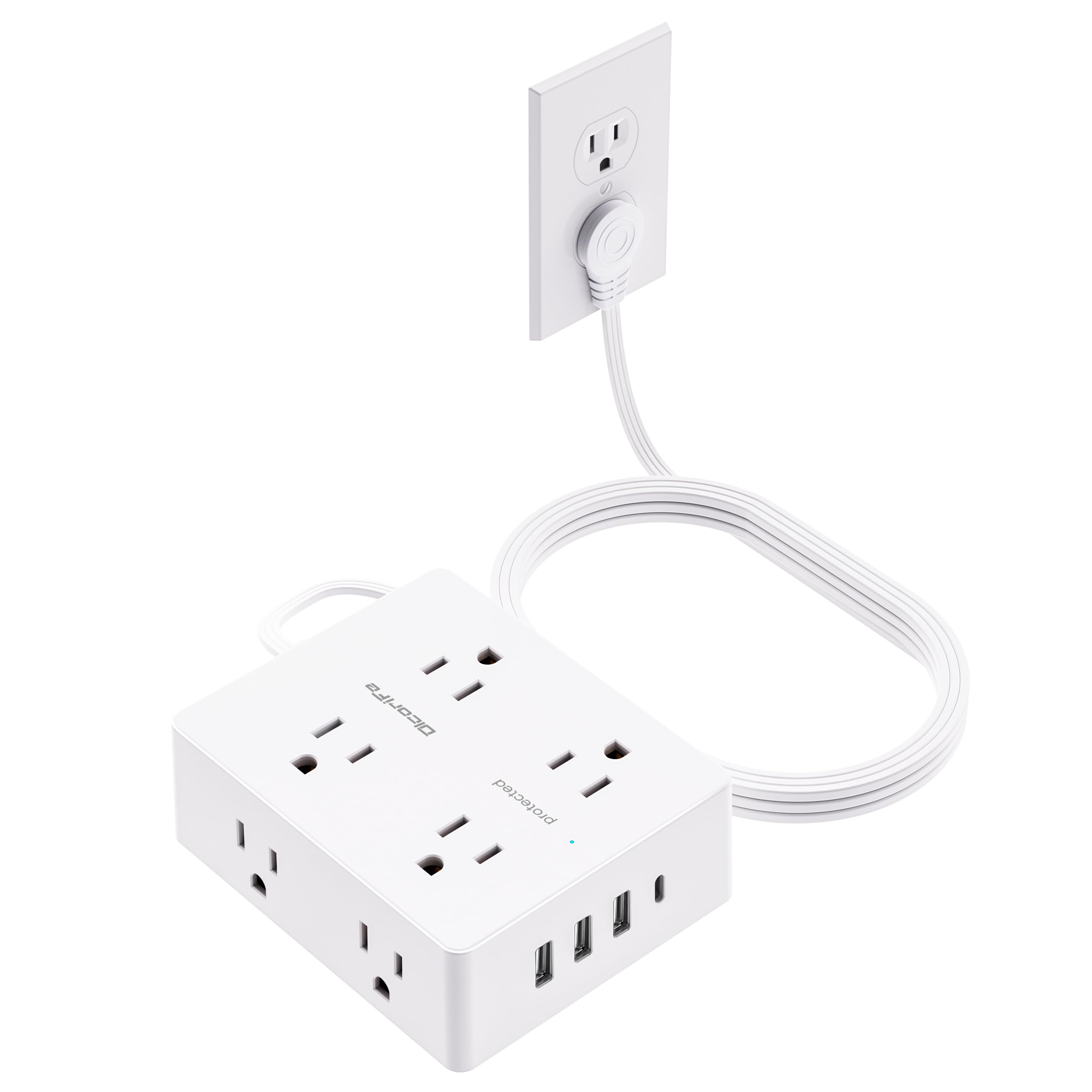
olcorife 10-Foot Power Strip

95 /100
LBD Score Outstanding

Key details

Outlets
8
USB Ports
4 (1 USB-C)
Cord Length
10 ft
Plug Profile
0.27 in flat plug
View on Amazon

Ten feet is the feature. Most strips here stop at five or six, which is fine until the only free outlet is behind the sofa and the desk is across the room. This one reaches, and the 0.27-inch flat plug means the sofa still sits against the wall afterwards.

The rest is a compact three-sided block: eight outlets, three USB-A ports and one USB-C, mounting holes on the back, and a breaker that cuts the power if you exceed the rating. We liked that it is small enough to sit on a windowsill or behind a curtain without announcing itself.

Two things to know before you buy. The protection described here is overload protection, with no joule rating attached, so if you are guarding a desktop rig or a television, spend the extra on the Anker 341 or the Alestor, which publish a rating and back it with a warranty. And the single USB-C port means a household of USB-C devices will be queuing for it.

Where it earns its place is reach and tidiness together. Routing a thin flat cord around a door frame or under a rug edge is far easier than wrestling a stiff 6-footer, and nothing else on this list goes past six feet.

Pros

  • 10 ft cord, the longest on this list
  • 0.27 in flat plug hides behind furniture
  • 8 outlets and 4 USB ports in a small block
  • The least expensive single strip here

Cons

  • Only one of the four USB ports is USB-C
Our verdict

Ten feet of cord and a plug thin enough to hide behind the sofa: this is the strip for an outlet that is nowhere near the desk.

Check Latest Price
6

Best Two-Pack

Addtam 2-Pack Power Strip

95 /100
LBD Score Outstanding

Key details

Outlets
5 widely spaced
USB Ports
3 (2 USB-C)
Cord Length
6 ft braided
Surge Rating
1080 joules
View on Amazon

Spacing is what turns a five-outlet strip into a three-outlet strip. This pair is built around that problem: five AC outlets spread wide enough for adapters, plus three USB ports with two of them USB-C, which is more USB-C than most singles here give you.

The hardware is nicer than the price suggests. The 6-foot cords are braided and rated 14 AWG, the plugs sit flat against the wall, and each strip is rated 15 A and 1,875 W to match a standard wall circuit. There are keyhole slots on the back of both.

What we like about the two-pack is that it answers the second room. One strip behind the television, one on the desk, and no second order. The flat plugs also mean a bookcase can go back against the wall, which is the small thing you notice every day.

The trade-off is outlet count: five per strip is the fewest of any bar here, and a media cabinet will outgrow it fast. The strips are also light enough that a stiff cord can roll one onto its side, so if it is going to slide, spend two minutes on the keyhole slots.

Pros

  • Five widely spaced outlets clear bulky adapters
  • Two strips in one purchase
  • 6 ft braided cords with flat plugs
  • 3 USB ports, two of them USB-C

Cons

  • Five outlets per strip is the fewest here
Our verdict

Two strips with five widely spaced outlets each: the pick for a bedroom and a desk that both need one.

Check Latest Price
7

Whole-Home

Amazon Basics 6-Outlet 10-Pack

96 /100
LBD Score Outstanding

Key details

Pack
10 strips
Outlets
6
Cord Length
6 ft
Surge Rating
790 joules
View on Amazon

Nobody buys a ten-pack for one desk. This is the purchase for the landlord, the small office, the workshop, or the house where every room has a lamp, a charger and something with a wall wart all competing for a single outlet.

Each strip carries six outlets, one of them spaced for a transformer, a 6-foot cord, a 15 A circuit breaker and a red light showing the surge protection is live. The rating is 790 joules, modest next to the 2,000-plus strips here and fine for lamps, chargers and routers rather than a home theater.

Simplicity is the appeal. There are no USB ports and nothing to configure, which makes them easy to hand out and easy to forget about in a closet. That also means a phone-heavy desk still needs a charger block, so pair one of these with a USB strip rather than expecting it to replace one.

The one annoyance is weight: each strip is light enough to skate across a shelf when you pull a plug, and the transformer outlet is the only one with real room to spare. Mounting through the keyhole slots fixes the sliding, and at this price the two minutes are worth spending.

Pros

  • Ten strips in one box for whole-home coverage
  • 6 ft cord and a 15 A breaker on each strip
  • Simple, no-fuss design with a protected indicator

Cons

  • No USB ports on any of the ten
  • Light body slides when you unplug something
Our verdict

The box to buy when the whole house needs strips: ten six-outlet units with 6-foot cords, a circuit breaker on each, and nothing to configure.

Check Latest Price
8

Wall Mounting

Flexoria 6-Outlet 2-Pack

88 /100
LBD Score Excellent

Key details

Pack
2 strips with screws
Outlets
6
Cord Length
2 ft
Surge Rating
600 joules
View on Amazon

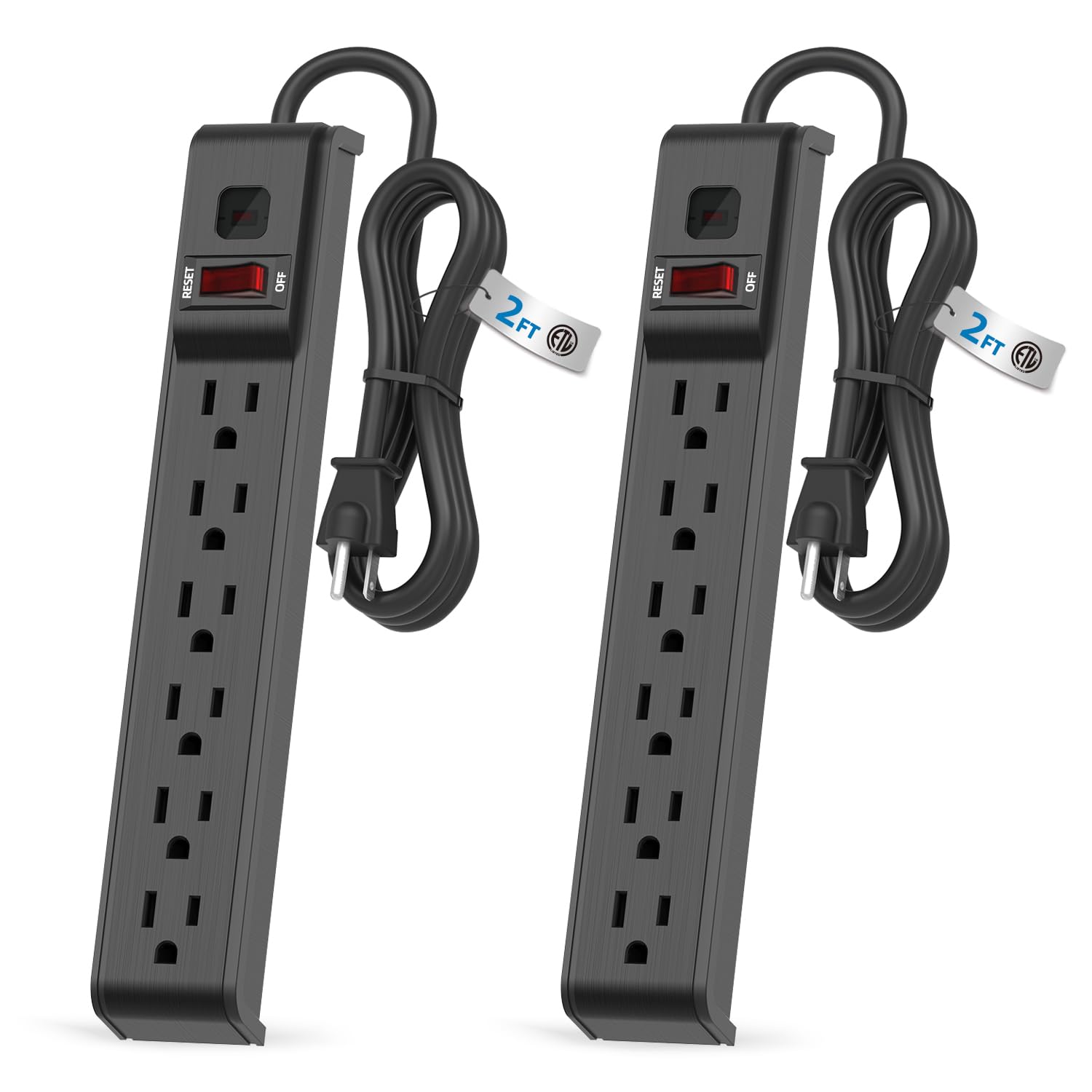
Two feet of cord sounds like a limitation until you know where the strip is going, and for a wall install it is the reason to buy these. Behind a wall-mounted television, under a workbench, inside a cabinet: there is nothing to coil and nothing to trip over.

Each strip has six outlets, four keyhole slots on the back and four screws in the box, so mounting does not turn into a hardware-store trip. That is a small thing that decides whether a strip ends up screwed to the bench or sliding around on top of it.

The electrical side is plain: 600 joules, 15 A and 1,875 W, ETL listed. That is enough for a television, a router and a console, or for a bench full of chargers, and it is short of what we want in front of a desktop and a monitor.

Both strips are identical, which is the useful part of a two-pack: one goes behind the television, one goes in the garage, and neither needs a cord run across a room. If you do need a strip to travel, this is the wrong shape entirely.

Pros

  • Two six-outlet strips with mounting screws included
  • Four keyhole slots for solid wall mounting
  • 15 A, 1,875 W rating and ETL listing

Cons

  • Two-foot cords limit where they can go
Our verdict

For a strip that lives right at the outlet, behind a TV or under a bench, these two mount with four screws each and stay put.

Check Latest Price

How We Tested Power Strips: Six Months, Fourteen Strips

We built a shortlist of more than 50 strips — bestsellers, store brands, and a few names I've used for years — and filtered by the things that change how a strip lives in a room: joule rating, outlet count and spacing, cord length, flat-plug shape, USB-C, and third-party certification like ETL or TUV. That left 14.

Those 14 spent six months moving through my house: a home-office desk with a laptop, monitor, lamp, and two chargers; a TV corner with a router, console, and soundbar; a bedside table; and a kitchen counter that picked up a kettle and a stand mixer.

At the desk, we filled each strip and then counted how many outlets were still usable once adapter bricks started blocking each other. We measured cord reach from the outlet to the furthest device rather than trusting the length on the box, and checked whether the flat plug cleared the wall behind a pushed-back bookshelf. Each USB port charged the same phone in turn while we watched the rate, and we noted whether the USB side stayed live with the main switch off.

For build, we tugged each cord at an angle a dozen times to see whether plugs seated or loosened, coiled and uncoiled the braided jackets until they showed wear or didn't, and ran a space heater on high to read the housing and cord with an infrared thermometer. In a dark bedroom, I noted whether the indicator light was a nightlight or a laser. Value came last: price weighed against the outlets you can realistically use and the joules behind them.

How to Choose a Power Strip

Count adapters, not cords

Two chunky adapters can eat four sockets on a standard strip, which is why outlet count alone tells you so little. Walk the room and count the plugs that have a box on them: laptop bricks, speaker adapters, smart plugs, the wall wart under the router. If that number is more than a couple, buy spacing before you buy capacity.

The picks here split along that line. The Anker 351 spreads all twelve of its outlets out on a 13-inch body, while the Alestor allows wide space at only two of its twelve. The HANYCONY takes a third route by putting outlets on three sides so plugs fan away from each other.

Joules and amps answer different questions

Joules measure how much surge energy a strip can absorb before the protection is spent; 600 to 1,100 is ordinary, and the Alestor's 2,700 is the most here. Amps measure how much current the strip can pass. A 15 A, 1,875 W strip matches a standard U.S. wall circuit, while a 10 A model is for electronics only.

Neither rating makes a strip a place to plug in a space heater, a window air conditioner or a microwave. Those belong on a wall receptacle. If a strip feels warm at the plug, you are close to its limit and should move the biggest load off it.

Treat USB ports as a convenience

USB is the most useful thing about a modern strip and the first part to give out. Ports also share their output, so four ports do not mean four fast charges: plug in three devices and each one slows down. Two USB-C ports rather than one is the detail that keeps a strip useful for the next few years.

Put anything that matters on an AC outlet with its own charger and leave the USB bank for phones, watches and earbuds. If you are shopping mainly for USB charging, you will be better served by a dedicated multi-port charger.

Measure the run and look at the plug

Five feet is a desk strip, six feet suits a cabinet, and ten feet is for crossing a room. Run a tape from the outlet to the farthest device before ordering, and remember the strip itself takes up a foot or so of that run. The olcorife's 10 feet is the only length here that clears a room in one go.

Plug shape matters as much as cord length. A flat or 45-degree plug lets furniture sit against the wall; a standard right-angle plug steals an inch or two behind a sofa or a bookshelf. The two Ankers and the olcorife all solve that.

Decide where it will live before you buy

A long bar belongs on the floor of a media cabinet, a three-sided block belongs on a desk or nightstand, and a short-cord strip belongs on the wall at the outlet. Keyhole slots are what make wall mounting possible, and the screws need to clear the slot or the strip will hang loose.

If the strip is going under a desk or behind a shelf, buy the mounting screws at the same time and check the slot depth when it arrives. A strip that slides around when you pull a plug is annoying enough that people stop using the outlets they paid for.

Frequently Asked Questions

Final Verdict

Most people should buy the HANYCONY. Eight outlets, four USB ports with two of them USB-C, a flat plug and a footprint small enough to disappear behind a monitor is the best balance of capability and price in this group.

Change the requirement and the answer changes. Powering a media wall means twelve outlets and wide spacing, which is the Alestor or the Anker 351. An outlet more than six feet from where the power has to be means the olcorife and its 10-foot cord.