Best Smart Sprinkler Controllers of 2026

A sprinkler controller fails quietly. Nothing beeps, nothing flashes — you just notice, weeks later, that the sidewalk has been getting watered every morning at five while the far corner of the lawn went tan. Going smart promises a schedule that bends to the weather and an app that tells you what actually ran; the delivery varies. My team and I have spent the past six months living with nine controllers, from four-zone boxes to twelve-zone units.

Zone count is what everyone shops by, and it is the least interesting thing about these. What separates them is what the schedule does when the forecast flips, whether the app still answers while you are standing at the curb with a screwdriver, and whether the controller keeps watering after the WiFi drops, because it will. Some fall back to a stored program. Some sit there doing nothing until you get home.

We judged all nine on performance, installation, programming, reliability, and what the app gives you for the money. The controllers below are the ones I would rewire my own side yard for.

1

Best Overall

ImoLaza 8-Zone

87 /100
LBD Score Excellent

Key details

Zones
8
App Control
iOS/Android, no subscription
Weather Skips
Rain, wind, freeze
Smart Watering
Real-time ET
View on Amazon

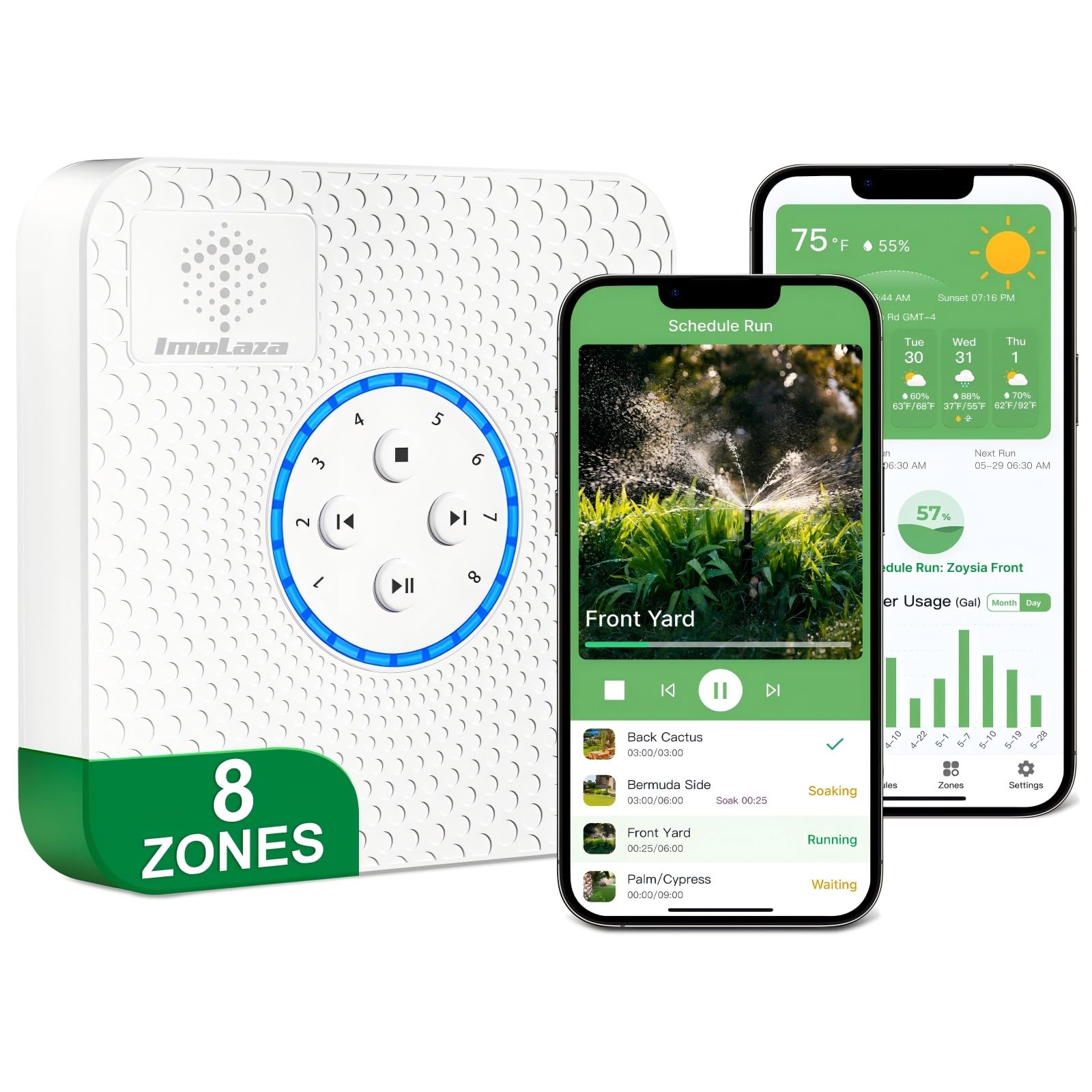
The feature that earned the ImoLaza 8 Zone our top spot is not the zone count. It is the combination of real-time evapotranspiration and fault alerts in a controller that does not charge a subscription. For a lawn with different sun exposure, that matters: ET adjusts run times to actual conditions instead of only skipping a scheduled cycle when rain is forecast.

We found the app more capable than most. It supports smart ET, fixed-cycle, and new-grass schedules, including multiple short starts for new sod. We paid close attention to fault alerts because a controller can silently keep running a broken zone; the app watches for open or short circuits and abnormal flow. That is the kind of detail you appreciate after a valve wire fails at the start of a hot week.

Eight zones cover a typical front-and-back system with room for a separate drip line. The panel is simple, and most adjustments happen in the app, which is where we preferred to work. What keeps it at the top is that the smart watering, remote control, and alerts all arrive without a monthly fee. The practical result is a controller that feels more like a small irrigation manager than a timer.

Pros

  • Real-time ET without subscription
  • Eight zones with fault alerts
  • Flexible schedules including new grass
  • Simple app setup and zone control

Cons

  • Weather data is ZIP-code based
Our verdict

We recommend the ImoLaza 8 Zone first for an eight-zone yard: real-time ET and fault alerts without a subscription make it the strongest all-round smart controller in this group.

Check Latest Price
2

Best Value

Orbit B-hyve 6-Zone

91 /100
LBD Score Outstanding

Key details

Zones
6
Warranty
2 years
Placement
Indoor/outdoor
Weather Scheduling
Rain delay, forecast
View on Amazon

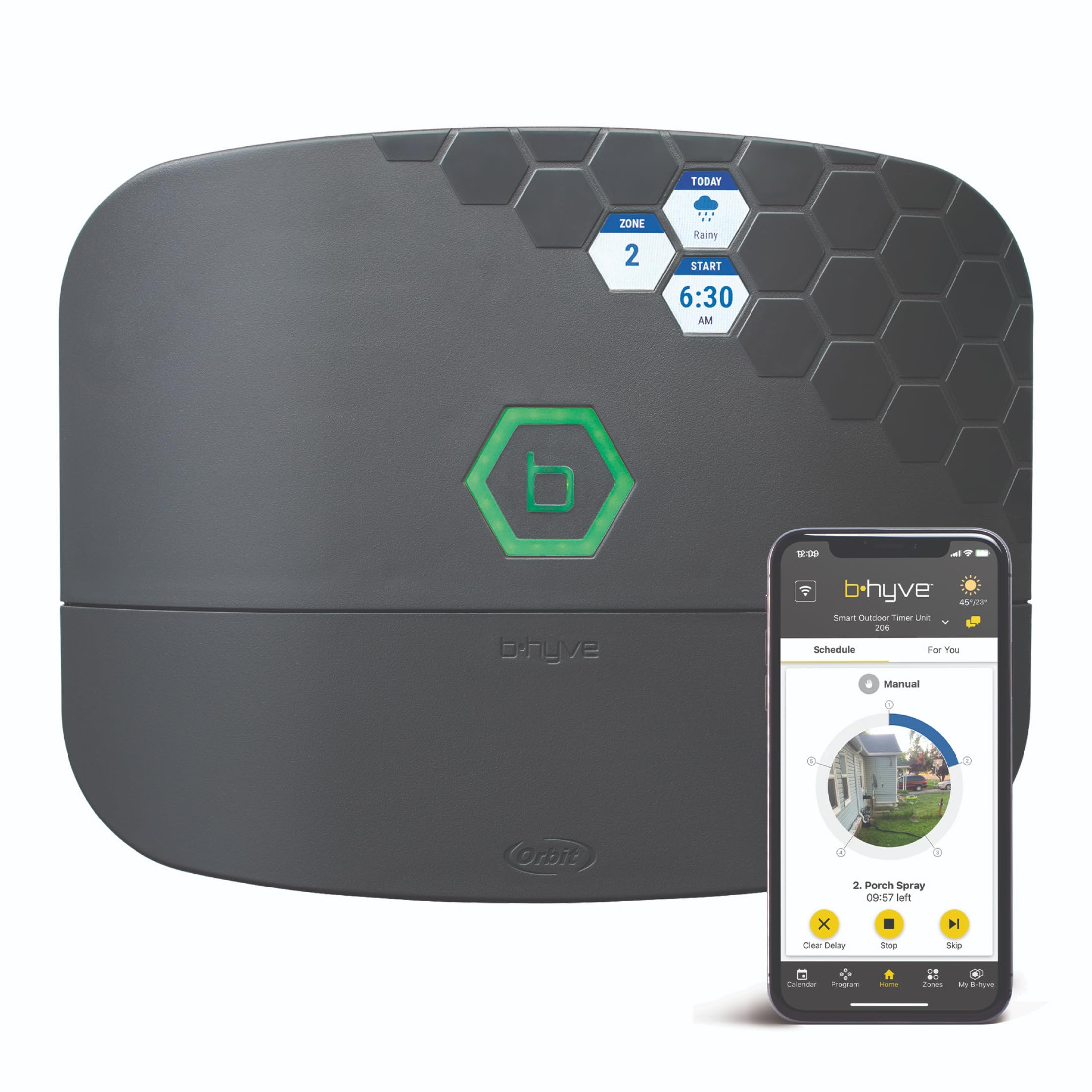
The Orbit B-hyve 6-Zone is the value pick in this group. Six zones and a weatherproof case cover a typical front-and-back system, and the app handles the schedules that used to require a trip to the garage. The case is a real advantage because it can live indoors or outdoors, so you are not forced to find a dry wall near the valve box.

We found the setup unusually approachable for a smart controller. The wiring labels are clear, the app is quick to learn, and the panel still lets you run a zone when you are standing at the box. Alexa compatibility is there for voice control, but the everyday win is being able to adjust a schedule from the couch. The panel is basic, but we rarely needed it once the app was set up.

Pros

  • Six zones at a value price
  • Indoor/outdoor weatherproof case
  • Straightforward app and panel programming
  • Alexa voice control

Cons

  • Wi-Fi can drop in weak signal areas
Our verdict

Budget-minded six-zone yards should start with the Orbit B-hyve; it covers the basics and asks only for a solid Wi-Fi signal at the panel.

Check Latest Price
3

Best Expandable

Hunter HPC400

85 /100
LBD Score Excellent

Key details

App
Hydrawise
Placement
Indoor/outdoor
Expandable
Up to 32 zones
Zones Included
4
View on Amazon

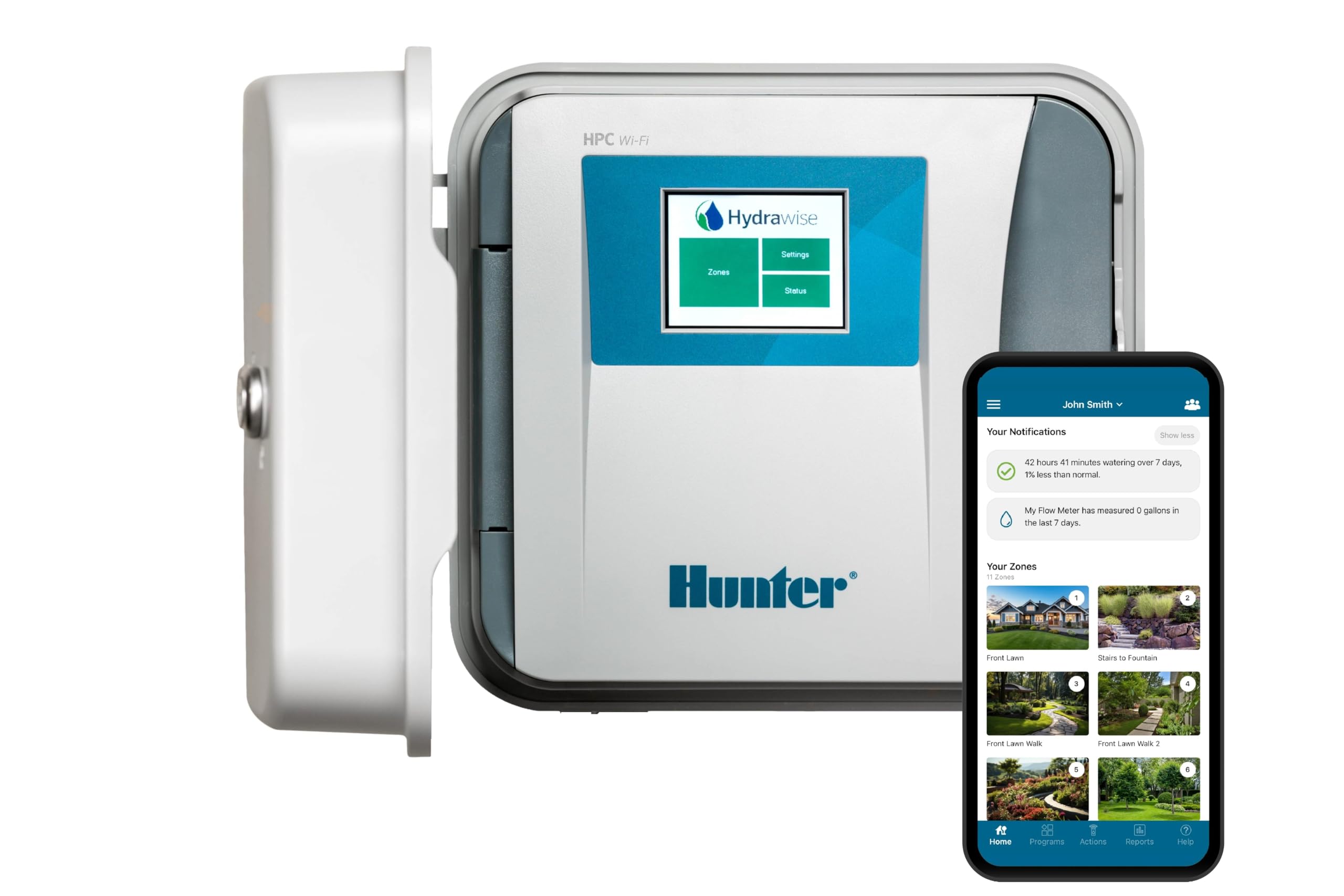
Four zones is enough to start, but the HPC400's real trick is that it does not stay a four-zone controller. The enclosure accepts expansion modules up to 32 zones, so a phased landscape can add a drip line, a new bed, or a side yard without another trip to the controller aisle. That makes it the one here that treats expansion as part of the design rather than an afterthought.

The Hydrawise app is the other half of the package. It uses local weather data to adjust watering, and the touchscreen gives you a way to set up zones at the panel instead of juggling a phone and a flashlight. We found the labeled wiring and guided setup easier to follow than a bare terminal strip.

What tips it for us is the combination of outdoor-rated hardware and a control system that does not feel like a compromise. The app is deeper than the Orbit B-hyve's, and the physical enclosure is built for a wall that gets weather. It suits a phased landscape better than any other pick here.

Pros

  • Expands from four to 32 zones
  • Hydrawise weather-based scheduling
  • Outdoor-rated enclosure
  • Touchscreen-guided setup

Cons

  • Expansion modules sold separately
Our verdict

If four zones are enough today but a bigger yard is coming, the Hunter HPC400 grows to 32 zones without replacing the box.

Check Latest Price
4

Best Panel-First Hybrid

Rain Bird ESP-TM2

89 /100
LBD Score Excellent

Key details

Wi-Fi
Included LNK module
Zones
8
Display
Backlit LCD
Weather Adjustments
Automatic
View on Amazon

If you have replaced a Rain Bird timer before, the ESP-TM2 will look reassuringly familiar: a large backlit LCD, clear terminal labels, and a straightforward three-step programming flow. That familiarity is not nostalgia. It means you can stand at the panel with a zone list and set a schedule without opening an app.

The included LNK module adds the app side. It works as a remote control for the irrigation system, so you can check zones or adjust a run time from your phone while the panel remains the primary interface. We found the value in not having to choose between a physical panel and a phone.

Weather adjustments trim run times when the forecast changes, and the contractor default lets you save and restore a custom schedule. That is a useful safety net if you experiment with seasonal settings and want to get back to a known-good program. The eight-zone layout is a good fit for a typical house with a few spare valves.

We think the hybrid approach is the reason to buy it. The ESP-TM2 is for the person who likes seeing the schedule at the panel, not hunting through menus. A quick zone check at the panel is faster than finding the app, and that is the point of this design.

Pros

  • Familiar panel with backlit LCD
  • Included LNK Wi-Fi module
  • Three-step programming
  • Contractor schedule save and restore

Cons

  • Weather adjustments are daily, not ET
Our verdict

Panel-first control is the reason to pick the Rain Bird ESP-TM2: physical programming, app access, and automatic weather adjustments.

Check Latest Price
5

Best for Large Yards

Hunter PRO-HC 12

89 /100
LBD Score Excellent

Key details

App
Hydrawise
Weather
Local station data
Stations
12
Placement
Outdoor
View on Amazon

Twelve stations puts the PRO-HC in a different class from the four- and six-zone controllers here. We keep it for large properties because it matches a system with many valves instead of forcing you to combine zones or add a second controller. The outdoor-rated enclosure is built for the side of a house or a equipment area, not a utility shelf.

The Hydrawise software is the reason it feels modern. You can manage schedules from a phone, tablet, or browser, and assign local weather data so the controller can hold watering for rain or freezing temperatures. In our testing, the desktop view was as useful as the app, which is rare for irrigation gear.

Where it earns its place is the combination of capacity and control. The terminal layout rewards a careful installer, and the weather tracking means you are not relying on a separate rain sensor. The enclosure and terminal layout feel built for a professional install rather than a temporary retrofit.

Pros

  • Twelve stations for large systems
  • Hydrawise app and browser control
  • Local weather station tracking
  • Rugged outdoor enclosure

Cons

  • More capacity than small yards need
Our verdict

Twelve stations and Hydrawise weather tracking make the Hunter PRO-HC the right fit for a large property.

Check Latest Price
6

Best Budget

HiOazo 4-Zone

82 /100
LBD Score Excellent

Key details

Plans
16
Wi-Fi
2.4 GHz
Zones
4
Weather Skips
Rain, freeze, wind
View on Amazon

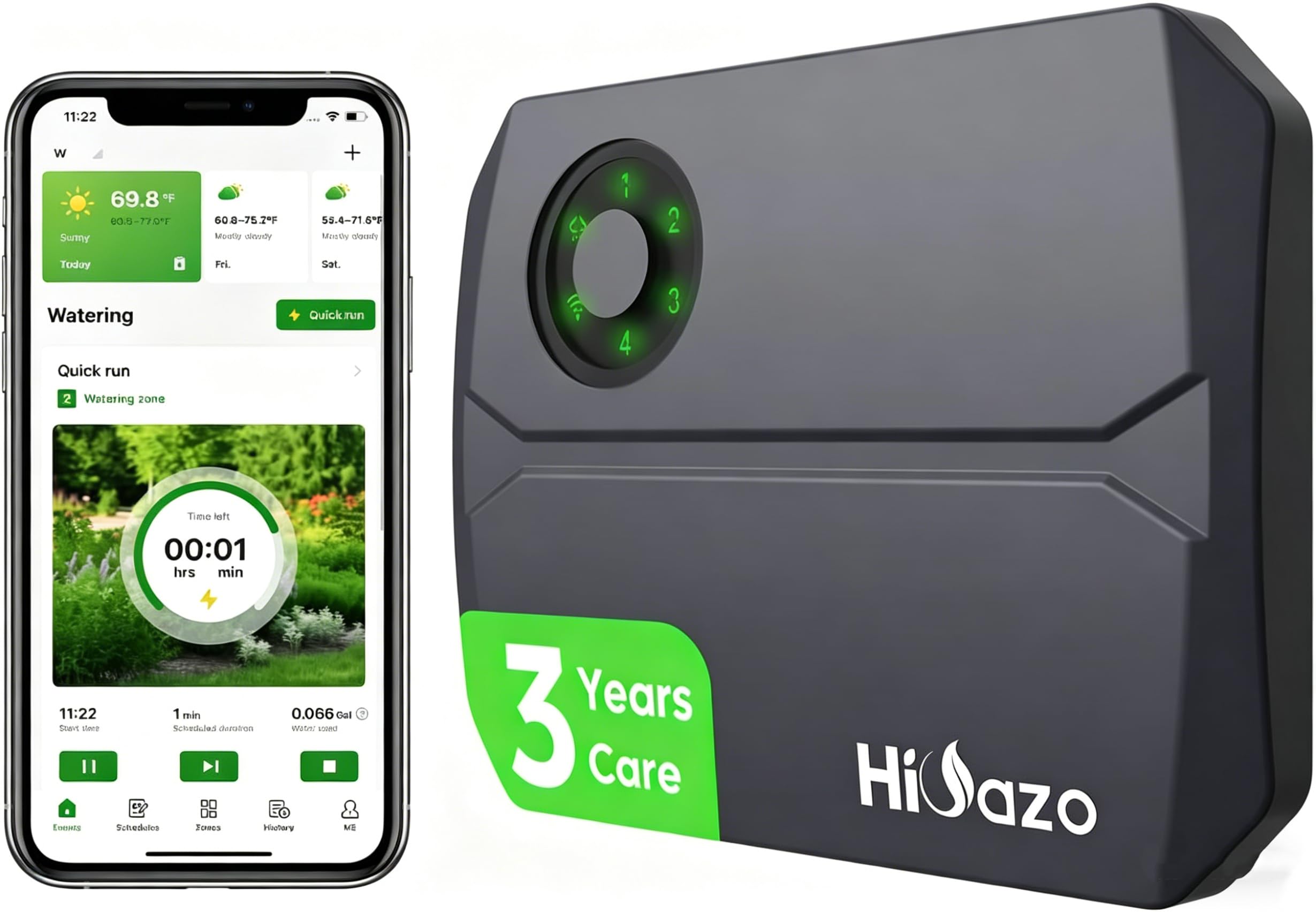
The HiOazo 4-Zone is the budget pick, and it gets the essentials right. Four zones, 16 watering plans, rain, freeze, and wind skips, and an app that does not feel like a stripped-down demo. The hardware is simple, which is exactly what you want at this end of the category: fewer screens, fewer menus, and a short path from wiring to a running schedule.

We were surprised by how much scheduling flexibility the app offers. You can set separate plans for different beds and choose a soak cycle so tight soil has time to absorb water between runs. That is a useful feature on clay or a slope, and it is not something every budget controller bothers with. The soak cycle is the feature we kept using; it gives tight soil time to absorb water between runs.

Pros

  • Four zones at a budget price
  • Sixteen separate watering plans
  • Rain, freeze, and wind skips
  • Soak cycle for tight soil

Cons

  • Four zones cannot be expanded
  • Requires 2.4 GHz Wi-Fi
Our verdict

For a small yard on a tight budget, the HiOazo 4-Zone covers four zones, 16 plans, and weather skips for the least money here.

Check Latest Price
7

Eight-Zone Value

Orbit B-hyve XR 8

86 /100
LBD Score Excellent

Key details

Zones
8
Weather
Forecast-driven
Warranty
2 years
Placement
Indoor/outdoor
View on Amazon

The B-hyve XR is the eight-zone sibling of our value pick. It takes the same app platform and adds a larger display and a weatherproof indoor/outdoor case, which makes it easier to check status at the panel without pulling out a phone. The charcoal housing looks more substantial than the basic B-hyve, and the display is legible in a garage.

We found the extra zones useful for separating drip from spray. Forecast-driven watering and custom programs are here, and the app gives you room to tune schedules by zone. The XR is a sensible step up if your system has outgrown six zones but you do not need the expandable Hunter HPC400.

Where the XR earns its place is the combination of eight zones and a physical display at a midrange price. It is a step up, not a transformation. The XR makes the most sense when the extra zones solve a real scheduling problem, not just a future one.

Pros

  • Eight zones with outdoor case
  • Large digital display
  • Forecast-driven watering
  • Two-year warranty

Cons

  • Wi-Fi reliability can be inconsistent
Our verdict

Eight zones, a readable display, and an outdoor-rated case define the B-hyve XR; just expect the six-zone model to be the easier value when it fits.

Check Latest Price
8

Indoor Installs

Netro Sprite 6

86 /100
LBD Score Excellent

Key details

Zones
6
Weather
Forecast, rain skips
Mounting
Built-in level
Placement
Indoor
View on Amazon

The Netro Sprite is the one controller here that is clearly meant to live indoors, and that shapes everything about it. The compact housing and built-in level make it easy to mount on a garage wall or a utility-room shelf, and the top cover lifts off for access. You are not fighting a bulky outdoor box or a short power cord.

The plant database is the feature that separates it from a generic timer. You choose the kind of plants in a zone, and the app uses that as a starting point for watering rather than making you invent a schedule from scratch. For a flower bed, a small lawn, and a row of shrubs on the same system, that guidance is genuinely useful.

Rain skips and forecast-based weather service are here too, and the app logs watering history so you can see what actually ran. We found the hardware tidy and the mounting straightforward, which matters when the controller is going in a finished space rather than a shed.

What we like about the Sprite is that it turns a technical setup into a guided one. The app can feel more involved than the simplest controllers here, but the plant library gives you a reason to use it. It is a small, tidy box that makes a dial timer feel ancient.

Pros

  • Six zones for indoor installs
  • Plant database for scheduling
  • Rain skips and forecasts
  • Built-in level for mounting

Cons

  • App can feel complicated
Our verdict

The Netro Sprite suits a garage or utility-room install, where its plant database and weather skips make a dial timer feel dated.

Check Latest Price

How We Tested Smart Sprinkler Controllers

Every controller here started as a spec sheet. We pulled roughly 30 models, filtered by zone count, indoor versus outdoor housing, app features, and price, then cut anything that needed a proprietary hub or a paid installer just to run a basic schedule. Nine made it into the ground.

We wired those nine into real valve boxes with a screwdriver and a phone and nobody from the manufacturer on the line, checking each one against the 24-volt valves and existing wiring already in place. I timed every install from killing power at the panel to the first successful manual run, and noted where the terminal labels got confusing. Outdoor-rated units went into the box beside the valves where the afternoon sun hits; indoor ones went on a garage wall. I also ran a zone from the unit itself, phone left in the house, to see how many taps it took without the app.

Testing ran six months, long enough to catch a rainy stretch, a heat wave, and two router reboots. Each week I compared the app's watering log against what the heads actually did, and once a month I set catch cups on three zones to check that reported runtimes matched the water reaching the grass. When rain was in the forecast, I watched whether the skip fired on its own or needed a nudge. Then I pulled the WiFi for a day to see which controllers held their schedule and which went dumb, and whether the app bothered to tell me it had gone offline.

How to Choose a Smart Sprinkler Controller

Start with zone count, not feature count

Count the wires connected to your current controller, then add one spare if you can. A six-zone controller for a six-zone system leaves no room for a new drip line, while the Hunter HPC400 starts at four and grows to 32. If the valve box is already full, an eight-zone model such as the ImoLaza 8 Zone gives most homes breathing room. A controller with more zones than you need is not wasteful; it is capacity you may use later. The exception is a small, fixed yard, where a four-zone model keeps the choice simple.

Weather skips are table stakes; ET is the upgrade

Every controller here can hold watering for rain, and several add freeze or wind. That basic skip saves the obvious wasted cycle. Real-time evapotranspiration goes further: it adjusts run times to temperature and local conditions, which is what the ImoLaza 8 Zone does. Most yards do fine with forecast-based skips and a well-set schedule. But if you have mixed sun, slopes, or new sod, ET is worth paying for. Check where the weather data comes from; a ZIP-code forecast can miss a storm that dropped rain on your block.

Choose the location before the model

An indoor-only controller such as the Netro Sprite belongs in a garage or utility room, not beside a valve box in the sun. Outdoor-rated models like the Hunter HPC400 and Orbit B-hyve are built for a shed wall or the side of a house. The practical trap is Wi-Fi: the controller needs a strong 2.4 GHz signal where it is mounted, not just at the kitchen table. Before you buy, stand at the mounting spot and check your phone's signal; if it is weak, plan a mesh node or a different location.

Pick the control style you will actually use

App-first controllers put schedules, zone tests, and weather settings on your phone. That is convenient, but some people want to walk up to the panel and turn on a zone without unlocking a phone. The Rain Bird ESP-TM2 and Hunter HPC400 keep a usable physical interface; the Orbit B-hyve 6-Zone is simpler at the panel but still app-led. We also check whether the app requires a subscription. None of our picks do, but that is not universal, so confirm before buying. Fault alerts are the other feature worth having if valves are hidden.

Frequently Asked Questions

Final Verdict

For a typical home system with up to eight zones, the ImoLaza 8 Zone is our default recommendation. It combines real-time ET, fault alerts, and subscription-free app control in a package that suits a normal front-and-back yard.

If six zones cover your yard and you want to keep the spend down, the Orbit B-hyve 6-Zone is the value alternative. If you expect to add zones, the Hunter HPC400 is the one that grows with the landscape.