Best Solar Watches of 2026

The first question I get about solar watches is the obvious one: what happens when it sits in a drawer for a week? Nothing, as long as it saw some light first. A panel under the dial drinks sunlight, desk light, and dashboard glare and keeps the cell topped off, so there's no jeweler trip and no dead watch on the morning of a flight.

I've worn solar watches daily for years, and over the past nine months my team and I have worn 12 of them, from resin tactical models to slim stainless three-handers to one 50mm brick, on runs, on a saltwater vacation, and on plenty of mornings when I needed the date without my glasses. The good ones separated themselves on how the dial reads at dusk, how the band adjusts on a bare wrist, and whether the time was still honest after a month in a drawer.

One thing worth knowing before you shop: solar means any light, not just sun, so a watch that lives under a sleeve still needs an afternoon out now and then. These are the ones that earned a permanent spot.

1

Best Overall

Citizen Promaster Dive Eco-Drive

93 /100
LBD Score Outstanding

Key details

Dial
Luminous hands and markers
Charging
Eco-Drive solar
Functions
3-hand date
Certification
ISO dive certified
View on Amazon

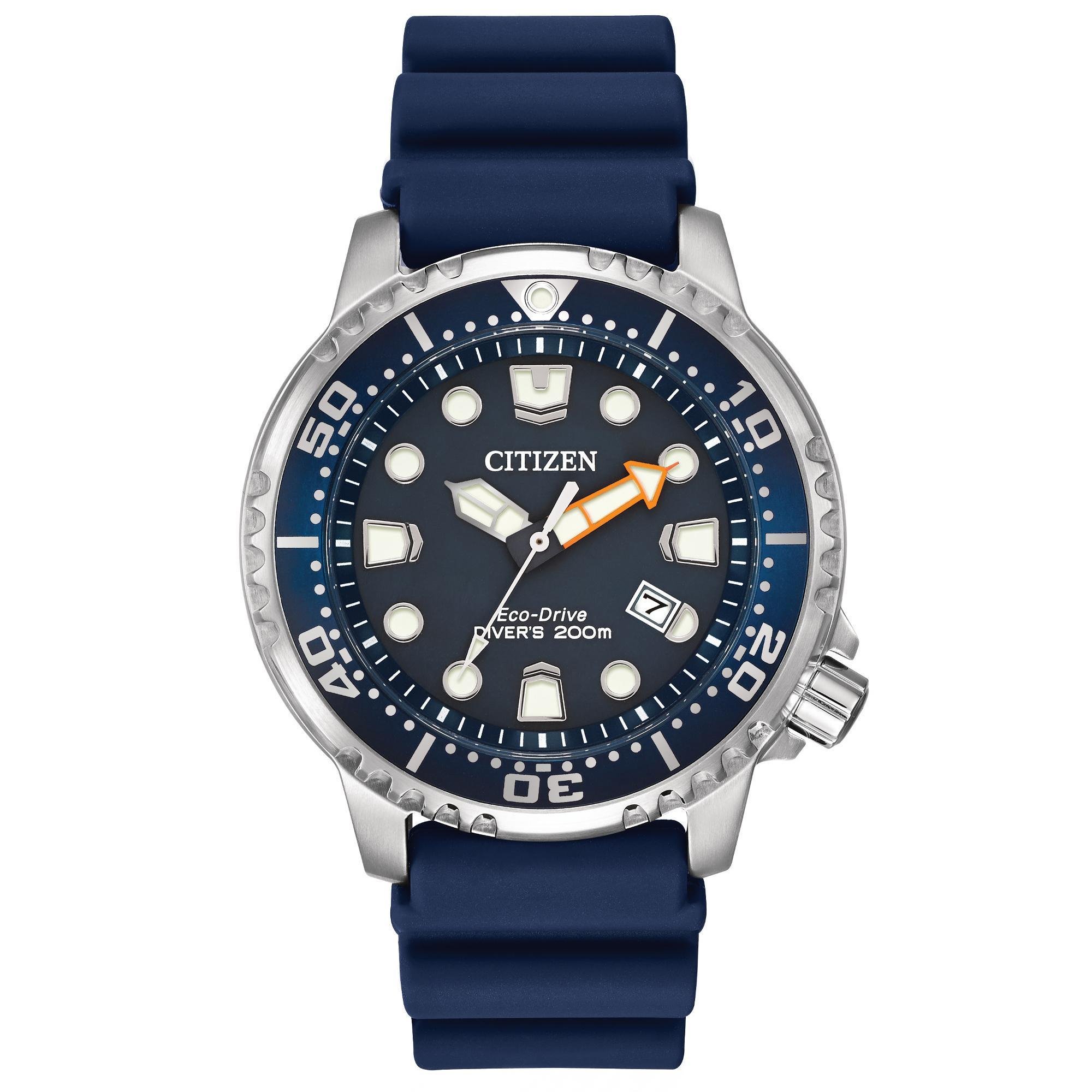
A solar watch is most useful when it stops announcing itself as a solar watch. The Promaster looks like a standard ISO-certified dive watch: rotating bezel, luminous hands and markers, a date window, and a case that reads purposeful rather than gadgety. We think that ordinary-watch feel is exactly why it earns the top spot. Nothing about the Eco-Drive system asks you to change how you wear a watch.

The charging cell hides behind the dial, so daylight and everyday wear do the work; there is no cable and no battery hatch to fuss with. We paid close attention to the details that make a dive watch useful away from the water: the lume is bright enough to read through the night, the bezel ratchets firmly, and the dial stays legible at a glance. It is also comfortable on a strap, which matters because this is a watch you will wear on errands, not just on a dive boat.

On the wrist, the Promaster feels like a watch you can forget about, which is the point. The case is substantial without turning into a dinner plate, though it may wear smaller than you expect if you like a bolder watch. If you are between sizes, that is the one thing to check before ordering. For everyone else, this is the solar watch we point to first: capable, classic, and free of charging rituals.

Pros

  • Eco-Drive charging needs no cable or battery change
  • ISO-certified dive build with a firm bezel
  • Bright lume and a legible dial
  • Classic look works for everyday wear

Cons

  • Date window is small and recessed
Our verdict

For most people who want a solar watch that simply works, the Promaster's ISO-rated dive build and no-fuss Eco-Drive charging make it our top pick.

Check Latest Price
2

Best Solar Smartwatch

Garmin Instinct 2X Solar Tactical

92 /100
LBD Score Outstanding

Key details

Weight
2.36 oz
Case Size
50 mm
Battery Life
Up to 40 days
Solar Charging
Unlimited with 3 hrs sun/day
View on Amazon

Garmin's claim of unlimited battery life in smartwatch mode sounds like marketing until you read the fine print: three hours of direct sunlight at 50,000 lux per day. That is a real commitment to being outside, but it is also the most useful solar feature here. The Instinct 2X pairs a 50 mm case with a 1.27-inch monochrome display, a built-in flashlight, and multi-band GPS.

In our testing, the appeal was the combination of a 40-day battery and a flashlight that saves you from digging out your phone at night. The solar lens does not magically top up a drained battery; it stretches the charge and, in good sun, keeps smartwatch mode from ticking down. The ABC sensors and GPS are there when you need them, and the buttons are easier to work with gloves than a touchscreen. We think that makes it the best solar smartwatch for people who spend whole days outdoors.

The interface is the bigger adjustment. Garmin packs a lot into a small display, and the menus take time to learn if you are coming from a simpler watch. But the battery life and flashlight are not party tricks; they change how you pack for a weekend. The flashlight is the feature we kept coming back to.

Pros

  • Up to 40 days per charge
  • Solar can extend smartwatch mode indefinitely in good sun
  • Built-in flashlight
  • ABC sensors and multi-band GPS

Cons

  • Large 50 mm case and 67 g weight
Our verdict

For outdoor days when you want GPS, ABC sensors, and a flashlight without a charging cable, the Instinct 2X Solar is the best solar smartwatch here.

Check Latest Price
3

Best Rugged Outdoor Watch

G-Shock Rangeman GW-9400

96 /100
LBD Score Outstanding

Key details

Weight
6 oz
Sensors
ABC: altimeter, barometer, compass
Charging
Solar charging
Water Resistance
200 m
View on Amazon

The Rangeman's defining feature is not its shape but the cluster of sensors behind it: altimeter, barometer, compass, thermometer, plus solar charging. That makes it less a wristwatch than a pocket instrument for hiking, hunting, or any job that takes you off the pavement. We like it for that role because the buttons are logical and the 200-meter water resistance means you do not have to baby it.

The solar cell is the quiet convenience. Leave it near a window and it keeps itself charged, so you are not hunting for a battery change. The ABC functions are useful for quick checks, and the display stays readable in bright light, which is not always true of watches with this many modes.

What we keep coming back to is the toughness. The case takes knocks, the buttons are easy to work with gloves, and the watch feels built for the job rather than for a display case. The compass is the function we reached for most, and it is the reason this one stays in the pack.

Pros

  • Solar charging and ABC sensors
  • 200 m water resistance
  • Takes hard knocks
  • Readable display with logical controls

Cons

  • Large case overwhelms smaller wrists
  • Altimeter and thermometer can drift
Our verdict

For hikers and outdoor workers who want solar, ABC sensors, and a 200-meter case in one bombproof watch, the Rangeman is the outdoor specialist here.

Check Latest Price
4

Best Budget Tough Solar

Casio G-Shock MTG-M900DA-8CR

92 /100
LBD Score Outstanding

Key details

Case
Stainless steel
Charging
Tough Solar
Time Sync
Atomic radio
Water Resistance
200 m
View on Amazon

The MTG is the watch that makes solar and atomic timekeeping feel affordable. It pairs Tough Solar charging with radio-controlled atomic time, a stainless steel case and band, and 200-meter water resistance. That is a lot of utility for the money, and it does not ask you to wear a bulky resin G-Shock to get it.

We like it most as an everyday watch that happens to be a G-Shock. The atomic sync corrects itself, so you are not resetting it after daylight saving time. The solar cell keeps it running without a battery change, and the analog hands are easy to read at a glance. It is not a sensor watch, though; this one is about timekeeping, not hiking.

The stainless band gives it a dressier look than a resin G-Shock, and the 200-meter rating means it can handle pool duty and yard work. The analog display is also a nice change from the digital outdoor models if you want a solar watch that works with a button-down. It is the practical choice when you want the technology without the expedition styling.

Pros

  • Tough Solar with atomic time sync
  • Stainless steel case and band
  • 200 m water resistance
  • Budget-friendly among solar tough watches

Cons

  • Metal band runs large and is fiddly to size
Our verdict

For a set-and-forget solar watch at the budget end, the MTG's atomic time, stainless case, and 200-meter rating are hard to beat.

Check Latest Price
5

Best Women's Solar Watch

Citizen Ladies Eco-Drive Classic

94 /100
LBD Score Outstanding

Key details

Case
Stainless steel
Dial
Blue
Charging
Eco-Drive solar
Case Size
26 mm
View on Amazon

At 26 mm, the Citizen Ladies Eco-Drive is the smallest watch here, and that is the point. It is a dress watch that disappears under a cuff, with a stainless steel case and bracelet, a clean analog dial, and Eco-Drive solar charging that removes the battery-change chore.

The size is not the only old-school thing about it. The dial is easy to read, the timekeeping is accurate, and the watch keeps running on ambient light, so it can sit in a jewelry box between wears without stopping. It looks like a watch you can wear to work or a dinner, not a scaled-down sport watch.

The bracelet may need links removed for a smaller wrist, which is normal for a metal watch but worth factoring in. The blue dial gives it a bit of jewelry sparkle without turning it into a novelty. We think this is the pick for someone who wants a traditional women's watch rather than a wrist gadget, and the no-battery movement is the reason it earns a place over a standard quartz dress watch.

Pros

  • 26 mm case suits smaller wrists
  • Eco-Drive solar charging
  • Easy-to-read analog dial
  • Dressy stainless look

Cons

  • Date window is tiny and hard to read
Our verdict

For a dressy solar watch that fits a smaller wrist, the Citizen Ladies Eco-Drive's 26 mm case and no-battery movement make it the best women's pick here.

Check Latest Price
6

Best Premium Multisport

Garmin Fenix 7X Pro Sapphire Solar

91 /100
LBD Score Outstanding

Key details

Lens
Sapphire solar
Weight
3.14 oz
Case Size
51 mm
Battery Life
Up to 37 days
View on Amazon

The Fenix 7X Pro is the premium option, and the sapphire solar lens is the first clue. It sits in a 51 mm fiber-reinforced polymer case with a titanium bezel and rear cover, a 1.4-inch display, and a built-in flashlight. That is a lot of watch, and it is aimed at people who want one device to handle training, hiking, and navigation.

The battery life is the feature that makes the case for it: up to 37 days in smartwatch mode, with solar charging stretching that further in good light. In our testing, the GPS and mapping features were the reason to choose it over the Instinct; the larger display shows maps and workout data without squinting, and the sapphire lens shrugs off scratches. The MIP screen is excellent outdoors.

The interface is deep, and that is both the appeal and the barrier. There are training metrics, maps, and settings for almost everything, which is great if you will use them and overkill if you will not. We think the Fenix is the best premium multisport watch here, but it is also the one that asks the most of the wearer. The flashlight is the small feature we missed most when we switched back.

Pros

  • Sapphire solar lens resists scratches
  • Up to 37 days in smartwatch mode
  • Built-in flashlight
  • Maps and multisport GPS

Cons

  • Premium price
  • MIP display can look dim indoors
Our verdict

For multisport athletes and hikers who want maps, training metrics, and a sapphire solar lens in one watch, the Fenix 7X Pro is the premium pick.

Check Latest Price

How We Tested Solar Watches, On the Wrist and in a Drawer

We started with spec sheets for about 30 solar models and narrowed to 12, keeping a mix of analog three-handers, ana-digi, and full digital, resin straps and stainless bracelets, and case sizes from 26mm up to 50mm so smaller and larger wrists both got a fair shot. Price mattered, but we filtered on what the money actually buys: sapphire versus mineral crystal, a bracelet with removable links versus a strap with a handful of holes, and whether solar was the main power source or just a backup.

Four of us wore the watches in rotation for nine months, at desks under fluorescent light, on runs and in the pool, through a week at the beach, and on the kind of days when you never take your jacket off. Every two weeks we left each watch face-up on a windowsill for an afternoon and logged what the charge indicator did, then parked several in a closed drawer to see how long they held and whether the power-save mode parked the hands or blanked the display.

Readability got checked at dusk, in direct sun, and with nothing but lume or a backlight, and I noted whether I could pull the date without my reading glasses and whether a busy dial turned to mush at arm's length. We compared each watch against a reference clock weekly, so a model that synced itself overnight to an atomic signal or GPS got credit for never needing the conversation. And we sized every band ourselves, counting links or holes, noting whether we needed a tool, and wearing each one loose and snug to see how the case sat.

How to Choose a Solar Watch

Treat Solar Charging as a Habit

Every solar watch here needs light, but they do not all ask for the same amount. Analog Eco-Drive models such as the Citizen Promaster and Ladies Classic charge from ordinary daylight and keep running between wears; Garmin's solar models stretch battery life, with the Instinct 2X claiming unlimited smartwatch mode only when it gets three hours of direct sun at 50,000 lux per day. That is a useful benchmark, not a promise for a watch that lives under a sleeve.

Our advice: choose a model with a visible charge indicator if you wear a smartwatch, and give any solar watch a windowsill day once a month. Do not expect a solar panel to rescue a completely drained GPS watch on a cloudy weekend. Solar is a maintenance advantage, not an emergency charger.

Fit the Case and Band to Your Wrist

Case diameter is the number shoppers fixate on, but weight and band style decide whether a watch feels right. The 26 mm Citizen Ladies is a true dress watch; the 50 mm Garmin Instinct 2X and the Rangeman are tools that sit tall on the wrist. A stainless bracelet also adds heft and usually needs links removed, while resin or silicone straps are more forgiving.

Measure your wrist and check the lug-to-lug measurement when it is listed, not just the case width. If you are between sizes, err toward the smaller case for daily wear and the larger one only if you need glove-friendly buttons or a bigger display. The watch you forget you are wearing gets worn more often.

Choose Sensors You Will Actually Use

Analog solar watches are timekeepers first. Digital outdoor models add ABC sensors—altimeter, barometer, compass—and GPS smartwatches add navigation, health tracking, and notifications. The Rangeman is the purest sensor tool here; the Fenix 7X Pro is the deepest multisport computer. More features mean more menus, more calibration, and more battery drain.

Be honest about the hiking you do. A compass and barometer are useful on a marked trail; a full-color map is better if you route-find off-trail. And treat any altimeter or thermometer as a reference that needs calibration, not a lab instrument. Buying fewer sensors than you need is a mistake; buying more is just weight and complexity.

Readability, Water Resistance, and Upkeep

A watch you cannot read is a bracelet. Analog models need strong contrast and lume; digital models need a display that works in sun and shade. The Garmin MIP screens are superb outdoors but can look dim indoors, while the Citizen and Casio analog dials rely on hands and markers that stay legible at a glance. Water resistance matters too: 100 meters is fine for swimming, 200 meters is the dive-watch neighborhood, and an ISO-certified dive watch is the safest choice for actual diving.

Keep the solar lens or dial clean, and rinse a saltwater watch with fresh water after a swim. Metal bracelets need occasional cleaning and sizing; resin straps wear out but are cheap to replace. None of this is complicated, but it is the difference between a solar watch that lasts and one that spends its life in a drawer.

Frequently Asked Questions

Final Verdict

For most people, the Citizen Promaster Dive Eco-Drive is the solar watch to buy. It looks like a normal dive watch, charges from light, and has the ISO-rated build and lume to handle more than a desk. If you want GPS, notifications, and a flashlight, the Garmin Instinct 2X Solar is the better tool; its 40-day battery and larger case suit outdoor days. If you need ABC sensors, the Rangeman is the specialist.