Best Projectors for Bright Rooms of 2026

Every projector makes the same promise: a picture the size of a wall. The catch is that the picture is made of light, so every window and table lamp in the room is competing with it. I once hosted a July movie night where we all watched a pale blue rectangle until the sun finally gave up around 8:45. A projector built for a bright room isn't just brighter — it gives you more control over where the light lands and how it's shaped.

Over the past six months, my team and I ran seven projectors through the conditions that break them: a living room with the blinds up at two in the afternoon, a patio at dusk with the porch lights on, and a console plugged in for a few fast rounds of a game.

Brightness is the number printed biggest on the box, and it matters — but a projector rated high and set up badly still washes out. Placement flexibility, autofocus that locks instead of hunting, and a speaker loud enough for a backyard did as much work as raw output. The picks below held their picture in rooms that weren't dark.

1

Best Overall

ViewSonic LS740HD

85 /100
LBD Score Excellent

Key details

Brightness
5,500 ANSI lumens
Throw Ratio
1.13–1.47
Light Source
Laser, 20,000 hours
Native Resolution
1920 x 1080
View on Amazon

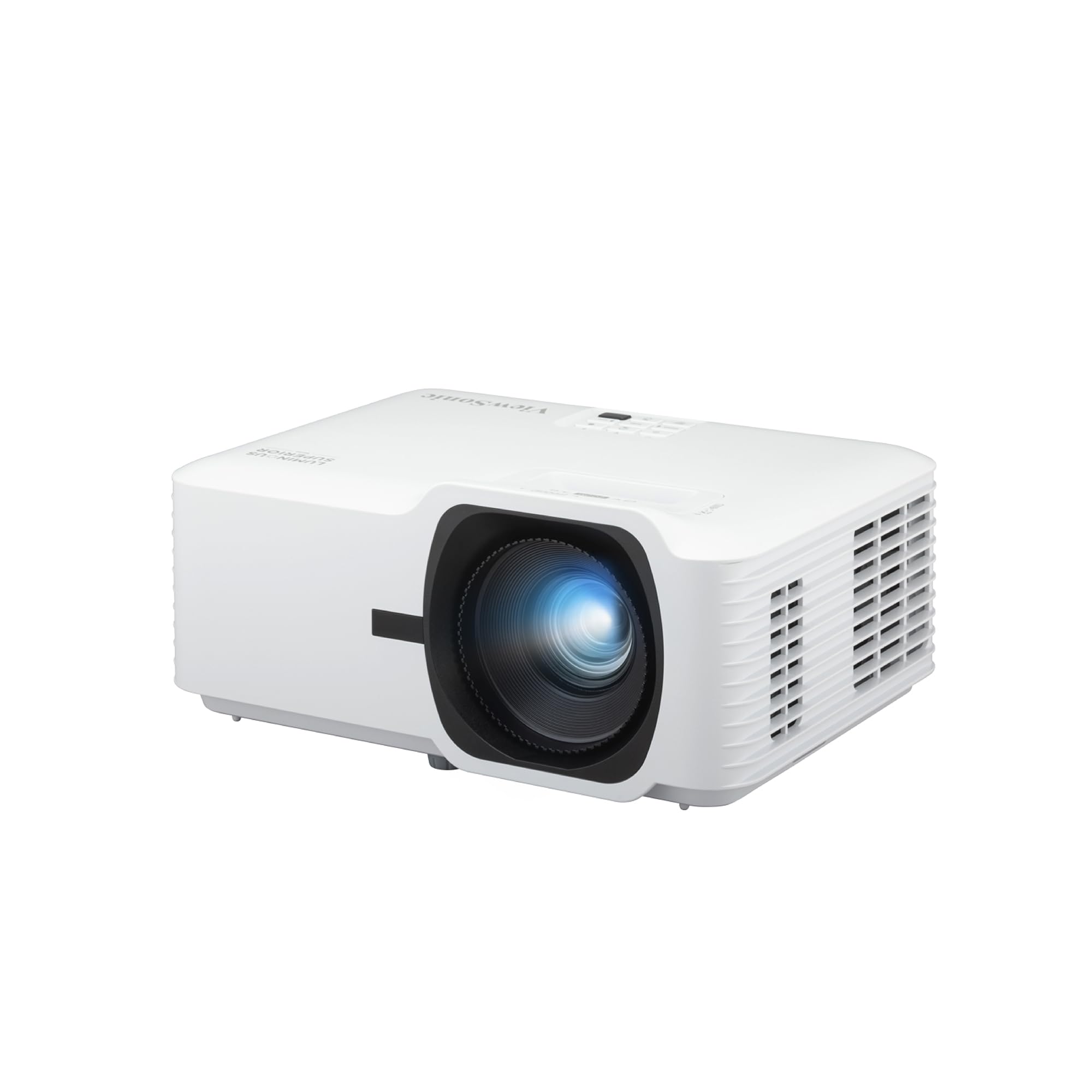
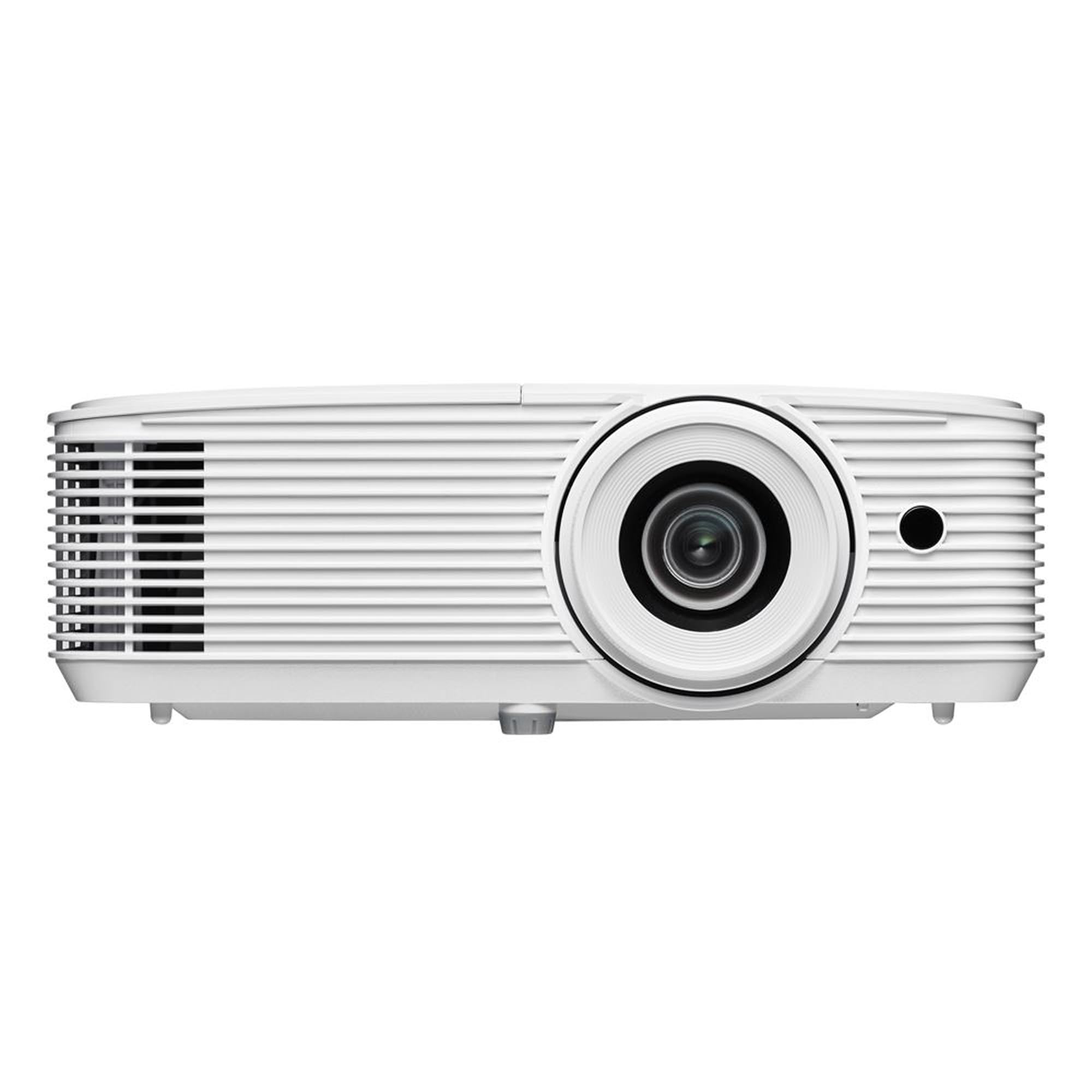
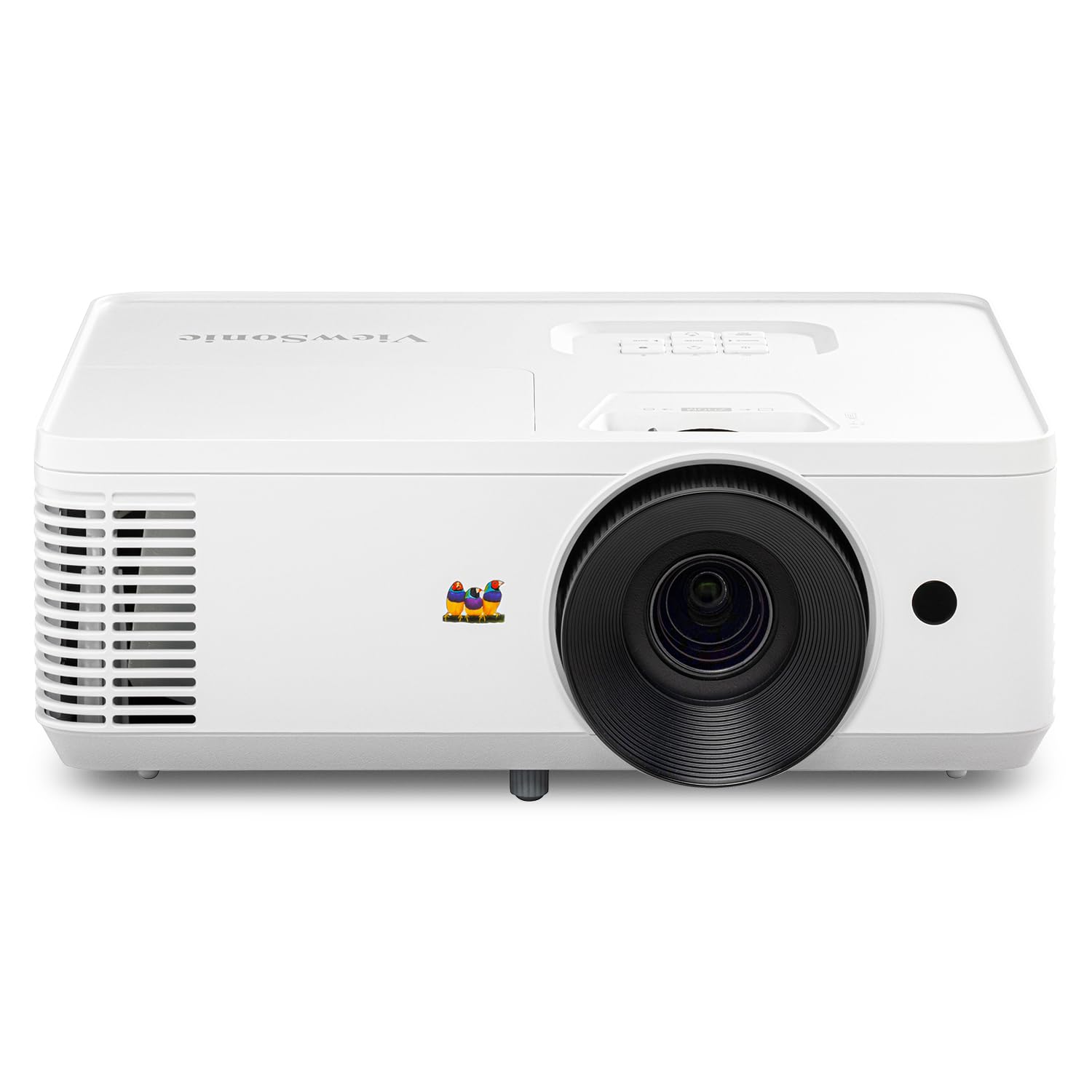
Five thousand five hundred ANSI lumens is what wins this one its place, and there's no subtlety about it. Put the LS740HD beside the 3,000- and 4,000-lumen projectors here and the difference shows the moment the lights come on: the dimmer models go gray and chalky, while this one holds a saturated, readable picture with the ceiling lights up and daylight coming in behind the seating. For daytime sports, a cartoon marathon, or a golf simulator in a garage with the door open, that headroom is the entire purchase.

The laser engine is what makes the brightness a long-term proposition rather than a launch-day number. ViewSonic rates the light source at 20,000 hours, so there's no bulb to buy in year three and no slow yellowing as a lamp ages out — what you paid for at the start is roughly what you still have at hour 10,000. The lamp-based picks here run from 4,000 to 15,000 hours, which is the honest comparison.

Placement is easier than the size suggests. The 1.3x optical zoom resizes the image without moving the projector, and — the part people get wrong — without throwing away resolution the way digital keystone does. Set the projector where it belongs, size the picture optically, then use the four-corner adjustment for the last inch. It also rotates through 360 degrees and projects in portrait, which is why you see it in golf bays and shop windows.

What it isn't is a grab-and-go projector. At 6.6 pounds and built for a ceiling mount, it wants a permanent home, and there's no smart platform inside, so plan on a streaming stick in one of the HDMI inputs and a soundbar for anything bigger than a bedroom. If you want something that comes out for a backyard night and goes back in the closet, the short-throw and budget picks below cover that. If it's going on the ceiling of a bright room and staying there, we haven't found a better answer in this group.

Pros

  • Brightest picture here with the lights on
  • Laser light source rated 20,000 hours
  • 1.3x optical zoom and four-corner adjustment
  • Three-year warranty with Express Exchange

Cons

  • Some units show random orange color flashes
Our verdict

We'd mount this and stop shopping: 5,500 ANSI lumens and a laser engine keep a bright room watchable for years without a bulb change.
Check Latest Price
2

Best Value

Optoma HD30LV

84 /100
LBD Score Excellent

Key details

Brightness
4,500 ANSI lumens
Light Source
Lamp, up to 15,000 hours
Contrast Ratio
22,000:1
Native Resolution
1920 x 1080
View on Amazon

The HD30LV is the answer for anyone who read our top pick's brightness figure, nodded, and then looked at what a laser costs. Optoma gets you 4,500 ANSI lumens — more than any other lamp projector here, and roughly four-fifths of the ViewSonic's output — for a midrange price.

We think that's the right trade for most living rooms. With windows down one side and a lamp on in the corner, 4,500 lumens holds a bright, crisp 1080p picture; it's direct sun through an unshaded window at noon that separates it from the laser. The lamp is rated at 15,000 hours, which at a few nights a week is a very long time. Read the warranty before you commit, though, because Optoma covers the projector for a year and the lamp for 90 days — the shortest lamp coverage in this group.

At 6.4 pounds and about 11 inches wide, it's small enough to live on a side table and move between rooms, and it takes tabletop, wall, or floor placement without complaint. Throw is standard rather than short, so it wants a few feet of depth between the seating and the screen. The 4K and HDR support is input-side; the chip is native 1080p, as every pick here is.

Pros

  • 4,500 lumens at a midrange price
  • 15,000-hour lamp rating
  • Light enough to move room to room
  • 4K and HDR compatible inputs

Cons

  • No built-in streaming apps
  • Lamp will eventually need replacing
Our verdict

The best bright-room value here: 4,500 lumens holds the picture with the lights on, and the bulb is a year-three problem rather than tonight's.

Check Latest Price
3

Best for Gaming

ViewSonic PA503HD

81 /100
LBD Score Excellent

Key details

Input Lag
16ms
Brightness
4,000 ANSI lumens
Light Source
Lamp, 4,000 hours
Refresh Rate
120Hz
View on Amazon

If there's a controller in the room, start here. The PA503HD runs at 120Hz with 16ms input lag, which is the specification that keeps a racing game or a shooter from smearing across a big screen — and it does it at 4,000 ANSI lumens, so the picture doesn't collapse when somebody turns the lights on for snacks.

The lamp is where we'd slow down. ViewSonic lists 4,000 hours on the light source, the shortest rating in this guide, and a 240W lamp runs hot. Four hours a night, most nights, and you're shopping for a replacement in under three years. That's the trade for the money: a fast, bright DLP picture now and a consumable later.

Setup is deliberately simple — a 1.1x optical zoom to size the picture, automatic vertical keystone, and a DLP chip that keeps edges crisp at 1080p across 80 to 150 inches. It's a projector that rewards being placed properly once, square to the screen and at a sensible distance, and then left alone. Do that and you get a big, quick, bright picture for a good deal less than the laser costs.

Pros

  • 120Hz refresh and 16ms input lag
  • 4,000 lumens holds up in ambient light
  • 1.1x optical zoom and auto keystone
  • Three-year projector warranty

Cons

  • No horizontal keystone correction
  • Shortest lamp rating in this group
Our verdict

Buy it if the projector doubles as a game screen: 120Hz, 16ms, and 4,000 lumens is a combination nothing else in this group matches.

Check Latest Price
4

Best Short Throw

BenQ TH671ST

87 /100
LBD Score Excellent

Key details

Throw
100-inch image from about 5 feet
Warranty
3 years
Brightness
3,000 ANSI lumens
Color Coverage
92% Rec. 709
View on Amazon

Short throw decides more installations than any spec sheet admits. A 100-inch picture from about five feet means the projector sits on a console under the screen instead of on a table in the middle of the room — no cable across the floor, and nobody walking through the beam on the way to the kitchen.

Three thousand lumens with the lights on and the sun off the screen gives a bright, genuinely sharp picture, and this is the only pick here that publishes Rec. 709 color coverage — 92% — which is why skin tones and grass look right rather than over-saturated. We'd call it the most accurate picture of the traditional projectors in this group, and the one we'd choose for a room where the television used to be.

Gaming and longevity round it out. Input lag is low enough for console play, dual HDMI inputs let a console and a streamer stay plugged in, and the lamp is rated at 10,000 hours behind a three-year warranty to match the ViewSonics. In practice the first thing you'll replace is a streaming stick, not a bulb.

Pros

  • 100-inch picture from about five feet
  • 92% Rec. 709 color coverage
  • Low input lag for console gaming
  • Three-year warranty

Cons

  • No built-in apps or streaming
  • 3,000 ANSI lumens is modest in direct sun
Our verdict

The short-throw answer: a 100-inch picture from about five feet, which is what makes a bright, shallow room workable.

Check Latest Price
5

Best Budget Smart Projector

VOPLLS G7

87 /100
LBD Score Excellent

Key details

Audio
16W with Dolby Audio
Brightness
3,000 ANSI lumens
Throw Ratio
1.24:1
Smart Platform
Google TV
View on Amazon

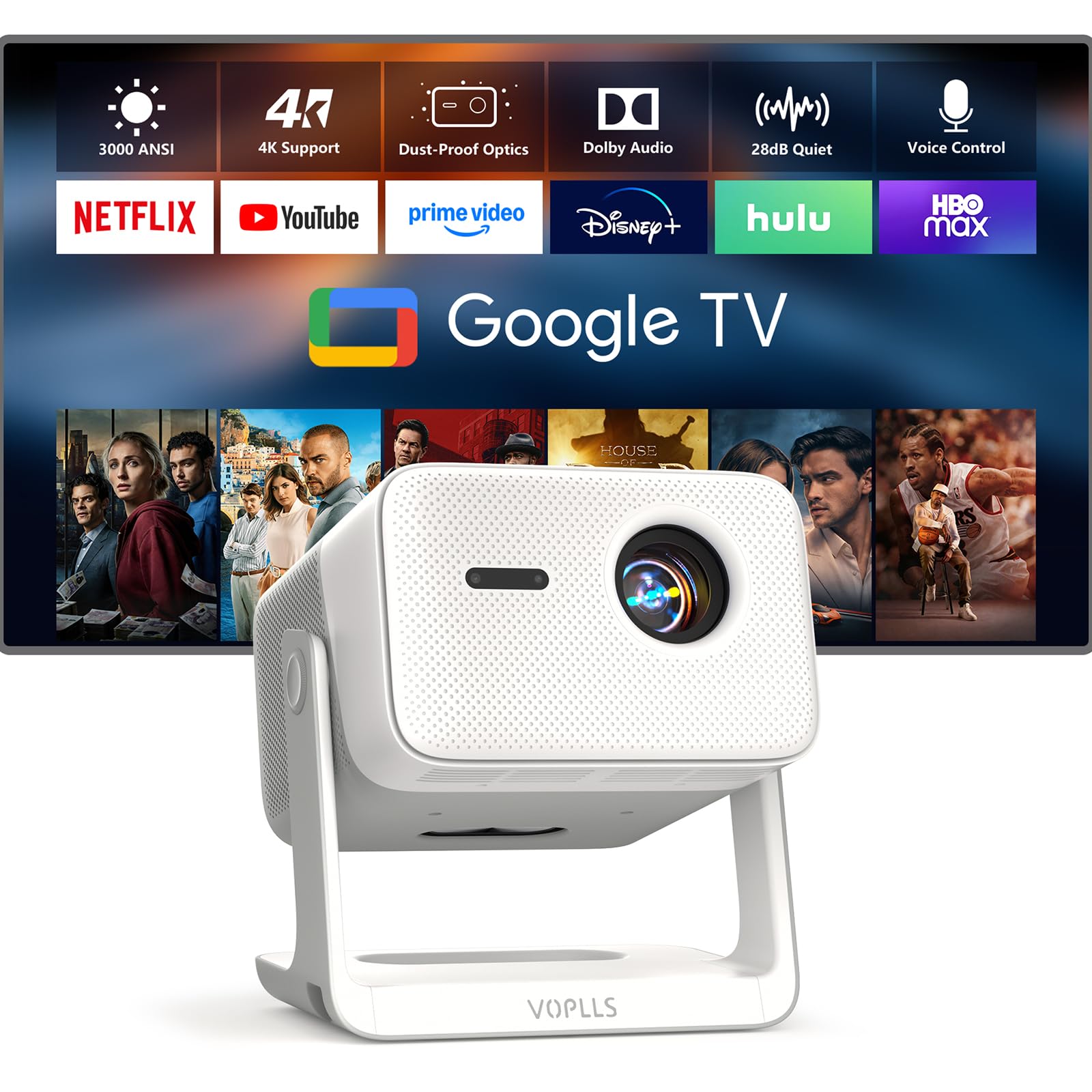
The G7 is the least expensive way here to get a real Google TV interface built in. Not an app store someone bolted on, but the licensed platform with Netflix, Disney+, and Prime Video ready to sign into and a remote that behaves like a television's, including voice search.

Three thousand ANSI lumens and a 1.24:1 short throw make it easy to live with: it sits close to the wall, throws 40 to 300 inches, and the AI setup settles focus, keystone, and screen fit in seconds rather than through a menu crawl. The sealed optical engine is meant to keep dust spots out of the picture over time, and the rotating stand lets you aim it at a ceiling without buying a mount. The wireless side is the fussy part — some phones and Bluetooth speakers pair immediately, others take a few tries — so keep the HDMI input as your fallback.

For a bedroom ceiling or a covered patio, that's a lot of capability for the money, and the interface is the reason. It's the one here we'd hand to someone who wants a projector, not a project.

Pros

  • Licensed Google TV built in
  • 3,000 lumens with a short throw
  • Auto focus and keystone in seconds
  • Rotating stand aims at ceilings

Cons

  • Audio sounds thin at higher volume
  • Wireless pairing can be stubborn
Our verdict

The budget pick we'd actually recommend — licensed Google TV and 3,000 lumens, with the streaming layer already solved.

Check Latest Price
6

One-Box Simplicity

HAPPRUN KC7 PRO

85 /100
LBD Score Excellent

Key details

Audio
Dual 10W with Dolby Audio
Weight
4 lb
Brightness
3,000 ANSI lumens
Smart Platform
Built-in apps, 1,000+
View on Amazon

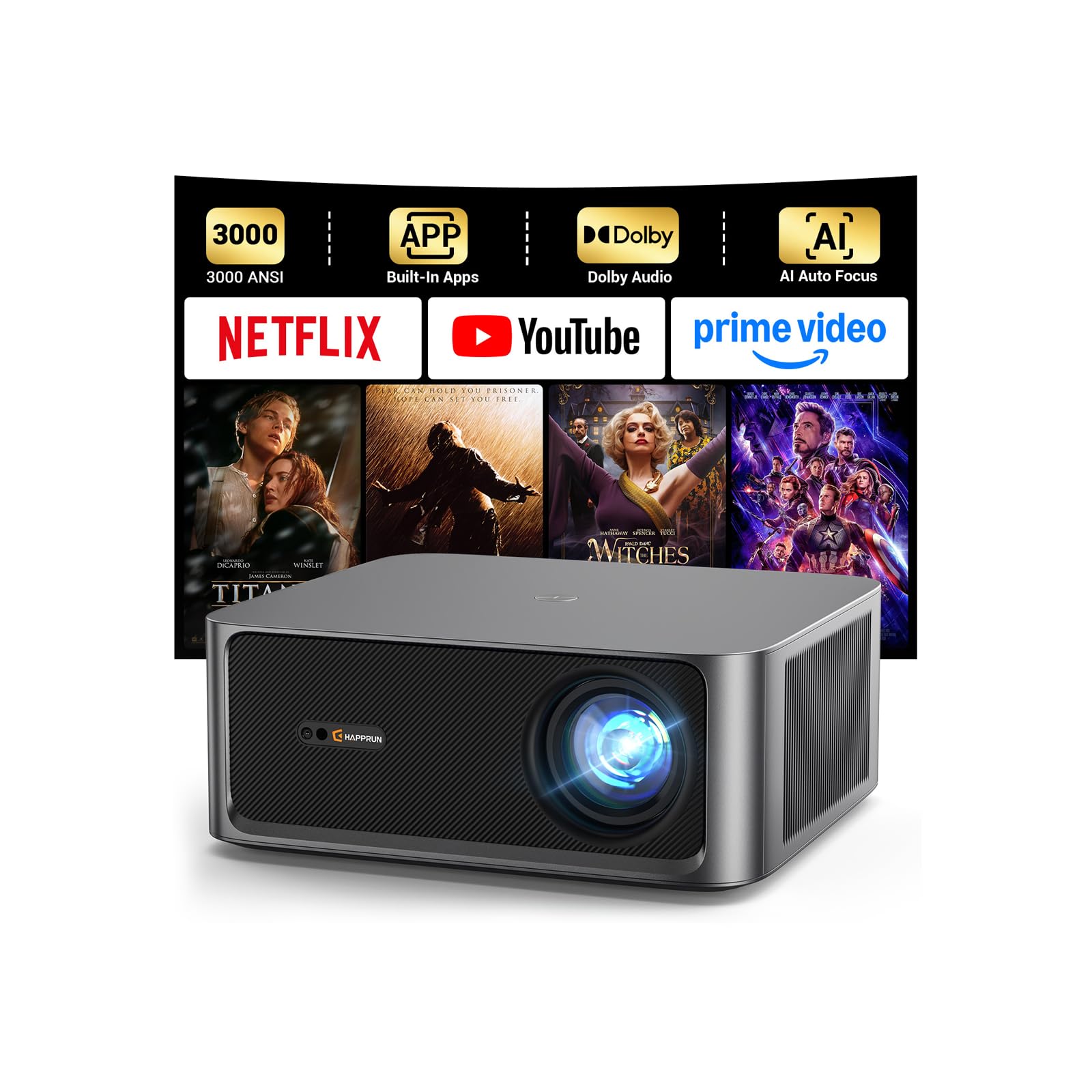
The KC7 PRO makes one bet: that you'd rather not bolt a soundbar and a streaming stick onto your projector. It ships with a streaming system holding more than a thousand apps and a pair of 10W speakers with Dolby processing, so the box on the table is the whole setup.

The rest of the specification is competitive rather than remarkable. Three thousand ANSI lumens, a native 1080p LCD panel that accepts 4K input, a 20,000:1 contrast ratio, and the full auto-calibration package — focus, keystone, obstacle avoidance, screen fit — that this generation of smart projectors has made standard. It covers 40 to 300 inches and weighs four pounds, so it moves between rooms without a second thought, and the bundled HDMI cable means you can plug a console in without hunting for one.

Where we hesitate is the record. This is a new model with very little written experience behind it, so we can tell you the design makes sense and the specifications line up with the Google TV and smart projectors further up this list, but we can't tell you how it behaves in month eight. Buy it as a considered gamble, or buy the G7 if you want the same idea with more history behind it.

Pros

  • Streaming apps and speakers included
  • Dual 10W speakers with Dolby Audio
  • Auto focus, keystone, obstacle avoidance
  • Four pounds with a 300-inch maximum

Cons

  • New model with little track record
  • 4K is decoding only; the panel is 1080p
Our verdict

An all-in-one that solves streaming and sound in one box — worth a look if you'd rather not build a system around a projector.

Check Latest Price
7

Backyard Evenings

Jimveo J62 Pro

91 /100
LBD Score Outstanding

Key details

Stand
180-degree rotating
Weight
2.6 lb
Smart Platform
Movin 3.0, Netflix built in
Native Resolution
1920 x 1080 with 4K decoding
View on Amazon

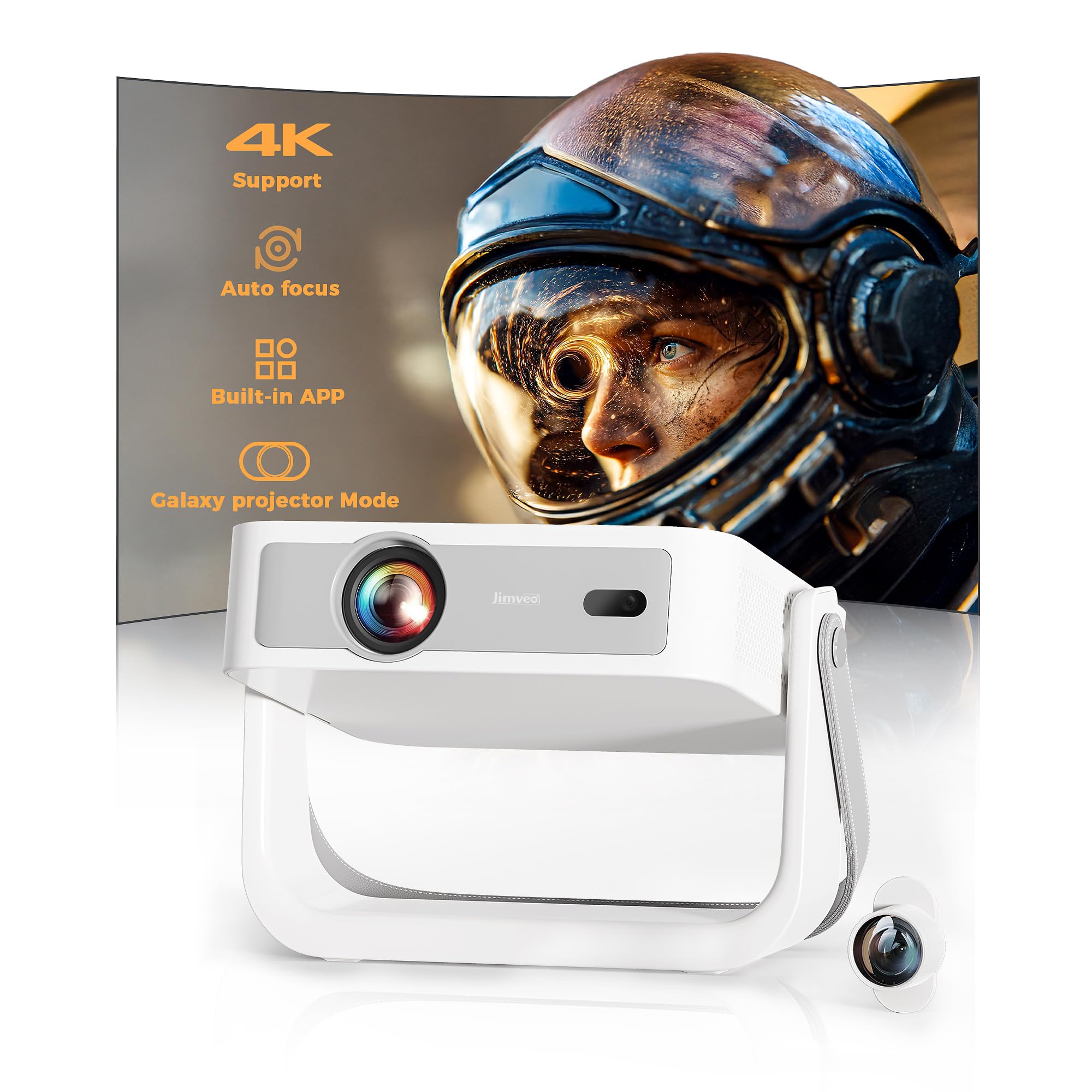
The magnetic star filter is a gimmick, and we mean that fondly. Snap it over the lens and the J62 throws a ceiling of drifting stars instead of a movie; snap it off and you have a 1080p projector. It's a small thing, but it's the reason this one gets pulled out for a sleepover rather than a movie night.

The rest of the package is built for the same casual use. At 1.18 kg and 2.5 inches tall it disappears into a bag, the stand rotates 180 degrees so it can sit on a table and throw at the ceiling, Netflix and the other apps are already installed, and the autofocus and keystone settle the picture in a few seconds without a menu crawl. Screen sharing from an iPhone or a MacBook is the kind of thing you can hand to a guest.

Brightness is where we slow down. Jimveo doesn't publish an ANSI figure for this model — the listing says 'High Bright' and supports 4K and leaves it there — so there's nothing to line up against the 3,000- and 5,500-lumen picks here. In practice that puts it firmly after dark: a bedroom ceiling, a tent, a backyard once the sun is down. We wouldn't plan a Sunday afternoon football game around it.

As a second projector, though, it's easy to like. Setup that actually finishes itself, apps already installed, a stand that aims anywhere, and a genuinely sharp 1080p picture for the size. This is the one that lives in a bag by the door.

Pros

  • Very compact at 1.18 kg
  • Netflix and apps built in
  • Magnetic star filter for ambience
  • 180-degree stand for ceiling projection

Cons

  • No published ANSI brightness rating
Our verdict

Charming and genuinely pocketable, and a lovely backyard projector after sunset — just not the one for a room the sun reaches.

Check Latest Price

How We Tested Projectors for Rooms With Windows

We started with spec sheets, because in this category the numbers do a lot of the sorting: rated brightness, throw ratio, how much optical zoom was on tap, how far keystone correction could stretch, how many HDMI inputs were on board, and whether streaming apps and a speaker were built in. We cut anything that couldn't go into an ordinary room without a ceiling mount and a contractor, then filtered by price. Seven projectors made the cut, and they've lived in our homes for six months.

Most of the testing happened in the least flattering conditions we could arrange. In a living room with the blinds up at two in the afternoon, we ran the same clips on every unit — a shadowy drama episode, a bright sports broadcast, an animated film with saturated color, and a plain gray test pattern — watching for the moment faces went waxy, blacks turned to gray fog, and greens drifted toward neon. Then we repeated the whole run on a patio at dusk with the porch lights on.

Setup got its own round, since placement is where a bright room is won or lost. I set each one up alone and timed box to first picture, then deliberately placed it off-center and used optical zoom and keystone to square the image, noting how much of the picture went soft or got cropped along the way. We nudged each unit mid-film to see whether autofocus snapped back or hunted, and carried them out to the yard to judge whether the size and weight made that a one-person job.

For sound and connectivity, we ran the built-in speakers at the volume a backyard movie actually needs, listening for harshness at the top end, then plugged in a streaming stick, a console, and a laptop to see how fast inputs switched and whether Wi-Fi streaming held on. The pattern by the end was clear: the units that kept their picture in daylight did it with brightness and real adjustability, not one or the other.

How to Choose a Projector for a Bright Room

Find the ANSI Number, Then Trust It

Almost every pick here publishes an ANSI lumen figure, and that figure is the only brightness claim worth comparing. 'High brightness,' 'daytime support,' and a 4K badge in the title tell you nothing about how a picture survives a lit room; a headline promising 5,000 ANSI beside a spec table listing 1,000 tells you which number to believe. For a room with windows and the lights on, treat 3,000 ANSI lumens as the floor and 4,000 to 5,500 as genuine headroom.

One thing that catches people out: the brightest mode on most projectors is a cooler, greener picture than the calibrated one, because every last lumen is being spent on output. Expect to choose between maximum brightness and accurate color, and check the model you're buying lets you switch between the two.

Laser or Lamp Changes the Five-Year Bill

Rated light-source life across this group runs from 4,000 hours on the ViewSonic PA503HD's lamp to 20,000 on the LS740HD's laser. Divide the rating by how much you watch: four hours a night on a 4,000-hour lamp is under three years of evenings, while 20,000 hours will outlast most people's upgrade cycle. Lasers also hold their brightness as they age, where a lamp dims gradually before it finally goes. We'd pay the laser premium for a ceiling-mounted projector that runs daily, and happily take the lamp for a few nights a week.

Match the Throw to the Room You Actually Have

The brightest projectors are often standard throw, which is where bright-room plans fall apart: the picture is superb, but nobody wants a projector on the coffee table. Short throw fixes that — the BenQ TH671ST puts a 100-inch image up from about five feet and the VOPLLS G7's 1.24:1 ratio is nearly as tight — while the LS740HD's 1.13 to 1.47 ratio wants real depth behind it.

Measure from the shelf or ceiling point to the wall before you order. Then lean on optical zoom for sizing and save keystone for the last inch, because digital correction squares the image by sacrificing pixels. Check which keystone the model does, too: the PA503HD corrects vertically only, so it has to sit square to the screen.

Decide Where the Apps Live

Built-in streaming is convenient, but the word 'apps' covers a lot. The VOPLLS G7 runs a licensed Google TV platform — the interface a smart TV uses, updates included — while some listings count a browser-based app store as thousands of apps. Every pick here has an HDMI input, so a streaming stick does the same job, keeps working when the projector's software stops, and gets replaced without replacing the projector. If built-in software costs you picture quality, take the stick.

Frequently Asked Questions

Final Verdict

If we were buying for a bright room tomorrow, we'd take the ViewSonic LS740HD. It's the only projector here with enough brightness in reserve that a sunny afternoon stops being a scheduling problem, and the laser engine means that output is still there in five years without a bulb purchase.

Tighter budget? The Optoma HD30LV gives you 4,500 lumens for a good deal less and only asks that you accept a lamp. Short room? The BenQ TH671ST solves a problem brightness can't.