Best Surge Protectors of 2026

A surge protector is the one appliance in your house built to sacrifice itself: a varistor inside absorbs a voltage spike and dies so your laptop doesn't. That's the pitch, anyway. What actually separates a good strip from a cheap one is duller — how many outlets stay usable once bulky plugs go in, whether the USB ports charge anything meaningful, and whether the cord and plug fit where you need them.

My desk is what pushed me into this. Monitor, laptop brick, lamp, phone charger, speaker — five things fighting over two outlets that no two adapters would share. My team and I have spent the past four months living with 14 surge protectors, from palm-sized outlet extenders to 12-outlet strips on 8-foot cords, and the differences show up fast, especially in whether a strip stays where you put it and how the ports feel after a few hundred plugs. The picks below sort themselves by where they earn their keep: a desk, a media wall, a garage bench, a dorm room.

1

Best Overall

Anker 351 Power Strip

96 /100
LBD Score Outstanding

Key details

Cord
5 ft, flat plug
Outlets
12 AC
USB Ports
3 (1 USB-C, 20W)
Surge Rating
2,100 joules
View on Amazon

Twelve outlets is a number on a box; whether the twelfth is usable is what you find out at the desk. We lined up a monitor brick, two laptop chargers, and a handful of wall warts on every strip in this group, and the Anker 351 was the one where everything still fit — the receptacles sit wider apart than a standard row, with extra room at the ends, so nothing blocked its neighbor.

The USB side is why it stayed on the desk. There's one USB-C at 20W and two USB-A, and that C port is the fastest single port on any strip here, close to what a phone's own wall charger delivers. All three share one supply, so we use the C port for the phone and leave the A ports for earbuds, a watch, and a desk fan rather than expecting three devices to fast-charge at once.

Behind the outlets the numbers are 2,100 joules, a TUV listing, and connected-equipment coverage up to $200,000 if the strip fails at its job — the most reassuring package here after the Tripp Lite. Overload, overheat, and flame resistance round out the protection, the flat plug sits close enough to the wall to go behind a bookshelf, and two screws in the keyhole slots take it off the floor.

For a desk with a monitor, a laptop, a router, a lamp, and a couple of chargers, this is the one we point people to. It protects more gear than the budget strips, it charges from the same bar, and a failure becomes a phone call rather than a dead computer.

Pros

  • Twelve outlets spaced for bulky adapters
  • 20W USB-C, the fastest port in this group
  • 2,100 joules plus connected-equipment coverage
  • Flat plug and keyhole mounting

Cons

  • 13-amp rating is below the 15-amp standard
  • 5-foot cord is short for a long run
Our verdict

For a desk full of gear, this is the strip we recommend: 12 spaced outlets, a genuinely fast USB-C port, and equipment coverage behind it.
Check Latest Price
2

Best for Home Theaters

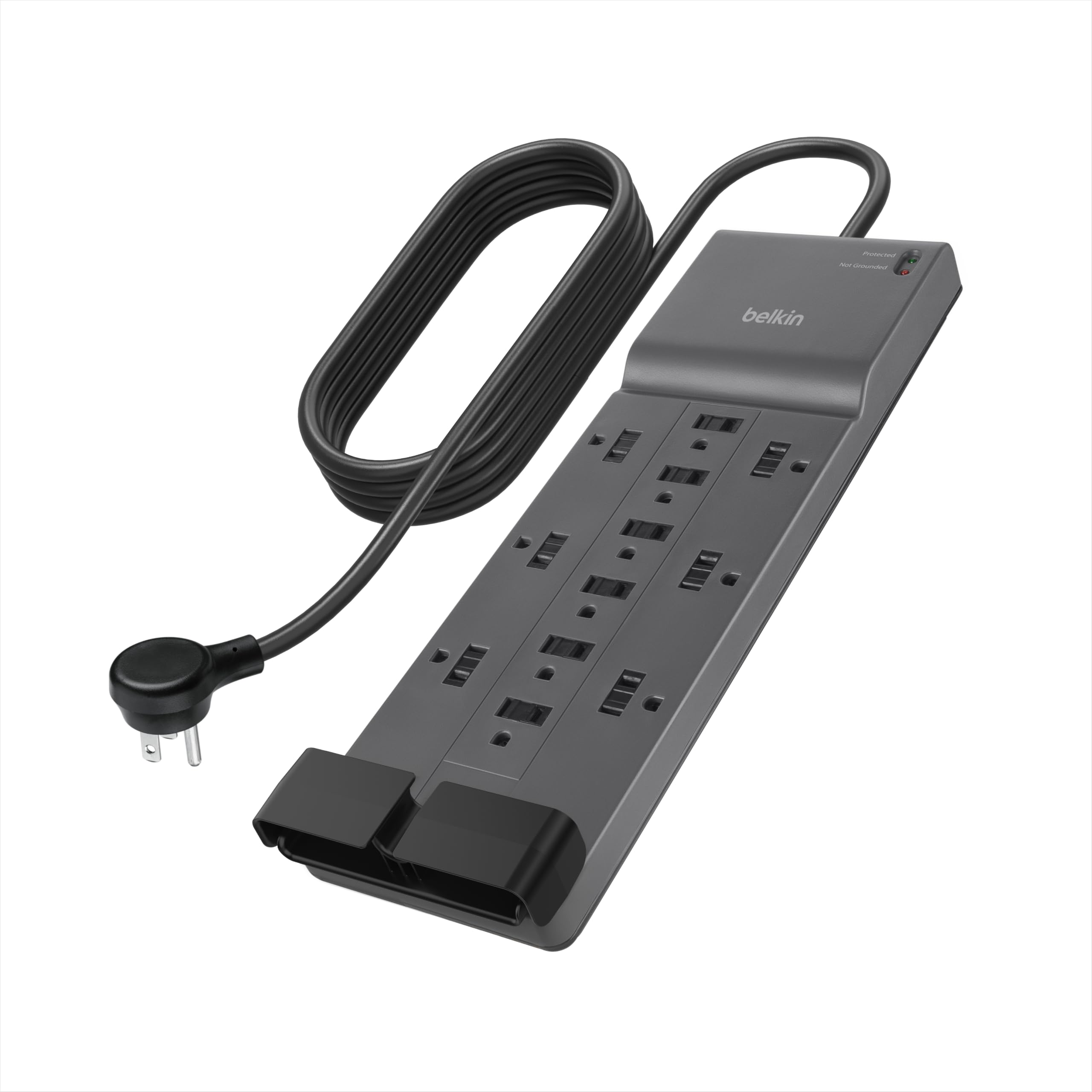
Belkin 12-Outlet Surge Protector

94 /100
LBD Score Outstanding

Key details

Cord
8 ft, flat plug
Outlets
12 AC
Surge Rating
3,940 joules
Certification
UL listed
View on Amazon

At 3,940 joules this sits near the top of the group for surge capacity, second only to the Amazon Basics 12-outlet strip, and it spreads that capacity across outlets with more room around each one than anything else here. For a TV shelf — receiver, console, subwoofer, router, a couple of lamps — that combination is the whole point: the bricks have space and the strip has the headroom to absorb a hit before it reaches the gear.

It's a big object: 13 inches long and about two pounds, with an 8-foot cord, a flat plug, and a cord keeper on the back. It's UL listed and carries a two-year limited warranty, a shorter term than the equipment coverage on the Anker and the Tripp Lite, though the housing itself feels like the most substantial plastic bar in the group.

Once it's in place, it stops asking for attention. The flat plug disappears behind the console, the cord keeper takes up the slack, and the spacing means you stop rearranging bricks every time you add a device. It's been sitting behind a TV since we set it up, doing nothing noticeable, which is what you want from a surge protector.

Pros

  • 3,940 joules of surge capacity
  • Widely spaced outlets clear big adapters
  • 8-foot cord with a flat plug
  • UL listed with a two-year warranty

Cons

  • Long, heavy body needs shelf or floor space
Our verdict

Buy this one if your outlets are full of power bricks — nothing else here gives them this much room, and 3,940 joules backs it up.

Check Latest Price
3

Best Value for a Big Setup

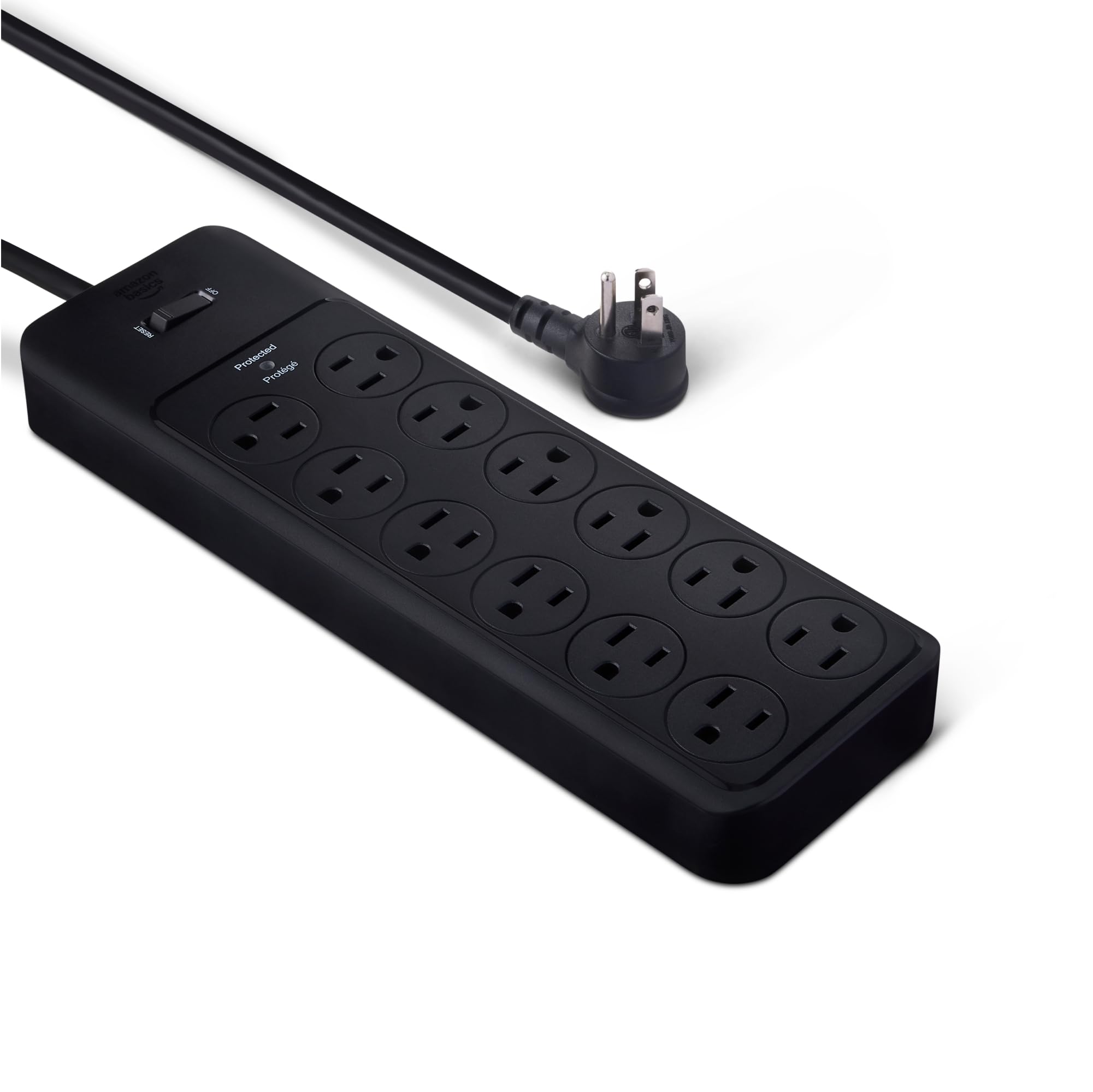
Amazon Basics 12-Outlet 4,000J

94 /100
LBD Score Outstanding

Key details

Cord
8 ft
Safety
Outlet shutters, 15 A breaker
Outlets
12 AC
Surge Rating
4,000 joules
View on Amazon

No USB ports, no braided cord, no swivel joint: the Amazon Basics 12-outlet strip is a plain black bar with a switch, and it carries the highest joule rating in this group at 4,000. An 8-foot cord and a full 15-amp rating come with it, for less than the Belkin.

For a home office or a gaming shelf where every device already has its own charger, we think that's the right trade — you're buying protection and outlets, not another USB hub. Twelve outlets swallow a whole desk's worth of gear, the safety shutters keep an empty receptacle from being a temptation, and the keyhole slots take two screws if the floor isn't an option.

At 1.8 pounds it's light enough to hang, and the housing is flame-retardant. Nothing about it feels premium and nothing about it feels flimsy; it's the strip you screw to the back of a desk and forget about until the next storm.

Pros

  • 4,000 joules, the highest rating in this group
  • 8-foot cord and 12 outlets for less than the Belkin
  • Safety shutters and a 15-amp breaker

Cons

  • Standard outlet spacing crowds bulky adapters
Our verdict

We point big setups here when the budget is tight: 4,000 joules, 12 outlets, and an 8-foot cord without extras you won't use.

Check Latest Price
4

Best for Small Desks

HANYCONY 8-Outlet Power Strip

96 /100
LBD Score Outstanding

Key details

Cord
5 ft braided, flat plug
Outlets
8 AC
USB Ports
4 (2 USB-C, 3.1 A shared)
Surge Rating
1,080 joules
View on Amazon

This is the strip for a desk you actually look at. Eight AC outlets and four USB ports fit in a squat block with receptacles on three sides, so it claims less surface than a conventional six-outlet bar and doesn't announce itself the way a long black strip does. We like it best where the outlet is the problem rather than the gear: a nightstand, a dorm desk, the end of a kitchen counter.

Two of the four USB ports are USB-C, which means a newer phone or a tablet plugs in without a dongle. The 5-foot braided cord and flat plug handle the tight-spot half of the job — the plug lies against the wall behind a dresser instead of jutting out from it, and the braided cord is easier to route around a desk leg than a stiff plastic one.

Protection is 1,080 joules, on the low side for this group but comfortably matched to a laptop, a monitor, a lamp, and a couple of chargers on one desk. It's ETL listed, and the breaker clicks back on if you overload it. Buy more protection for a gaming rig with a big card and a bigger monitor; for ordinary desk gear, this is the one that fits.

Pros

  • Eight outlets and four USB in a small footprint
  • Two USB-C ports on a budget strip
  • Flat plug and braided 5-foot cord

Cons

  • USB ports share 3.1 A, so charging is slow
Our verdict

Our pick for a small desk: eight outlets and four USB ports that take up almost no surface and disappear behind a monitor.

Check Latest Price
5

Best for Garages

Tripp Lite TLM825SA

94 /100
LBD Score Outstanding

Key details

Cord
25 ft
Housing
Steel
Outlets
8 AC
Surge Rating
3,900 joules
View on Amazon

Twenty-five feet of cord is the entire argument. A garage, basement, or barn rarely has an outlet where the work happens, and this strip's cord reaches from the wall to the bench, the driveway, or out a window to a generator without another extension cord in the chain. The steel housing and OSHA yellow say the same thing: it's meant to be kicked, hung, and left out.

We've come to think of it as shop equipment rather than a power strip. At 4.5 pounds it's the heaviest thing here by a wide margin, and that weight buys a metal case, cord wrap arms, 3,900 joules with EMI/RFI filtering, and a lighted switch with a 15-amp breaker you can find in a dim corner. The lifetime warranty and connected-equipment coverage are the kind of backing the plastic strips don't offer.

The outlets are spaced for transformer blocks, and it ships with four safety covers for the ones you're not using, which makes more sense in a garage than on a desk. Nothing about it is subtle, and nothing about it is meant to be.

Pros

  • 25-foot cord reaches across a garage
  • Steel housing built for a workshop
  • 3,900 joules with EMI/RFI filtering
  • Lifetime warranty and equipment coverage

Cons

  • No USB ports
Our verdict

If the strip lives in a garage, this is the one — 25 feet of cord, a steel case, and a lifetime warranty.

Check Latest Price
6

Best Two-Pack

Mifaso 2-Pack Power Strip

96 /100
LBD Score Outstanding

Key details

Cord
5 ft braided, flat plug
Pack
2 strips
Outlets
6 AC per strip
Surge Rating
900 joules
View on Amazon

Two strips in one box is the reason to look at this one. A bedroom and a home office, a TV stand and a desk, a kid's room and the laundry corner — the pair covers two problem outlets for about what a single 12-outlet strip costs, and each one is slim enough at 1.9 inches across to sit behind a couch or along the back edge of a desk.

Each strip gives six outlets, USB charging, a 15-amp breaker, a lighted switch, a flat right-angle plug, and a braided 5-foot cord. The braid turns out to matter more than it sounds: it's a cord you don't mind seeing across a floor, and the 14-gauge wire inside is rated for the full 15 amps rather than the thinner stuff in a bargain strip.

We keep one under a desk and one behind a TV, which is exactly the job — two ordinary rooms fixed at once instead of one room fixed expensively. The mounting tabs are shallow enough that a standard screw head fouls the slot, so plan on the floor or the back of a shelf rather than the wall.

Pros

  • Two strips cover two rooms
  • Braided 14-gauge cord with a flat plug
  • Slim enough to hide behind furniture

Cons

  • 900 joules is modest for expensive gear
Our verdict

Two decent strips for less than one big one — the right buy when two rooms need fixing at once.

Check Latest Price
7

Tight Outlets

One Beat Outlet Extender

95 /100
LBD Score Outstanding

Key details

Form
Rotating wall tap
Outlets
6 AC
USB Ports
4 (2 USB-C)
Surge Rating
1,800 joules
View on Amazon

Some outlets are in the wrong place: behind the couch, above a kitchen counter, in the two inches between a desk and the wall. A strip has to sit on the floor to serve those; a wall tap doesn't. The One Beat plugs straight into the receptacle and swivels, so its six outlets and four USB ports can be turned to face whatever room there actually is.

The three-sided layout does the work wide spacing does on a strip — a brick on one face doesn't block the ports on the next — and 1,800 joules is a real rating for something this size. Two of the four USB ports are USB-C, and the whole bank shares 3.1 amps, which is overnight-charging territory rather than fast charging.

The joint is the weak point. A tap hangs off the receptacle with only the plug holding it, and the swivel collar can work loose when a cord gets yanked out; brace the body with one hand when you unplug something and it stays put. In a spot where a strip would have to live on the floor, that's a fair trade.

Pros

  • Rotating plug aims outlets into tight spaces
  • Six AC outlets on three faces
  • 1,800 joules with two USB-C ports

Cons

  • No cord, so it only works at the outlet
Our verdict

Get this when the outlet is in the wrong place: it swivels out of tight corners and adds six outlets and four USB ports.

Check Latest Price

How We Chose and Tested the Best Surge Protectors

We started with a wide sweep of what's on the market and filtered hard: only strips with a UL or ETL listing, then sorted by joule rating, cord length, plug profile, outlet count and layout, USB-A and USB-C ports, and price. Anything without a safety certification or some form of connected-equipment coverage got cut before it ever reached an outlet. That left 14 units, which we used for four months.

Each one lived somewhere real. One anchored a home office desk shared by a monitor, a laptop brick, a printer, and a phone; another went behind a living room TV; one went to a garage bench alongside a shop vacuum and a battery charger; a couple landed in a dorm-style setup where the only free outlet sits behind a bed. We charged phones and laptops from the USB ports and timed how long a nearly dead phone took to reach 50 percent.

Outlet spacing was tested with the bulkiest plugs we own — a laptop brick, a smart speaker adapter, a grounded three-prong heater plug — and we counted how many outlets stayed usable with all of them seated. We yanked cords at an angle, dropped each strip onto a hard floor, coiled the cords back up, and checked for cracked housings, loose outlets, and any scorch or rattle after a heavy load. Strips sold as mountable went up on a wall and under a desk with their included hardware, and we watched whether they held or slid out of the screws. The rest sat on desks and countertops while we noted which ones crept backward under the weight of their own cords, and whether a flat plug actually cleared the back of a bookcase.

How to Choose a Surge Protector

Joules: how much protection you're buying

Joule ratings in this group run from 900 to 4,000, and the spread is real. The protection circuit absorbs a spike before it reaches your gear, so a higher rating means more capacity to absorb. Put the big numbers in front of a desktop, a TV, and a receiver you'd hate to replace; for lamps, chargers, and a laptop, something in the 800 to 1,200 range is a fair match.

None of it is a guarantee against a direct strike — it's headroom. Buy more of it for expensive equipment and less for the bedroom nightstand.

Spacing beats outlet count

Twelve outlets are worth less than eight if four of them are blocked by power bricks. Look at how the receptacles are arranged: wide-set rows, sideways outlets, and three-sided blocks all buy room for adapters, while a tight uniform row turns one big charger into a two-outlet event.

Count your bricks — a laptop supply, a monitor supply, a speaker brick — before you count outlets. With more than two of them, choose a strip built around spacing rather than one with an extra pair of receptacles.

Cord length and the plug on the end

Measure the run, not the room. A 5-foot cord looks generous until the strip is on the floor and the cord has to round a desk leg; the 8-foot cords on the Belkin and the Amazon Basics are what make those two easy to hide, and the Tripp Lite's 25 feet is for a garage where the outlet is on the wrong wall.

Behind a bookshelf or a couch, a flat plug matters as much as length. Don't run any cord under a rug or across a doorway.

USB ports: check the total, not the count

Four USB ports sharing 3.1 amps deliver roughly 15 watts between them — fine overnight, slow for a tablet that's nearly dead. One 20W USB-C port beats four ports on a shared low-wattage supply when you want a phone topped up quickly.

Read the total output and whether the C port has its own rating, then decide whether the strip is doubling as your charger or just saving you a wall adapter.

Certification, housing, and what the warranty covers

A UL, ETL, or TUV listing is the floor, not a feature. Above that, the differences are housing and backing: plastic for a desk, steel for a garage where the strip gets stepped on, and connected-equipment coverage that pays out if the strip fails and takes your gear with it.

Both the Anker and the Tripp Lite back their strips with that kind of coverage. For a desk full of equipment, it's worth paying a little more for.

Frequently Asked Questions

Final Verdict

For most desks and home offices, the Anker 351 is the surge protector to buy: 12 outlets with room for real plugs, a 20W USB-C port that earns its place, 2,100 joules, and connected-equipment coverage that turns a failure into the company's problem rather than yours.

If the strip is going behind a TV with a receiver and a console, the Belkin's wider spacing and 3,940 joules fit that shelf better. If it's going in a garage, nothing here touches the Tripp Lite's 25-foot cord and steel case.