Best Solar Power Banks of 2026

A dead phone is annoying at home and a real problem when you're far from an outlet, whether you're on a trail, at a campsite, or waiting out a storm-related outage. A solar power bank is meant to keep you connected without a wall plug, but the category has a credibility gap: big capacity claims, slow panels, and built-in cables that quit early. The right one is a backup battery first and a solar gadget second.

I've kept solar power banks in my hiking pack and car console for years, and over the past four months my team and I tested 16 of them in everyday and outdoor situations. The models people enjoy using tend to be portable enough to forget in a bag, with built-in cables that feel sturdy, wireless charging that doesn't require perfect placement, and a flashlight that's easy to find in the dark. We paid attention to real charging speed, not just the wattage on the label, and to whether the solar panel did anything beyond looking rugged. The picks below are the ones that held up.

1

Best Overall

SOARAISE 50000mAh Solar Power Bank

88 /100
LBD Score Excellent

Key details

Weight
16 oz
USB-C Output
22.5W
Battery Capacity
50,000mAh
Wireless Charging
15W
View on Amazon

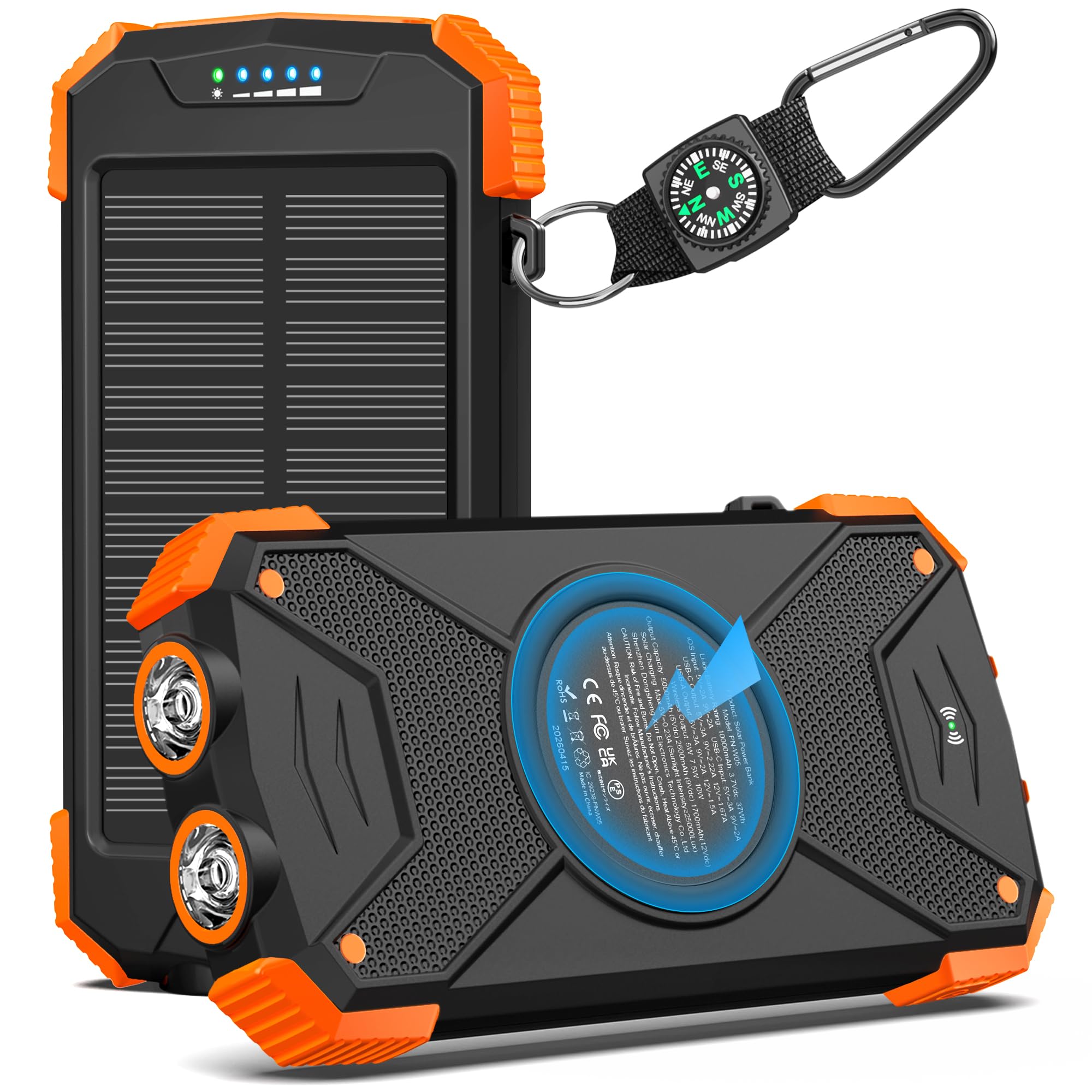
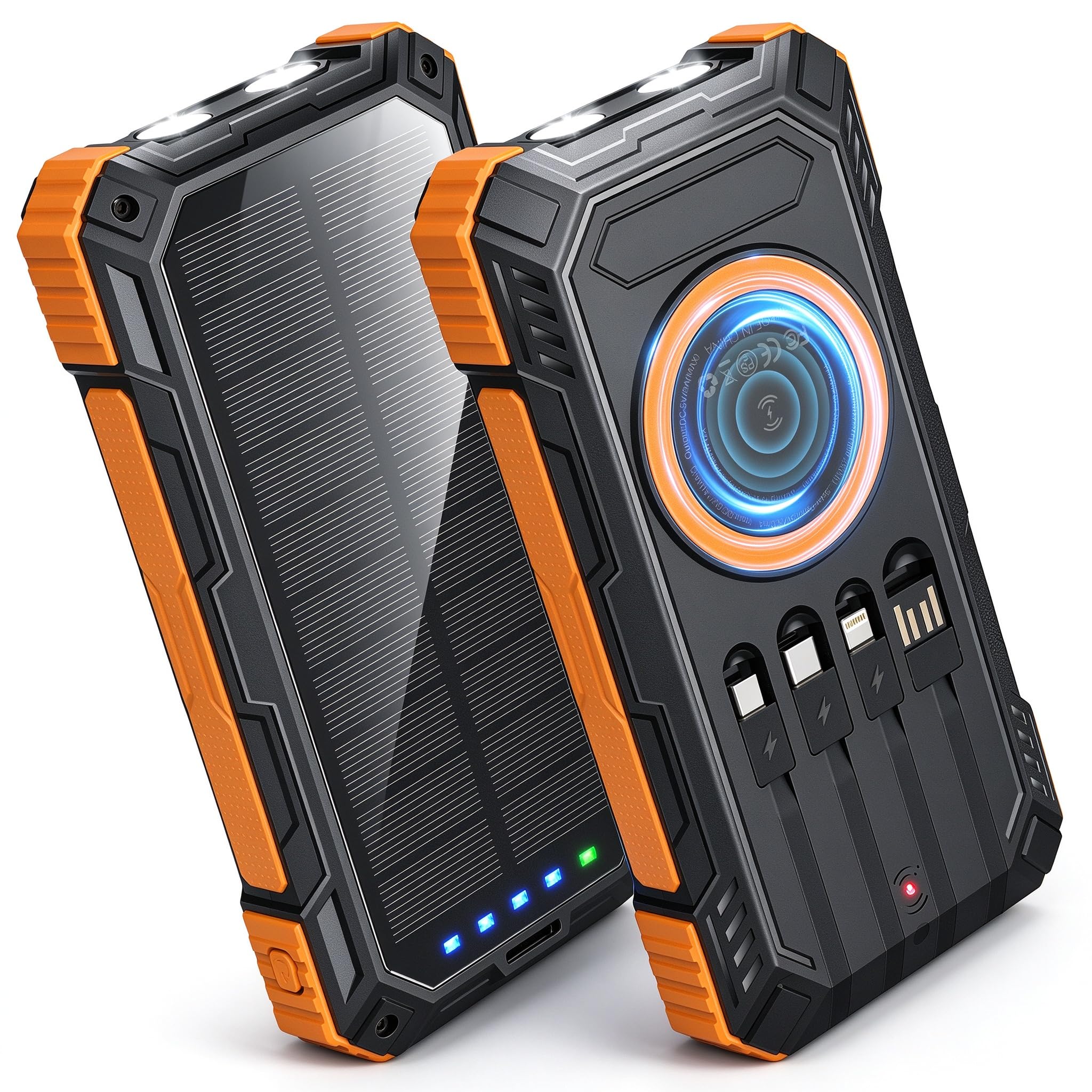
A 50,000mAh rating usually comes with a brick attached, so the 16-ounce body and 6 x 3 x 1-inch footprint are the first things we noticed. It still takes up real space in a daypack, but it slides into a laptop sleeve or a bottle pocket instead of demanding its own pouch. The 22.5W USB-C output is the useful part for phones, and the 15W wireless pad lets you drop a phone on top without hunting for a cable.

The two built-in cables cover USB-C and Lightning, and the three extra ports let it charge up to six devices at once. That setup is useful for a family trip: one bank on the counter, several phones plugged in, no pile of loose cords. The solar panel is a top-up, not a wall-charge replacement. In direct sun it adds charge slowly, so we plug the bank in before a trip and use the panel to stretch a day rather than refill the whole battery.

That mix is why it earns the top spot: enough capacity for a weekend, enough output to be useful in a hurry, and enough ports to serve more than one person. We also appreciate the flashlight, compass, and thermometer living in the same shell, because those are the small things you notice when a pack gets wet and a phone is low. They make it a better car-camping bank than a bare battery.

Pros

  • 50,000mAh capacity for a weekend
  • 22.5W USB-C and 15W wireless
  • Charges up to six devices at once
  • Compact 6 x 3 x 1-inch body

Cons

  • 12-month warranty is short for the price
Our verdict

We recommend the SOARAISE 50000mAh to most people because it pairs a large battery with 22.5W charging in a body that still fits a daypack.
Check Latest Price
2

Best for Cable-Free Family Charging

BLASOUL 49800mAh Solar Power Bank

83 /100
LBD Score Excellent

Key details

Weight
1.08 lb
USB-C Output
22.5W
Built-in Cables
4
Battery Capacity
49,800mAh
View on Amazon

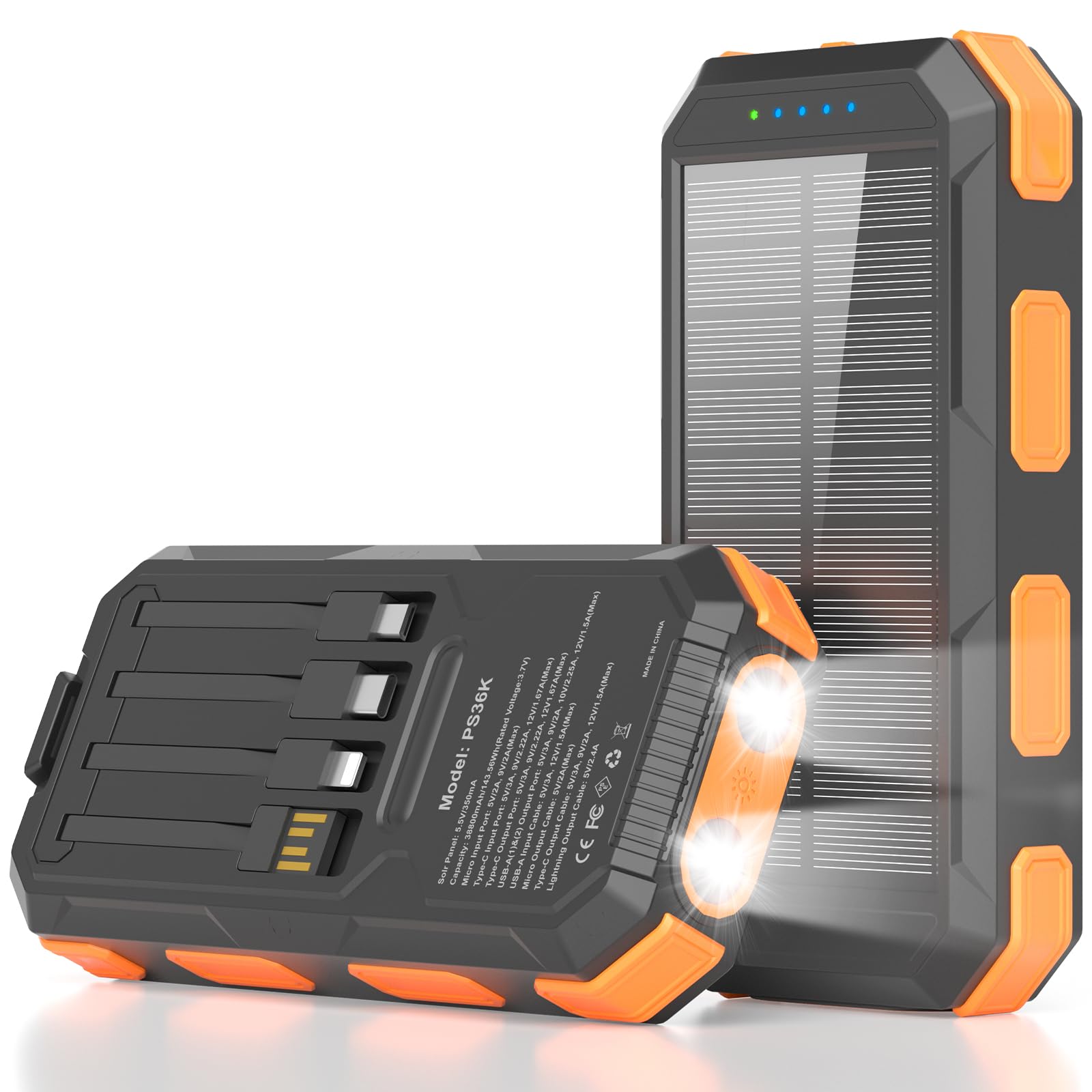
The first thing that disappears with this bank is the cable pouch. Four built-in cables cover USB-C, Lightning, Micro-USB, and a USB-A input, so you can leave the short cords at home, and the extra ports and 15W wireless pad let it serve a mixed group. We noticed the difference on a family trip, where one bank on the table replaced a tangle of adapters and kept two phones and a tablet going. That everyday convenience is why it sits near the top of this set.

The 49,800mAh battery and 22.5W USB-C output are the other reasons it earns a runner-up spot. It is the pick for a group because the cable count is the feature you feel every day; the capacity just makes the convenience last. The IP65 shell handles dust and splashes, which is the right level for a picnic table or a tent, and the 15W wireless pad is a useful fallback when someone has a compatible phone. The built-in cable layout takes some getting used to because the short leads tuck into the body, but that is a small ritual for the clutter it removes.

Pros

  • Four built-in cables cover most phones
  • 22.5W USB-C and 15W wireless
  • 49,800mAh capacity

Cons

  • Heavy at 490 grams
Our verdict

We reach for this one when several phones need charging at once, since four built-in cables and 15W wireless eliminate the usual cable scramble.

Check Latest Price
3

Best Emergency Backup

BLAVOR Hand Crank Solar Power Bank

85 /100
LBD Score Excellent

Key details

Weight
1.3 lb
Battery Capacity
20,000mAh
Wireless Charging
15W
Emergency Charging
Hand crank
View on Amazon

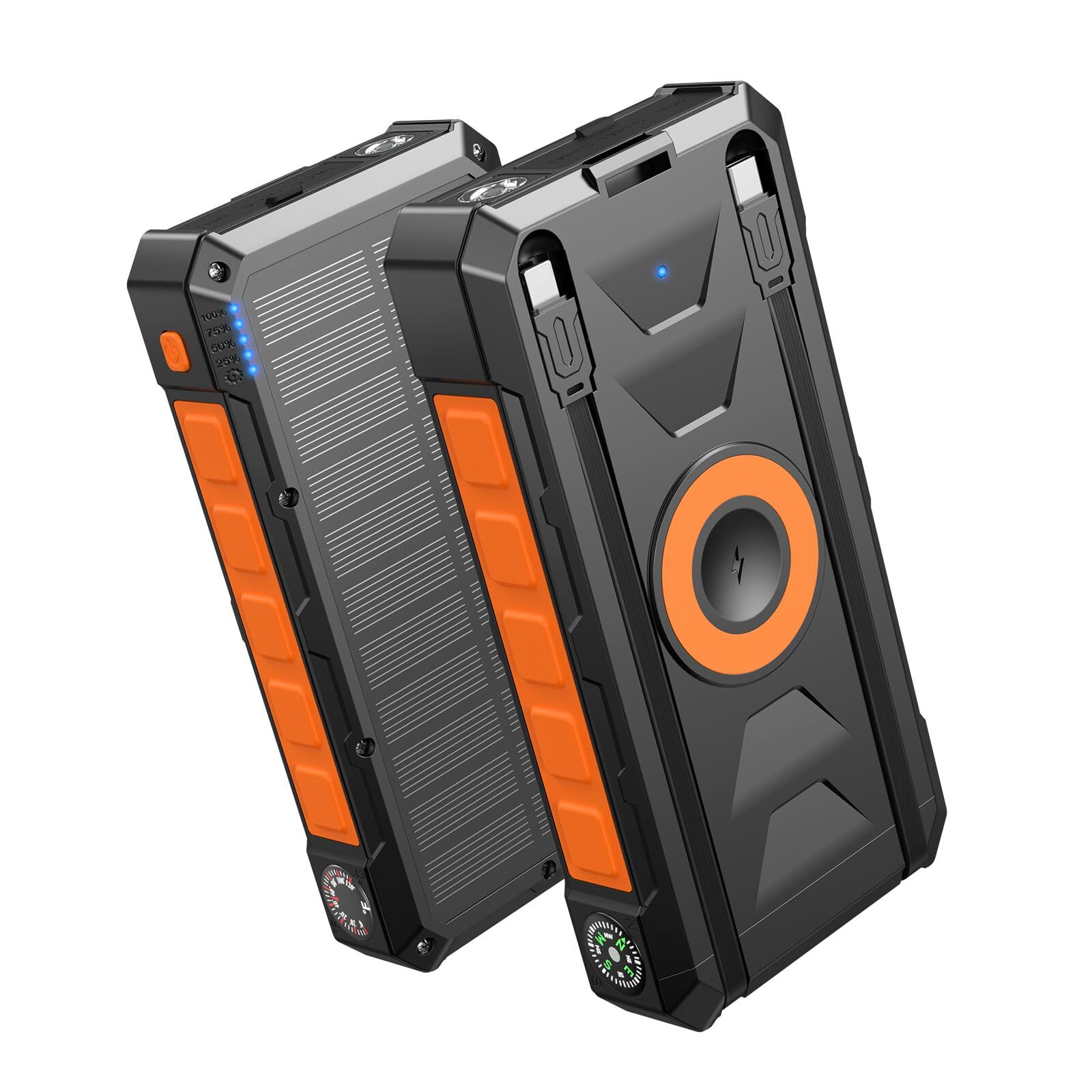
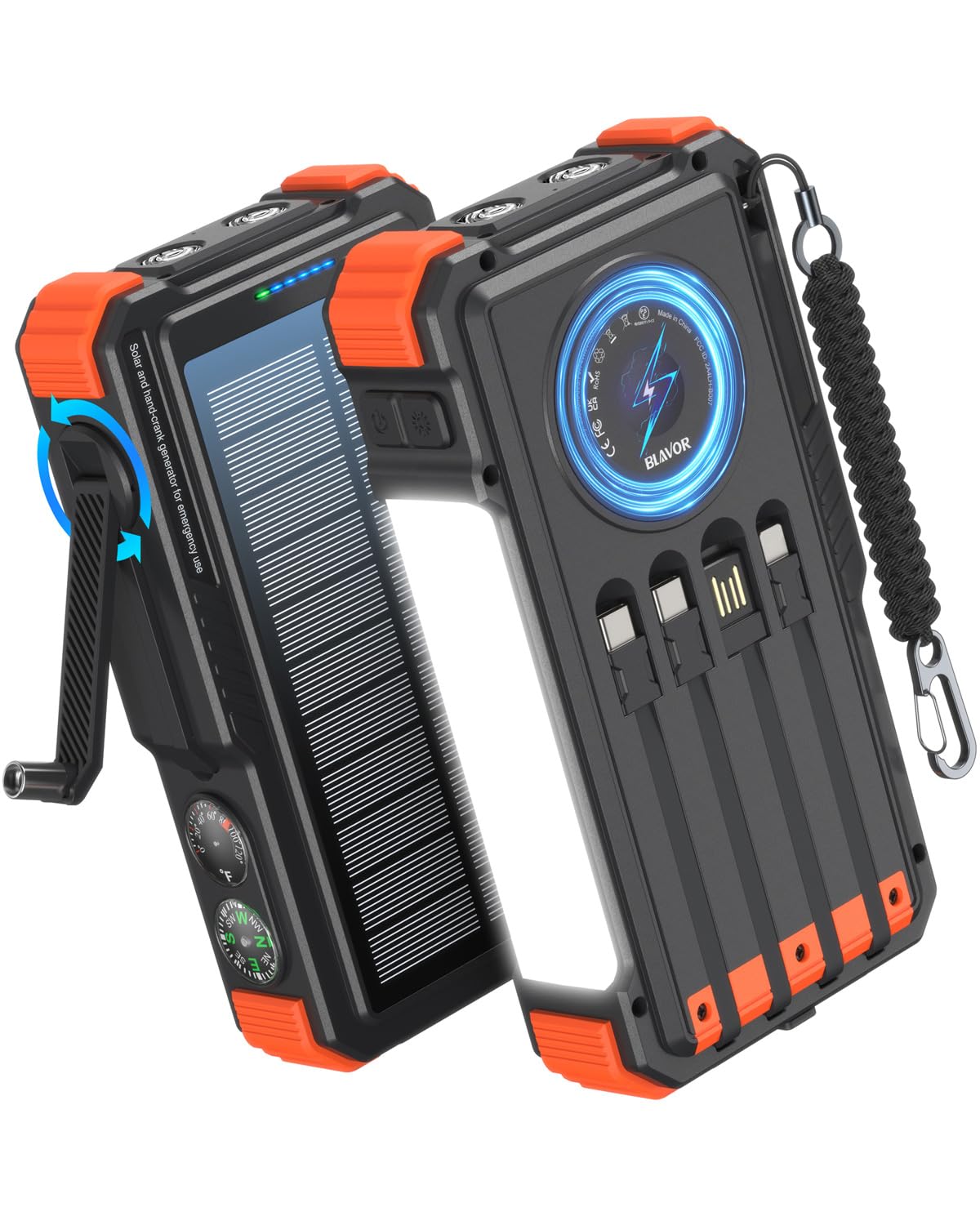
The hand crank is the reason this bank exists in our kit. When the battery is flat and there is no outlet, turning the handle produces a trickle of power; it is not a substitute for a wall charge, but it is a second way to make a call when the grid is down. The handle has a sturdy feel in the hand rather than the loose plastic click we expected.

The rest of the package is aimed at the same buyer: 20,000mAh, 15W wireless charging, four built-in cables, a camp lantern, dual flashlight, compass, and thermometer. We like the lantern more than we expected. It turns the bank into something you leave on a tent table instead of burying in a pack, and the four cables mean the family can share it without a separate pouch. The 20W output is fine for phones, though this is not the quickest bank here.

The solar panel is a backup to the backup. We treat it as a way to recover a little between outings, not as the main source, and the same goes for the crank. That is the right expectation for a bank built around emergency redundancy rather than fast everyday charging.

We keep it for the moments when a dead bank is not an option, and that is a narrower job than the top pick handles. If you want one bank for everyday travel, the extra hardware works against it; if you want a light, a charger, and a last-resort crank in one box, it is the most distinctive pick here.

Pros

  • Hand crank adds off-grid backup
  • Camp lantern and dual flashlight
  • 20,000mAh with 15W wireless

Cons

  • Heavy at 1.3 pounds
Our verdict

We keep this in an emergency kit for the hand crank and lantern as much as the battery, and that redundancy is why it earns a place.

Check Latest Price
4

Best Lightweight

BLAVOR 10000mAh Solar Power Bank

86 /100
LBD Score Excellent

Key details

Weight
9.3 oz
USB-C Output
20W
Battery Capacity
10,000mAh
Water Resistance
IPX5
View on Amazon

At 9.3 ounces, this is the one we can drop in a jacket pocket and forget about until a phone starts to die. The 10,000mAh battery is small by the standards of this group, but that is the point: it is a personal top-up bank, not a family power source. The 20W USB-C port gives it enough output to be useful, and the wireless pad is the convenience we noticed most, because you can set a phone down without lining up a connector. The 5.9 x 3.1 x 0.8-inch body is closer to a thick phone than a brick, and the IPX5 shell shrugs off splashes.

We recommend it for travel because the size is the feature. It disappears into a small bag, and the dual flashlight is bright enough for a tent or a dark parking lot. The catch is solar: the panel is a trickle charger, and we do not rely on it to refill the bank on a trip. Treat the 10,000mAh battery as the real source and the panel as a bonus. That limit is honest: a phone and a tablet top-up on a weekend is fine; two phones for three days is not.

Pros

  • Pocketable 9.3-ounce body
  • 20W USB-C and wireless charging
  • IPX5 splash resistance

Cons

  • Wireless charging is slower than USB-C
Our verdict

We recommend this to travelers who want a genuinely pocketable backup that can also charge wirelessly.

Check Latest Price
5

Best Fast-Charging Value

YELOMIN 38800mAh Fast-Charge Solar Bank

84 /100
LBD Score Excellent

Key details

USB-C Output
22.5W
Built-in Cables
4
Battery Capacity
38,800mAh
Water Resistance
IP65
View on Amazon

Four built-in cables and a 22.5W USB-C port are the reasons this YELOMIN stands apart from the cheaper 38,800mAh bank below. The cables cover USB-C, Lightning, Micro-USB, and USB-A, so a group can charge without anyone unpacking a cord. We also like the four-port setup for a car trip: it is one object to hand around, not a bag of adapters.

The 38,800mAh capacity is enough for several phone top-ups, and the IP65 shell is built for dust and splashes. What sells it for us is the combination of fast output and built-in cables at a midrange price; that is a more useful package than a bigger battery that charges slowly. It is not pocketable at 6.3 inches long, but it fits a glovebox or a small daypack without drama.

We treat the solar panel as a supplemental charger. It helps if the bank sits in direct sun between stops, but it will not replace a wall charge. The 6.3-inch body is a glovebox or daypack item, and that is where it belongs. Keep the order number handy, because the 12-month warranty is standard rather than generous.

Pros

  • 22.5W USB-C fast charging
  • Four built-in cables
  • 38,800mAh with IP65 shell

Cons

  • No wireless charging
Our verdict

We think this is the value pick for fast cable-free charging, with 22.5W USB-C and four built-in cables at a midrange price.

Check Latest Price
6

Budget Backup

YELOMIN 38800mAh Solar Power Bank

84 /100
LBD Score Excellent

Key details

Ports
3
Weight
9.9 oz
Output Current
2.4A
Battery Capacity
38,800mAh
View on Amazon

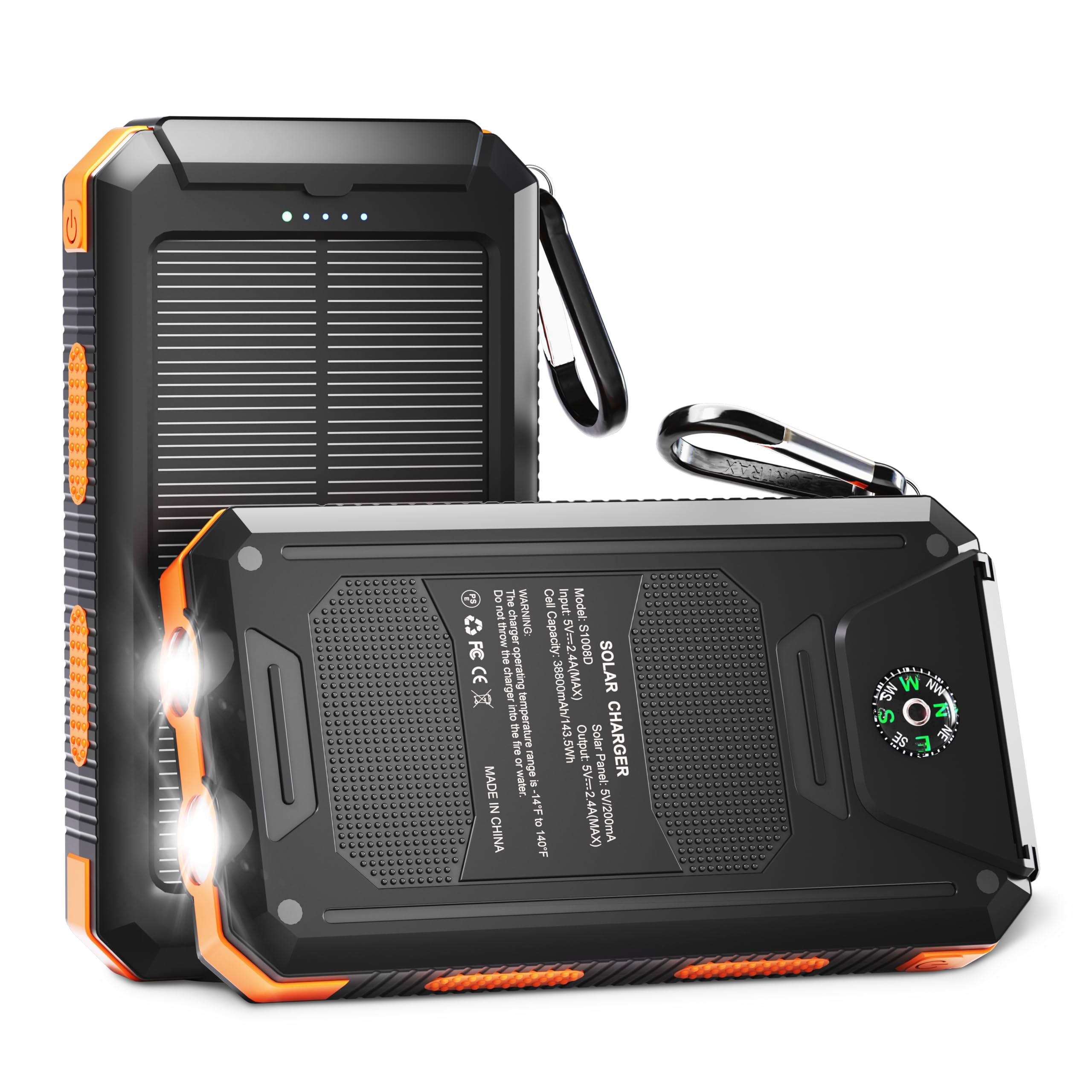
The 9.9-ounce weight and low price are what get this bank into a glovebox or a hiking pack. It is the lightest way here to carry a claimed 38,800mAh, and the built-in solar panel and carabiner fit the outdoor brief. We like it as a set-and-forget backup: clip it to a pack, leave it in a window between trips, and keep a phone cable in the car.

The dual LED lights and three modes are genuinely useful in a tent or a dark car, and the carabiner makes the bank easy to keep within reach. The 5.9 x 2.95 x 0.98-inch body is small enough for a jacket pocket, though the capacity is the reason to carry it rather than the size. We treat the solar panel as a trickle, not a main charger, and the same goes for the small built-in light.

We see it as a budget emergency bank, not a primary travel charger. The 2.4A output is fine overnight or in a glovebox, but it will not rush a phone back to life, and the 38,800mAh rating is optimistic in real use. That is acceptable for the money if you keep expectations modest; it is not the bank to buy if you need dependable fast charging every day.

Pros

  • Light at 9.9 ounces
  • Dual LED lights and carabiner
  • USB-C input and output

Cons

  • No wireless charging
Our verdict

We see this as a cheap glovebox backup for short trips, not a bank to trust for a week off-grid.

Check Latest Price
7

Big-Capacity Budget

Durecopow 49800mAh Solar Power Bank

80 /100
LBD Score Excellent

Key details

Ports
3
Weight
14.4 oz
USB-C Output
15W
Battery Capacity
49,800mAh
View on Amazon

This is the least expensive way here to get near 50,000mAh, so it is the pick for a glovebox or a cabin drawer where capacity matters more than features. The 15W USB-C port and two USB-A outputs cover the basics, and the 14.4-ounce body is heavy but not absurd for the capacity. We noticed the simple layout right away: three ports, one button, and a flashlight.

The 49,800mAh battery is the whole reason to consider it. You need to pack your own cable because there are no built-in leads; the upside is that the body is simpler and the ports are easy to reach. The solar panel is a trickle, and the 12-month warranty is standard. The 7 x 3.22 x 1.02-inch body is longer than a phone but slim enough for a door pocket. We treat the flashlight as a trunk or tent light rather than a main feature, and the included carabiner is a small convenience.

Pros

  • 49,800mAh capacity for the money
  • 15W USB-C and three ports
  • Slim 1.02-inch body

Cons

  • No wireless charging
Our verdict

We recommend this when capacity matters more than weight or wireless charging, and the budget is tight.

Check Latest Price

How We Tested Solar Power Banks

To build the shortlist, we researched current solar power bank listings and filtered for realistic capacity claims, built-in cable setups, wireless charging pads, weather resistance, and price. We bought 16 models at retail and tested them for four months, with no brand or model treated as the favorite going in. Seller wattage was treated as a claim to verify, not a result.

The banks went into a hiking pack, a car console, and a tent for a three-day camping trip; at home, I ran a planned blackout drill. I drained a phone to 5 percent and timed how long each bank took to reach 50 percent, then repeated the test with a tablet and earbuds to see how charging capability held up with more than one device. I also left each solar panel in direct afternoon sun for an hour and checked how much the battery indicator moved; in shade, I noted whether it moved at all. I clicked through each flashlight mode in a dark garage and checked whether the beam was broad enough to light a trail map.

Portability got judged by weight and bulk after I packed each bank into a daypack and carried it on a two-mile walk. For built-in cables, I plugged in and gently wiggled each connector while charging, noting any cutouts; for wireless charging, I set phones down without centering them and watched whether charging started or slipped. I dropped each unit from waist height onto a garage floor, splashed the casing at the sink, and ran three full charge cycles to check for reliability and capacity fade. Value came down to usable charge for the money, not the biggest number on the shell.

How to Choose a Solar Power Bank

Start With Real Capacity

Capacity is quoted in milliamp-hours, but your phone sees usable watt-hours after conversion losses. A 10,000mAh bank is a personal top-up for a phone; 20,000mAh is a weekend companion; 50,000mAh is a group or outage bank. We treat the printed number as a ceiling, not a promise, and we plan on fewer full phone charges than the arithmetic suggests. Match the capacity to the trip: a day hike and a week off-grid are different purchases.

Look at Ports and Cables, Not Just Watts

Built-in cables are the feature you notice every day. A bank with four cables and a wireless pad can serve a mixed group without anyone unpacking a pouch, which is why the BLASOUL and the fast YELOMIN earn their places. If you carry your own cable anyway, a simpler bank with one good USB-C port is lighter and cheaper. Count the devices you actually travel with, then count the ports and cables; buying for a family of four with a two-cable bank is how the cable scramble starts.

Treat the Solar Panel as a Trickle Charger

Solar charging is real, but it is slow. A panel the size of a phone can add a little charge over a sunny day; it will not refill a 50,000mAh battery between breakfast and lunch. More panel area helps, and direct sun helps more, but the panel still adds charge gradually. We charge by USB before a trip and use the panel to stretch the time between outlets. If solar is the only source you plan to use, buy a separate folding panel rather than a pocket bank.

Carry Weight Follows Capacity

Weight tracks capacity more closely than any other spec. A 10,000mAh bank around 9 ounces disappears into a jacket; a 50,000mAh bank around a pound is a daypack item; a hand-crank model adds hardware and lands near 1.3 pounds. Weather sealing matters for outdoor use, but IPX5 and IP65 are splash-and-dust ratings, not proof it survives a river. Choose the lightest bank that covers your longest usual trip, then add a rugged model only if it will live outside a pack.

Plan for Reliability and Emergency Features

Lithium cells age, and a bank that works on the first trip can fail after a few months. Before a big trip, run a full charge and discharge at home so a dud shows up while the return window is open. A 12-month warranty is common; a longer one is a reason to pay more. Emergency features such as a lantern, SOS light, or hand crank are worth it if the bank lives in a storm kit, but they add weight and complexity you do not need on a city commute.

Frequently Asked Questions

Final Verdict

For most trips, the SOARAISE 50000mAh is the bank we point to first: it has enough capacity for a weekend, fast enough USB-C for a phone, and wireless charging for the moments when a cable is a nuisance. It is not pocket-light, but the size is the price of the capacity. If cable clutter is the bigger problem, the BLASOUL holds four cables and charges a group; if you want a true blackout kit, the BLAVOR hand crank adds a lantern and a crank. Buy for the trip you take most often, not the disaster you hope never comes.