Best Telescopes for Deep-Sky Viewing of 2026

The first time you find the Andromeda Galaxy, it won't look like the photographs. It's a faint gray smudge, and through a small scope under a streetlight it may not show up at all. That's the honest tradeoff in deep-sky viewing: aperture gathers the light, but the mount, the focuser, and the app that promises to find objects for you decide whether you ever get to look.

My team and I have spent the past ten months with eight telescopes, from tabletop Dobs to computerized Schmidt-Cassegrains, and the lesson kept repeating: great optics don't help if the tripod shivers every time you touch the focuser, or if alignment eats forty minutes of a clear night. What separates a scope you love from one that gathers dust is usually setup, not glass.

Aperture still matters most, though a 6-inch under dark skies will beat a 10-inch in a lit backyard. The picks below are the ones we kept hauling outside — for their image quality, but just as much for how quickly and steadily they got us to the eyepiece.

1

Best Overall

Celestron StarSense 10" Dob

85 /100
LBD Score Excellent

Key details

Mount
Altazimuth Dobsonian base
Weight
54.8 lb
Aperture
10 in (254 mm)
Included
32 mm eyepiece, 2-inch Crayford focuser
View on Amazon

Ten inches is the number that matters here. A 254 mm mirror gathers enough light that a globular cluster stops being a grey smudge and starts breaking into individual stars, and the brighter galaxies show a shape instead of a hint. It sits on a Dobsonian rocker box, a wooden base that rests flat on the ground, which is the simplest and sturdiest way to carry a mirror this size.

What kept us coming back to it is that the two hard parts of deep-sky viewing are already handled. Finding: dock a phone in the StarSense cradle and the app works out where the tube is pointed, then tells you which way to nudge. Steadiness: with no tripod legs to flex, a light touch at the eyepiece doesn't send the object swinging out of view. The 2-inch Crayford focuser and the 32 mm eyepiece mean there is nothing to buy before the first clear night.

The cost is bulk. At 54.8 pounds across a 56-inch tube and a separate base, it leaves the house in two trips and wants a hatchback rather than a back seat. That is also why the base is as rigid as it is, and a scope parked near a door you can carry it through turns the size into a non-issue. Start with the 32 mm eyepiece, since low power is where faint objects look their best, and it is the one we left in all night.

Pros

  • 254 mm aperture resolves clusters and shows galaxy shape
  • Dobsonian base holds aim without tripod flex
  • StarSense app guides a manual mount to targets
  • 2-inch Crayford focuser and 32 mm eyepiece included

Cons

  • Manual tracking, so high-power views drift
Our verdict

We think this is the deep-sky scope to buy: 254 mm of aperture on a base that doesn't shake, with an app that finds faint targets for you.

Check Latest Price
2

Best Computerized

Celestron NexStar 8SE

86 /100
LBD Score Excellent

Key details

Mount
Computerized single fork arm
Aperture
8 in (203 mm)
Focal Length
2032 mm
Object Database
40,000+
View on Amazon

The 8SE exists to remove the two most tiring parts of an evening. Center three bright objects for SkyAlign and the hand control takes over from a database of 40,000-plus: choose a galaxy, the mount slews to it, and then it keeps tracking, so the object is still in the eyepiece after you swap eyepieces or go back to a chart. The tube is only 43.2 cm long, which means the whole rig carries out in one piece and stores on a closet shelf.

Eight inches of Schmidt-Cassegrain aperture is plenty for galaxies, planetary nebulae, and globulars, the largest light grasp here after the big Dobsonian in a package a fraction of its size. What we noticed in use is how much of the work the mount quietly absorbs: at high power, where an undriven scope loses the object in seconds, this one simply holds it.

Two things to know before you commit. The 0.75-degree field is comfortable for galaxies and tight for the biggest nebulae, so the Andromeda galaxy and the North America Nebula won't fit whole and you'll be panning around them. Alignment is the part that asks for patience: under a cluttered suburban sky, centering those three objects can take a few tries, so choose a night with an open view south and start with the brightest thing you can find. Neither point is a reason to skip it; both are reasons to buy it for galaxies and clusters rather than sprawling clouds of gas.

Pros

  • GoTo mount slews to and tracks 40,000+ objects
  • 8-inch optics in a 43.2 cm tube
  • Holds a high-power target without nudging

Cons

  • Batteries and 12V adapter both sold separately
  • The most expensive scope in this group
Our verdict

If you want the telescope to do the finding and hold the target while you look, this is the one: 8 inches of aperture on a GoTo mount that tracks.

Check Latest Price
3

Best Portable

Sky-Watcher Heritage 150

80 /100
LBD Score Excellent

Key details

Mount
Altazimuth tabletop
Weight
23 lb
Aperture
150 mm
Focal Length
750 mm (f/5)
View on Amazon

The Heritage 150's tube slides down its struts and locks, turning a 750 mm focal length into a package that tucks behind a seat. That single design decision is why we rate it the most portable serious option here: 23 pounds, a rocker base with rubber feet, and a tube that stores on a shelf. Set it down and you are observing in the time it takes to carry it out.

The optics are the surprise. The primary is borosilicate glass with a parabolic figure and Sky-Watcher's RAQ coating, and the f/5 focal ratio gives a 1.15-degree field, wide enough to hold open clusters whole and to make star-hopping practical with a chart. The collapsible truss is built to keep collimation when it slides open, and that matched what we saw: it came back together and stayed sharp.

Aperture is the ceiling. At 150 mm it shows clusters, bright nebulae, and the Messier galaxies happily, but the faintest fuzzies a 10-inch pulls in stay out of reach. That is the bargain you are accepting, and it buys a scope that goes in the car every single time, where a dark sky will do more for it than any accessory. The Plossl eyepiece in the box is a fair starting point; the first addition worth making is a low-power wide-field eyepiece.

Pros

  • Collapses for storage and car travel
  • Parabolic borosilicate primary with RAQ coating
  • 1.15-degree field suits large clusters
  • Stable tabletop rocker base with rubber feet

Cons

  • No tripod, so it needs a sturdy table or tailgate
  • Single-speed helical focuser with no fine knob
Our verdict

This is the deep-sky scope we reach for when the car is already full: 150 mm of aperture in a tube that collapses to a fraction of its length.

Check Latest Price
4

Best Complete Kit

Dianfan 150EQ

84 /100
LBD Score Excellent

Key details

Aperture
150 mm
Included
Carry bag, moon filter, phone adapter
Focal Length
650 mm
Tripod Height
48.4 to 66.2 in
View on Amazon

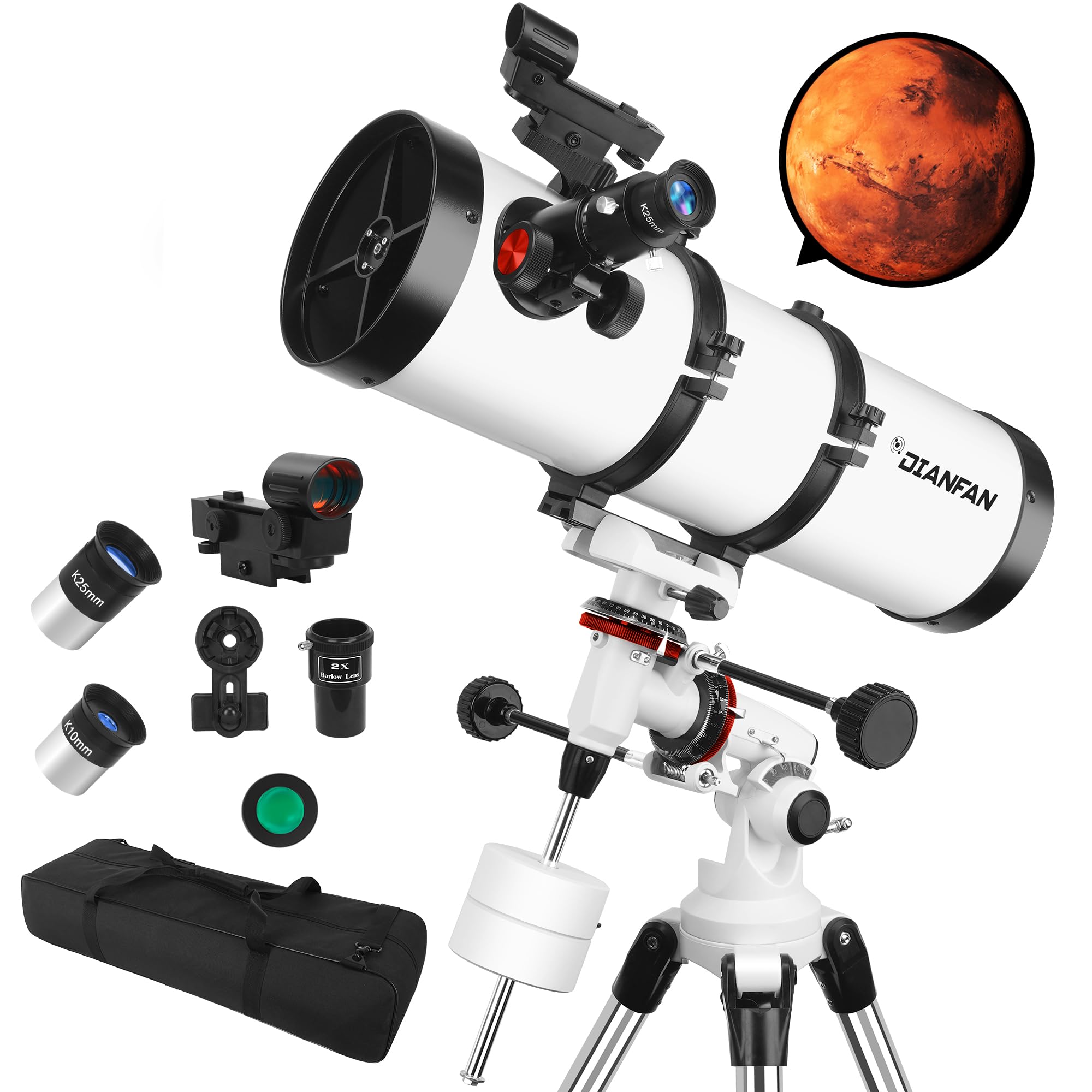
Most budget scopes put the money into the mirror and save it on the tripod, and you feel that the moment you touch the focuser. This one ships with a stainless steel tripod whose legs run from 48.4 to 66.2 inches, enough to stand at the eyepiece instead of crouching, and the equatorial mount arrives pre-assembled, so first light is a single sitting rather than a project.

The kit is the other reason it earns a place. Two Kellner eyepieces and a 2x Barlow cover 26x to 130x, there is a moon filter for bright nights, a phone adapter for a snapshot, and a fitted carry bag, which matters more than it sounds, because a reflector you can bag and put in a trunk is a reflector that gets used. A short 650 mm tube behind a 150 mm mirror is a wide-field combination, and it suits clusters and nebulae better than the long-focal-length scopes here.

What we like most is what the mount does once it is set up: slow-motion cables on both axes let you follow an object at 130x without the shakes a bare alt-az mount introduces, and the counterweight holds the tube where you leave it. Collimation is the upkeep, since a short 650 mm tube is sensitive to mirror alignment, so check it before the first session and after a bumpy ride.

Pros

  • 150 mm aperture on a full-height steel tripod
  • Carry bag, moon filter, and phone adapter included
  • Slow-motion controls on both axes

Cons

  • Equatorial mount takes practice to polar align
Our verdict

For a first deep-sky setup that arrives ready to use, this is the kit we hand people: 150 mm of aperture, a full-height steel tripod, and the extras bundled in.

Check Latest Price
5

Wide-Field Views

SVBONY SV503 102ED

91 /100
LBD Score Outstanding

Key details

Weight
8.71 lb
Aperture
102 mm
Focal Length
714 mm (f/7)
Optical Design
S-FPL51 ED doublet
View on Amazon

A 102 mm doublet using S-FPL51 ED glass, 714 mm of focal length, and a 1.45-degree field describe a rich-field refractor, and that is what this is: an instrument built for the wide end of the sky. The ED element is doing real work on bright stars, which come through clean instead of ringed with purple, and the fit and finish, from the tube rings to the retractable hood, is a step above the painted tubes on the budget reflectors here.

We like it most as a second telescope, or a first one for someone with a mount already in the garage. Refractors hold collimation, cool down quickly, and give the widest usable field in this group, which is exactly what the large diffuse nebulae and sprawling clusters want. The dual-speed 1:10 focuser and the 360-degree rotating field assembly are the details that make it pleasant rather than fiddly: you can reframe without loosening the tube rings, and fine focus is a knob away.

The trade is light grasp. At 102 mm this is the smallest aperture here, so the faintest galaxies stay on the edge of visibility, and its strength runs the other way, toward a wide, clean, high-contrast field where a big object fills the eyepiece. Point it at the big stuff and it is a joy; point it at a faint galaxy and you will wish you had a mirror.

Pros

  • ED glass keeps bright stars free of color fringing
  • Widest field of view among these picks
  • Dual-speed focuser and rotating field assembly

Cons

  • No mount, eyepiece, diagonal, or finder included
Our verdict

For a reader who already owns a mount, this 102 mm ED doublet is the wide-field tube that makes big clusters and nebulae look their best.

Check Latest Price
6

First Deep-Sky Kit

SOLOMARK 130EQ

84 /100
LBD Score Excellent

Key details

Mount
German equatorial
Aperture
130 mm
Included
Moon filter, phone adapter, 1.5x Barlow
Focal Length
650 mm
View on Amazon

Every hobby has a first-purchase trap, and in telescopes it is a big aperture number on a tripod that shakes. This one avoids it by staying at 130 mm and putting the money into a wide aluminum tripod and a German equatorial mount with fine-control cables. That is still enough light grasp for the Orion Nebula, the brighter globulars, and the core of Andromeda, and a steady 130 mm beats a shaky bigger tube every night of the week.

The box is generous for the money: two eyepieces, a 1.5x erecting Barlow, a 13% transmission moon filter, a phone adapter, and an accessory tray for the eyepieces you are not using. Assembly is the part that surprised us, since the mount arrives largely together and the instructions are followable, so a first session does not disappear into setup.

The finder is the weak link: a straight-through design mounted low on the tube, which gets awkward when you aim high overhead. An inexpensive red-dot finder fixes it and is the first upgrade worth making. Otherwise this is a scope that does what a first deep-sky telescope needs to do, holding aim, showing real objects, and not punishing you for learning on it.

Pros

  • Wide aluminum tripod with a German equatorial mount
  • Moon filter, phone adapter, and Barlow included
  • Straightforward assembly

Cons

  • 130 mm leaves the faintest galaxies out of reach
Our verdict

The least expensive way into a real deep-sky reflector here: 130 mm on a steady equatorial mount, with the accessories a beginner would otherwise add one at a time.

Check Latest Price

How We Chose and Tested Deep-Sky Telescopes

We started by pulling every scope we could find that was genuinely deep-sky capable at prices short of a serious imaging rig, then narrowed by aperture, mount type, and what shipped in the box. Years of owner reports told us which models still held collimation and steady mounts after the first season. That left eight telescopes, which we ran for ten months on a suburban driveway under light pollution, at a dark-sky field a couple of hours out on new-moon weekends, and on a city balcony, where a tabletop model had to earn its footprint.

We timed unboxing and first assembly with a stopwatch and noted where the instructions lost us, then timed every session from case to first eyepiece. Each scope got carried outside in the dark, ideally in one trip, because that predicts whether you'll use it in February. To judge sturdiness and build quality, we tapped the tube with an object centered and counted how long the view shook, and we pressed on the focuser to see which plastic parts flexed under a hand.

Image quality got the most nights: the same targets, the same eyepieces where they fit, comparing resolved stars in a globular cluster, dust lanes in a galaxy, the Trapezium in Orion. We noted whether focus snapped in or hunted and slipped, how much of the Pleiades fit in the field of view, and how many attempts the alignment routine or phone app needed before an object landed on the eyepiece. Value came down to how much we still had to buy after opening the box.

How to Choose a Telescope for Deep-Sky Viewing

Aperture is the spec that decides what you see

Deep-sky objects are faint, and light grasp is what turns a grey smudge into structure. A 130 mm reflector will show the brighter galaxies, clusters, and nebulae; a 10-inch mirror resolves globulars into individual stars and starts hinting at dust lanes.

The trap is buying aperture you cannot move. A 10-inch Dobsonian here weighs 54.8 pounds across two pieces, so check the door, the step, and the trunk before deciding the extra inches are worth it. A scope that stays in the garage shows you nothing.

Match the focal length to the objects you chase

A short tube gives a wide field; a long one gives magnification. For nebulae and big clusters you want the wide end, and the two 150 mm scopes here both deliver fields over a degree, which is what it takes to frame something larger than the Moon.

Long-focal-length designs work the other way: the NexStar 8SE's 2032 mm squeezes the field to 0.75 degrees, superb on galaxies and planetary nebulae and cramped on the Andromeda galaxy. Decide whether you are chasing big faint clouds or small faint fuzzies, and buy the tube that matches.

The mount decides whether you can actually look

Every shake costs detail, and the mount is where budget scopes fail first. A Dobsonian rocker box rests on the ground and is the most stable thing you can put a large mirror on; a tripod trades some of that for height and a smaller footprint.

German equatorial mounts add slow-motion tracking at the cost of a polar alignment you have to learn. Tabletop bases are steady but need something solid underneath; a wobbly picnic table undoes everything the base gets right.

Finding objects: star-hop, phone, or GoTo

Faint targets are hard to locate, and three approaches suit different temperaments. Star-hopping with a finder and a chart costs nothing and teaches you the sky, but expect to spend more time finding than looking at first.

Push-to systems such as StarSense read the sky through your phone and tell you which way to nudge a manual mount, with no motors and no alignment stars. GoTo mounts slew and track for you, at a higher price and with an alignment step that can be fussy under a bright or cluttered sky.

Budget for the whole setup, not the tube

A telescope sold as a tube only needs a mount, a diagonal, an eyepiece, and a finder before it shows you anything, so price the complete system before comparing. With a kit, spend the next money on one good low-power eyepiece rather than a high-magnification one; extra power on a faint object usually just magnifies the blur.

One note that comes with the accessories: a moon filter cuts lunar glare, it is not a solar filter, and no telescope should be pointed at the sun without a filter made for the aperture.

Frequently Asked Questions

Final Verdict

The Celestron StarSense Explorer 10-inch Dobsonian is the scope we recommend for deep-sky viewing, because aperture and a steady base are the two things faint objects demand and it delivers both, with app-guided finding that keeps a beginner from spending the night lost.

If the size is a non-starter, the Sky-Watcher Heritage 150 collapses into a trunk and still shows real structure in clusters under dark sky. If you want the mount to find and track for you, the NexStar 8SE does that in a package you can carry out assembled.