Best Thermal Putty for GPU and Laptop Repairs of 2026

Thermal putty fills the uneven gap between a hot chip and the metal sitting above it. A pad is cut to one fixed thickness and only makes contact where the surfaces happen to line up; putty is moldable, so it squeezes into the gap that's actually there. That's why it has quietly replaced pads on VRAM, VRMs, and laptop heat spreaders.

I've re-puttied my own card twice chasing memory temps that wouldn't budge, so I know a bad container costs you an afternoon. Over four months we worked through 14 containers on two aging GPUs, a throttling laptop, a current-gen console, and a cramped small-form-factor build, logging memory and hotspot temps over repeated stress runs. We also judged the unglamorous parts: whether it spread without tearing, how far 30 grams really goes, and whether leftovers stayed workable weeks later.

Because this goes down on bare PCB next to tiny surface-mount parts, non-conductive isn't a marketing bullet — it's the reason putty works here at all. The picks below run from easy-spreading to stretch-further-per-gram to reusable, so match the container to the gap you're actually filling.

1

Best Overall

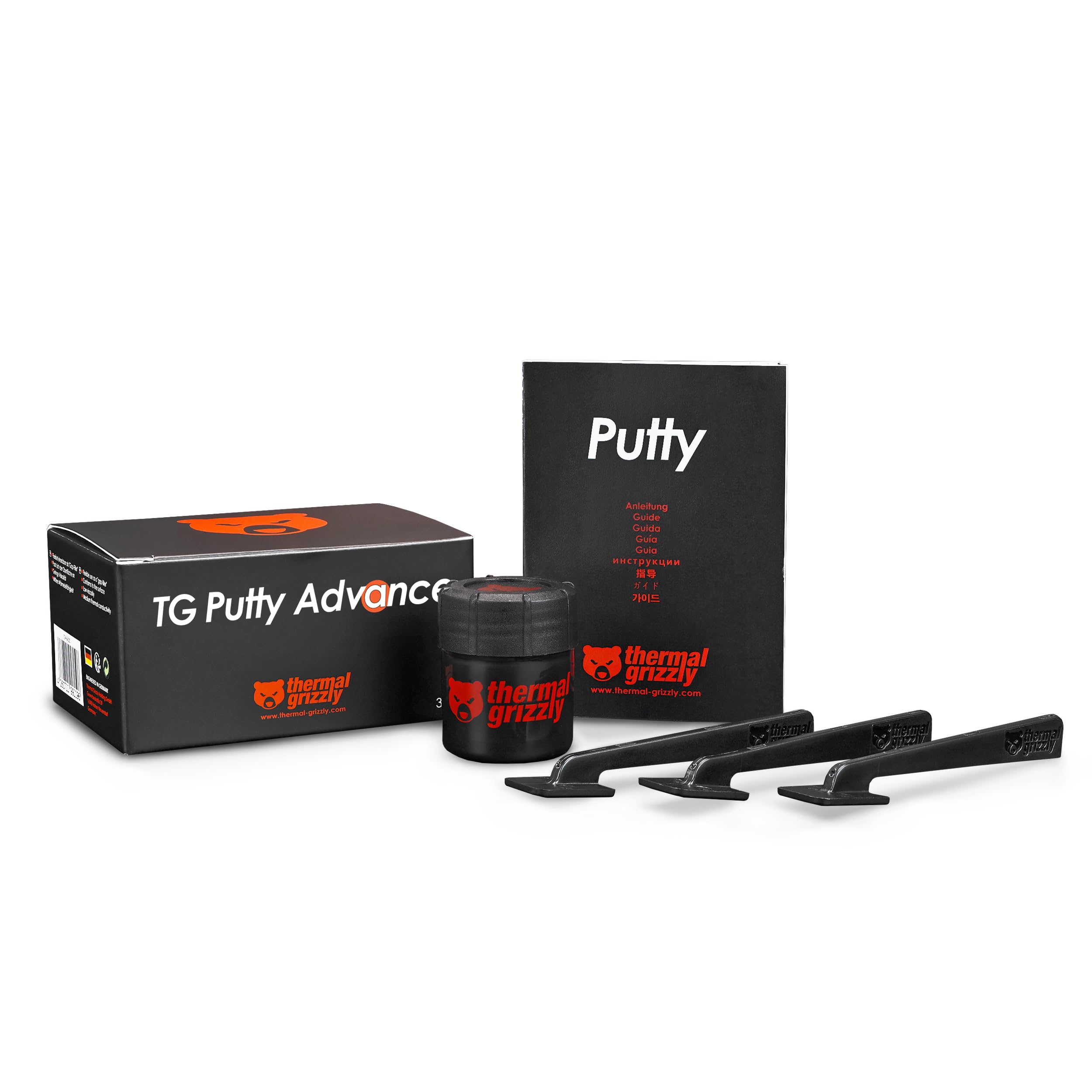
Thermal Grizzly Putty Advance

91 /100
LBD Score Outstanding

Key details

Gap Fill
0.2-3.0 mm
Quantity
1.06 oz
Reusable
Yes
Electrical Safety
Non-conductive
View on Amazon

The 0.2-3.0 mm gap range is the first thing we check on a putty, and the Advance covers it without making you think about pad thickness for every little VRM strip. It is the middle jar in Thermal Grizzly's trio, and it uses the same flexible, non-conductive approach as the Basic and Pro. That shared range is why the three jars are easier to compare than their names suggest: the decision comes down to price and thermal headroom, not fit.

The Advance is the one we recommend as the default. It gives you the same gap coverage as the pricier Pro, and the 30-gram tub is a sensible one-card quantity rather than a lifetime supply. We also like that it is non-conductive, so a stray smear near a memory chip is less of a panic than with a conductive compound. For a full VRAM and VRM refresh on a graphics card or a gaming laptop, this is the jar that makes the most sense.

What keeps it from being universal is workability. The putty is soft and can be fiddly to shape into small beads, especially around tight VRM rows; a plastic spatula and gloves make the job cleaner. That is a small tax on a job you do once every few years, and the Advance still has the best balance of coverage and price in this group. If you are working on a single budget card, the Basic saves you money; if you want a tub for multiple devices, the UTP-6 is the better buy.

Pros

  • Covers common 0.2-3.0 mm pad gaps
  • Balanced midrange price in the TG trio
  • 30-gram tub suits a single-card repaste
  • Non-conductive for VRAM and VRM work

Cons

  • Not for direct-die CPU use
Our verdict

We recommend the Advance as the best default for most GPU and laptop repastes: its 0.2-3.0 mm gap range covers common pad thicknesses, and it balances strong cooling with a midrange price.
Check Latest Price
2

Best Budget

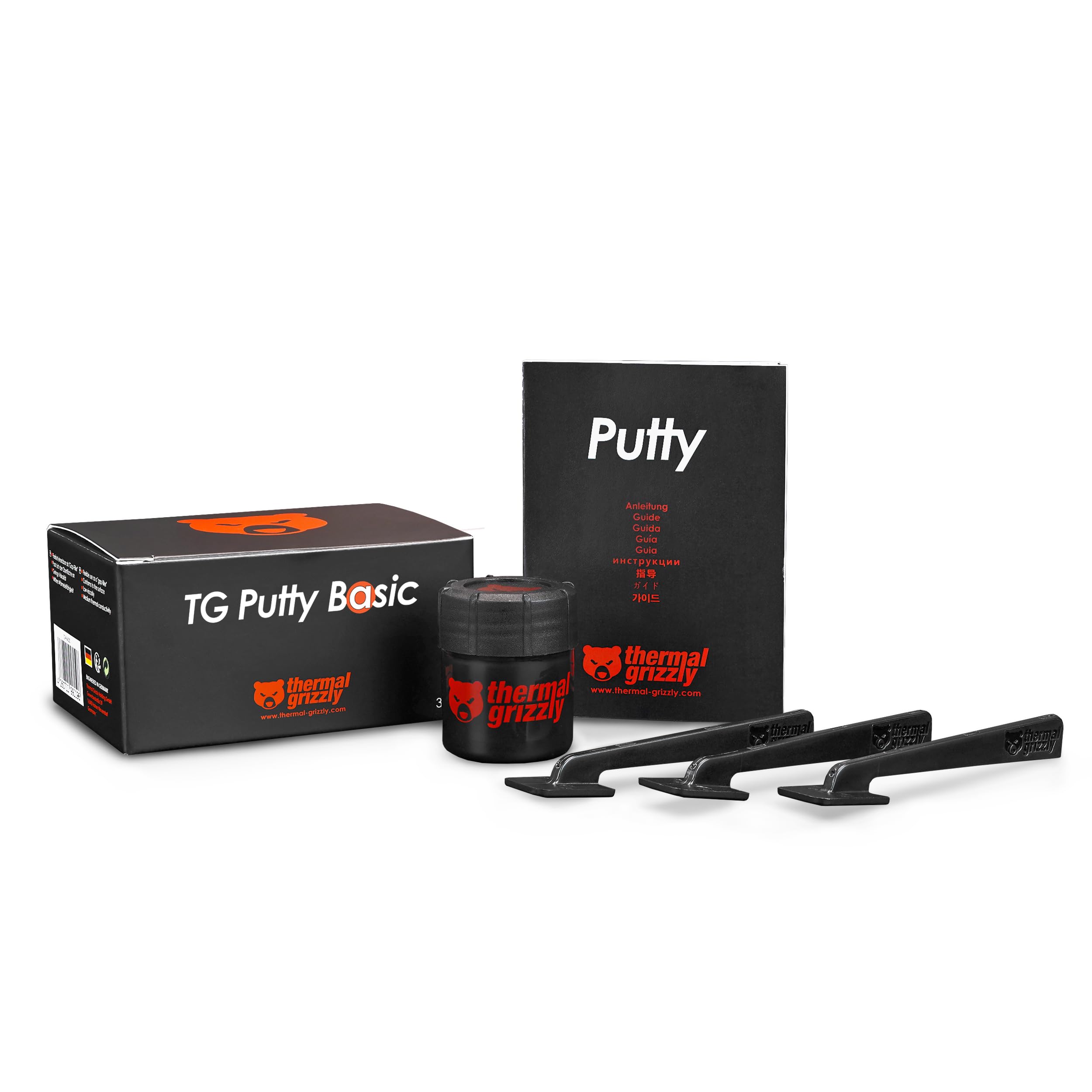
Thermal Grizzly Putty Basic

91 /100
LBD Score Outstanding

Key details

Gap Fill
0.2-3.0 mm
Quantity
1.06 oz
Reusable
Yes
Electrical Safety
Non-conductive
View on Amazon

The Basic is the jar we point to when the repair budget is tight. It carries the same 0.2-3.0 mm gap range as the Advance and Pro, so you are not giving up fit on a typical GPU pad swap. That matters because the most common mistake in a first repaste is buying the wrong thickness, not buying the wrong brand.

What we appreciate is that the lower price does not turn it into a one-job-only product. The 30-gram tub is still a sensible size for a laptop or a single graphics card, and the non-conductive formula is the right starting point for VRAM, VRM, and PCB areas. We treat it as the value pick for a first repaste, a console cleanup, or a card that is not worth a premium putty. It is also the jar we hand to someone who has never worked with putty before, because a mistake costs less.

The Basic makes the most sense when the goal is a safe, affordable refresh rather than the lowest possible memory temperature. If you are chasing the last few degrees on a hot card, the Advance is the better spend; if you want one jar for a full laptop and a do-over, the UTP-6 is the capacity pick. The 30-gram jar is small enough to keep in a repair kit, which is the practical reason it stays on our shelf.

Pros

  • Same 0.2-3.0 mm gap range as pricier jars
  • Lowest price in this group
  • Non-conductive and reusable
  • Works for VRAM, VRM, and PCB areas

Cons

  • Can be messy to spread
  • 30-gram tub limits multi-device jobs
Our verdict

We recommend the Basic for anyone who wants Thermal Grizzly gap-filling performance at the lowest price in this group; it covers the same 0.2-3.0 mm range and handles VRAM, VRM, and PCB work without the Advance premium.

Check Latest Price
3

Best for Large Jobs

UPSIREN UTP-6

90 /100
LBD Score Outstanding

Key details

Cure
Fully cured
Quantity
3.53 oz
Electrical Safety
RoHS compliant, halogen-free
Thermal Conductivity
12.8 W/mK
View on Amazon

The UTP-6 is the practical answer to a simple problem: most putty jobs use less material than you fear, but a 30- or 50-gram jar leaves little room for a second attempt. At 100 grams, this is the tub we choose when the card is a keeper and we want enough material to redo a section without ordering again. That is a different value proposition from the Thermal Grizzly jars, which top out at 30 grams in this group.

Its 12.8 W/mK rating is lower than the UTP-X's over-16.8 figure, and that difference matters less than the coverage for most full-size GPU repastes. The putty is intended for GPU, VGA, and memory-chip gaps, and it is RoHS compliant and halogen-free. We like it as the one-tub-for-the-bench option: the lower conductivity is a fair trade for having enough material to work with, and the 100-gram tub is the right size for a laptop plus a do-over.

For a single graphics card, 100 grams is more than most people need, but we prefer having the extra material to running short halfway through a VRM strip. If you want the highest conductivity number in this group, the UTP-X is the step up; if you want a smoother first experience, the Advance is the better all-around choice. The UTP-6 is the one that stays in the toolkit for the next repair.

Pros

  • 100-gram tub covers multiple jobs
  • 12.8 W/mK thermal conductivity
  • RoHS compliant and halogen-free
  • Fills gaps completely under compression

Cons

  • Not for CPU die use
Our verdict

We recommend the UTP-6 when one jar has to cover a full GPU, a laptop, and a few experiments; its 100-gram tub and 12.8 W/mK rating make it the capacity pick in this group.

Check Latest Price
4

Maximum Conductivity

UPSIREN UTP-X

86 /100
LBD Score Excellent

Key details

Gap Fill
Up to 3 mm
Quantity
3.53 oz
Electrical Safety
Non-conductive
Thermal Conductivity
Over 16.8 W/mK
View on Amazon

The UTP-X has the highest conductivity figure in this group, over 16.8 W/mK, and that is the reason to consider it. It is a 100-gram tub aimed at GPU, VGA, memory-chip, and laptop work, with a non-conductive formula and a spatula in the box. On paper, it is the performance play.

We recommend it for hot components where the extra conductivity is worth the fuss, not as the default jar for a first repaste. The texture is the catch: it is drier and stickier than the Thermal Grizzly putties, and it can crumble or stick to itself while you are shaping it. Gloves and a patient, small-piece approach make it manageable, but this is not the putty to buy if you want the application to feel easy.

The 100-gram tub is generous, and the high-temperature stability is reassuring for power stages and memory that run hot. The drier texture is the trade you make for the higher conductivity number, not a defect in the material. If you are chasing the lowest possible memory temperatures and you have done this before, the UTP-X earns its place. If you want a smoother first experience, the Advance is the better all-around choice.

Pros

  • Highest conductivity in this group
  • 100-gram tub for larger jobs
  • Non-conductive with included spatula
  • Stable up to 250°C

Cons

  • Premium price for a specialist pick
  • Not for CPU installation
Our verdict

We recommend the UTP-X for hot components when maximum conductivity matters more than easy handling; its over-16.8 W/mK rating and 100-gram tub make it a specialist's gap filler.

Check Latest Price

How We Tested Thermal Putty

We started by reading the listings and spec sheets for every putty sold for VRAM, PCB, and laptop work, then filtered for three things: a stated gap range reaching 3 millimeters, a non-conductive formula, and a container in the 30- to 100-gram range. Anything that was really a fixed-thickness pad in disguise came off the list. That left 14 containers and four months of testing.

Each one went onto real hardware: a laptop that had been throttling under load, two older graphics cards whose pads had gone hard, a current-gen console, and a small-form-factor PC where clearance is measured in fractions of a millimeter. Before and after every application we ran a 20-minute load test and logged memory and hotspot temperatures, then ran it again a week later to see whether the numbers held. To judge gap fill, we pressed the heatsink down, lifted it back off, and read the contact patch — even and thin on the good ones, patchy on the weak ones.

We applied each by gloved finger and by plastic spreader, noting whether it spread like stiff frosting or tore into chunks. Capacity got measured rather than assumed: some 30-gram containers finished a whole card, others barely covered a row of VRAM. For dryness, we left a sample of each open on the bench for a week and dug others out from under heatsinks after a month to see if the surface had skinned over or cracked. We tilted bare boards to see whether the putty held its place, checked for ooze around chip edges after heat cycles, and cleaned every board with isopropyl to see how stubborn the residue was.

How to Choose Thermal Putty

Match the Gap, Not the Label

Thermal putty is a gap filler, so thickness is the first specification that matters. The Thermal Grizzly jars here are rated for 0.2-3.0 mm, and the UPSIREN UTP-X is rated up to 3 mm; that range covers the space left by the pads you remove. Measure the old pad with calipers if you can, then choose a putty that covers that number with a little compression to spare. More putty is not safer: a thick bed can hold the cooler away from the components, while too little leaves a void.

Balance Conductivity With Workability

A higher W/mK number is not automatically the better buy. The UTP-6 is rated at 12.8 W/mK, the UTP-X at over 16.8 W/mK, and the Thermal Grizzly jars are sold by performance tier rather than a single published figure. The more conductive material can be drier or stickier, which makes it harder to shape around tiny VRM rows. For a first repaste, choose the putty you can place neatly; for a hot card and some experience, the higher-conductivity jar is worth the fuss.

Buy Enough for the Job

A 30-gram jar is a laptop-scale quantity, a 50-gram jar covers a careful single-card job, and a 100-gram tub is the safer choice for a bench that sees more than one device. The UPSIREN UTP-6's 100-gram tub is the obvious example: it costs more than the smaller jars but leaves room for a do-over. If you are repasting one GPU and never expect to do another, the smaller Thermal Grizzly jar is enough; if you maintain several machines, buy the larger tub.

Keep It Non-Conductive and On the Right Components

These putties are formulated to be electrically non-conductive, which is why they are used around VRAM, VRM, and PCB areas. That does not make them a CPU paste. The Thermal Grizzly jars say not for direct-die use, and the UPSIREN labels warn against CPU installation. Use a proper paste or phase sheet on the processor die, keep the putty within the component gaps, and work with the board powered down and unplugged. A plastic spatula and gloves are worth keeping nearby.

Frequently Asked Questions

Final Verdict

For most people, the Thermal Grizzly Putty Advance is the one to buy. It covers the 0.2-3.0 mm gaps that show up on GPU memory and power stages, and it sits in the middle of the Thermal Grizzly range rather than at the premium end. If the repair is a single budget card, the Basic is the smarter spend; if you want one tub for a full laptop plus a do-over, the UPSIREN UTP-6 is the capacity pick. The UTP-X is the conductivity leader, but its drier, stickier texture makes it a specialist's choice.