Best Action Cameras for Mountain Biking of 2026

The footage from my first real season of mountain biking was nearly unusable. Every root and braking bump turned the trail into a blur of shaking trees, and the horizon tilted sideways the moment I stood up out of the saddle. What I needed wasn't more resolution — it was a camera that held a steady frame, shrugged off mud and creek splashes, and was still alive two hours later when the good descent finally came.

Since then I've ridden with a lot of these little boxes. Over the past six months, my team and I strapped 12 action cameras to handlebars and chest harnesses and rode them hard, and the gap between a clip you post and one you delete almost never comes down to the spec sheet. Buyers chase resolution; the real deciding factors are stabilization, what actually comes in the box, how fast you can swap a battery with gloves on, and whether the camera overheats in the sun before your run ends. Below are the ones that survived.

1

Best Overall

DJI Osmo Action 4

93 /100
LBD Score Outstanding

Key details

Sensor
1/1.3-inch
Weight
5.11 oz
Battery Capacity
1770mAh
Video Resolution
4K/120fps
View on Amazon

The Osmo Action 4 leads with the two numbers that matter on a trail: RockSteady stabilization and a 1770mAh battery. The 1/1.3-inch sensor is the largest in this group, and the 155° lens gives you a wide, immersive view without cropping the action. That is the right recipe for fast, dusty descents.

We think it is the best default here because it solves the three things that go wrong on a mountain-bike shoot: shaky footage, a dead battery, and a mount that takes too long to adjust. RockSteady and HorizonBalancing keep the horizon steady when you lean the bike over, and the magnetic quick-release lets you move from bar to chest without hunting for a thumbscrew. The 4K/120 mode is there for short slow-mo clips, but we treat it as a treat, not the default.

Battery life is rated for well over two hours, and the camera is waterproof and cold-resistant to -4°F, so a cold morning or a stream crossing is not an instant problem. The app is the weak link: pairing and transfers can be fussy, so we use a card reader for offloading and keep the phone for quick framing checks. It is a full-size action camera, not a clip-on, but the size buys the sensor and battery headroom.

Pros

  • RockSteady stabilization handles trail chatter
  • 1770mAh battery is rated for long rides
  • Magnetic quick-release swaps mounts fast
  • Large sensor and 4K/120 video

Cons

  • Premium price versus budget picks
Our verdict

For most mountain bikers, this is the action camera we recommend: the stabilization, battery, and magnetic mount make fast trail footage easier to capture.

Check Latest Price
2

Best Video Quality

GoPro HERO12 Black

89 /100
LBD Score Excellent

Key details

Stabilization
HyperSmooth 6.0
Photo Resolution
27MP
Video Resolution
5.3K/60fps
Waterproof Depth
33 ft (10 m)
View on Amazon

The HERO12's 5.3K/60 video and HDR color are the sharpest combination in this group. If you want the most detail for cropping, stills, or a bright sky that does not blow out, this is the camera that makes the case. We still recommend the DJI for most riders because its battery and mount workflow are easier, but the GoPro wins on pure image potential.

HyperSmooth 6.0 is the other top-tier stabilizer here, and the camera is waterproof to 33 feet without a case. That matters on a muddy ride: you can hose it off and keep shooting. The 27MP photos are strong enough to pull a frame or shoot a quick hero image at the trailhead.

The catch is that 5.3K burns through battery and builds heat. We treat it as a short-clip mode, switch to 4K60 for long descents, and carry a spare Enduro battery. Reliability is the bigger question: some units have shut down and failed to restart, so buy from a retailer with an easy return policy. When it works, the footage is the best here. For riders who want the highest-resolution record of a descent, that trade is worth it.

Pros

  • 5.3K/60 HDR video and 27MP photos
  • HyperSmooth 6.0 stabilization
  • Waterproof without a case

Cons

  • Premium price versus the rest
Our verdict

Buy the HERO12 if you want the sharpest 5.3K footage and HDR color, and you can live with shorter high-res clips and a premium price.

Check Latest Price
3

Best Budget Trail Camera

AKASO Brave 7 LE

89 /100
LBD Score Excellent

Key details

Battery
2x 1350mAh
Stabilization
EIS 2.0
Video Resolution
4K/30fps
Water Resistance
IPX7
View on Amazon

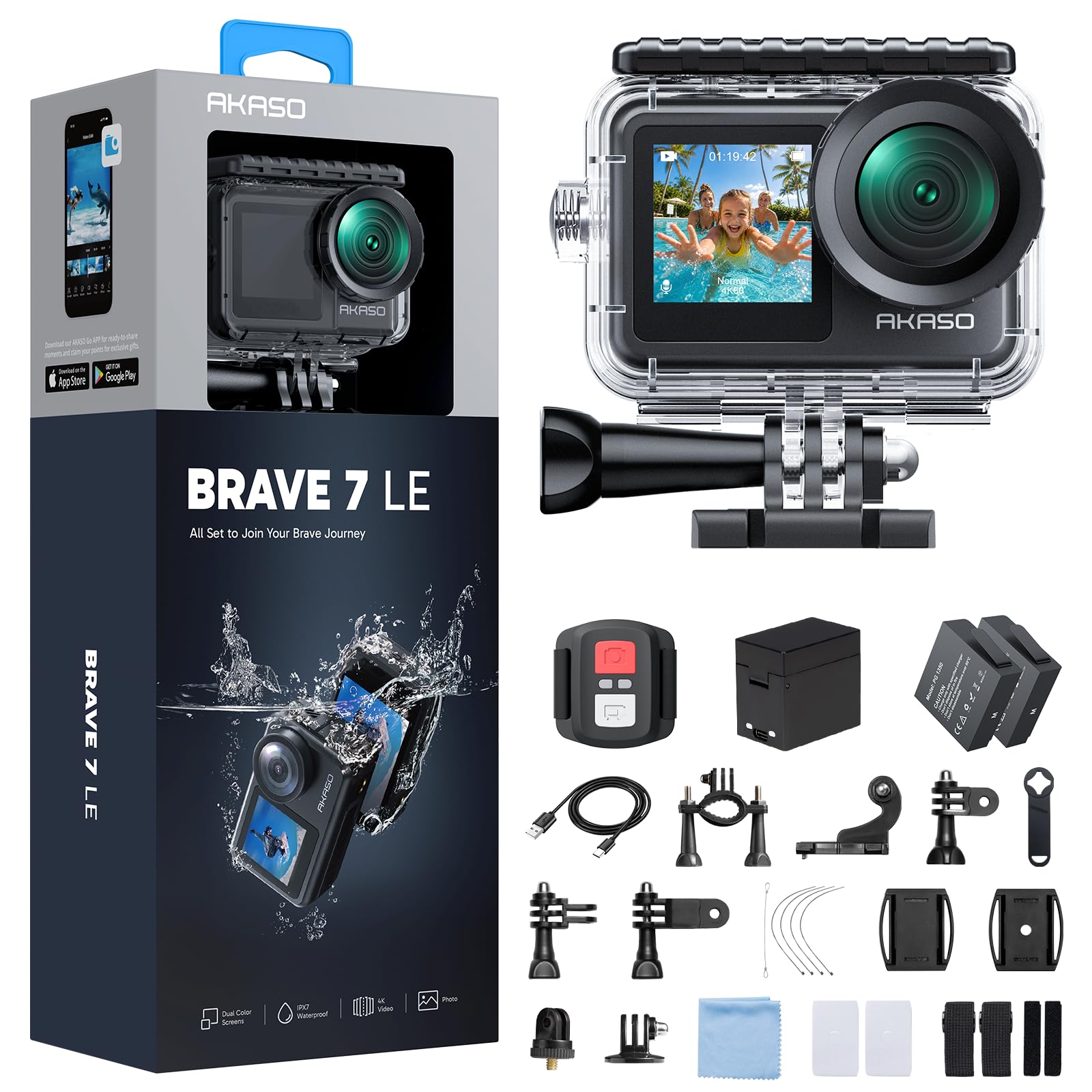
The Brave 7 LE's IPX7 rating is the detail that makes it useful on a mountain bike. Unlike the case-dependent cameras here, it can take rain, mud, and sweat without a housing, so you can leave it on the bar and keep recording. The 4K/30 sensor and EIS 2.0 stabilization are not flagship-grade, but they are enough for a clean trail clip.

The rest of the kit is sensible: two 1350mAh batteries, a touch screen, a remote, and a dual-display design that helps with framing. We like the remote for starting a clip without reaching for the camera, and the spare battery means a full morning is realistic. The 107-gram body is light enough for a helmet mount, though it is happier on the bar or chest.

This is the budget trail camera we point riders to when they want weatherproofing and stabilization without a premium spend. It handles the core job, and the two batteries make a full morning realistic. It is not a low-light standout, so plan around daylight rides. For riders who want a camera they can leave on the bar in bad weather, it is the value pick.

Pros

  • IPX7 weatherproofing without a case
  • EIS 2.0 stabilization
  • Two 1350mAh batteries
  • Touch screen and remote

Cons

  • No 4K60 for slow-motion clips
Our verdict

The Brave 7 LE is the budget trail camera we point riders to when they want weatherproofing, stabilization, and spare batteries without a premium spend.

Check Latest Price
4

Best Lightweight Helmet Cam

Sixmou i3

84 /100
LBD Score Excellent

Key details

Weight
1.26 oz
Battery Life
Up to 150 minutes
Included Storage
64GB card
Video Resolution
4K
View on Amazon

At 35.7 grams, the Sixmou i3 is the lightest camera in this group. It clips to a jersey, sticks to a metal surface with its magnet, or drops into the included waterproof case, and you barely notice it is there. That is a different kind of action camera from the DJI and GoPro, and for helmet or chest POV clips, the low weight is the feature.

We like it for riders who want a casual record of the ride without a big rig on the bars. The 150-minute battery and included 64GB card mean fewer stops, and the spring clip is quicker to move than a thumbscrew mount. The 4K footage is sharp in good light, and the 150° view captures more of the trail than a narrow lens. The magnetic lanyard is the mount we reach for on a jersey, and the spring clip works on a hydration pack strap.

The stabilization is the limit. It is digital only, so rocky descents and brake bumps show up in the footage; mount it tight to your chest and keep the speed reasonable. It is not the camera for a race run, where the basic stabilizer runs out of headroom. For smooth trails and short POV clips, it is the easiest camera here to carry.

Pros

  • 35.7-gram clip-on body
  • Up to 150 minutes of battery
  • 64GB card included
  • Magnetic and spring clip mounts

Cons

  • App pairing can be unreliable
Our verdict

Choose the i3 when low weight matters more than gimbal-like stabilization; it is the easiest camera here to clip on and forget.

Check Latest Price
5

First Action Camera

AKASO Brave 4

89 /100
LBD Score Excellent

Key details

Batteries
2x 1050mAh
Field Of View
170° adjustable
Video Resolution
4K/30fps
Waterproof Depth
131 ft with case
View on Amazon

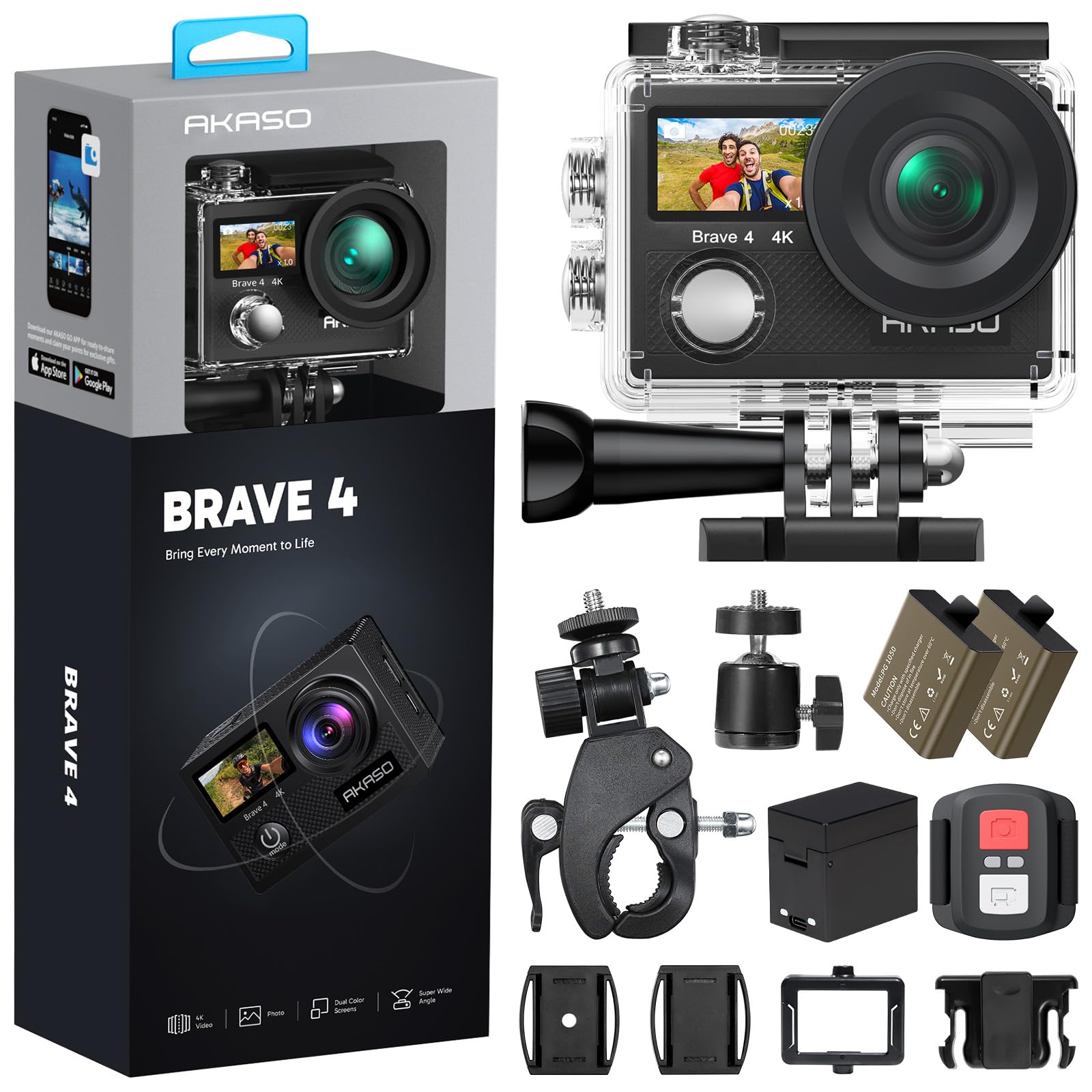
The Brave 4 arrives with the thing a first-time rider actually needs: a box of mounts, two 1050mAh batteries, a charger, and a waterproof case. You can try a bar mount, a helmet mount, and a chest rig without buying extras, which is why it makes sense as a starter camera.

The camera itself is a familiar 4K/30 action-cam shape with EIS and a 170° adjustable lens. We like the four field-of-view settings because you can go ultra-wide for a tight trail and narrower when the fisheye becomes too much. The 20MP photos are fine for trailhead shots, and the remote is a small convenience when the camera is on your helmet.

This is the budget pick for riders who want to learn what mounting position they prefer before spending more. The waterproof case is the trade-off for wet rides—it adds bulk and dulls audio—so for dry trail days, run the camera bare and save the housing for rain. It is not the camera for the cleanest low-light footage, but it covers the basics and the spare battery keeps a morning ride going. For a first action camera, the bundle is the value.

Pros

  • Complete mount kit
  • Two batteries and charger
  • 170° adjustable field of view
  • 4K/30 with EIS

Cons

  • 4K30 only, no 60fps
Our verdict

The Brave 4 is a great first action camera for riders who want a full mount kit and two batteries at a budget price.

Check Latest Price
6

Budget Dual-Screen

Hiicam Speed 20

83 /100
LBD Score Excellent

Key details

Screens
2" rear, 1.4" front
Batteries
2 rechargeable
Video Resolution
4K/30fps
Waterproof Depth
131 ft with case
View on Amazon

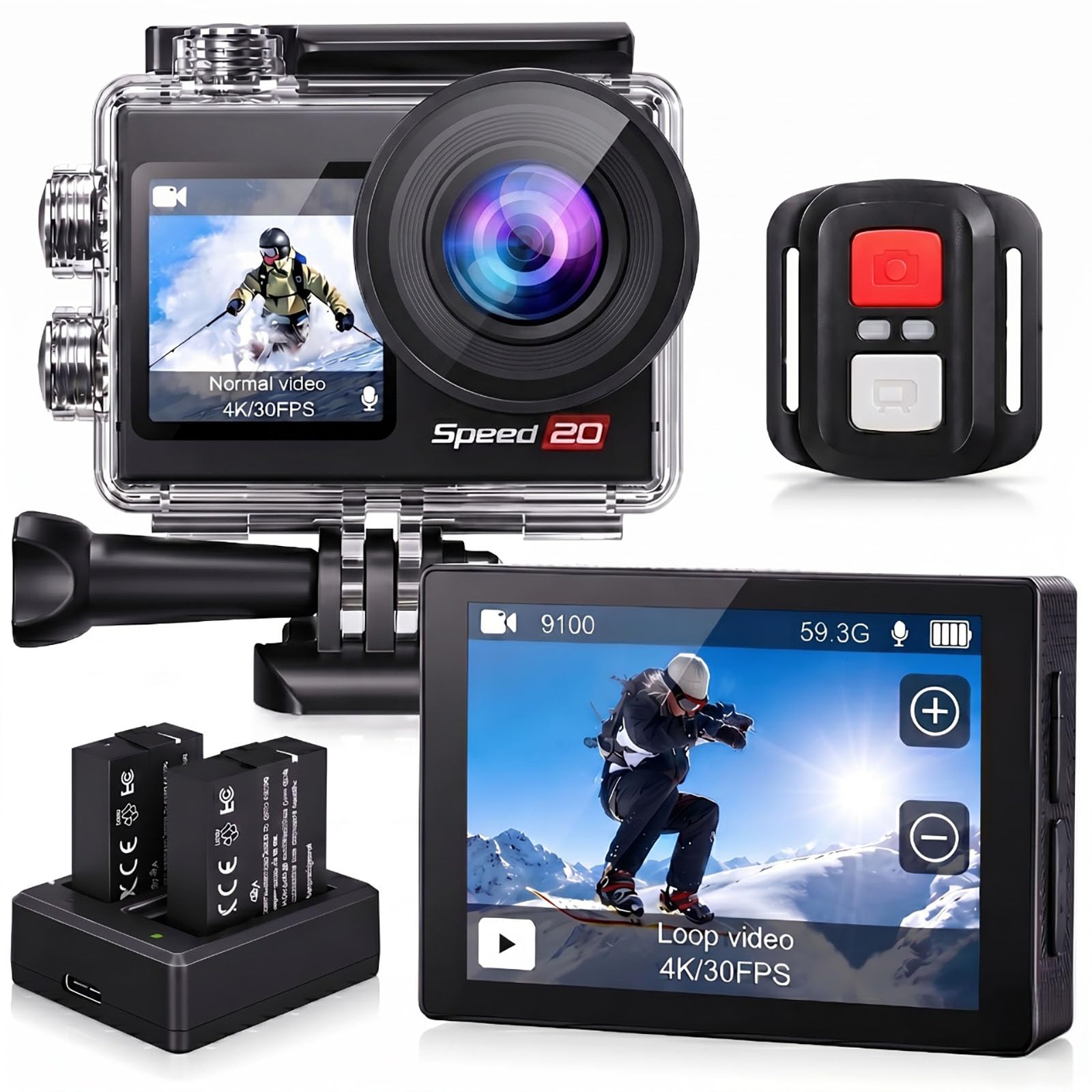
The Speed 20's dual-screen layout is the reason to look at it: a 2-inch rear touchscreen for settings and a 1.4-inch front display for framing yourself. At its price, that is a lot of camera. We think it is a sensible budget pick for riders who want a traditional action-cam shape and do not need the stabilization or battery headroom of the DJI.

The core specs are competitive for the money: 4K/30 video, 20MP photos, EIS, a 170° lens, Wi-Fi, a remote, two batteries, and a 131-foot waterproof case. The touchscreen makes menu changes easier than the button-heavy budget cams, and the front screen is handy when you turn the camera around for a selfie or a talking-head clip.

EIS is the only stabilization, so it is not the tool for the roughest descents; keep it for easy trails and casual clips. The rest of the package covers the essentials, and the dual screens make it easy to live with. The remote is a useful extra on a helmet mount, and the two batteries give you a realistic backup. For a budget camera, the controls are refreshingly straightforward. It is a good choice for a first season of trail filming.

Pros

  • Dual touch screens
  • 4K/30 with EIS
  • Two batteries, remote, and case

Cons

  • Short six-month warranty
Our verdict

The Speed 20 gives budget shoppers a dual-screen action camera with the core trail features, as long as they accept a shorter warranty.

Check Latest Price

How We Tested Action Cameras for Mountain Biking

We started with every camera we could find that used a standard mount and published a waterproof rating, then cut anything that couldn't take a third-party mount, ran past our price ceiling, or shipped without a way to swap batteries. That left 12 cameras, and we rode with all of them for six months.

Testing happened mostly on the same three miles of rooty singletrack after work, plus weekend trips to a lift-served park and one very wet stretch of muddy, standing-water riding. Each camera spent time on a bar mount, a chest harness, and a full-face helmet, and afterward we watched the raw files side by side, noting where the horizon dipped, where the image smeared under tree cover, and whether skin tones and dirt held up in deep shade.

Battery life got timed, not estimated: we recorded continuously at the highest frame rate each camera allowed until it shut down, then swapped batteries mid-ride to see whether it took one hand or a multitool. On 90-degree afternoons we logged heat warnings and how long each camera took to recover before it would record again. On trail we worked the controls with muddy gloves and in direct sun, to see how easy the screens were to read and whether the menus made sense without stopping.

Connectivity and app function got checked at the tailgate, where we pulled a two-minute clip over each camera's phone app and timed the transfer. Reliability meant hosing off mud, dropping each one onto gravel from handlebar height, and riding out the rest of the day without babying it. We finished by tallying what came in the box — mounts, spare batteries, memory cards — because value in this category is usually decided by what you'd otherwise have to buy separately.

How to Choose an Action Camera for Mountain Biking

Start With Stabilization, Not Resolution

Trail chatter and brake bumps are the enemy. Electronic stabilization is standard, but the implementations differ: DJI's RockSteady and GoPro's HyperSmooth are the top-tier systems in this group, while the budget AKASOs and the thumb cameras rely on simpler EIS. If you ride rocky descents and want smooth footage without a gimbal, pay for the better stabilizer. If you mostly film smooth flow trails or clip a tiny camera to your helmet for short POV shots, basic EIS can be enough.

Frame rate matters too. 4K60 gives you smoother action and the option to slow footage; 4K120 is useful for short slow-mo clips but eats storage. For most riders, 4K60 is the practical target.

Plan for Battery and Heat

A mountain-bike run can outlast a small battery, especially in cold weather or at high frame rates. Look for a camera with a spare battery in the box or buy one; the Brave 7 LE and Brave 4 both include two. High-resolution modes generate heat, so treat 5.3K or 4K120 as short-clip settings and switch to 4K60 or 1080p60 for long descents. Mounting the camera where air moves around it helps.

Choose the Mount Before the Camera

A chest mount gives a stable, immersive view and hides the camera from branches; a helmet mount follows your line of sight but can feel top-heavy. Handlebar mounts are easy, though they transmit every bump. The best cameras here use standard GoPro-style fingers or magnetic quick releases. The DJI's magnetic mount is the fastest to move between positions; the Sixmou i3's clip and magnet are the least noticeable on a helmet or jersey.

Decide How Much Weatherproofing You Need

Mountain biking brings sweat, mud, and sudden rain, so at least IPX7 or a sealed body is worth having. A bare waterproof body like the Brave 7 LE is easier to live with than a camera that needs a housing; housings add bulk and can muffle audio. If you only ride dry trails, a case-dependent camera like the Brave 4 is fine, but leave the housing on for wet rides and check the seal before every use.

Budget for Storage and Transfers

4K files are large, and a 64GB card fills faster than you expect. Buy a card rated for the camera's bitrate, and carry a spare if you record full rides. The companion app is convenient for framing and sharing, but pairing can be inconsistent; a card reader is the reliable way to offload footage. Cameras that include a card, like the Sixmou i3, save you a purchase but not the need to manage space.

Frequently Asked Questions

Final Verdict

After testing the group, the DJI Osmo Action 4 is the camera we recommend for most mountain bikers. It has the best combination of stabilization, battery life, and mounting speed here, and those are the things that decide whether you come home with usable footage.

If you want the sharpest 5.3K image and HDR color, the GoPro HERO12 is the alternative; plan for shorter high-res clips and a spare battery. For a tighter budget, the AKASO Brave 7 LE is the weatherproof trail camera we point riders to.