Best Bench Power Supplies for Electronics of 2026

A cheap bench supply will dial in 5 volts and quietly hand you 4.6 the moment you draw current — the difference between a working prototype and an afternoon spent chasing ghosts. A good one holds its setpoint under load, limits current where you set it, and puts an honest number on the display. My team and I spent eight months with 11 of them, on a garage workbench and a spare-room repair desk.

Spec sheets sell voltage and current range, and most shoppers fixate on both. What actually shapes your afternoon is smaller: how much ripple rides on the output, whether the encoder splits coarse and fine so you can swing from 5 to 12 volts without overshooting, and whether a real output switch lets you kill the load without unplugging anything. The front-panel USB ports earn their keep more often than you'd expect. None of the supplies below are four-figure lab instruments; they're the ones that survived real repairs, battery charging, and late-night breadboarding, and the write-ups tell you which is which.

1

Best Overall

Jesverty SPS-3010V

91 /100
LBD Score Outstanding

Key details

Max Power
320W
USB Ports
USB-A and USB-C, 20W
Adjustment
Encoder coarse and fine
Output Range
0–32V, 0–10A
View on Amazon

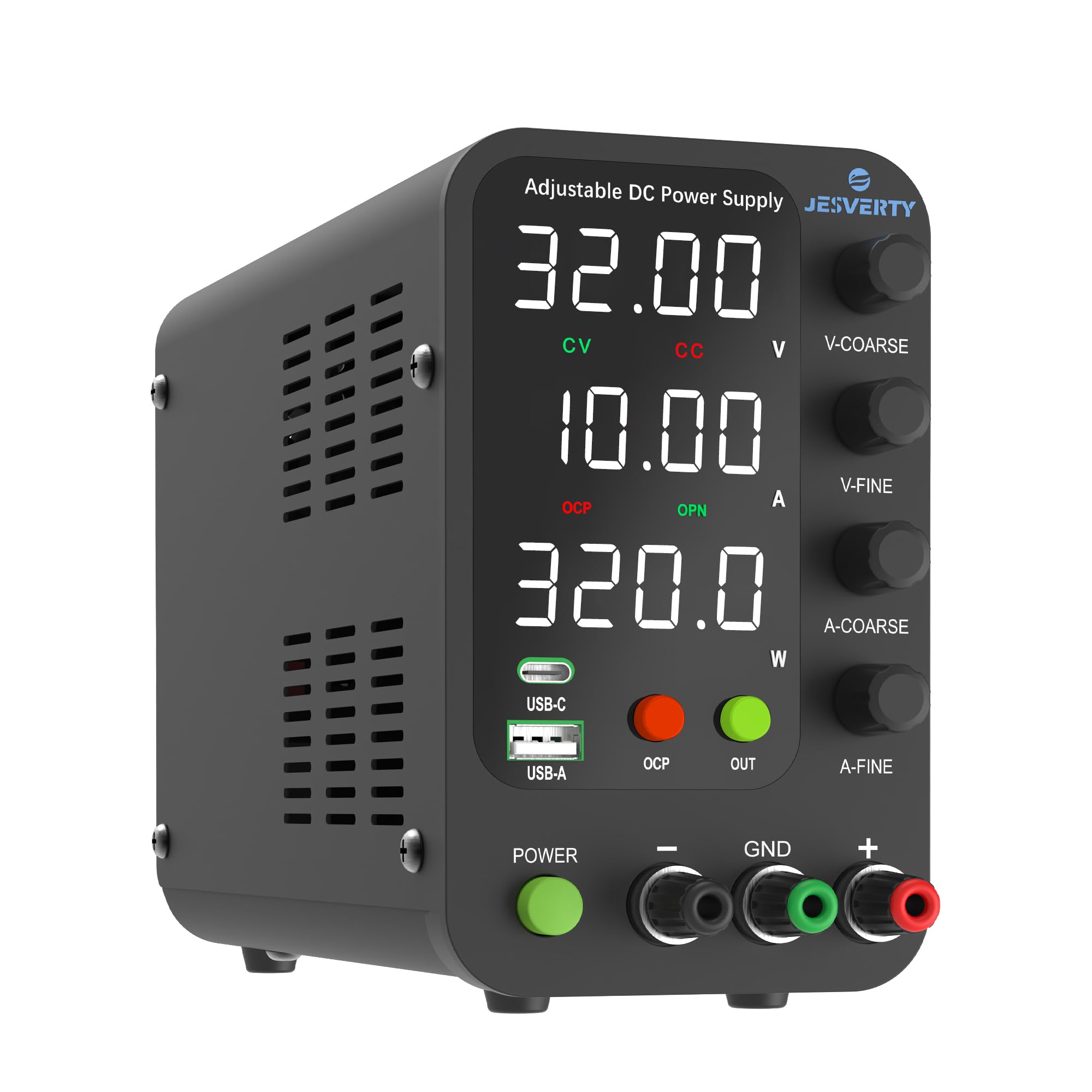
A potentiometer is the wrong instrument for setting a voltage: nudge it a hair and you jump from 3.2V to 4.1V, usually with a chip connected. The SPS-3010V replaces it with an encoder. Press the knob to pick the digit you want, turn it to move only that digit, and 3.30V becomes deliberate instead of lucky. That one change is why we recommend this one first.

The output button is the other thing we appreciate. Connect the leads, set the voltage and the current limit, then press OUTPUT, and there is no arc across the clips while you are wiring a board and no scramble for the mains switch. An OPN setting brings the output up with the power switch if you prefer, which saves a press when you are running the same test all afternoon. The display is bright and large enough to read from a step back.

Underneath is a 0–32V, 10A, 320W supply, a little more headroom than the 30V/10A standard, in a 1.53 kg case that leaves room on the bench. The supplied test leads are 18 AWG, which is thin for a 10A pull, so buy a heavier set if you plan to run near the ceiling. Beyond that there is very little to work around.

Pros

  • Encoder knobs set exact values in seconds
  • Output switch lets you wire up before power
  • Compact 1.53 kg case with 32V of range

Cons

  • USB-A and USB-C ports are limited to 20W
Our verdict

If you want one supply that makes exact settings easy and holds them once they are made, this is the one we point people to, especially for chasing gremlins on digital boards.
Check Latest Price
2

Best for 12V Projects

WANPTEK DPS3010U

90 /100
LBD Score Outstanding

Key details

Weight
2.6 lb
Max Power
300W
Adjustment
Encoder coarse and fine
Output Range
0–30V, 0–10A
View on Amazon

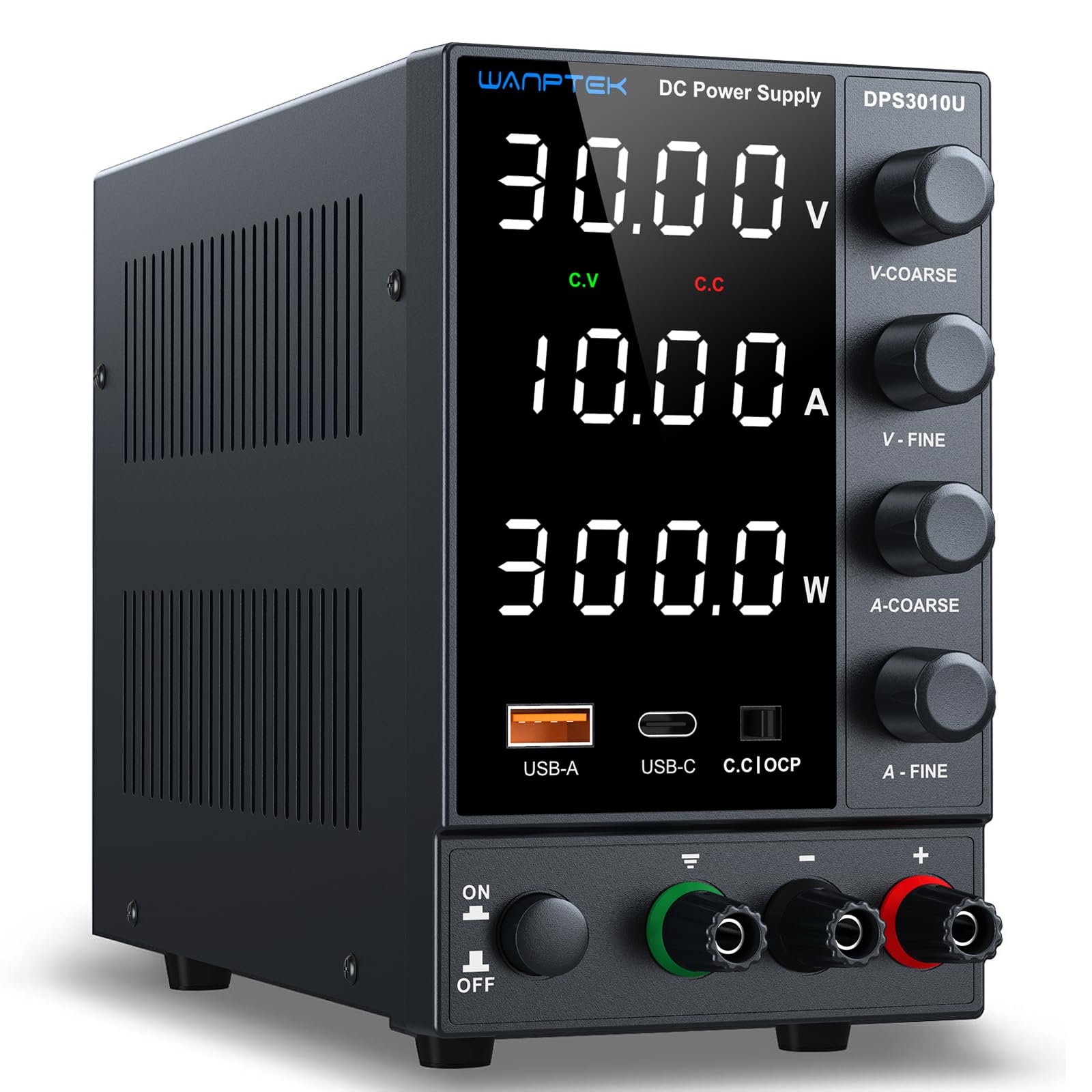
Twelve volts at ten amps covers more real bench work than the headline number suggests: a car head unit on the desk, a slot-car motor being broken in, a window regulator you are diagnosing, a relay board that wants more than a wall adapter will give. This WANPTEK is the one we plug those into. It puts 300W behind the terminals, and the 0–30V, 0–10A range is set with encoder coarse and fine knobs rather than bare pots.

The meters are the part we trust most. Readings hold close to a decent handheld DMM and stay steady while a load pulls, which means you can work from the display instead of clipping a meter on every time. The output relay is a real feature too: short something and it cuts out and tells you, rather than quietly cooking the leads.

One annoyance, and it is fixable. The unit beeps while you turn the knobs. Pressing the coarse voltage knob mutes it, which is a small thing that goes from irritating to invisible once you know it is there.

Pros

  • Holds 10A at 12V for real loads
  • Encoder coarse and fine adjustment
  • Output relay cuts out and warns on a short

Cons

  • Fan runs even with a light load
Our verdict

For 12V work that actually draws current, such as car audio, motors, and relay boards, this is the supply we reach for, and its meters are steady enough to work from.

Check Latest Price
3

Best for Battery Charging

Kungber SPS3010B

90 /100
LBD Score Outstanding

Key details

Max Power
300W
Adjustment
Coarse and fine potentiometers
Output Range
0–30V, 0–10A
Battery Charging
Ah readout
View on Amazon

A bench supply will charge a battery; very few will tell you what went into it. Kungber's charging mode puts accumulated amp-hours on the display alongside volts and amps, so when you are bringing a LiFePO4 pack up before assembling a bank, you can watch the number climb instead of guessing. None of the other picks here counts what it has delivered, and that readout is the reason this one is on the list.

The rest is a plain 30V/10A, 300W supply in a 2.3 lb plastic case, and it gets used for everything from electroplating to embedded boards to reviving dead tool batteries. Hookup is simple, the 18W USB port is there for a phone, and the supply crosses between constant voltage and constant current on its own as the load changes.

The knobs are where we part company with it. They are potentiometers with fixed stops, so you sweep through a range rather than stepping to a number, and turning the voltage down is slow because the output has to discharge before the reading follows. Dialing 5V or 12V is fine. Dialing 1.85V is fiddly, and you will overshoot.

Reliability is the open question, and it deserves saying plainly: these either run for years or quit early, and the early failures arrive in the first months rather than after a long life. Run it hard while the return window is open and you will know which unit you got. Buy it for the counter and for a design that has been through a lot of hands; look elsewhere if you need a supply you can install and forget for a decade.

Pros

  • Counts accumulated amp-hours while charging
  • 30V/10A with automatic CV/CC switching
  • Light 2.3 lb case
  • OCP alarm cuts output on a short

Cons

  • Potentiometer knobs with fixed stops
Our verdict

Buy it if you charge packs and want to see exactly what went in; the amp-hour counter is the reason to choose this over the other 30V/10A units here.

Check Latest Price
4

Best Budget

NICE-POWER SPS-C3010

90 /100
LBD Score Outstanding

Key details

USB Port
5V/2A
Footprint
3.3 x 8.4 x 5.5 in
Max Power
300W
Output Range
0–30V, 0–10A
View on Amazon

This is the least expensive full-size supply in the group, and the savings come off the parts that show: a plastic case, plain potentiometer knobs, and a 5V/2A USB port rather than a fast charger. What is left is the part that matters, a 30V/10A, 300W supply with voltage that holds and a meter that reads it accurately.

It is also the easiest of these to fit on a small bench. The vertical layout is 8.4 inches across and 5.5 tall, so it tucks against a shelf instead of spreading over the work surface, and the rubber feet keep it planted. The output button does what it should: set the values with the output off, then switch on. The display calculates watts for you, which is more useful than it sounds when something is getting hot and you want to know why.

We did find one quirk in the fine knob. It has limited travel, so start it mid-way before you tune or you run out of adjustment before you reach your number. Learn that in the first afternoon and it never bothers you again. For straightforward voltage work, this is the value pick of the group.

Pros

  • Lowest price of the full-size units here
  • Narrow vertical footprint
  • Output switch plus calculated wattage display

Cons

  • Current limiting is the weak spot
Our verdict

For straightforward voltage work this is the value pick: it sets and holds a voltage, meters it accurately, and takes less bench space than the other full-size units.

Check Latest Price
5

Portable Kits

FNIRSI DPS-150

86 /100
LBD Score Excellent

Key details

Weight
6.24 oz
Max Power
150W
Input Power
PD/QC/DC, no adapter
Output Range
0–30V, 0–5A
View on Amazon

Six ounces, roughly the size of a deck of cards: the DPS-150 is the only supply here you can drop in a laptop bag and forget about until you need it. It is a real adjustable supply too, 0–30V and 0–5A for 150W, with a 2.8-inch color screen that flips 90 degrees so it reads whether the unit is lying flat or standing up.

Ripple is under 20 mV, which is quiet enough for sensitive boards, and the connections are more varied than most: 4 mm banana jacks, U-shaped terminals, and fine copper wire points, so a breadboard lead and a proper test lead both have somewhere to go without an adapter.

What we like most is the PC link and the six preset groups. Store the handful of voltages you use every day and recall them instead of dialing, or program a sequence from a laptop. For a bench that moves, a site visit, a repair call, a shared desk, small size and stored settings are a genuinely useful combination, and nothing else here offers it.

The catch is power. This is a buck converter, so the output cannot exceed what you feed it, and there is no adapter in the box at all. Run it from a 20V USB-C PD brick and you have a 20V supply, not a 30V one; the full range needs a DC source above 30V that you supply yourself. For 3.3V, 5V, and 12V work on the move it is the one we pack; for 24V rails or PoE, it stays home.

Pros

  • Palm-sized at just over 6 ounces
  • Under 20 mV output ripple
  • PC programmable with six preset groups

Cons

  • No power adapter included
  • Output cannot exceed the input voltage
Our verdict

If your bench moves, this is the supply to carry: six ounces, six presets, and quiet output, as long as you pack a DC source that tops 30V for the full range.

Check Latest Price
6

Long Warranty

HANGELL HPS3010

89 /100
LBD Score Excellent

Key details

Warranty
5 years
Max Power
300W
Adjustment
Encoder coarse and fine
Output Range
0–30V, 0–10A
View on Amazon

A five-year warranty is the reason this one is here. Nothing else in the group comes close, and on a mains-powered box full of capacitors and a fan, that coverage is worth more than another feature or two. HANGELL backs a conventional 30V/10A, 300W supply with encoder coarse and fine knobs, an output button, and a short-circuit alarm that sounds and cuts the output when you cross the wrong thing.

The controls are the plain, good kind: two encoders so you can select a digit and change just that digit, a dedicated output switch, and a 1.2 kg case that lives in a corner of the bench without crowding the iron. Controls on a supply only get noticed when they are bad, and these are not; set 5V and a 500 mA limit and it holds while you probe.

One practical note: at 1.2 kg it is light enough to skate across a smooth bench when you push a button, so a rubber mat underneath earns its keep. Otherwise the front panel is easy to live with, with crisp digits and well-spaced controls, the sort of thing you notice only after using a supply whose display you have to squint at.

Pros

  • Five-year warranty
  • Encoder coarse and fine knobs
  • Small 1.2 kg case

Cons

No notable drawbacks to flag.

Our verdict

If you want the longest warranty on the bench behind a compact, conventional 30V/10A supply, this is the one we point to.

Check Latest Price
7

Shop Bench

SKY TOPPOWER PS3010H

85 /100
LBD Score Excellent

Key details

Weight
3.88 lb
Enclosure
Metal
Output Range
0–30V, 0–10A
Display Resolution
0.01V / 0.001A
View on Amazon

A metal case and a grounding terminal: that is the SKY TOPPOWER's pitch, and it is a real one if your bench shares space with a soldering iron, a hot air station, and the debris of repair work. At 1.76 kg it is the heaviest unit in this group, and the earth point gives you somewhere to bond a chassis under test instead of hunting for a screw on the bench frame.

The rest is standard issue: 0–30V, 0–10A for 300W, a four-digit display resolving to 0.01V and 0.001A, CV/CC switching that follows the load, and protection for overvoltage, overcurrent, thermal events, and shorts. There is also anti-reverse protection on the output, which saves the supply when you clip the leads on backwards, something that happens to everyone eventually.

So where does it land? This is the supply for a shop bench where the unit gets knocked around and shares a power strip with a soldering station; the case and the earth terminal are worth more day to day than a USB port you never touch. It is also the biggest box here at 8.86 inches across, so measure the shelf before you commit.

Pros

  • Metal case with a grounding terminal
  • Anti-reverse protection on the output
  • 0.01V and 0.001A display resolution

Cons

  • Larger footprint than the compact units
Our verdict

For a shop bench, buy it: the metal case and grounding terminal suit daily repair work better than the plastic enclosures here.

Check Latest Price
8

Higher-Voltage Work

WANPTEK TPS-C605

83 /100
LBD Score Excellent

Key details

Presets
3 memory keys
Max Power
300W
Adjustment
Encoder digit tuning
Output Range
0–60V, 0–5A
View on Amazon

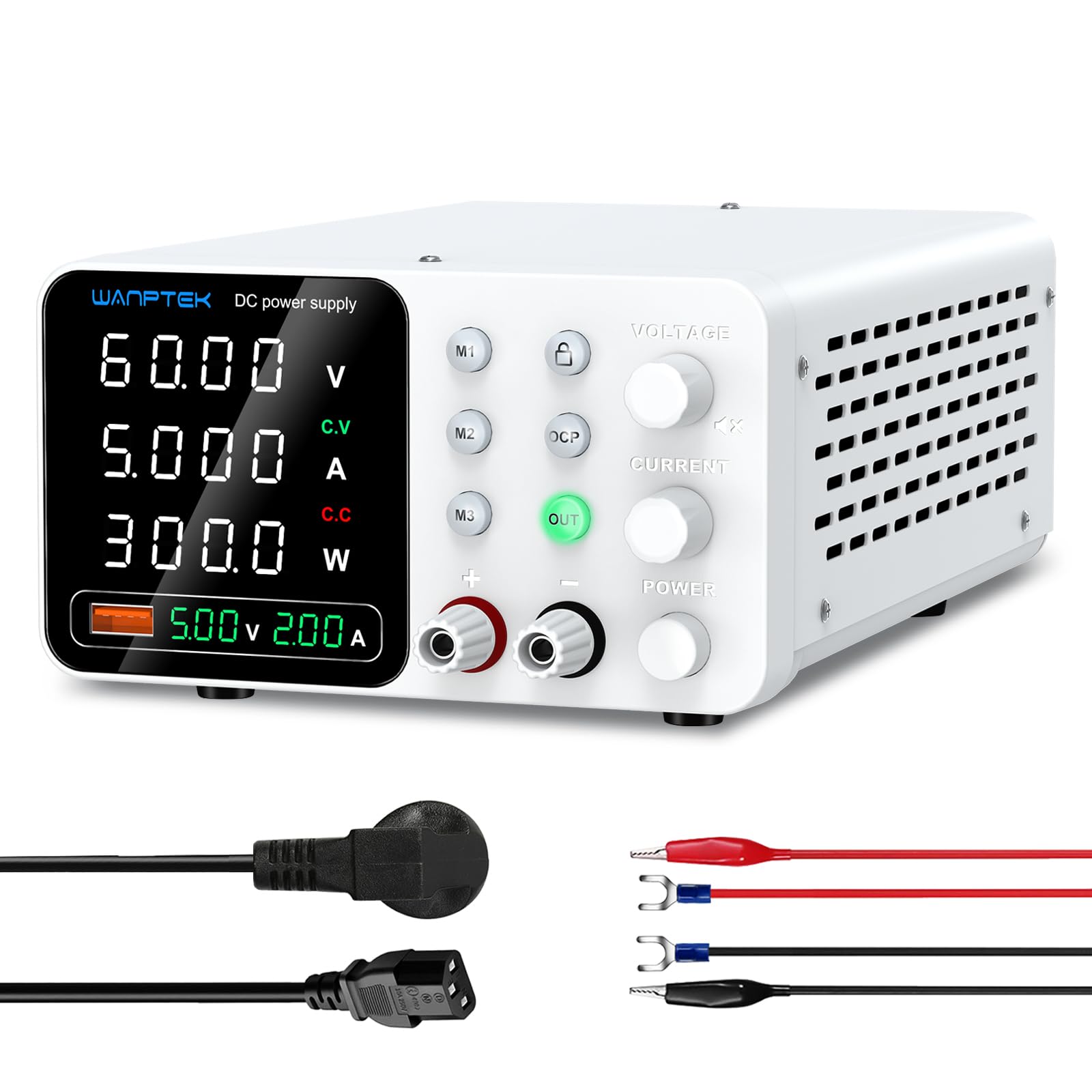
Sixty volts is the reason to look at this one. Everything else here tops out near 30V, which covers logic, motors, and 12V gear but stops short of the 48V rails in PoE equipment, telecom gear, and older audio. The TPS-C605 gives you 0–60V at up to 5A, a different trade from the 10A units: half the current, twice the voltage.

What makes it pleasant to use is the memory. Three keys store a voltage and current pair, so 5V for a logic board, 12V for a fan, and 48V for a PoE injector are one press apart instead of three knob sweeps. Add an output switch, an OCP cutoff that resumes after you clear the fault, and a key lock that stops a sleeve from changing your setting mid-test, and we think it is the best laid-out unit in this group.

The 5A ceiling is the thing to weigh. If your work is motors, car audio, or anything that pulls a real 8 to 10 amps, this is the wrong side of the trade and the 10A units above are the answer. If your work is higher voltage and lower current, PoE, 48V systems, older valve gear, it is the only supply here that reaches.

Pros

  • 0–60V range, unmatched in this group
  • Three memory presets
  • Output switch and key lock
  • OCP cuts out and resumes after a fault

Cons

  • 5A ceiling rules out high-current loads
Our verdict

If you need more than 30V on the bench, this is the only supply here that gets you there, provided 5A covers what you are powering.

Check Latest Price

How We Tested Bench Power Supplies

We started with roughly 40 listings and cut them on paper first: whether the encoder had separate coarse and fine control, whether the readout was a true four-digit display, whether there was a physical output switch, and what actually came in the box. Then we grouped supplies that compete with each other on price and ordered 11 of them — the same 11 that sat on a garage workbench and a spare-room repair desk for eight months.

Every supply got the same first afternoon. We set 5 volts into a fixed resistive load, measured the real output with a calibrated benchtop multimeter, and compared it to what the display claimed. Then an oscilloscope went across the terminals so we could watch ripple at light load and again near rated current, noting where noise spiked and where voltage sagged. Each one also ran into a 1-amp load for an hour with a meter logging drift.

Current limiting got tested the way it usually fails: leads shorted through an ammeter, limit dialed down, watching whether the supply held steady or hunted, then tripping overcurrent protection on purpose to see how cleanly it recovered. I timed the trip from 5 to 12 volts one-handed and in dim light, and tried the memory presets and lock key where a supply had them. Fan noise was recorded a foot from the front panel during an hour at 80 percent load.

The rest was real work — laptop repairs, battery packs, electrolysis, a DC motor on a breadboard, phones charging off the front ports while the supply carried a load. What we weighed in the end was less about peak specs and more about whether a supply told the truth, held its setting, and didn't make us re-dial a number we'd already nailed.

How to Choose a Bench Power Supply

Range, and the amps you actually get

Thirty volts and ten amps covers most bench work: logic rails, 12V gear, motors, relays, and battery charging. Shop for more voltage only if you work on 48V systems, PoE gear, or older audio, where a 0–60V unit earns its keep. Below 30V you are usually trading capability for size, which is fine for a kit that travels.

Treat the current rating with some suspicion. A 10A label does not guarantee 10A continuous into a real load, and the leads in the box are often thinner than the rating: 18 AWG is good for roughly 8A, so buy heavier leads if you plan to run near the ceiling of the range.

How the knob sets the value

Most budget supplies use potentiometers: you turn and watch the display, and the last digit is a moving target, especially between 1 and 3 volts. Encoder knobs let you select a digit and step it, which makes 3.30V a deliberate setting instead of an accident. That matters more day to day than an extra digit of resolution.

If you do end up with pots, start the fine knob at mid-travel so you have adjustment in both directions, and set the voltage with the output off.

Current limiting is the feature you are paying for

A bench supply's real job is protecting the thing you are testing. Set the voltage, then set the current limit just above what the circuit should draw, and a board with a short will drop the supply into constant current and hold instead of dumping ten amps into it. The voltage and current you set are the crossover point where the supply moves between modes.

Cheap units do not all limit cleanly, so test it on arrival: with the voltage low, short the leads and watch whether the supply drops to the limit you set and stays there.

Bench fit, noise, and the extras

Measure the shelf first. These run from about 7 inches to nearly 9 inches across, and a supply that will not sit beside the scope is one you will resent. Fan noise matters if the bench is in a living space, since several units here run the fan even at light loads.

An output switch is the extra we value most, because it lets you wire a circuit up before it is live. The USB ports are worth what you pay for them: 20W or 5V/2A will charge a phone, and none of these will run a laptop.

Frequently Asked Questions

Final Verdict

The Jesverty SPS-3010V is the supply we point most people to. The encoder knobs take the guesswork out of setting a voltage, the output switch lets you wire a circuit up before it is live, and the meters are accurate enough to work from rather than double-check.

If the budget is tight, the NICE-POWER does the basic job for less. If you charge packs, the Kungber's amp-hour counter is worth the step up. And if your work runs above 30V, the WANPTEK TPS-C605 is the only unit here that reaches.