Best Bridge Cameras of 2026

A bridge camera is the one-lens answer to a bag full of gear—wide for landscapes, long enough to pull a bird from a distant tree. The catch is that huge zoom usually comes with a small sensor, so the best ones earn their keep by nailing autofocus and keeping noise under control. I've spent years chasing kids and stalking herons, and the specs never tell you how a camera feels after an hour on a strap or whether it can lock focus on a running dog.

Over eight months, we tested eight bridge cameras, from 40x compacts to a 125x superzoom, at a wildlife refuge, a soccer game, a dim birthday party, and birding from the backyard. The zoom number gets attention, but stabilization matters just as much—at 80x, a tiny hand tremor blurs the shot, so we noted how well each camera steadied it. We also checked the features you'll use—Wi-Fi transfer, a rotating screen, 4K video—and weighed whether each camera felt worth its price; these delivered best mix of image quality, autofocus, and comfort.

1

Best Overall

Nikon COOLPIX P950

86 /100
LBD Score Excellent

Key details

Video
4K UHD
Sensor
16MP 1/2.3-inch CMOS
Weight
16 oz
Optical Zoom
83x (24-2000mm equivalent)
View on Amazon

Twenty-four to 2000mm in a body that weighs a pound is why the COOLPIX P950 is the camera we recommend to most people. The 83x zoom runs from a wide trailhead landscape to a bird on a distant branch without a second lens, and the camera still drops into a daypack. For one body that covers a signpost and a nesting heron on the same walk, this is the pick.

Reach is only half the job. At 2000mm every tremor in your hands is magnified, which is why the Dual Detect VR matters more here than on a short lens; it is what makes a handheld frame at the far end realistic in good light. The 3.2-inch screen tilts, so you can brace the camera low without kneeling in the mud. Bird and Moon modes are a genuine shortcut, setting focus and exposure for the two subjects people buy this camera to chase.

Autofocus is the part to learn. Contrast detection takes its time at full zoom, and it is slowest when you zoom out to re-find something that just moved. Half-press to lock focus before you recompose, keep the AF area on a single point for busy branches, and shoot a short burst instead of waiting for one perfect frame. The keeper rate climbs quickly once that becomes habit.

4K video, RAW files, and a 16-ounce body round it out — that weight is why this one goes on a six-mile hike instead of staying in the car. Nothing else here balances reach, size, and flexible file formats the way this one does.

Pros

  • 83x zoom spans 24-2000mm in one lens
  • About a pound, so it travels easily
  • Bird and Moon modes shorten setup
  • 4K video and RAW capture

Cons

  • Small sensor limits low-light shots
Our verdict

The P950 is the camera we recommend to most buyers: 24-2000mm, 4K video, and a one-pound body that ends up in the bag instead of the closet.

Check Latest Price
2

Best for Extreme Reach

Nikon COOLPIX P1100

83 /100
LBD Score Excellent

Key details

Video
4K UHD
Sensor
16MP 1/2.3-inch CMOS
Weight
3.1 lb
Optical Zoom
125x (24-3000mm equivalent)
View on Amazon

Three thousand millimeters is the number the P1100 exists for. The 125x lens runs from 24mm to a focal length that puts a distant bird's eye at the end of your arm, and nothing else in this group comes close.

We expected the reach to be the whole story, and it is not. What we appreciated most is how the controls assume you will be shooting moving subjects far away: bird-watching mode sits on the mode dial where you can find it without the menu, and the control ring takes manual focus or exposure compensation under your thumb. The hybrid autofocus with phase-detect points is a step beyond the contrast-only systems on the cheaper picks.

At 3000mm the atmosphere joins the optics. Heat shimmer off a warm field softens a shot no matter how steady your hands are, so shoot early, shoot close, and treat the last stretch of zoom as a clear-day tool. Focusing slows at the extreme end as well, which is where the seven-frame burst and the four-stop VR rating earn their keep: hold a beat, fire a short sequence, keep the sharpest frame.

So it is a specialist's camera. Buy it when distance is the point and the camera can live on a strap; for a single body that has to do everything, a lighter pick in this group will get more use.

Pros

  • 125x zoom reaches 3000mm
  • Bird mode sits on the mode dial
  • Hybrid autofocus with phase-detect points

Cons

  • 3.1 pounds makes it a deliberate carry
Our verdict

For subjects you cannot approach, nothing here reaches further: we recommend the P1100 to shooters who will trade three pounds and a premium for 3000mm.

Check Latest Price
3

Best All-In-One Kit

Panasonic LUMIX FZ80D

81 /100
LBD Score Excellent

Key details

Video
4K UHD
Sensor
18.1MP 1/2.3-inch MOS
Optical Zoom
60x (20-1200mm equivalent)
Stabilization
POWER O.I.S. optical
View on Amazon

The box is the first thing worth mentioning. This bundle arrives with a Slinger shoulder bag, a 32GB card, a battery and charger, and a cleaning cloth, so there is no separate shopping trip before the first outing — more than most cameras here can say.

The lens is why it earns a place. A 20-1200mm equivalent range starts wider than the 24mm Nikons, and that matters indoors, in a car, or in front of a view you cannot back away from. It is 18.1MP, with 4K video and 4K Photo, which pulls an 8MP still out of a clip — the practical way to catch the exact frame when a bird leaves a branch mid-video.

What makes it the value pick is the combination rather than any single figure: 60x reach, a bright screen and electronic viewfinder, 24 scene modes, and POWER O.I.S. to steady the long end. Post-Focus is a nice safety net for branches and fence lines, letting you choose the focus point after the shot instead of fighting autofocus before it. And the wide end is the underrated part — nobody advertises 20mm on a superzoom, and it is why this one handles a street or a small room better than the rest of the group.

Handling stays forgiving: scene modes and auto mean a first-timer shoots the same afternoon, while program, aperture, shutter, and manual modes are there when you want them.

Pros

  • 20mm wide end is the widest here
  • 60x reach with 4K video and 4K Photo
  • Bag, 32GB card, and charger included

Cons

  • Detail softens near the 1200mm end
Our verdict

Buy the FZ80D if you want 4K, the widest lens here, and a bag and card in the box — we think it is the easiest kit to start shooting with.

Check Latest Price
4

Best Budget

Kodak PIXPRO AZ528

83 /100
LBD Score Excellent

Key details

Video
1080p Full HD
Sensor
16MP 1/2.3-inch BSI CMOS
Weight
1.1 lb
Optical Zoom
52x
View on Amazon

Fifty-two times zoom and an electronic viewfinder for the least money in this group is the whole pitch, and it is a fair one when the budget is fixed. The lens starts at a 24mm wide angle, reaches 52x, and records 1080p — nobody is pretending it is a Nikon.

For the money we think it makes the right compromises. The sensor is a 16MP backside-illuminated CMOS, a design that gathers light more efficiently than older front-lit chips, and it shows in shade and indoors. It also accepts cards up to 1.5TB, which means one card can live in the camera for an entire trip instead of being swapped on a cold morning.

Autofocus is where the savings show. It is contrast detection with 25 points, and at long zoom it hunts, especially against a busy background of branches or grass. Half-press to lock before you recompose, drop to a single AF point, and brace against a railing or a car roof; the keeper rate improves a lot with those three habits.

Burst runs at 6 fps and Wi-Fi moves files straight to a phone, which is enough to post from the parking lot after a morning at the marsh. It is the camera you buy when the alternative is not having a long lens at all.

Pros

  • 52x zoom at the lowest price here
  • Electronic viewfinder for bright days
  • Backside-illuminated sensor helps in shade

Cons

  • Fixed screen will not tilt for low angles
  • ISO tops out at 3200
Our verdict

On a tight budget, this is where we point: 52x, an electronic viewfinder, and honest 1080p for the least money in this group.

Check Latest Price
5

First Superzoom

Kodak PIXPRO AZ425

82 /100
LBD Score Excellent

Key details

Video
1080p Full HD
Sensor
20MP 1/2.3-inch BSI CMOS
Weight
15.7 oz
Optical Zoom
42x
View on Amazon

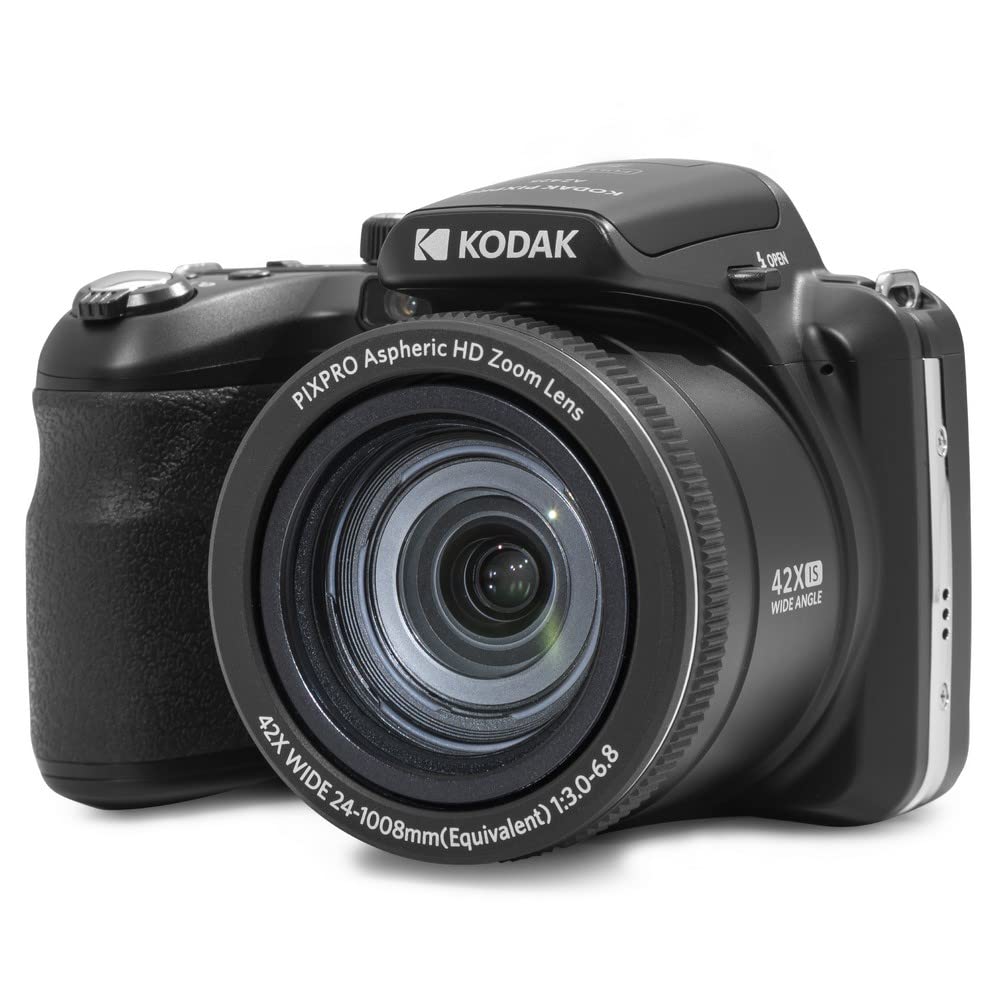
If you are buying your first superzoom, this is the camera that assumes the least about you. Auto mode, scene modes, and a straightforward layout mean you can be shooting the same afternoon you open the box.

Twenty megapixels is more resolution than the Kodak AZ528 offers, and 42x from a 24mm wide angle still reaches a backyard feeder or the far sideline of a kids' game. We think that is the smarter trade for most people: crop into a 20MP file and you claw back part of the reach you gave up, while everything else you shoot keeps more detail.

The controls are the friendly kind. Program, aperture, shutter, and manual modes sit alongside panorama, face beautifier, and scene modes, so you can start in auto and grow into the rest without changing cameras. Video stays at 1080p, which is where the budget Kodaks sit; if 4K matters to you, the Panasonic FZ80D is the step up.

The 42x reach and optical stabilization together make handheld long shots realistic in daylight, no tripod required. It is the camera for someone who wants the reach first and the specifications second.

Pros

  • 20MP sensor outresolves the AZ528
  • 42x zoom from a 24mm wide end
  • Auto and scene modes suit beginners

Cons

  • Nine autofocus points limit fast action
  • About 240 shots per charge
Our verdict

The AZ425 is our pick for a first superzoom: 20MP, 42x, and controls that will not intimidate anyone stepping up from a phone.

Check Latest Price
6

Pocket Travel

Minolta ProShot MN40Z

81 /100
LBD Score Excellent

Key details

Video
1080p Full HD
Sensor
20MP
Batteries
4 AAA (included)
Optical Zoom
40x
View on Amazon

At 4.5 by 3.2 by 3.3 inches, the MN40Z is the one here that will live in a jacket pocket rather than a camera bag. That is the whole argument: a superzoom you actually have with you beats a better one sitting at home.

Forty times optical zoom, 20MP stills, 1080p video, and Wi-Fi with app transfer cover the travel basics. Optical stabilization is the specification that matters most at the long end — it is the difference between a usable frame and smear when you shoot handheld at full zoom in decent light.

What we appreciate most is the power choice: four AAA cells, available at any gas station or market in the world. The cost is running expense, since alkalines drain and a set will not last a long trip, so pack rechargeables and treat disposables as backup. For a traveler, that trade beats a proprietary pack left on a charger at home.

Twenty megapixels and 40x are honest numbers, and the small body does not fight you in the hand. What you do not get is 4K, and 40x is the shortest reach in this group — fine for a feeder outside the kitchen window, limiting for a bird on the far side of a lake.

Pros

  • Compact 4.5-inch body fits a pocket
  • 40x zoom with optical stabilization
  • Runs on widely available AAA cells

Cons

  • 1080p video only, no 4K
Our verdict

If the camera has to fit in a jacket pocket, we choose the MN40Z: 40x zoom, Wi-Fi sharing, and AAA power you can buy anywhere.

Check Latest Price

How We Tested the Best Bridge Cameras

We started by rounding up every bridge camera with at least 40x zoom, a built-in viewfinder, and a fair price for a one-lens kit. We filtered out models with no manual controls or a fixed screen, then narrowed the shortlist to eight cameras spanning the widest range of zoom and features. Over eight months, we carried each one on a strap for full days of shooting and compared them side by side.

Our testing scenes were ordinary: a weekend at a wildlife refuge shooting distant herons, a high school soccer game tracking players sprinting toward us, a dim birthday party where we pushed ISO and tested the flash, and backyard birding from a kitchen window. We also took each camera on a day hike and a family barbecue, because that's where most people actually use these cameras.

For image quality, we shot the same landscape scenes at low and high ISOs, then compared files at 100 percent on a calibrated monitor. We judged autofocus by shooting bursts of a dog running toward us and kids playing tag, noting how often it locked on eye versus background. We tested stabilization by zooming all the way out and shooting handheld at 1/30th of a second, then checking how many frames came out sharp. We also timed startup and shot-to-shot delay, and carried each camera for a full day to gauge weight on a shoulder strap.

Beyond core shooting, we checked the features that separate a good bridge camera from a great one: we transferred photos over Wi-Fi, flipped out the rotating screen for low-angle shots, recorded 4K clips, and shot RAW to see editing latitude. We compared all of that against each camera's price to judge value, because a 125x zoom means nothing if images fall apart at the long end.

How to Choose a Superzoom Bridge Camera

Read the focal range, not the multiplier

An 83x lens starting at 24mm ends at 2000mm; a 42x lens starting at the same 24mm ends around 960mm. Two cameras with similar-looking multipliers can sit a thousand millimeters apart, so compare the 35mm-equivalent range instead of the headline number. The wide end matters too: the Panasonic FZ80D starts at 20mm where the Nikons start at 24mm, and that shows up in small rooms and narrow streets. Decide the longest reach you will genuinely use, then buy the lightest body that delivers it, because a superzoom left at home has no reach at all.

Stabilization and autofocus decide whether the reach is usable

At 1000mm and beyond, handshake moves the frame by millimeters on the sensor, so optical stabilization is not a luxury. The P1100 quotes the equivalent of four stops, and even the budget Kodaks include optical stabilization. Focus is the harder question: contrast-detection autofocus slows and hunts at long focal lengths, especially against busy backgrounds. Our fix on every camera here is the same — half-press to lock focus, keep a single AF point, and brace against something solid. If fast autofocus at 2000mm is a priority, spend up; it is the feature that separates the price tiers.

Accept the small sensor, or give up the zoom

Every camera in this group uses a 1/2.3-inch sensor, and that is the bargain that makes an 83x lens possible at this size and price. In daylight it is fine. In shade, at dusk, or indoors, noise climbs quickly, and the ISO ceiling tells you where the designers drew the line — the Kodak AZ528 stops at ISO 3200. If most of your shooting happens in dim light, a larger sensor with a much shorter lens serves you better than any superzoom. If it happens on sunny walks, accept the trade and save RAW files where the camera allows it.

Viewfinder, screen, and handling

An electronic viewfinder is close to essential on a long lens: you hold the camera against your face for stability, and an LCD washes out in sunlight. A tilting screen is the other feature worth paying for — it is the difference between shooting a bird at eye level and lying in wet grass. Then there is the body itself. The P950 carries 2000mm at about a pound; the P1100 carries 3000mm at three. Neither is wrong. Think about the trip you take most often and pick the weight you will tolerate on it.

Power, cards, and what ships in the box

Bridge cameras split between proprietary lithium-ion packs and standard AA or AAA cells. Lithium-ion gives you a charger in the box and a stated shot count; AA and AAA models let you buy power anywhere, at the cost of running through alkalines. Whichever you choose, add a 32GB or 64GB card and check the bundle contents — the Panasonic FZ80D here arrives with a shoulder bag and a 32GB card, which is accessory money you do not spend afterward.

Frequently Asked Questions

Final Verdict

The Nikon COOLPIX P950 is the bridge camera we recommend to most people: 24-2000mm, 4K video, and about a pound, a combination nothing else in this group matches. You learn its autofocus quirks in an afternoon and then stop thinking about them.

If your subjects are consistently far away and the camera can live on a strap, the P1100's 3000mm earns its weight. If the budget is fixed, the Kodak AZ528 still gets you 52x and a viewfinder for the least money here.