Best Camera Backpacks of 2026

A camera backpack has one job, and it's the job nobody notices until it goes wrong: get a few thousand dollars of glass and bodies from point A to point B without a scratch. I've watched a strap give out on a trail and a rain cover fail to cover the thing that actually mattered, so when we started sorting through bags this year, the questions weren't about looks. Would the dividers hold a 70–200 in place through a full day of walking? Could the seams handle a downpour and not just a drizzle? Would it still slide under an airplane seat once it was fully loaded?

We've spent the past eight months loading, carrying, and occasionally abusing 12 backpacks, and the pattern is clear: the feature first-time buyers overrate is padding, and the one they underrate is access. A bag that's comfortable but makes you unzip the entire back panel to reach a lens will drive you up a wall mid-shoot. The picks below got the storage, the fit, and the durability right — and stayed worth the money.

1

Best Overall

CADeN Camera Backpack 2.0

95 /100
LBD Score Outstanding

Key details

Weight
1.7 lb
Capacity
17 liters
Exterior
11 x 5.9 x 15 in
Laptop Compartment
Fits 14 inches
View on Amazon

Empty, the CADeN 2.0 Small weighs 1.7 pounds, and that number is why it became our default. A camera pack is carried loaded, so every ounce the shell doesn't add is an ounce you aren't feeling at the end of a long day. The 17-liter bay takes two camera bodies and four lenses on repositionable dividers, with a tripod strapped to the side and a 14-inch laptop in its own sleeve. The dividers keep the shape you set instead of folding flat the moment the bag goes down, which is the difference between a bag you pack once and one you repack every time.

What separates it from other budget packs is the harness. The shoulder straps are thick, long and elastic, and the strap anchors and grab handle are reinforced — the two places a cheap camera bag tends to give out first. There's ten millimeters of frame padding behind the camera bay, a front pocket that swallows a 10-inch tablet, cards and cables, and a stretch mesh pocket on the side for a bottle or a folded tripod.

The ceiling is the laptop: 14 inches, no more. The tripod holder wants compact legs rather than a full set of studio sticks, and a gripped body with a 70-200 mounted eats most of the bay. Inside those limits there's nothing here we want changed, and a year of free replacement takes some of the risk out of buying a bag at this end of the market.

Pros

  • Two bodies and four lenses in 17 liters
  • 1.7 pounds empty, easy to carry all day
  • Reinforced strap anchors and grab handle
  • Dividers that hold the position you set

Cons

  • 14-inch laptop compartment is the ceiling
  • Tripod holder suits compact tripods only
Our verdict

Our pick for most photographers: two bodies, four lenses and a laptop in a pack that weighs 1.7 pounds empty and leaves budget for glass.

Check Latest Price
2

Best for Large Kits

MOSISO Hardshell Camera Backpack

95 /100
LBD Score Outstanding

Key details

Weight
3.2 lb
Capacity
35 liters
Exterior
17.32 x 11.8 x 7.5 in
Laptop Compartment
Fits 15.6 inches
View on Amazon

Thirty-five liters is the biggest bay here, and the MOSISO spends it on a second compartment: a removable padded insert in the upper section that sits above the camera space, so a change of clothes or a spare body travels apart from the glass. The front is a waterproof PU-leather hard shell laid over foam, and that is what you are paying for — a bag that doesn't care what it gets set down on.

In use, the shell changes how you treat the bag. We stopped thinking about where it landed, which is not something we can say about the soft packs in this group. The cost is 3.2 pounds before anything goes in and a boxy profile that reads as luggage rather than daypack; on a crowded bus that width is noticeable.

The organization is thorough: nine pockets, two accessory pockets on the back face for cables, cards and a power bank, a tripod strap, and shoulder straps that adjust from 17.72 to 39.4 inches. A bag this size invites you to fill it, and the straps and zippers are what suffer when you do, so keep the load to what a 20-liter pack would carry and it holds up fine.

Pros

  • 35 liters with a separate upper compartment
  • Waterproof hard shell over foam padding
  • Fits a 15.6-inch laptop and nine pockets

Cons

  • 3.2 pounds empty and boxy to carry
  • Hard shell covers the front only
Our verdict

Buy this one when your kit has outgrown a 20-liter pack: 35 liters, a separate upper compartment and a hard front that takes the knocks for you.

Check Latest Price
3

Best Protection

K&F CONCEPT Hardshell B07

93 /100
LBD Score Outstanding

Key details

Weight
2.8 lb
Capacity
22 liters
Exterior
17.3 x 11 x 7 in
Laptop Compartment
Fits 15-15.6 inches
View on Amazon

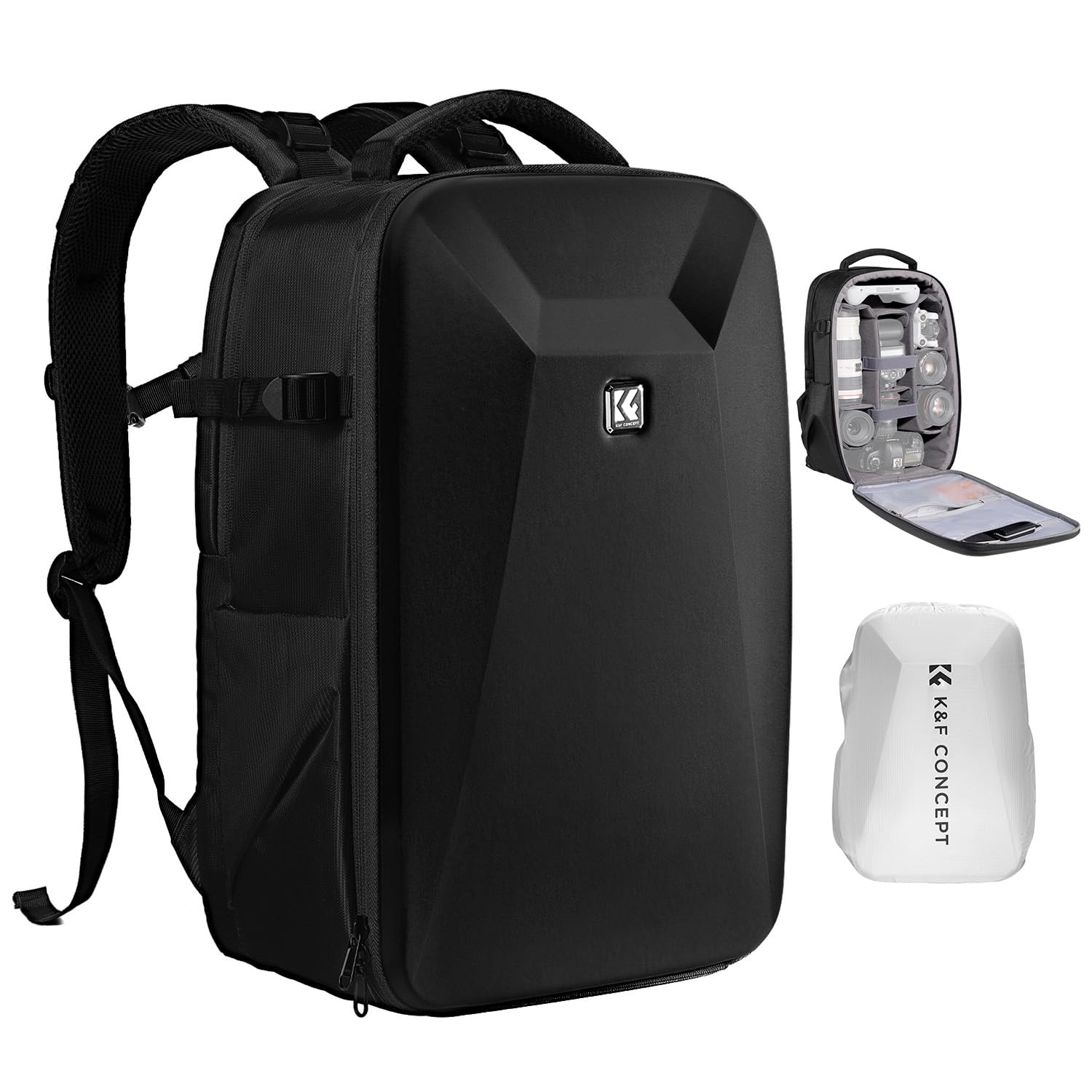
Set this next to the MOSISO and the difference is where the plastic is. K&F molds the EVA shell in one piece across the front of the camera bay rather than adding a hard panel, and the result is 22 liters of pack we trust on a trail, in a truck bed, or in an overhead bin next to someone else's roll-aboard.

The bay opens flat on a full-width front flap, and five compartments plus the accessory pockets take a body, three or four lenses and a drone without turning packing into a jigsaw. Depth is the pleasant surprise: a 400mm lens goes in with room left over for a second body, which is unusual at this size.

Carrying it is fine rather than special. The mesh back panel breathes, the shoulder straps adjust from 20 to 38.9 inches, and a trolley belt lets you wheel it through an airport behind a suitcase. Two things to know before you commit: the shell is stiff enough that it won't squash into a tight overhead, and the warranty runs six months, which is short for a bag built to take this much abuse.

Pros

  • One-piece EVA shell around the camera bay
  • Fits a 400mm lens plus a spare body
  • 15.6-inch laptop and trolley belt

Cons

  • Stiff shell won't squash into tight spaces
  • Short six-month warranty
Our verdict

The one to take when the bag gets thrown around: a one-piece EVA shell over a 22-liter bay that swallows a 400mm lens.

Check Latest Price
4

Best for Professionals

Lowepro ProTactic BP 450 AW III

84 /100
LBD Score Excellent

Key details

Capacity
28 liters
Access Points
4
Divider System
Molded MaxFit dividers
Laptop Compartment
Fits 16 inches
View on Amazon

Four ways into the same bag: a door on each side, a top opening sized for a long lens, and a back panel that lies flat so you can see the whole kit at once. That is the ProTactic's argument, and it holds up for anyone shooting events or working out of a vehicle, where the camera comes out twenty times an hour and the bag never leaves your back.

The MaxFit dividers are molded rather than flat panels, and they connect to one another in different arrangements, so a 28-liter bay can be rebuilt around two bodies and a 70-200 for one job and a drone plus a flash kit for the next. The back panel is the one we used most: everything visible, nothing stacked on top of anything else, and a place for every accessory.

The rest is professional housekeeping. 86% recycled fabric, a rain cover, two quick straps, two pouches and a removable utility belt you can wear on its own, plus a sleeve that takes a 16-inch laptop and a two-year warranty. It is the most capable bag in this set, and it is priced like it.

Pros

  • Four access points, including a full back panel
  • Molded dividers reconfigure for each job
  • Fits a 16-inch laptop
  • Rain cover, pouches and belt included

Cons

  • Side doors and straps get in each other's way
  • Heavy once a full kit is loaded
Our verdict

For working photographers who need the camera out fast and often: four access points, molded dividers and a two-year warranty.

Check Latest Price
5

Best Compact Travel

Lowepro Tahoe BP 150

93 /100
LBD Score Outstanding

Key details

Capacity
20 liters
Exterior
10.8 x 8.54 x 15.8 in
Interior
10.04 x 5.04 x 14.17 in
Tablet Sleeve
Fits 10 inches
View on Amazon

If the bag has to slide under the seat in front of you, start here. The Tahoe BP 150 measures 15.8 inches tall and 10.8 wide outside and holds 20 liters inside, which is the size airlines tend to accept as a personal item, and the shell is quilted and weather-resistant rather than armored.

What surprised us is how much goes into those 20 liters. A body with a long lens mounted, a second body, a couple more lenses and a flash will fit if you build the dividers vertically instead of stacking. The UltraFlex panel folds down over the top of the camera bay and keeps the load from shifting when the bag is shoved under a seat with a foot.

The tablet sleeve is the compromise: 10 inches, so a laptop stays home or travels in another bag. In exchange there's a two-year Lowepro warranty, stretch mesh pockets on both sides for a bottle and a folded tripod, quilted padding throughout, and a shape that stays upright when you set it down.

Pros

  • Under-seat personal-item size
  • Takes a body with a long lens mounted
  • Two-year Lowepro warranty

Cons

  • No laptop sleeve, just a 10-inch tablet pocket
  • 20 liters limits how much glass comes along
Our verdict

The travel pick: small enough to ride under an airplane seat, padded enough for a body, three lenses and a flash.

Check Latest Price
6

Best Everyday Carry

RAINSMORE Tactical Camera Backpack

90 /100
LBD Score Outstanding

Key details

Weight
3.64 lb
Capacity
28 liters
Rain Cover
Full-coverage cover included
Laptop Compartment
Fits 15.6 inches
View on Amazon

The top pocket on this RAINSMORE is the detail that won us over: it takes a sweatshirt or a spare layer, which is the choice most camera packs force on you — clothes or gear, not both. Below it, the padded bay holds a body with a 100-500 mounted and opens from the side, so you can pull the camera out without unpacking the top of the bag.

Outside, MOLLE webbing runs down the front and sides for add-on pouches, and the main opening is positioned as an anti-theft quick-access point rather than a full back panel. The fabric is heavy, the dividers are thick, and there are eight compartments and seven pockets, which is either excellent organization or too many zips depending on how you pack.

It's the heaviest of the midrange bags here at 1.65 kg empty, and the breathable back panel earns its keep once you're loaded. Spot clean only — this fabric doesn't want a washing machine.

Where it earns its place is as a one-bag daypack for someone whose camera is one part of the day: hike, lunch, a few frames, home. As a pure camera bag it's overbuilt; as the bag you take everywhere, the extra pockets stop being clutter and become the reason the other bags stay on the shelf.

Pros

  • Top pocket takes a spare layer
  • MOLLE webbing for add-on pouches
  • Padded 15.6-inch laptop sleeve
  • Full-coverage rain cover included

Cons

  • 1.65 kg before you pack anything
  • MOLLE webbing reads tactical, not urban
Our verdict

The best everyday carry in the group: a top pocket for a layer, MOLLE webbing outside and a padded 15.6-inch laptop sleeve inside.

Check Latest Price
7

Best Lightweight

K&F CONCEPT Lightweight B19

92 /100
LBD Score Outstanding

Key details

Weight
1.96 lb
Capacity
13 liters
Exterior
10.6 x 5.1 x 15.2 in
Laptop Compartment
Fits 14 inches
View on Amazon

Thirteen liters is the smallest bay here, and it's better to say so first: this is a bag for one body and two or three lenses, not a working kit. What the size buys is 1.96 pounds empty and a pack you forget you're wearing halfway up a hill.

The main compartment opens from the front rather than the back, which is quicker on a trail and less exposed than it sounds in a crowd, and five dividers let you build a slot for a body with a lens attached plus a couple of primes. There are ten pockets, a padded 14-inch laptop sleeve, two deep zip pockets on the outside, and a rain cover packed in with the bag.

We kept coming back to this one for city trips and day hikes, where the camera is one item on a list that also includes a jacket and a water bottle. It's not the bag for a second body, and the bay rewards packing small — a body, two primes and a charger fill it — but for a light kit it's the easiest carry of the group, and the year of warranty covers the fabric and zips.

Pros

  • 1.96 pounds empty
  • Rain cover and 14-inch laptop sleeve included
  • Front-opening bay with five dividers

Cons

  • 13 liters fills fast with a second body
  • Splash-proof fabric, not a waterproof shell
Our verdict

For a body and two or three lenses on a long walk: 1.96 pounds empty, a rain cover in the box and a 14-inch laptop sleeve.

Check Latest Price

What We Put These Camera Bags Through

We started with roughly 40 bags from brands photographers actually buy, then filtered on the things that disqualify a bag fastest: exterior dimensions against carry-on limits, the size of the laptop sleeve, whether the dividers were adjustable, and whether a rain cover came included or was sold separately. Twelve made the cut — hardshell cases, lightweight daypacks, and padded workhorse bags — and each one was loaded with the same kit: a mirrorless body, a DSLR body, three lenses, a laptop, and a tripod.

Over eight months, those bags went everywhere I'd normally carry one: a daily train commute, three flights, weekend hikes, a wedding, and one memorably muddy sideline shoot in the rain. I packed and unpacked each bag dozens of times and paid attention to the fumbling — which dividers let a lens roll around after I turned the bag upside down and shook it, which straps dug into my shoulders after an hour under a 20-pound load, and whether the hip belt and sternum strap actually moved weight off my back or just decorated the bag.

For water resistance, I ran each exterior under a faucet for two minutes with folded paper towels packed inside, then checked whether the towels came out dry. Laptops went in and out of every sleeve at 14, 15, and 16 inches to see whether the padding pressed into the camera compartment. I strapped a tripod to each mounting point and walked a mile to see if it swung or slipped. And I weighed every bag empty and packed, because the one that feels light on paper is often the heaviest on your back by the end of a long day.

How to Choose a Camera Backpack

Start With the Bay, Not the Liter Count

Liters tell you less than your own kit does. A 17-liter pack like the CADeN holds two bodies and four lenses because the dividers run the full depth of the bay; a 13-liter pack takes one body and two or three lenses and nothing else. Measure your longest lens with the hood reversed and your tallest body with a grip attached, then check the bay dimensions against those two numbers. Between 22 and 28 liters you're buying room for a drone, a flash kit or a long lens left mounted; at 35 liters you're buying a second compartment.

Decide How You Want to Reach the Camera

Back-panel access is the safest and the slowest: the bag lies flat, you see the whole kit, and nothing is exposed to a crowd. Side doors are faster, but the shoulder strap tends to share the same space as the zip, as it does on the ProTactic. A top opening is what you want if you carry a long lens mounted.

Be honest about your shooting. A back panel on a bag used for events will frustrate you every time, and a side door on a bag dragged through crowded transport hands a stranger a straight line to your body and lens.

Weigh a Hard Shell Against Padding

A molded EVA shell, as on the K&F hard shell, protects against the knock you don't see coming: a bag set down on a curb, loaded into a trunk, wedged into an overhead bin. It costs weight, bulk and the ability to squash into a tight space. Soft padded packs are lighter and more forgiving to pack, but their protection is only as good as the dividers, and loose walls let lenses meet each other. If the bag mostly rides on your back, padding is enough; if it rides in vehicles, pay for the shell.

Check the Laptop Sleeve, the Empty Weight and the Harness

Laptop sleeves here run from a 10-inch tablet pocket on the Tahoe to a 16-inch sleeve on the ProTactic, and a stated 15.6 inches usually means a slim 15-inch, so measure the laptop rather than trusting the label. Empty weights run from 0.89 kg to 3.2 pounds, and that gap matters far less than what you put in it — four kilos of glass is four kilos whichever bag holds it. If you can't hold your loaded kit in one hand for a minute, get a bag with a hip belt.

Frequently Asked Questions

Final Verdict

Buy the CADeN 2.0 Small. It carries the kit most photographers actually own — a body or two, four lenses, a 14-inch laptop — at a weight and a price that leave nothing to resent, and the reinforced harness is still comfortable on the walk home. That combination is why it holds the top spot rather than the biggest or the most feature-heavy bag here.

Go up to the MOSISO if your kit needs 35 liters and a second compartment. Go to the Lowepro Tahoe BP 150 if the bag has to slide under an airplane seat.