Best Solar Panel Kits for Sheds of 2026

For two years, the only power in my shed came from a 50-foot extension cord dragged across wet grass, and every time I wanted to charge a drill battery I questioned my choices. A solar kit solved it: a panel on the roof, a controller on the wall, and enough stored juice for lights, a trickle charger, and a fan on a hot afternoon. The real payoff isn't convenience — it's that a shed with its own power stops being storage and starts being a workspace.

The catch is that "complete kit" means something different to every seller. Some boxes arrive with everything needed to mount and wire a panel; others leave you hunting for Z-brackets, an inline fuse, and cable thick enough for the run from roof to battery. The controller deserves just as much suspicion — a cheap PWM unit can quietly cook a battery over a single season. We've spent eight months with 12 kits mounted on real sheds in full sun and dappled shade, and the gaps showed up fast.

Here's what nobody tells a first-time buyer: a 100-watt panel almost never delivers 100 watts, and the honest number depends on angle, shade, and how far the power has to travel. So the right kit for a shed isn't the biggest one — it's the one whose controller, wiring, and battery match what you're actually running. The picks below are the ones that held up.

1

Best Overall

Renogy 200W N-Type Kit

90 /100
LBD Score Outstanding

Key details

Mounting
Brackets included
Panel Output
200W (2 x 100W)
Cable Included
30 ft plus 16 ft, 10AWG
Charge Controller
30A PWM, flush mount
View on Amazon

Getting power to a shed is mostly a wiring problem. The panel goes on the roof, the battery has to stay dry and above freezing, and between them sits a hole you drill through a wall and have to seal again. Renogy's 200W kit is the one in this group that anticipates that: a 30-foot 10AWG adaptor kit, a 16-foot tray cable, a pair of branch connectors, mounting brackets, and a cable entry housing all come in the box. That is roughly the difference between a weekend job and three trips to the hardware store.

Two 100W monocrystalline panels at 22% cell efficiency make up the array, and Renogy rates the pair at about 800Wh a day across four hours of good sun. That is a realistic shed budget — LED lights, a phone and a couple of tool batteries, a fan in July, with something left over. The Adventurer controller is a 30A PWM unit that mounts flush to a wall like a thermostat, carries an LCD, and lists a lithium profile alongside flooded, gel, and AGM, which we do not take for granted at this price.

The compromise is the controller type. PWM is cheap and tough, but it cannot chase a panel's maximum power point, so a cold, bright morning that pushes panel voltage up leaves some harvest unclaimed. An MPPT controller costs more and earns the difference on bigger arrays; at 200W we do not think that gap should decide a shed purchase. Installation is otherwise as easy as anything here — pre-drilled panels, plug-and-play leads, and a controller that screws to a wall.

Pros

  • Long cable runs, entry housing, and brackets included
  • 200W array rated near 800Wh a day
  • Flush-mount 30A controller with a lithium profile

Cons

  • Bluetooth pairing is the fussiest step in the kit
  • About 46 ft of cable total; longer runs need more
Our verdict

Our default for a shed: 200W is enough for lights, chargers, and a fan, and the box already includes the long cable runs and wall entry housing most kits leave out.

Check Latest Price
2

Best for a Small Shed

Renogy 100W Starter Kit

94 /100
LBD Score Outstanding

Key details

Expansion
Up to 400W of panels
Panel Output
100W
Panel Warranty
10 years
Charge Controller
30A PWM (Wanderer)
View on Amazon

A lot of sheds do not need two hundred watts. A light, a trickle charge for the mower battery, a phone on the wall — that is a 100W job, and buying the bigger kit means paying for panels that sit idle most of the day. This is the one we point at that shed: a single 100W monocrystalline panel at 22.5% cell efficiency, rated at about 500Wh a day, with Z-brackets and cable in the box.

The panel is the part we trust most. It carries UL 61730 and IEC 61215 certification and is rated for 2400Pa of wind and 5400Pa of snow load, which is more than a shed roof will ever ask of it, and the junction box is IP65. Ten-year coverage on panel material and workmanship backs that up.

The controller is basic — small display, no frills — but it is rated at 30A, far more than the single panel needs, so panels can be added later without replacing it. It handles AGM, gel, flooded, and lithium. For a shed you plan to build out over a few summers, that headroom is the more useful half of the package.

Pros

  • Least expensive kit in this roundup
  • 30A controller leaves room for up to 400W of panels
  • UL-listed panel with 10-year material coverage

Cons

  • Battery leads are short for most shed layouts
  • Bluetooth monitoring needs a separate module
Our verdict

For a shed with a light, a charger, and a battery you already own, this is the least expensive kit here and the simplest to wire.

Check Latest Price
3

Best Value

ECO-WORTHY 200W Kit

91 /100
LBD Score Outstanding

Key details

Daily Output
800Wh (4 hours sun)
Panel Output
200W (2 x 100W)
System Voltage
12V or 24V
Charge Controller
30A PWM
View on Amazon

Same wattage, different priorities. Where the Renogy kit spends its money on long cable runs and a wall entry housing, this one puts two 100W monocrystalline panels and a 30A controller in the box and leaves the installation hardware question to you. The cells are 21.5% efficient in a corrosion-resistant aluminum frame rated for 2400Pa of wind and 5400Pa of snow, and the pair is quoted at 800Wh a day in four hours of full sun.

The flexibility is what stands out. Both panels can run in parallel into a 12V battery or in series into a 24V bank, and the controller covers either, so a shed running a 12V light circuit today can grow into a 24V setup later. For a first system you intend to add to, that is worth more than a screen or an app.

Output is the honest caveat. A 200W rating assumes cool cells and direct sun, and a flat-mounted pair on a shed roof in July will spend the afternoon well under that label, so size the battery around a realistic harvest rather than the box. Set that expectation and this is the value of the group: the panels are the same class as the ones costing more, and the money saved covers the odds and ends.

Pros

  • 200W for less than the top pick
  • Wires as 12V parallel or 24V series
  • Panels rated for 2400Pa wind and 5400Pa snow

Cons

  • Plain 30A PWM with no Bluetooth or app
  • Included leads are short for a roof-to-battery run
Our verdict

If the battery sits close to the panels, this is the same 200W as our top pick with fewer extras and a lower price.

Check Latest Price
4

Turnkey Shed System

ECO-WORTHY 200W Complete Kit

80 /100
LBD Score Excellent

Key details

Battery
12V 50Ah LiFePO4
Inverter
600W pure sine
Daily Output
800Wh (4 hours sun)
Panel Output
200W (2 x 100W N-type)
View on Amazon

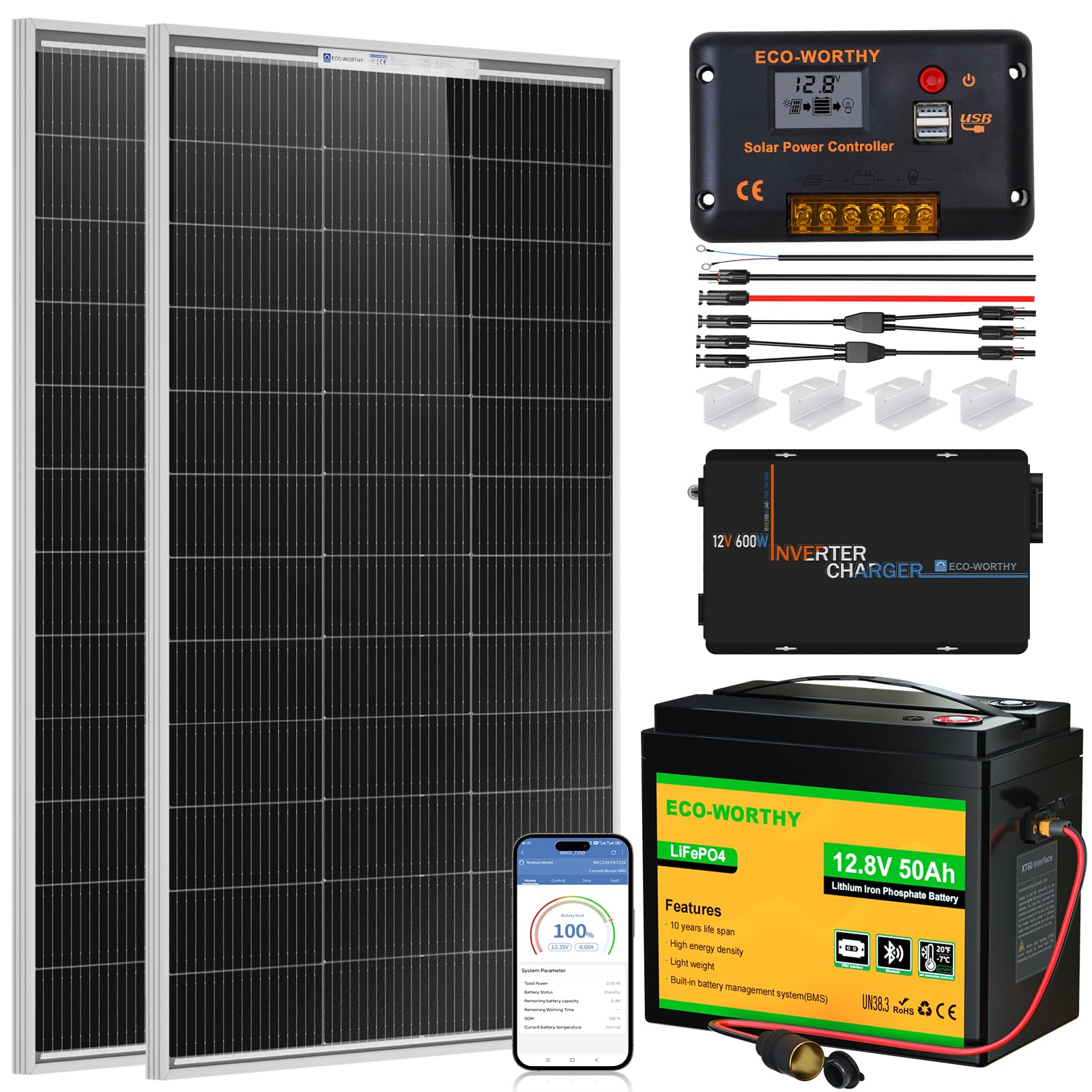
Most kits here stop at the charge controller and leave you to buy a battery, a fuse, and an inverter — a second shopping trip that can rival the panels themselves. This one closes the loop: two 100W N-type panels, a 30A controller, a 12V 50Ah LiFePO4 battery, and a 600W pure sine inverter with a built-in 30A charger and a 20ms UPS switchover.

Having real outlets in a shed changes what the building is for. The inverter runs a work light, a laptop, a drill battery charger, a radio; charge current is adjustable from 5A to 40A so you can keep it gentle on the 50Ah pack, and the UPS function means anything plugged in keeps running when the shore cord comes out. The N-type cells are rated at 25% efficiency, a step above the panels on the cheaper kits here.

Capacity is the limit. Fifty amp-hours of 12-volt storage covers a day of lights and small loads, not a heater, a microwave, or an air conditioner, and 600W of inverter output caps what you can run at once no matter what the battery holds. Load-test the inverter on day one — a drill or a work light, left running a while — before you commit to mounting panels and routing cable.

Pros

  • Battery and 600W inverter included
  • Inverter doubles as a shore-power charger
  • N-type panels rated at 25% efficiency

Cons

  • 600W output rules out heaters and big appliances
Our verdict

Buy it when the shed has nothing in it yet: panels, a 50Ah lithium battery, and a 600W inverter arrive together, and the inverter also charges from shore power.

Check Latest Price
5

Small Storage Sheds

ECI Power 100W Kit

85 /100
LBD Score Excellent

Key details

Battery
12V 20Ah LiFePO4
Panel Output
100W
Cables Included
10 ft solar, 6 ft battery
Charge Controller
10A PWM
View on Amazon

Twenty amp-hours is the smallest battery in this roundup, and it shapes everything else about the kit. That is enough for LED lights, a phone, a small fan overnight, and not much more. What we appreciate is that ECI sized the parts to match: a 100W panel, a 10A controller, a 20Ah LiFePO4 battery, 10 feet of solar cable, 6 feet of battery cable, and mounting brackets, all in proportion to each other.

The controller is more thoughtful than 10A suggests. It auto-detects 12V or 24V, holds a temperature-compensated CC-CV charge profile — which matters in a shed that swings from freezing in February to oven-hot in August — and protects against overcharge and over-discharge. The battery is rated for 2,000 cycles at 80% depth of discharge, a long life for a small pack provided you do not flatten it week after week.

Matching a 100W panel to a 20Ah battery is the design decision that makes this kit work and also the one that closes the door on growth. The panel refills the battery in a decent day, and the battery cannot ask for more than the panel makes — a self-limiting loop built for one job. There is something refreshing about a kit that admits its size, and something limiting about it too.

Pros

  • Complete kit with a lithium battery and brackets
  • Temperature-compensated charging suits a shed
  • 10 ft solar and 6 ft battery cables included

Cons

  • 20Ah battery suits lights and a charger, little more
  • 10A controller is already near its ceiling
Our verdict

For a storage shed that needs a light and a trickle charge, this arrives complete — panel, 20Ah lithium battery, controller, cables, and brackets.

Check Latest Price

How We Tested Solar Panel Kits for Sheds

We started by gathering every 100- to 200-watt kit sold for sheds, outbuildings, RVs, and general off-grid use, then narrowed the field to 12 based on panel type, controller amperage, cable length and gauge, what came in the box, and price per watt. Kits that called themselves complete but required buying brackets, fuses, or extra cable separately weren't dropped — they were flagged, and the cost of those missing pieces got folded into the value math.

Each kit went onto a working shed. Some panels sat on a clear south-facing roof; others went under a tree line that threw shade across them for part of the afternoon. I did every install solo, with no solar background beyond what the manual provided, and timed the job from breaking the tape to the first reading on the controller. Along the way I noted where the instructions assumed knowledge the box never gave, whether the included cable reached from panel to battery without a splice, and how firmly the connectors seated.

Then we lived with them for eight months, from late summer into winter. Lights and a tool battery charger ran nightly, a small inverter pulled a fan on hot afternoons, and I logged controller readings at midday and again at dusk, cross-checking against a clamp meter so a flattering display couldn't fool me. Each morning I checked whether the battery had recovered overnight; after storms and a hard freeze I went back over frames, brackets, and cable jackets looking for cracks, corrosion, or loose fittings.

Value came last: purchase price plus anything missing, divided by the output we actually measured rather than the number printed on the panel. That's where the field separated — a kit that saves you forty dollars but needs a longer cable and a better controller isn't a bargain by the time the shed is lit.

How to Choose a Solar Panel Kit for a Shed

Size Around Daily Watt-Hours, Not Watts

Add up what the shed actually runs. Two LED lights, a phone charger, and a fan come to roughly 100 watt-hours a day; a tool charger, a small fridge, or a radio left on all day pushes that several times higher. Then work backward: panels are rated in watts, and multiplying by about four hours of usable sun gives a daily figure. Renogy quotes around 500Wh from its 100W panel, and ECO-WORTHY 800Wh from a 200W pair under four hours of full sun.

Double your own estimate before you shop. A flat-mounted panel on a hot roof produces less than its label for most of the afternoon, and a system that only just covers today's loads will feel thin the first cloudy week.

Decide How Much Controller You Need

Two things matter on the charge controller: type and amperage. PWM is the inexpensive standard and a fine match for a 12V system of 100 to 200 watts, where panel voltage sits close to the battery's. MPPT tracks the panel's maximum power point and recovers more of the available power, especially on cold bright mornings and long cable runs, and it earns its premium once you go past roughly 400 watts.

Amperage is the ceiling. A 10A controller is about right for a single 100W panel and little more, while the 30A units on the larger kits here have slack — worth checking against the panel count you intend to run, not just what ships today.

Measure the Cable Run Before You Order

Kits ship with short leads, and 8 to 16 feet of panel cable is typical. A shed install usually needs 20 to 40 feet from the roof, through a wall, to wherever the battery lives, and a 12V system loses voltage quickly over distance, so thin wire is a false economy. Measure the path, add a fifth for bends and slack, and buy 10AWG cable plus an entry gland to seal the hole.

This is the detail that separates the picks here most sharply. The Renogy 200W kit ships a 30-foot adaptor kit, a 16-foot tray cable, and a cable entry housing; most of the others assume your battery sits within a few feet of the controller.

Work Out What Is Still Missing From the Box

Only two kits here include a battery and only one includes an inverter, so for the rest you are buying storage separately, plus a fuse, a fuse holder, and cable clamps. Price the whole list before deciding, because a cheaper kit plus a deep-cycle battery and an inverter can pass the cost of a complete system.

Chemistry matters too. Lead-acid is cheap, heavy, and dislikes being run flat; LiFePO4 costs more up front, lasts several thousand cycles, and has to stay above freezing while charging.

Frequently Asked Questions

Final Verdict

Solar for a shed is less a kit problem than a wiring and storage problem, and the Renogy 200W kit is the pick that treats it that way: 200 watts of panel, a controller you can mount on a shed wall like a thermostat, and enough 10AWG cable and entry hardware to finish the run in one weekend.

If the battery sits close to the panels and the budget is tight, the ECO-WORTHY 200W kit does the same electrical job for less. If the shed has nothing in it at all, the ECO-WORTHY complete kit arrives with storage, outlets, and a shore-power charger.