Best Solar Panel Kits of 2026

A solar panel kit promises off-grid power in a box, but the box is where trouble starts: a hot-running controller, cables that stop a foot short, mounting hardware for a roof you don't have. A good kit fixes the guesswork of matching panels, controller, and cable.

I've wired enough of these into campers and backyard sheds to know headline wattage is the least interesting number. Over the past six months, we tested eight kits, from a 100W battery maintainer to a complete 400W setup with lithium batteries and an inverter; the real differences were controller quality—MPPT versus PWM—cable length, mounting hardware, and whether the instructions let a first-timer assemble solo.

Value isn't just price per watt—it's the kit that includes a controller suited to your battery and enough cable to reach it without a hardware-store run. A few add Bluetooth modules, which seem like a gimmick until you're on a roof wondering if the panels are charging. The picks below earned their place through real charging cycles, overnight battery draws, and weather that didn't cooperate.

1

Best Overall

Renogy 400W Premium Kit

88 /100
LBD Score Excellent

Key details

Weight
56.4 lb
Monitoring
Bluetooth module included
Rated Output
400W (4 x 100W)
Charge Controller
40A MPPT
View on Amazon

Panels get the spec sheet, but the controller decides whether a kit is worth owning, and this one ships with Renogy's 40-amp Rover MPPT instead of the PWM units most bundles at this power level include. MPPT tracks the array at its maximum power point rather than clipping panel voltage down to battery voltage, so four 100-watt panels give you more of what they collect. That component, plus the Bluetooth module and a full mounting pack in the same box, is why this is the kit we put first.

Setting it up means four pre-drilled panels, Z-brackets, an adaptor kit, tray cable, and a fuse, and the Bluetooth module pairs with Renogy's app for charge settings and live output. We found the app better for today's numbers than for history, since the graphing is thin, but changing charge parameters from a phone instead of squinting at a controller display is the kind of convenience that keeps a system tuned as the seasons change. Budget a second pair of hands for the roof: the panels and hardware come to just over 56 pounds.

Four hundred watts is a working system rather than a maintenance trickle. In decent sun it carries a 12-volt compressor fridge, lights, and device charging with enough left over to bring a partly drained bank back up, which is the RV and van use this kit is built for. If your plan is a weekend camper and a single battery, you're paying for headroom you won't use — the 200-watt kit below covers that for far less. Renogy covers the panels for five years, which is the paperwork you want behind holes drilled in a roof.

Pros

  • 40A MPPT controller gets more from four panels
  • Bluetooth module for live output and charge settings
  • Brackets, adaptor kit, tray cable, and fuse included
  • Five-year panel warranty

Cons

  • Premium price among the kits here
  • Short panel leads limit side-by-side spacing
Our verdict

This is the kit we point people to when they want a real 400-watt system with a controller worth keeping: MPPT, app monitoring, and every bracket in the box.

Check Latest Price
2

Best Budget

ECO-WORTHY 200W Kit

91 /100
LBD Score Outstanding

Key details

Weight
31.6 lb
Panel Size
35.2 x 23.1 x 1.3 in
Rated Output
200W
Charge Controller
30A PWM
View on Amazon

Two hundred watts is a promise about noon in full sun, not a daily average, and this kit is where that distinction earns its keep. ECO-WORTHY's own 800 watt-hours a day assumes four hours of direct sun on panels square to it; lay two rigid panels flat on an RV roof in low winter light and you'll collect a fraction of that. Mount them where they can see the sun and the rating holds, which is why the same kit turns in such different numbers in different hands.

At this price we're happy to live with a basic 30-amp PWM controller. It's the sensible match for 200 watts — simple, cheap to replace, and easy to troubleshoot — but it does leave harvest on the table next to the MPPT units on our top picks, and it's the first thing to upgrade if you add panels. The panels themselves are pre-drilled with MC4 connectors and wire in series for a 24-volt system or parallel for 12, so you get flexibility without extra hardware.

Two panels listed at just over 31 pounds total are a one-person job on a camper shell or a shed roof, and the box is complete enough to charge a battery the day it arrives. What it isn't is a system for running an inverter or a big appliance load; treat 200 watts as fridge-and-lights capacity and size the rest of your plans around that. For a first kit, a boat on a mooring, or a cabin that needs the battery held up between visits, that's the right trade.

Pros

  • Low cost per watt among the panel kits here
  • Wires in series for 24V or parallel for 12V
  • Pre-drilled frames with MC4 connectors

Cons

  • One-year warranty is the shortest here
Our verdict

If you want the most panel for the least money and can live with a basic PWM controller, this is the budget kit we recommend before anything else.

Check Latest Price
3

Best All-In-One System

ECO-WORTHY 1.6kWh Kit

78 /100
LBD Score Very Good

Key details

Battery
Two 12V 100Ah lithium
Inverter
2000W pure sine
Rated Output
400W (4 x 100W bifacial)
Charge Controller
40A MPPT
View on Amazon

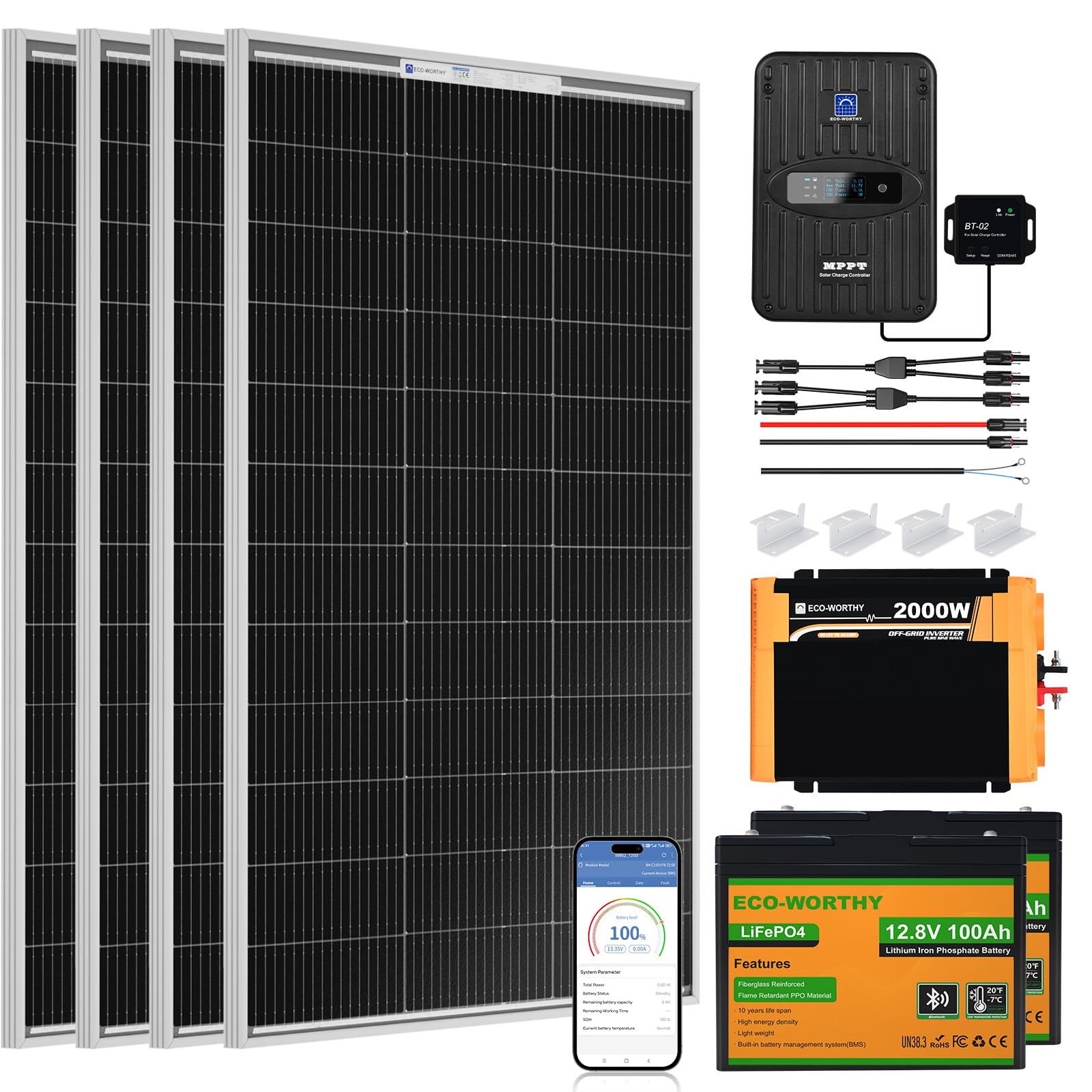
There's a version of this purchase where you don't want to match a controller to a panel count or work out which fuse lands where — you want one order that arrives with the array, the electronics, the storage, and the inverter, and you want to bolt it together. That's this kit: four 100-watt bifacial panels, a 40-amp MPPT controller, two 12-volt 100-amp-hour lithium batteries, a 2,000-watt pure sine wave inverter, and the Bluetooth module and cabling to tie them together.

The batteries are the part to think hardest about. Two 100-amp-hour lithium units, rated for more than 3,000 deep cycles with a built-in BMS, will run lights, a compressor fridge, a laptop, and a fan overnight without the replacement math that comes with lead acid. Ask them to run a microwave or an induction hob and the bank drains quickly; the inverter can deliver the surge, but the storage behind it is modest for that kind of load.

The case for it is straightforward: matched components, cable in the box, and no hunting for an inverter that suits a 12-volt bank, with a controller already paired to the panels. That's worth real money to someone who wants the system running this weekend rather than sourced over a month. It's also the most capable single order in this group, which is why we keep it on the list despite the assembly it asks of you.

Pros

  • Panels, MPPT controller, batteries, and inverter in one order
  • 3,000-cycle lithium batteries with built-in BMS
  • 2,000W pure sine inverter for small appliances
  • Bluetooth module included for monitoring

Cons

  • Documentation assumes 12-volt wiring experience
  • Most expensive kit in this group
Our verdict

Buy this if you want a matched 12-volt system delivered in one order and can accept that the storage is sized for small loads, not appliances.

Check Latest Price
4

Best for Small Rigs

Renogy 100W Starter Kit

94 /100
LBD Score Outstanding

Key details

Weight
14.1 lb
Rated Output
100W
Cell Efficiency
22.5%
Charge Controller
30A PWM
View on Amazon

A quarter of the panel count of our top pick, and the kit we reach for when the job is smaller: a camper van with one battery, a boat on a mooring, a shed with a light and a pump. The single 100-watt panel weighs about 14 pounds, so you can carry it up a ladder and position it yourself, and the frame is pre-drilled for the included Z-brackets.

The panel spec is why this one holds up. Cell efficiency is 22.5%, the junction box is IP65 and the connectors are IP67, and the panel is certified to UL 61730, CSA C22.2#61730, and IEC 61730/61215 — the kind of listing that matters when the installation lives outdoors and moves. The Wanderer controller is generously sized for one panel and accepts additional panels up to 400 watts, so the electronics don't have to be replaced as the system grows.

Where the money went is the panel, not the electronics. The Wanderer is a basic PWM unit — fine at this scale, and part of why the kit costs less than an MPPT system of similar output, but not the equal of the controller on our top pick. Panel coverage runs to 10 years, the longest here, and the box includes a wiring diagram instead of assuming you'll find one online.

Pros

  • Single 14-pound panel one person can mount
  • UL and IEC certified with IP65 and IP67 ratings
  • Controller takes panels up to 400W later

Cons

  • Battery-to-controller cables run short
  • Bluetooth needs a separately sold BT-1 module
Our verdict

The kit we recommend for boats, small campers, and first systems: one light panel, serious certifications, and a controller that leaves room to grow.

Check Latest Price
5

First Solar Setups

Hoysicy 100W Kit

84 /100
LBD Score Excellent

Key details

Warranty
2 years
Rated Output
100W
Cable Included
16.4 ft extension
Charge Controller
20A PWM
View on Amazon

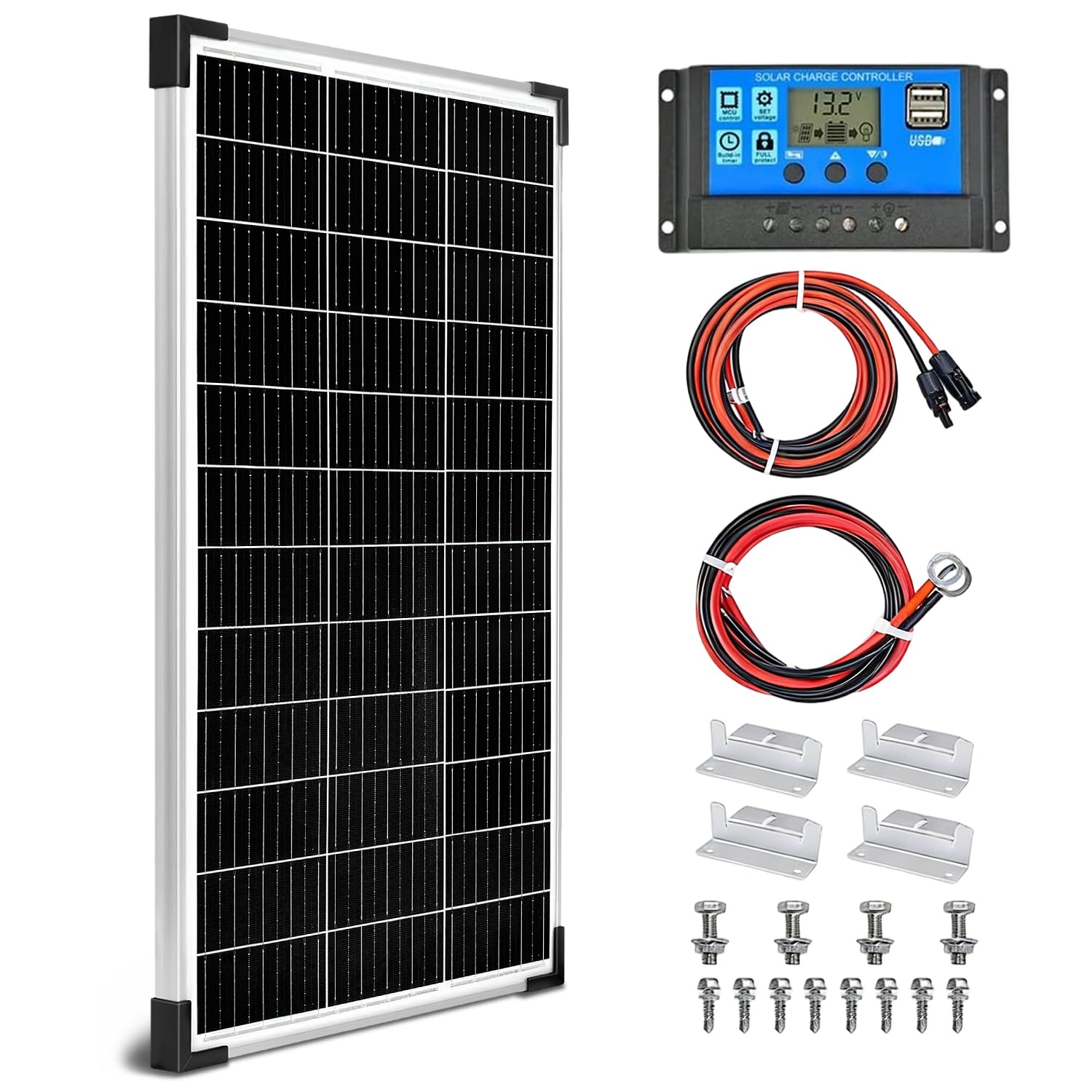
Sixteen feet of cable doesn't sound like a feature until you're parked under trees and the only sun is across the clearing. Hoysicy includes a 16.4-foot extension with this kit, along with the solar-to-controller lead, O-ring terminal cables, Z-brackets, and screws, so the panel can sit in the light while the controller and battery stay out of the weather.

The panel is the least documented part of the package. Hoysicy lists a waterproof junction box, edge sealing, and a corrosion-resistant aluminum frame, but there's no stated weight, and the dimensions in the listing don't describe a 100-watt panel sensibly enough to plan a roof layout around — measure your space rather than trusting that line. The 20-amp controller carries more capacity than the single panel will ever use, and this is the cheapest complete kit here.

Our read is that it suits a second panel or a first system on a shed, a trailer, or a boat that lives on a trailer, where the long cable answers the real problem. For a permanent roof array, the Renogy 100-watt kit is the safer spend. For trying solar out with the least money at risk, this does the job with the fewest surprises.

Pros

  • 16.4 ft extension cable lets you chase the sun
  • Brackets, screws, and terminal cables in the box
  • Lowest price of the kits here

Cons

  • Two-year warranty trails the Renogy kits
Our verdict

A fair choice for a shed, a trailer, or a first experiment where the long cable solves a real problem and the lowest price matters more than pedigree.

Check Latest Price

How We Chose and Tested Solar Panel Kits

We started with kits that included the essentials—panels, a charge controller, cables, and mounting hardware—and filtered out listings where the complete package still required a separate controller or connector purchase. Eight kits made the cut, from a 100W battery maintainer to a 400W system with lithium batteries and an inverter. Over six months, we used them on a camper roof, a shed roof, and a ground-mount rack through cloudy mornings, hot afternoons, and several storms.

I assembled each kit solo using only the included instructions, timing the job and noting where a step assumed a part or tool that wasn't in the box. We mounted panels with the supplied Z-brackets and hardware, then checked frames, seals, and cable jackets after weeks of sun and rain. Cable runs went from panel to battery bank; we measured whether the included length actually reached without an extension and whether the connectors seated firmly.

At midday and in partial shade, we watched controller readouts and felt controllers for heat, comparing MPPT and PWM behavior on hazy mornings. For kits with batteries, we ran the same overnight load and recorded voltage by morning; for all kits, we noted how quickly charge current recovered after a cloud passed. We also paired Bluetooth modules where included to see whether app data matched the controller display, and counted every extra cable or mount needed to get the system running—because value isn't the sticker price, it's what the box actually covers.

How to Choose a Solar Panel Kit

Start With the Charge Controller

The panels are close to commodities at this level; the controller is where kits differ. An MPPT controller tracks the array at its maximum power point, so the same panels deliver noticeably more usable current than they do through a PWM unit, which simply clips panel voltage down to battery voltage. At 100 to 200 watts, PWM is a fair economy — our budget picks use it — but at 400 watts the harvest you give up is worth more than the upgrade costs. Match the amperage to your array with a little headroom, and check the controller lists a charge profile for your battery type.

Rated Watts Versus Real Watts

Every rating here assumes full sun, square to the panel, with nothing shaded. ECO-WORTHY's 800 watt-hours a day for a 200-watt kit is four hours of that ideal, and a flat roof mount in December might give you half. Two things follow from that. Angle matters more than brand, so budget for tilt brackets or a mount you can adjust seasonally. And a folding panel you can aim at the sun beats a fixed one in shade, though folding kits trade the aluminum frame and glass for fabric and stitching — the first part to wear.

Read the Box Before You Order

Complete usually means the panel, the controller, and enough cable to reach each other — not enough to reach your battery bay or the far end of a roof. Several kits here ship with short panel leads and a battery cable sized for a compact install, so plan the run and add MC4 extension cable to the order if the distance is longer. No kit includes the battery. Assume you're buying that, plus a couple of spare connectors, before you compare totals.

Mounting: Roof, Ground, or Portable

Rigid aluminum-framed panels with pre-drilled holes are the durable choice and the heaviest: four 100-watt panels plus hardware run past 55 pounds, which is a two-person roof job, while a single 100-watt panel at about 14 pounds is manageable alone. Check the wind and snow load ratings before you bolt anything down — 2,400 and 5,400 pascals is what the kits here quote. If the array moves between campsites, a folding kit saves the roof work but needs re-aiming several times a day.

Storage and Inverter: Bundle or Build

A panel-and-controller kit assumes you already own a battery, so add that to the total before you compare anything. If matching components isn't the project you want, the ECO-WORTHY 1.6kWh bundle delivers four panels, an MPPT controller, 200 amp-hours of lithium, and a 2,000-watt inverter in one order — more capability up front and less choice later. Building up from a panel kit costs more over time but lets you size storage to what you actually run and replace one part instead of the whole system.

Frequently Asked Questions

Final Verdict

Buy the Renogy 400-watt Premium kit if you want an array worth keeping: the MPPT controller and app monitoring are what separate it from everything else here, and the mounting hardware is already in the box. If budget is the deciding factor, the ECO-WORTHY 200-watt kit charges the same kind of battery for a lot less and leaves the controller as the one upgrade to plan for.

Reach for the ECO-WORTHY 1.6kWh bundle only if you want the batteries and inverter delivered with the panels, and the Hoysicy 100-watt kit if you're testing solar on a shed or a trailer with the least money at risk.