Best Camera Drones of 2026

Your first camera drone flight is a small act of faith: the thing is 200 feet up, a gust rolls through, and the only thing between a lovely aerial shot and an expensive recovery hike is a return-to-home button you have never actually tested. That worry is why so many drones end up in a closet. The right one makes a first flight almost boring, then makes you want to be back out there the next weekend.

I have been flying camera drones for years, and my team and I spent the past eight months with seven of them — featherweight beginner models and larger dual-camera rigs alike — in parks, over open fields, and in my own backyard at dusk. We ran batteries down to forced landing, weighed every drone with the battery installed, and handed the controller to people who had never flown.

The number printed on the box that matters least is maximum transmission range; the ones that matter most are whether a drone comes in under 250 grams, which spares you a registration step, and how many batteries are included, because 25 minutes of flight goes quickly. The picks below are the ones we kept reaching for.

1

Best Overall

DJI Mini 5 Pro

87 /100
LBD Score Excellent

Key details

Camera
1-inch CMOS, 4K/60fps HDR
Gimbal
225° rotation
Weight
8.78 oz
Obstacle Sensing
Nightscape omnidirectional
View on Amazon

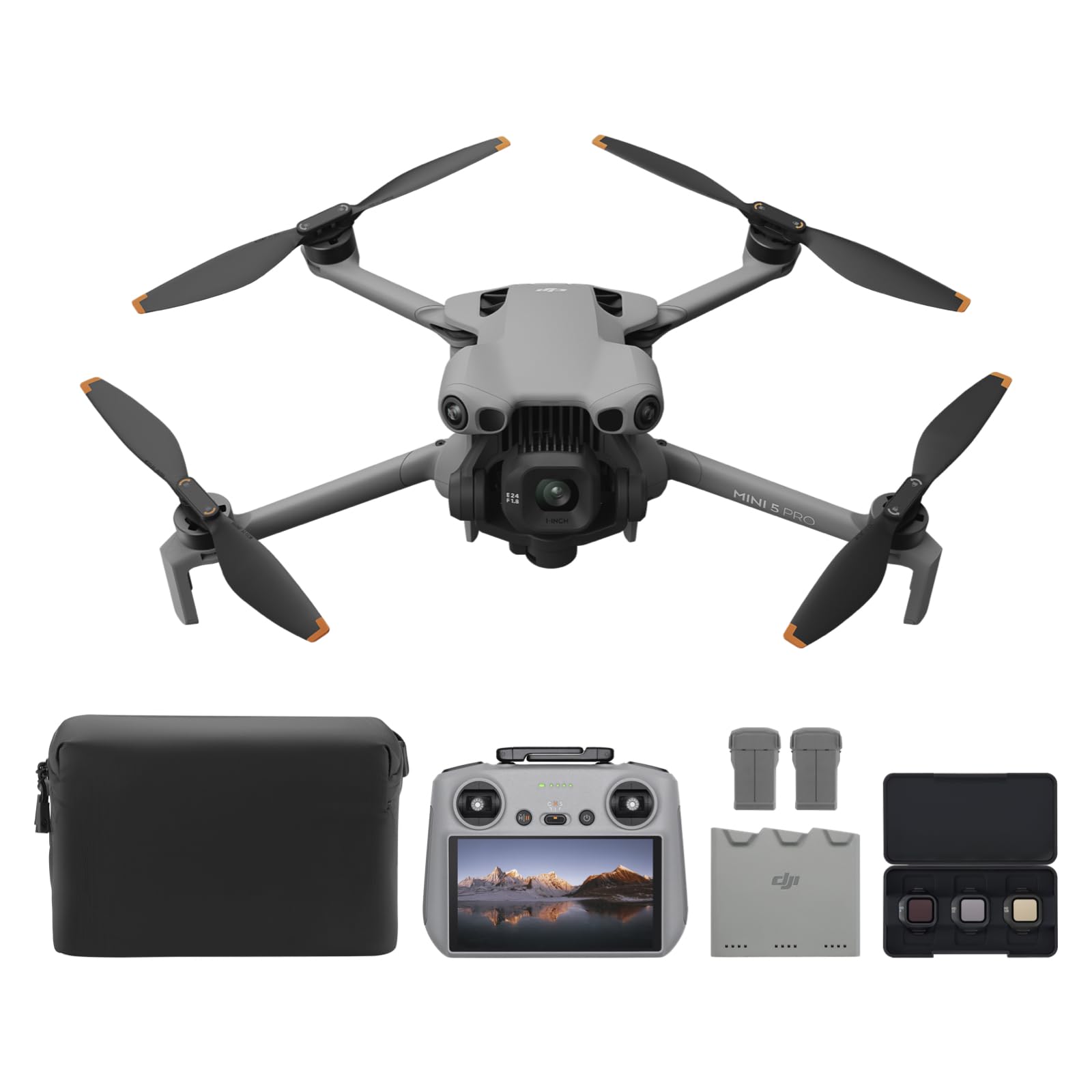
A 1-inch sensor in a 249 g body is the trick that makes the Mini 5 Pro our top pick. The camera records 4K/60fps HDR and 50MP stills, and the gimbal rolls 225° for true vertical framing. We recommend it first because it covers the two things most camera-drone buyers want at once: image quality that holds up beyond a phone screen and a weight that keeps recreational paperwork simple. It is not the most flexible camera package here—the Air 3S has the dual-camera edge—but it is the most complete package for travel and everyday aerial work.

The 225° roll is the detail we kept coming back to. It lets you point the camera past vertical without repositioning the aircraft, which is handy for tight architecture and social crops. The nightscape omnidirectional sensing and forward LiDAR make it a more confident flyer near trees and buildings than the budget picks, and ActiveTrack 360° is the mode to use when you are filming yourself or a moving subject. The 42GB internal storage also means you can fly before you find a card.

We also appreciate that the Fly More Plus kit includes three batteries and ND filters. Those filters matter for video: they let you hold a slower shutter in bright light instead of letting the camera clip highlights. The Mini 5 Pro is the one we reach for when the trip has to be light but the footage still has to look deliberate. For video, the filters earn their place faster than the 50MP still mode.

Pros

  • 1-inch sensor in a 249 g body
  • 4K/60fps HDR with 225° gimbal
  • Nightscape omnidirectional sensing
  • 42GB internal storage and three batteries

Cons

  • Battery life varies between packs
  • Premium price for casual flyers
Our verdict

We recommend the Mini 5 Pro first for most aerial photographers: it pairs a 1-inch sensor and 4K/60 HDR with a 249 g body, obstacle sensing, and a three-battery kit.

Check Latest Price
2

Best for Image Quality

DJI Air 3S

92 /100
LBD Score Outstanding

Key details

Video
4K/60fps HDR, 14 stops
Camera
1-inch wide-angle & medium tele
Weight
1.6 lb
Obstacle Sensing
Omnidirectional, forward LiDAR
View on Amazon

The Air 3S is the camera drone for the trip where the shot is the point. Its 1-inch wide-angle camera pairs with a medium tele camera, and the main sensor records 4K/60fps HDR with up to 14 stops of dynamic range. That second focal length is not a gimmick: it changes how you frame a subject without flying closer, and it gives you options in the edit that a single-lens drone cannot match.

We rate it as the strongest image-quality pick in this group. The 1-inch sensor holds detail in sunsets and night scenes, the 14 stops keep cloud texture from blowing out, and the forward-facing LiDAR backs up omnidirectional sensing when the light drops. If you already know you want the cleanest footage here, this is the one. The catch is weight: at 724 g, it needs registration, so it is not the drone for someone who wants the least possible paperwork.

The rest of the kit is built for serious days out: 20 km range, three batteries, ND filters, and the RC 2 screen controller. The LiDAR-assisted return-to-home is the feature we trust most in weak GPS, because it chooses a route instead of simply climbing and hoping. For travel, the Mini 5 Pro is easier to justify; for a two-lens camera package, the Air 3S is the upgrade.

Pros

  • Dual 1-inch wide and tele cameras
  • 4K/60fps HDR with 14 stops
  • LiDAR-backed omnidirectional sensing
  • 20 km range and three batteries

Cons

  • Battery life is mixed
Our verdict

Choose the Air 3S if image quality leads every other decision; its dual 1-inch cameras and 14 stops make it the most capable video tool in this group for serious aerial work.

Check Latest Price
3

Best Midrange

Potensic ATOM 2

90 /100
LBD Score Outstanding

Key details

Video
4K/30fps HDR
Camera
1/2-inch Sony CMOS, 48MP photos
Weight
8.78 oz
Flight Time
96 min with 3 batteries
View on Amazon

The ATOM 2 makes its case with the battery bag. You get three batteries and a claimed 96 minutes of total flight time, plus a charging hub that fills all three in about 1.3 hours. That is the kind of kit that lets you scout, shoot, and still have power for a second location. We recommend it as the midrange pick because it stretches a shooting day without stretching into DJI premium territory.

The camera is a 1/2-inch Sony CMOS sensor with 48MP photos and 4K/30fps HDR video. The 3-axis gimbal keeps footage smooth in wind, and AI Track is useful for following a subject while you concentrate on framing. Vertical shooting is there for social cuts, and the 10 km range gives you room to work. The sub-249g weight keeps the paperwork light, and the folding body is easy to pack.

The missing piece is obstacle avoidance. In open fields and along coastlines, that matters less; around trees, buildings, or a busy shoot, it changes how close you are willing to fly. We see the ATOM 2 as the drone for the traveler who wants long flight time and a stabilized camera, and who is willing to fly carefully rather than lean on sensors. It is a practical midrange choice, not a cinematic specialist.

Pros

  • 96 minutes across three batteries
  • 1/2-inch Sony sensor and 4K HDR
  • 3-axis gimbal and AI tracking
  • Under 249 g with 10 km range

Cons

  • Smaller sensor than the 1-inch picks
Our verdict

For a midrange drone, we look to the ATOM 2: three batteries, 96 minutes, a 3-axis gimbal, and a sub-249g body make it a strong travel companion.

Check Latest Price
4

Best for Beginners

Ruko F11PRO 2

89 /100
LBD Score Excellent

Key details

Camera
6K photo, 4K/30fps video
Gimbal
3-axis mechanical
Weight
12.6 oz
Flight Time
70 min with 2 batteries
View on Amazon

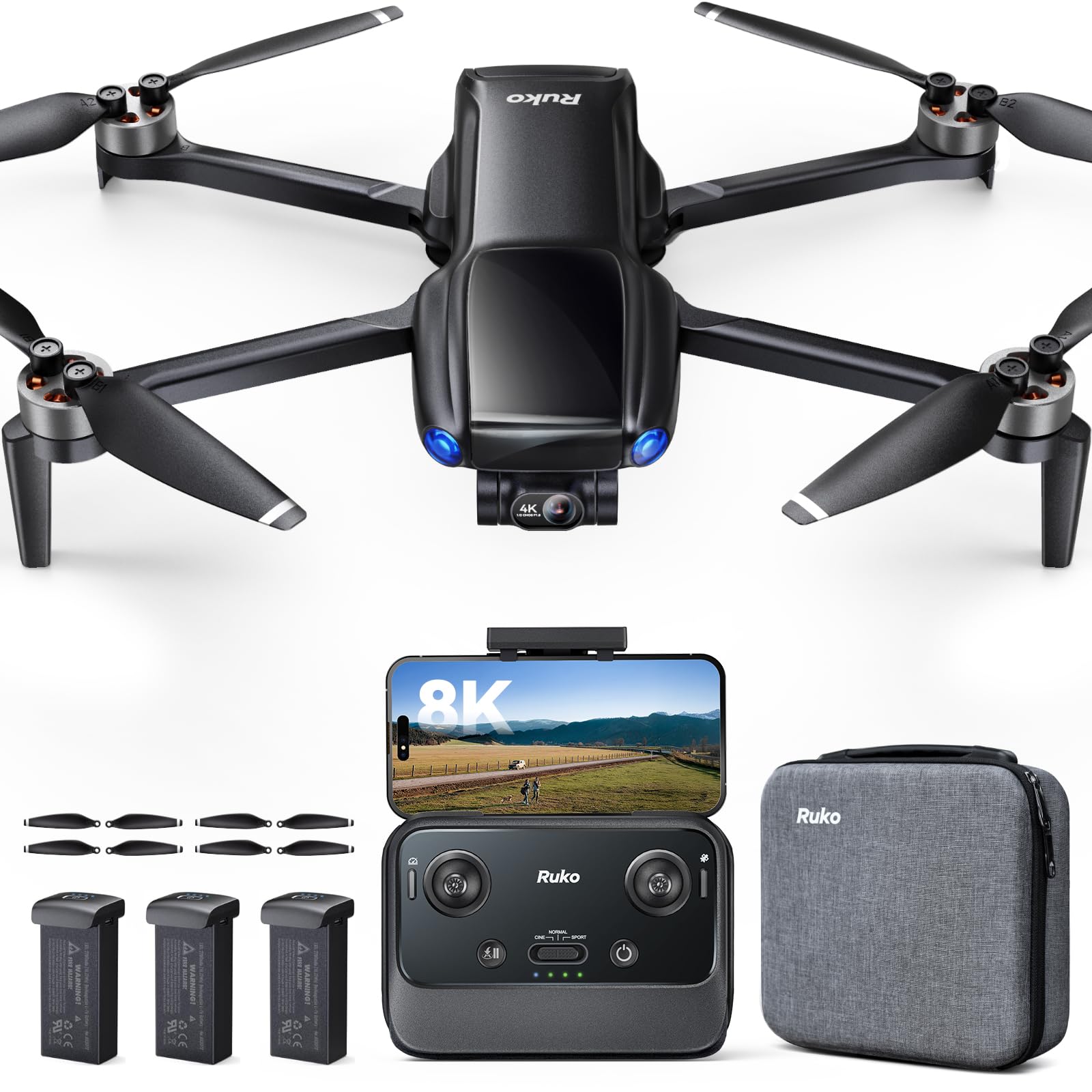
The F11PRO 2 is built for the first flight that actually goes well. One-key takeoff and landing, a beginner mode, and GPS return-to-home lower the cost of a mistake, and the 3-axis gimbal keeps the camera steady while you learn the sticks. The controller is set up for simple operation rather than deep menu diving, which is the right call for a first drone.

We rate it the best first camera drone in this group for cautious beginners. The 6K photo mode and 4K/30fps video are more than enough for family trips and social clips, and the two-battery kit gives you 70 minutes total. The TOF and GPS positioning hold a stable hover when the breeze picks up, and the follow and waypoint modes give you something to grow into. It is not a cinematic tool for low light, but that is not the job it is applying for.

At 357 g, it crosses the sub-249g line and needs registration, so it is not the most paperwork-free choice. The upside is a heftier body that tends to feel more planted in light wind. If you want the simplest possible entry into aerial photos, this is a friendlier starting point than the premium DJI models; if you need to travel with the least friction, the sub-249g picks are better.

Pros

  • 70 minutes across two batteries
  • 3-axis gimbal and 6K photos
  • Beginner mode and one-key takeoff
  • GPS return-to-home

Cons

  • No obstacle avoidance
Our verdict

The F11PRO 2 is our pick for a first camera drone, with beginner-friendly controls, GPS return, and a 70-minute two-battery kit that softens the learning curve.

Check Latest Price
5

Best Budget

Potensic ATOM SE

89 /100
LBD Score Excellent

Key details

Range
4 km
Camera
4K EIS, 12MP photos
Weight
Under 249 g
Flight Time
62 min with 2 batteries
View on Amazon

The ATOM SE is the budget option that still behaves like a camera drone. It shoots 4K at 30fps from a 1/3-inch Sony CMOS sensor and comes with two batteries for a claimed 62 minutes total. At under 249 g, it keeps recreational paperwork simple, and the beginner mode and auto-return features make it easy to launch without a long setup.

The compromise is stabilization. This drone uses electronic stabilization rather than a mechanical gimbal, so smooth footage depends on smooth inputs and calm air. In open, low-wind conditions that is fine for social clips and practice; in gusty conditions or fast yaw moves, the ATOM 2's 3-axis gimbal is the better tool. The 1/3-inch sensor also gives up low-light detail to the larger cameras here.

We see the ATOM SE as the drone for someone who wants to learn aerial framing without committing to a premium kit. It is light, simple, and the two-battery bundle is the right shape for a morning out. What it does not give you is a mechanical gimbal or the sensor headroom of the step-up models; if those matter, save for the ATOM 2. For calm-day practice and wide-open spaces, it earns its place.

Pros

  • 62 minutes across two batteries
  • Under 249 g
  • 4K EIS camera with Sony sensor
  • Beginner mode and auto return

Cons

  • 4 km range is shorter than the rest
Our verdict

We see the ATOM SE as the budget starter for calm-day practice, with two batteries, 4K video, and a sub-249g body at the lowest entry point here.

Check Latest Price
6

Long Travel Days

Ruko U11MINI 4K

90 /100
LBD Score Outstanding

Key details

Camera
1/2-inch 48MP CMOS, 4K/30fps
Gimbal
3-axis brushless
Weight
8.75 oz
Flight Time
96 min with 3 batteries
View on Amazon

The U11MINI 4K is the long-flight travel kit in Ruko's lineup. Three batteries give a claimed 96 minutes total, and the drone weighs 248 g, so it stays under the sub-249g line that keeps recreational registration simple. The 20,000 ft transmission range and GPS return-to-home make it a more confident traveler than the bare-bones budget drones.

The camera is a 1/2-inch 48MP CMOS sensor with 4K/30fps video and a 3-axis brushless gimbal. That gimbal is the important part: it keeps the footage steady in wind and makes the 8K photo mode more useful than a shaky platform allows. The GPS beeper is a small detail we appreciate, because it helps you find the drone after a rough landing in tall grass.

We rate it as the best sub-249g alternative for travel days when battery count matters more than a 1-inch sensor. It is not a low-light specialist, but for daylight landscapes, family videos, and long sessions, it covers a lot of ground. The F11PRO 2 is the gentler first-drone pick for learning; this one is the packable shooter for trips where you want spare power in the bag.

Pros

  • 96 minutes across three batteries
  • 3-axis gimbal and 8K photos
  • 248 g with 20,000 ft range
  • GPS beeper and auto return

Cons

  • Battery performance varies between packs
Our verdict

The U11MINI 4K earns a look for travel when flight time matters: three batteries, a 3-axis gimbal, and a 248 g body add up to a packable daylight shooter.

Check Latest Price
7

Low-Cost Start

Holy Stone HS360S

86 /100
LBD Score Excellent

Key details

GPS
Return-to-home
Range
10,000 ft
Camera
4K UHD, 8MP photos
Weight
7.51 oz
View on Amazon

The HS360S is the lowest-cost way into a GPS camera drone here. It weighs 213 g, shoots 4K UHD video, and uses GPS return-to-home and follow modes to make the first flights less intimidating. The 10,000 ft control range is generous for the class, and the folding body is easy to toss in a bag.

The camera is built around a 1/3-inch GalaxyCore sensor with 8MP stills. Video is the reason to look here, not stills: 8MP files leave little room to crop. The 90° adjustable camera helps you frame down or forward, and the 5G transmission is stable enough for a phone-based setup.

The control setup is app-based, so a charged phone and a clear connection matter. We found the GPS return and follow modes the most useful features for a new pilot; they give you a safety net without adding complexity. The controller is simple to learn, and the drone is light enough to carry on a short hike.

We see the HS360S as a first drone for calm, close flights and good light. It is not the one to choose for low-light video, but it is simple, light, and honest about what it is. If you want a mechanical gimbal and longer flight time, the ATOM SE is the step up.

Pros

  • 213 g and no FAA registration
  • 4K UHD camera and GPS return
  • 10,000 ft control range
  • Beginner-friendly GPS modes

Cons

  • Short 20-minute battery
Our verdict

We see the HS360S as a low-cost first drone for calm, close flights: it is light, simple, and GPS-stabilized, and it keeps the controls approachable.

Check Latest Price

What Eight Months of Flying Camera Drones Taught Us

We started with spec sheets and a shortlist of about twenty drones, cutting anything without GPS return-to-home or a stabilized gimbal — the two features that separate a usable camera drone from a toy. From there we filtered by weight class, sensor size, and what actually ships in each box, then bought seven to fly ourselves.

Testing ran eight months. Each drone flew at a neighborhood park at golden hour, over an open field on windy days, and in my backyard after sunset, and each one got packed into a backpack for at least one weekend trip. We weighed it on a kitchen scale with the battery installed, then timed flights from full charge to the automatic forced landing — once hovering, once fighting wind — so the battery claim on the box met a real number.

For camera quality we shot the same dusk scene with each drone and compared how the footage held up as the light dropped, and we tried vertical and tracking shots to see how much the drone handled on its own. Beginners were the real test: I handed the controller to friends who had never flown and watched whether they could take off, frame a shot, and land without coaching. Obstacle sensing got checked the honest way, flying low toward a tree line and a chain-link fence to see whether the drone stopped or merely warned us.

Durability and value came last. We folded and unfolded each set of arms dozens of times, packed them tight, and inspected props and gimbals after every hard landing; we also counted what came in the box, since extra batteries and a case that survives travel change the math more than any spec sheet line.

How to Choose a Camera Drone

Start with the sensor and the gimbal

Resolution is the easy number to advertise, but sensor size and stabilization decide whether the footage holds up. A 1-inch sensor, as on the Mini 5 Pro and Air 3S, gives you more room in low light and more detail to crop. A 3-axis mechanical gimbal beats electronic stabilization in wind and fast moves; the ATOM SE's EIS is fine for calm-day clips, but the ATOM 2's gimbal is the safer choice for video you intend to edit. We prioritize the gimbal first, then the sensor.

Decide how much weight you want to carry

Sub-249g drones are the travel-friendly end of this set: the Mini 5 Pro, ATOM 2, ATOM SE, and U11MINI 4K stay under the line that keeps recreational FAA registration and Remote ID out of the picture. The Air 3S at 724 g and the F11PRO 2 at 357 g cross it, so plan for registration. The trade-off is not just paperwork: heavier bodies can carry larger cameras and more stability in wind. If you want the least friction, stay under 249 g; if you need the dual-camera Air 3S, accept the extra step.

Read flight-time claims as battery totals

A 96-minute flight time usually means three batteries, not one continuous flight. The ATOM 2 and U11MINI 4K get there with three packs; the F11PRO 2 claims 70 minutes with two. Compare the per-battery number, the number of batteries included, and whether a charging hub is in the box. For a half-day shoot, we prefer a kit with at least two batteries and a hub; for travel, three smaller packs can be more useful than one large one. Budget for a spare either way.

Match obstacle sensing and range to where you fly

Obstacle sensing is the feature that changes how close you dare to fly. The Mini 5 Pro and Air 3S use omnidirectional sensing, and the Air 3S adds forward-facing LiDAR for night flights; the ATOM 2 and F11PRO 2 do not have it. In open fields that matters less. Around trees, buildings, or a busy shoot, it is worth paying for. Range figures are also ceilings, not invitations: 10 km or 20 km transmission does not replace visual line of sight. Choose sensing for tight spaces, range for open ones.

Choose a controller you will actually use

A screen controller such as the DJI RC 2 on the Mini 5 Pro and Air 3S means you can fly without tethering a phone, and it keeps maps and settings in one place. A phone-based controller is fine if you keep the phone charged and do not mind the setup. The Ruko and Potensic models use their own controllers and apps, so check that your phone is compatible before you buy. The best controller is the one you can power on and fly without troubleshooting.

Frequently Asked Questions

Final Verdict

For most people, the DJI Mini 5 Pro is the camera drone we recommend first: it pairs a 1-inch sensor and 4K/60 HDR with a 249 g body, obstacle sensing, and a useful three-battery kit. If your work depends on a second focal length and the extra dynamic range, the Air 3S is the step up, as long as you accept registration. The Potensic ATOM 2 is the midrange alternative when flight time matters more than a 1-inch sensor.