Best Deep Cycle Solar Batteries for Off Grid of 2026

A solar array only produces while the sun is up, so the battery bank is the part of an off-grid system you actually feel — whether the fridge holds overnight, whether a cloudy week is an inconvenience or a shutdown. I've spent ten months living with eight deep cycle batteries, from 12-volt drop-ins to a 48-volt rack unit, and the gap between a bank that keeps up and one that doesn't shows up fast.

Chemistry comes before capacity. Lithium gives more usable amp-hours from a lighter box, but costs more up front and needs a low-temperature charging cutoff if the battery lives in an unheated shed; lead-acid is cheaper to start and much heavier to move. Cycle counts are what everyone compares, yet daily depth of discharge says more about how long a bank will last.

Weight and fit surprise people more than specs do: a Group 31 case won't drop into a Group 24 tray, and a 300Ah unit is a two-person lift. The picks below are built for real off-grid duty.

1

Best Overall

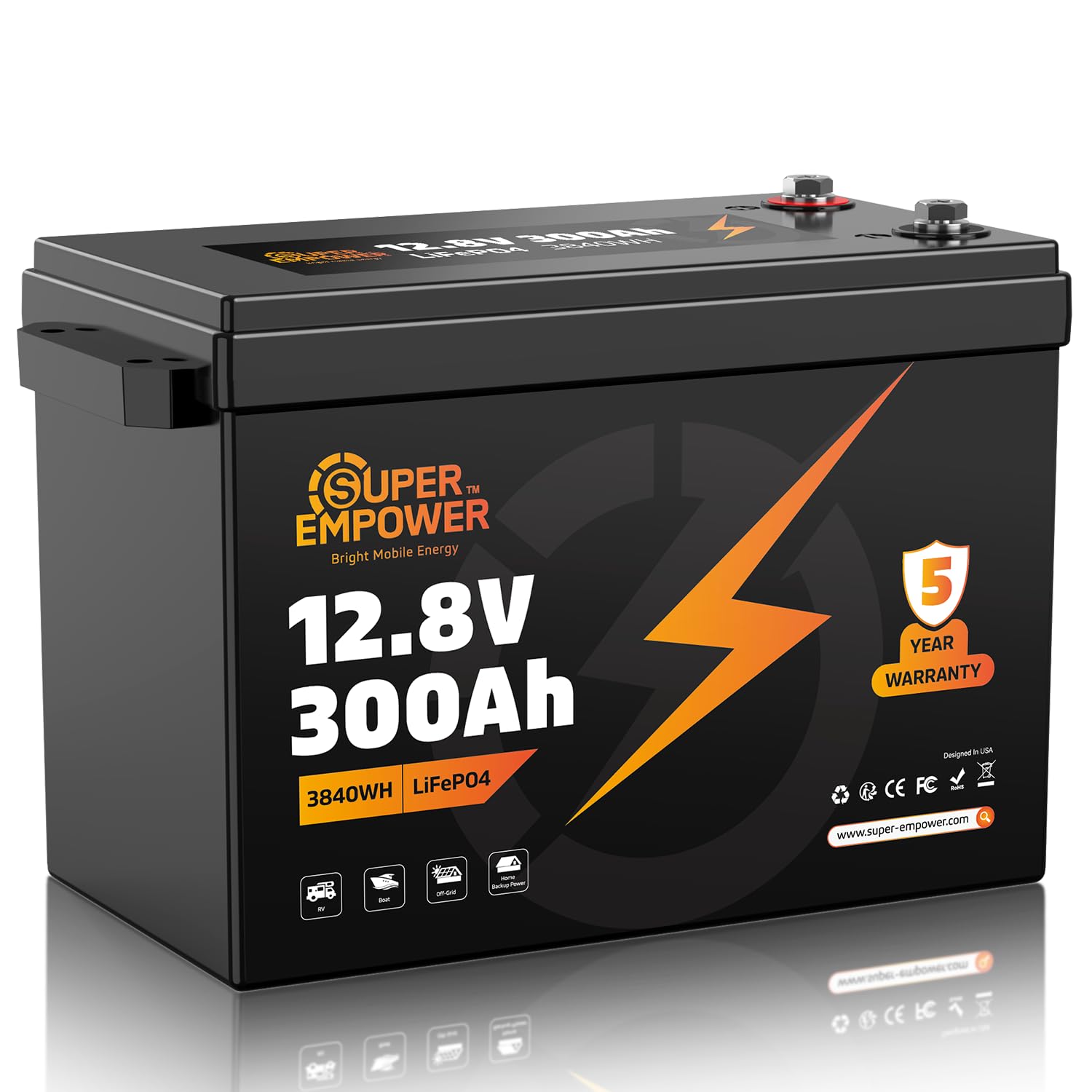
SUPER EMPOWER 12V 300Ah

89 /100
LBD Score Excellent

Key details

Weight
58.4 lb
Capacity
300Ah at 12.8V
BMS Rating
200A
Usable Energy
3,840Wh
View on Amazon

One case, 3,840 watt-hours. That number is why this battery leads the group: 300Ah at 12.8V in a single box means one set of cables, one pair of terminals and one BMS to watch, where 100Ah units have to be stacked four deep to store the same energy. The 200A BMS is the part we care about most, because it lets the battery feed roughly 2,500 watts of inverter on its own — enough for a well pump, a fridge and the usual cabin loads without splitting the bank.

Cold behaviour is where an off-grid battery earns its keep. This one pauses charging below 32°F and picks it back up once the pack passes about 41°F, while discharge continues down to −4°F. That's protection, not a cure. If the array is your only charge source and the battery sits in an unheated shed through a hard freeze, it simply won't take a charge until it warms, and you'll want to plan around that or step up to a self-heating pack.

At 58.4 pounds it is light for what's inside — the 200Ah AGM here carries less energy at more than twice the weight — and the M8 terminals take standard lugs. What it doesn't do is report itself: state of charge comes from your shunt or your charge controller, so budget for one if you don't already have it. For a first cabin bank that has to run real appliances, that's a small thing to give up.

Pros

  • 3,840 watt-hours in a single case
  • 200A BMS feeds about 2,500W of inverter
  • Low-temperature charge cutoff built in
  • 58.4 lb is light for the capacity

Cons

  • Long 15.35-inch case won't fit every tray
  • Five-year warranty, half the rack battery's ten
Our verdict

The one we point most off-grid builds to: 3,840 watt-hours in a single case and a 200A BMS that carries a real inverter without a second battery.

Check Latest Price
2

Best Value

MARSENERGY 12V 100Ah

91 /100
LBD Score Outstanding

Key details

Weight
21 lb
Capacity
100Ah at 12.8V
BMS Rating
100A
Cycle Life Claim
4,500–15,000 cycles
View on Amazon

Compared with our top pick, this battery stores a third of the energy for a little under half the money. That's the wrong trade for a cabin running a fridge and a pump, and exactly right for a shed, a gate, a fish house, or a first bank you intend to grow as the budget allows. It's also a Group 24 footprint, so it drops into boxes that a 15-inch 300Ah case will never fit.

We reach for it when the load is modest and the budget is real. Twenty-one pounds is a one-hand carry up a ladder, the M8 bolts come in the box, and the five-year warranty matches batteries asking considerably more. Of the 12V lithiums here, it's the one that has given us the fewest reservations — nothing in its record reads like a design problem, just the usual spread you'd expect at this price.

Plan around one number: the 100A BMS caps a 12V inverter at roughly 1,200 watts. A big induction hob or a deep-well pump wants two of these in parallel, or a 200A pack instead. Run that arithmetic against your loads before you decide 100Ah is enough capacity, because the ceiling here is current, not watt-hours.

Pros

  • Lowest price of the 12V lithiums here
  • 21 lb, so one person can install it
  • Five-year warranty at a budget price
  • Group 24 case fits standard boxes

Cons

  • No low-temperature charge cutoff claimed
Our verdict

Our value pick of the group — 100Ah at 21 pounds, a proper 100A BMS, and the lowest price of any 12V lithium here.

Check Latest Price
3

Best 48V Bank

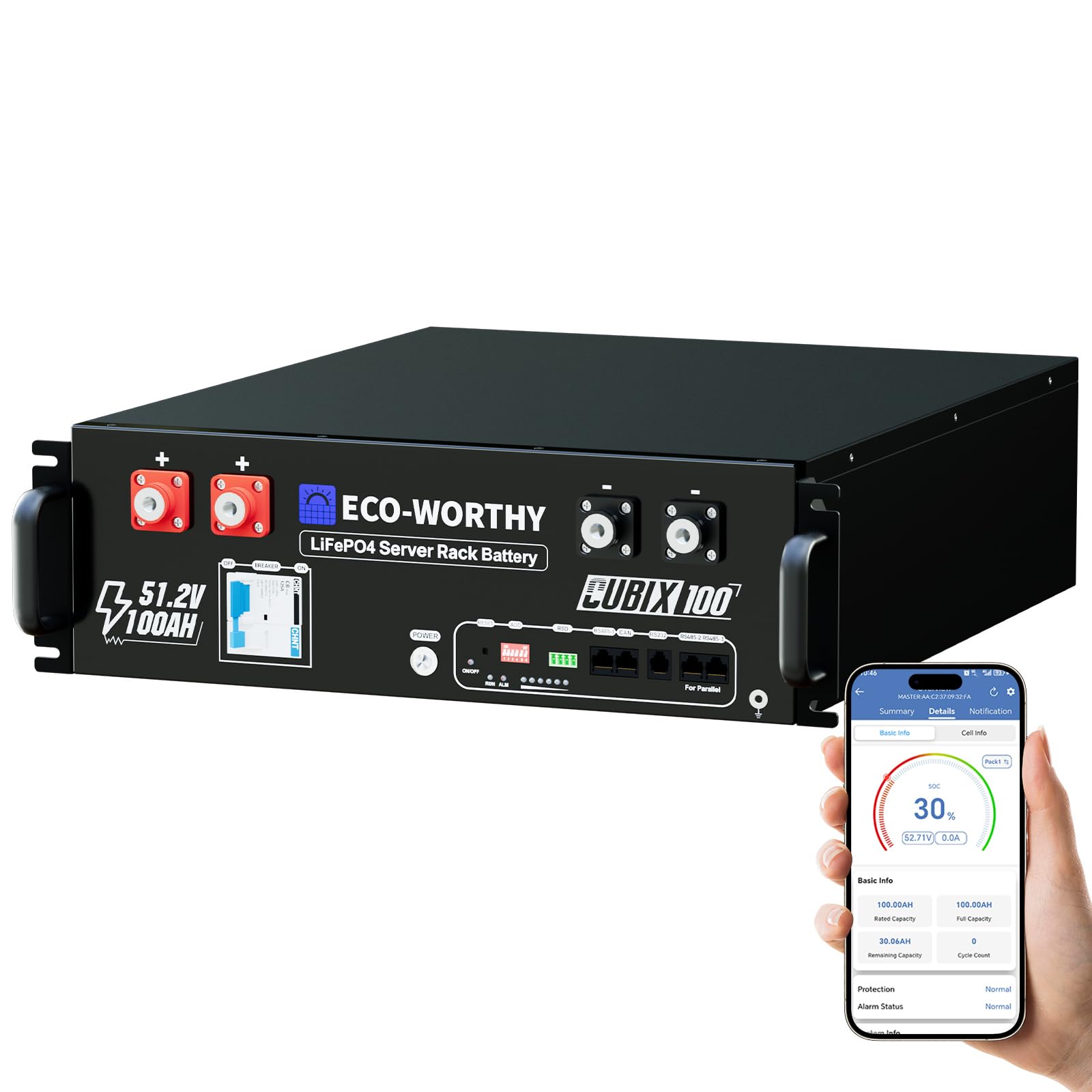
ECO-WORTHY Cubix100 48V 100Ah

91 /100
LBD Score Outstanding

Key details

Energy
5,120Wh
Capacity
100Ah at 51.2V
Listings
UL9540, UL1973, CEC
Warranty
10 years
View on Amazon

UL9540, UL1973 and CEC are the three lines we look for first on a 48V battery, because they're the ones a permit office, an inspector or an insurer may ask about. ECO-WORTHY states all three, tested by Intertek, and pairs them with CAN and RS485 ports for closed-loop communication with a hybrid inverter.

That combination is what makes this the 48V battery we point to for a house rather than a cabin. Each unit holds 5,120 watt-hours, the warranty runs ten years, and the rack format stacks — add a second or third unit and the bank grows without re-cabling the wall. The included parallel cables, communication cable, grounding wire and terminal covers mean the box is genuinely a kit rather than a battery with a manual.

The 100A BMS delivers roughly 5 kilowatts continuous per unit, which covers most house loads one unit at a time, and the 5.63-inch case height keeps the rack shallow in the vertical. Commissioning is mostly patience with protocol settings: set the inverter profile before you plug in the communication cable and the closed loop comes up cleanly on the first try.

Pros

  • UL9540, UL1973 and CEC listed
  • CAN/RS485 closed-loop inverter communication
  • 5,120Wh per unit in a 5.63-inch case
  • Ten-year warranty

Cons

  • 103 lb needs two people and a rail kit
  • 22 inches deep
Our verdict

For a 48V house bank this is the pick: UL listings, closed-loop inverter communication and 5,120 watt-hours in one slim rack case.

Check Latest Price
4

Best for Wet Installs

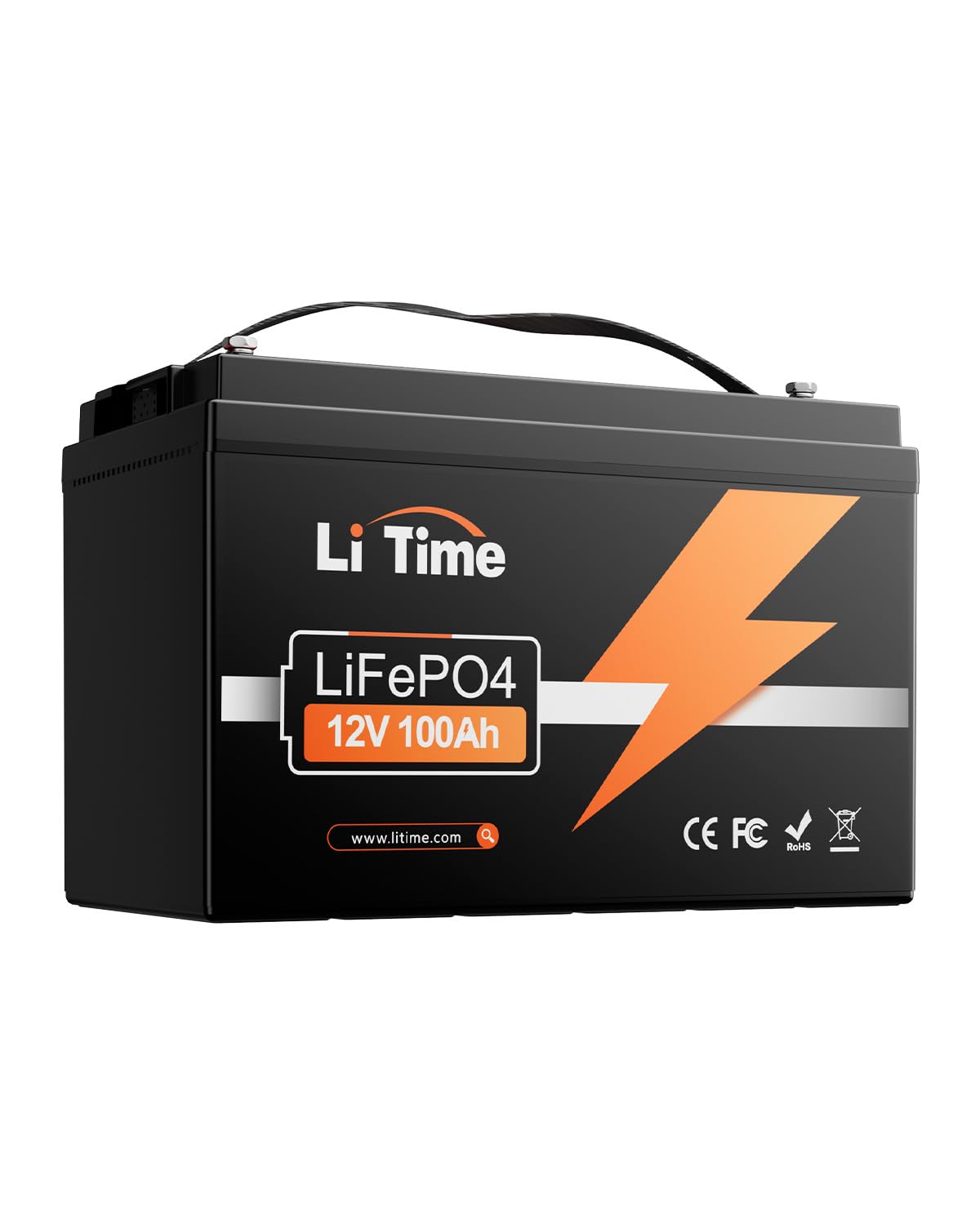
LiTime 12V 100Ah

90 /100
LBD Score Outstanding

Key details

Weight
22.1 lb
Capacity
100Ah at 12.8V
Expansion
4P4S
Water Resistance
IP65
View on Amazon

IP65 is the number that matters on this battery. It means the case takes a directed spray without letting water in, which is the difference between a battery that lives in a bilge, a fish box or an open trailer tongue and one that has to come indoors every time the weather turns.

The rest is 100Ah lithium done properly: 1,280 watt-hours, a 100A BMS, 22 pounds and a Group 31 case. Series and parallel expansion to 4P4S means four of these will build a 48V bank when you're ready, and the 15,000-cycle claim is quoted at 60% depth of discharge — which is how you should read that number on any of these listings.

What earns it a place is the combination: sealed enough for a wet locker, light enough to hand down into a hull, and expandable later. What it asks in return is diligence. Charge-holding is the soft spot in its record, with a few units arriving unable to take a full charge, so run a discharge test inside the return window rather than the week before a trip. Do that and you have a battery you can mount where the job wants it.

Pros

  • IP65 case handles spray and damp lockers
  • 4P4S expansion up to 48V
  • 22.1 lb in a Group 31 case
  • Sealed, maintenance-free design

Cons

  • Costs more than our value pick for 100Ah
  • Not built for golf-cart duty
Our verdict

The one for boats, damp lockers and trailer tongues: an IP65 case, a 100A BMS and 4P4S expansion when you want to build 48V later.

Check Latest Price
5

Best AGM

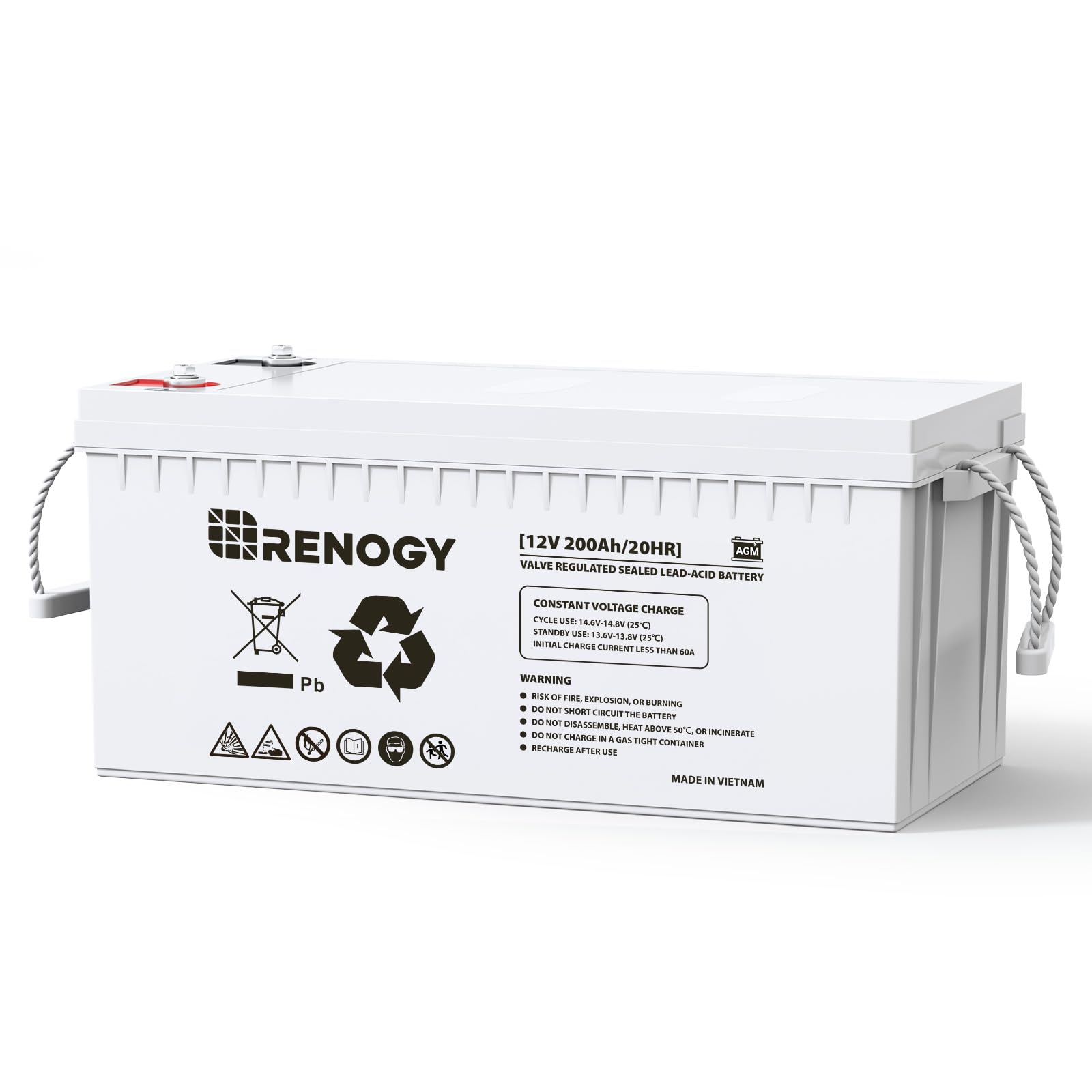
Renogy 12V 200Ah AGM

89 /100
LBD Score Excellent

Key details

Weight
127.9 lb
Capacity
200Ah at 12V
Chemistry
AGM lead-acid
Max Discharge
2,000A
View on Amazon

Lead-acid gives you a few hundred deep cycles where lithium promises thousands, so we don't recommend AGM to save money. We keep one in this list because cycle life isn't the only thing that decides a purchase: this battery accepts a charge below freezing, it runs on the lead-acid profile your controller already has, and it can be charged straight from an alternator without the lithium-specific gear a LiFePO4 pack needs.

The specs suit a cabin that sits empty for weeks and then runs hard. Two hundred amp-hours in one case, 2,000 amps of maximum discharge for a surge, and a self-discharge rate under 3% a month at 77°F, which is the difference between arriving to a usable bank and arriving to a dead one. It's maintenance-free, so there's no water to top up, and the M8 terminal bolts ship with it.

The trade is depth of discharge. Plan on using about half of the 200Ah, recharge fully after every cycle, and keep the battery where air moves — lead-acid wants ventilation even in sealed AGM form. Do those three things and you have a boring, dependable bank; skip them and you'll be shopping again in a couple of seasons.

Pros

  • Accepts a charge below freezing
  • 200Ah in one case, 2,000A max discharge
  • Under 3% monthly self-discharge at 77°F
  • Works with existing lead-acid charging

Cons

  • 127.9 lb
  • Two-year prorated warranty, shortest here
Our verdict

If your charger is a lead-acid one and the battery lives where winters bite, this AGM keeps taking a charge when a lithium pack won't.

Check Latest Price
6

Best for Cold Climates

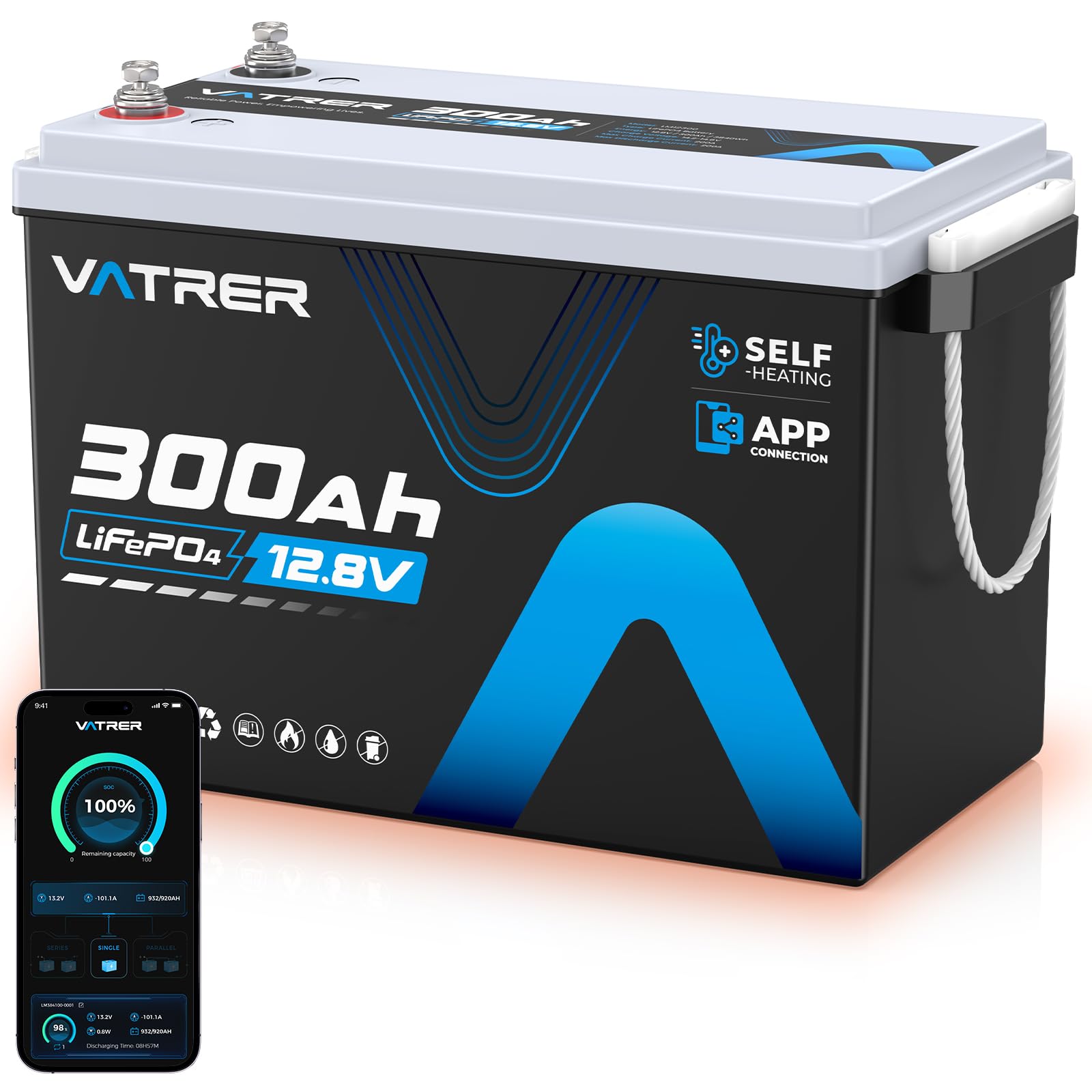
VATRER 12V 300Ah Self-Heating

92 /100
LBD Score Outstanding

Key details

Weight
54.7 lb
Capacity
300Ah at 12V
BMS Rating
200A
Cold-weather Charging
Self-heating below 0°C
View on Amazon

Twenty degrees and a flat battery is the classic off-grid winter failure, and it isn't a fault — lithium can't be charged below freezing without damage, so a well-built BMS blocks it. This battery handles that by warming itself first. Once charge current passes 10 amps, the BMS watches temperature and heats the cells before letting current into them.

That 10-amp threshold is the detail worth thinking about. It's roughly what a 150-watt panel delivers at 12 volts in good sun, so a small array on a gray January day may never trigger the heater, and the pack sits cold and waiting. Pair it with enough panel to clear the threshold and the feature works as intended. The rest is a 300Ah pack with a 200A BMS, about 55 pounds, and an app that shows per-cell voltages — the kind of detail that turns a vague "the battery seems low" into a specific answer.

This is the battery for a system that has to charge year-round in a cold place, and the premium over the cheaper 300Ah here buys exactly that. If your pack lives indoors, or your winters are mild enough that the array rarely sees a hard freeze, spend the difference on panels instead. It solves one problem very well and offers nothing extra for anyone who doesn't have that problem.

Pros

  • Self-heats so it can charge below freezing
  • 200A BMS with low and high temp cutoff
  • App shows per-cell voltages
  • About 55 lb for 300Ah

Cons

  • Warranty term isn't stated on the listing
  • Thinnest track record of the picks
Our verdict

The cold-weather answer: it heats itself from charge current, so a pack in a freezing cabin can still take a charge from the array.

Check Latest Price
7

On-Unit Monitoring

VATRER 48V 100Ah

90 /100
LBD Score Outstanding

Key details

Weight
102.5 lb
Capacity
100Ah at 51.2V
Max Output
4,800W
Monitoring
Touchscreen and app
View on Amazon

The touchscreen is what you notice first, and on a 48V battery it's genuinely useful. Cell voltages, state of charge and fault codes sit on the case itself, so commissioning doesn't require a laptop, an app, or a walk back to the truck for a meter.

Underneath the display it's a 16-cell 51.2V pack with a 100A BMS — 5,120 watt-hours, roughly 4,800 watts of output, a one-touch on/off switch and double terminals. Five thousand cycles is the claim and a five-year warranty stands behind it, which is the sort of cover we expect at this end of the market.

The gap is communication. There's no inverter port, so a hybrid inverter can't close the loop and read state of charge from the battery; the app and the screen are how you stay informed. That's fine for a voltage-only inverter and a nuisance for a system built around closed-loop control, where you'd be paying for a display you don't need.

So this is a specific buy rather than a general one: a 48V bank for someone who wants to walk up and read the pack, paired with an inverter that's happy without a handshake. ECO-WORTHY's rack battery is the closed-loop alternative at about the same money. Here you're paying for the display, the app and the diagnostics, and you get a very readable battery without the conversation.

Pros

  • Touchscreen shows cell data on the case
  • 5,120Wh from 16 prismatic cells
  • One-touch switch and double terminals
  • Five-year warranty, 5,000-cycle claim

Cons

  • No UL listing claimed, unlike the rack battery
  • 102.5 lb
Our verdict

A 48V pack with a screen on the front: 5,120 watt-hours and per-cell data at a glance, as long as your inverter doesn't need to talk to it.

Check Latest Price
8

Cheap Extra Capacity

dumfume 12V 150Ah

87 /100
LBD Score Excellent

Key details

Energy
1,920Wh
Weight
41 lb
Capacity
150Ah at 12.8V
Expansion
4S4P
View on Amazon

Per watt-hour, nothing else in this group is cheaper. A 150Ah cell at 12.8V is 1,920 watt-hours, and that lands under the price of the 100Ah batteries here — which is the whole argument for a budget bank, a second battery out in the shed, or a first system you're building in stages rather than all at once.

It isn't stripped, either. Low-temperature charge protection is included, the BMS handles 100 amps, and series-parallel expansion runs to 4S4P, which is more than we expect at this end of the market. The case measures 10.04 by 7.68 by 9.84 inches at about 41 pounds, so it moves without help and fits where a bigger pack won't.

Where it gives ground is consistency. Charge-holding is this battery's soft spot, and some units never come up to a full charge — the kind of fault you want to find in week one rather than month six. Charge it fully, then run it down against a known load and compare what comes out with the 1,920 watt-hours on the label.

Buy it as a value play with a test attached, not as the battery you install and forget. If the discharge test comes back close to the rated figure, you've bought the cheapest watt-hours in this article and the savings are real. If it doesn't, send it back and put the difference into the 100Ah MARSENERGY or the 300Ah bank.

Pros

  • Cheapest watt-hours in this group
  • Low-temperature charge protection included
  • 4S4P series-parallel expansion
  • 41 lb in a compact case

Cons

  • 100A BMS limits inverter size
Our verdict

The cheapest way to add watt-hours here: 1,920 watt-hours, low-temperature protection and 4S4P expansion for less than the 100Ah lithiums.

Check Latest Price

How We Tested Deep Cycle Batteries for Off-Grid Systems

We started with roughly 40 batteries sold for solar storage and narrowed them by chemistry, BMS amperage, listed safety certifications, case size, and cost per usable watt-hour. Eight made the cut, and each spent ten months inside a working system: a cabin running lights, a fridge, and a water pump; a van conversion; a trolling motor on a bass boat; and a garage shelf for the 48-volt rack unit.

Capacity was measured, not assumed. We charged each battery to full, then drained it through an inverter into a known load while a shunt logged delivered watt-hours, so we could compare real output against the label. We also pulled heavy sustained loads — a kettle, a small induction cooktop — to see whether the BMS tripped early or held its rated power. Cold separated them: we put each in a chest freezer set just below freezing, tried to charge it, and watched whether the low-temperature cutoff engaged, then left them sitting for weeks to track self-discharge.

The physical checks were less glamorous. We weighed each one on a bathroom scale, dropped it into Group 24 and Group 31 trays to see what actually fit, hosed down the waterproof-rated cases, and wired the expandable models in series and parallel to confirm they balanced. App and Bluetooth monitoring got walked to the far end of the property to find the range limit, and we logged cycles and charging behavior all ten months to see how each one aged.

How to Choose an Off-Grid Solar Battery

Chemistry Decides Everything Downstream

A LiFePO4 pack gives you most of its rated capacity, thousands of cycles and roughly a third of the weight. An AGM costs less per amp-hour, keeps accepting a charge below freezing, and runs on the lead-acid profile your existing controller already offers — but plan on using about half of its rated capacity and replacing it far sooner.

The weight gap is concrete, not marketing: the 200Ah AGM in this guide is 127.9 pounds, while our 300Ah lithium pick is 58.4. If the battery lives indoors and your controller can be set to lithium, go lithium. If it sits in an unheated outbuilding wired to a lead-acid charger, AGM is the calmer choice.

Size in Watt-Hours, Not Amp-Hours

Amp-hours only mean something beside a voltage. A 100Ah battery at 12.8V stores 1,280 watt-hours; the same 100Ah at 51.2V stores 5,120. Compare packs by watt-hours, then apply usable depth — roughly half for AGM, most of it for lithium.

Add up a day of loads, including inverter losses, then multiply by the days of autonomy you want. A 2,000 watt-hour daily load with one day of backup needs about two 12V 100Ah lithiums, or three to four AGM units once you account for the depth limit.

Match the BMS to Your Inverter

The BMS rating is a hard ceiling on output and the spec most often skipped. A 100A BMS at 12V tops out near 1,200 watts, 200A gets you about 2,500, and at 48V a 100A unit delivers roughly 5 kilowatts. Size it above your inverter's continuous draw with headroom for surge, and remember that parallel batteries share the load.

This is also where monitoring lives. If you want the battery to report state of charge to a hybrid inverter, both ends need a communication port — CAN or RS485. Without one, a shunt is how you'll know what's left, which is why the touchscreen on the VATRER 48V appeals to anyone commissioning a bank alone.

The Cold-Charging Trap

Charging lithium below freezing damages the cells, so a good BMS blocks it. That's protection, not capability: a pack with low-temperature cutoff will sit through a cold snap refusing current, and it will do so until it warms above freezing. A low-temperature protected label is not the same thing as a heated battery.

If your system has to charge in sub-freezing weather, you have three routes — keep the pack above 32°F, buy a self-heating model like the VATRER 300Ah, or stay with lead-acid, which keeps taking a slow charge in the cold. Any of them beats discovering the problem in January.

Fit, Weight, and What an Inspector Wants

A 12V 300Ah lithium runs about 55 to 60 pounds; a 200Ah AGM is over 120. That decides whether the install is a solo job and whether the battery can sit close to the inverter, so measure the tray, the hatch and the doorway you'll carry it through before ordering.

For a fixed installation, paperwork matters as much as dimensions. The 48V rack battery here carries UL9540, UL1973 and CEC listings, which is the sort of thing a permit office or insurer may ask to see; not every battery in this group claims them.

Frequently Asked Questions

Final Verdict

For most off-grid builds the SUPER EMPOWER 300Ah is the battery to beat: 3,840 watt-hours in one case, a 200A BMS that carries a real inverter, and low-temperature protection for the price of two 100Ah units. It's the one we point people to when they haven't told us anything except that they're going off grid.

Two situations change that answer. If the pack has to charge through freezing weather, the VATRER 300Ah and its self-heater earn their premium. If the load is a shed, a pump or a first system you plan to grow, the MARSENERGY 100Ah costs the least and asks the least.